
Free Special Education Teacher Resume Template: ATS Examples & Writing Guide [2025]
Your special education teaching certificate is in hand, you’ve completed your student teaching, and you’re ready to make a difference in students’ lives. But there’s one major hurdle standing between you and your dream classroom: your resume.
Here’s the challenge. Every school district receives hundreds of applications for special education positions, and many use automated systems to screen resumes before a human ever sees them. Your resume needs to pass both the robots and impress the hiring committee. That’s a tough balance to strike.
The good news? We’ve created a free special education teacher resume template that does exactly that. By the end of this article, you’ll have access to two downloadable resume templates (one filled example and one blank template), plus expert guidance on how to customize them for your unique experience and target positions.
Whether you’re a new graduate looking for your first teaching position or an experienced educator ready for your next opportunity, these templates will help you create a resume that opens doors. Let’s start by understanding what makes special education resumes different from general teaching resumes.
☑️ Key Takeaways
- Special education resumes must highlight IEP development skills and quantifiable student outcomes to stand out to hiring managers
- ATS optimization is critical as most schools use applicant tracking systems to filter resumes before human review
- Your resume should emphasize both hard skills (data collection, behavior management) and soft skills (patience, collaboration)
- The Bureau of Labor Statistics projects about 37,800 annual openings for special education teachers, making a strong resume essential in this competitive field
What Makes a Special Education Resume Different?
Special education teaching requires a specialized skill set that goes far beyond traditional classroom instruction. Your resume needs to reflect this expertise from the very first line.
The key difference is specificity. While a general education teacher might list “classroom management” as a skill, special education teachers need to highlight specific methodologies like Applied Behavior Analysis, positive behavior interventions, or crisis prevention techniques. Generic teaching buzzwords won’t cut it in this field.
Your resume should immediately demonstrate three core competencies that schools look for. First, your ability to develop and implement Individualized Education Programs. Second, your experience working with diverse student populations and disabilities. Third, your collaboration skills with multidisciplinary teams including speech therapists, occupational therapists, and parents.
Interview Guys Tip: Schools want to see evidence that you can handle the unique challenges of special education. Include specific examples like “Developed IEPs for 18 students with autism, learning disabilities, and emotional disturbances” rather than vague statements like “worked with special needs students.”
According to research from the National Center for Education Statistics, there’s particular demand for professionals with knowledge and skills in evidence-based practices for students with autism. If you have specialized training or certifications in high-need areas, your resume should highlight these prominently.
Special Education Teacher Resume Example
Here’s a professional resume example. This example gives you an idea of what type of content fits in a good ATS friendly resume.
Example Resume:
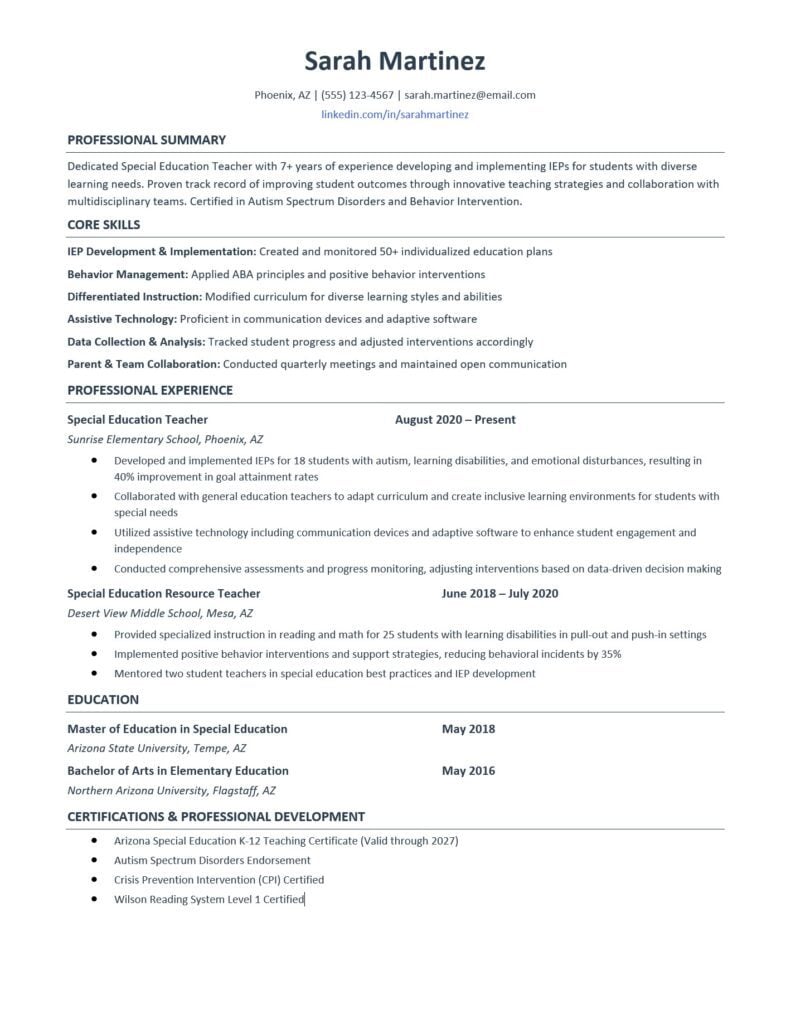
Here’s a professional special education teacher resume template you can download and customize. This template is designed to be both visually appealing and ATS-friendly, with clean formatting that highlights your strengths.
Blank Customizable Template
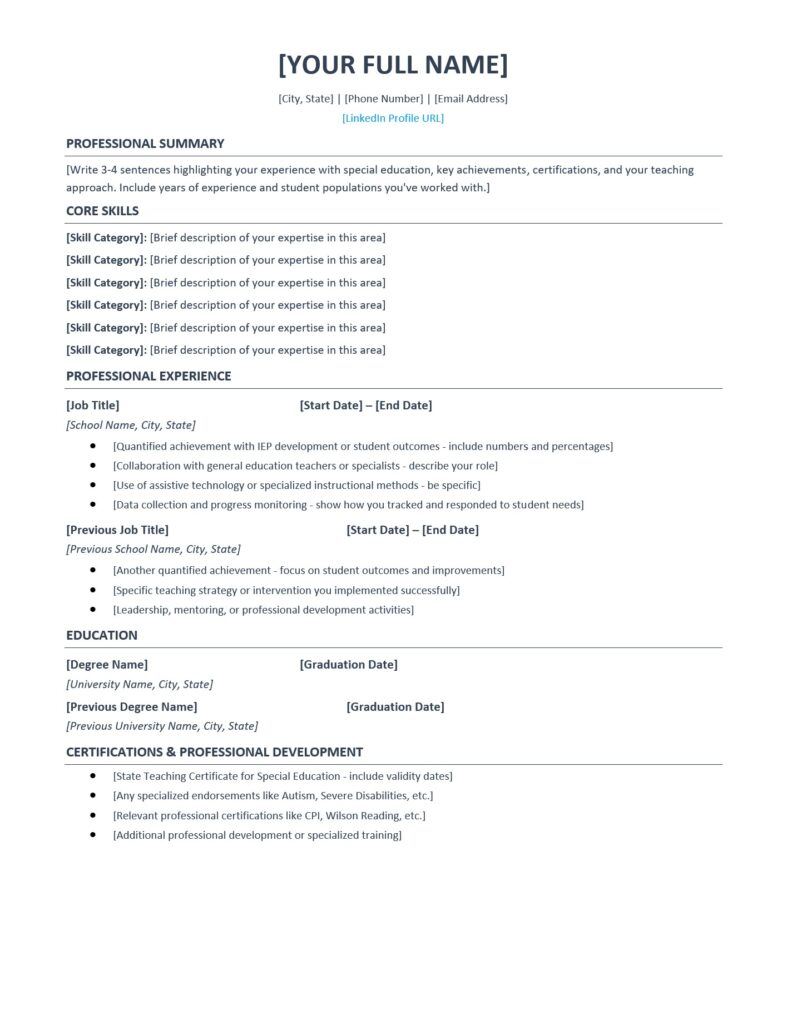
Download Your Free Template:
- Download DOCX Template (fully editable in Microsoft Word)
Interview Guys Tip: The DOCX template is fully editable, allowing you to adjust fonts, colors, and spacing to match your personal brand while maintaining professional formatting. Just replace the placeholder text with your own information.
Here’s what most people don’t realize: employers now expect multiple technical competencies, not just one specialization. The days of being “just a marketer” or “just an analyst” are over. You need AI skills, project management, data literacy, and more. Building that skill stack one $49 course at a time is expensive and slow. That’s why unlimited access makes sense:
Your Resume Needs Multiple Certificates. Here’s How to Get Them All…
We recommend Coursera Plus because it gives you unlimited access to 7,000+ courses and certificates from Google, IBM, Meta, and top universities. Build AI, data, marketing, and management skills for one annual fee. Free trial to start, and you can complete multiple certificates while others finish one.
Essential Components of a Special Education Resume
Your special education resume should include six critical sections, each serving a specific purpose in telling your professional story.
Professional Summary
This 3-4 sentence section at the top of your resume serves as your elevator pitch. It should immediately communicate your years of experience, specialized areas, and biggest achievements. Think of it as the hook that makes hiring managers want to keep reading.
A strong professional summary includes your certification status, student populations you’ve worked with, and one quantifiable achievement that demonstrates your impact. For example: “Dedicated Special Education Teacher with 7+ years of experience developing IEPs for students with diverse learning needs. Improved student goal attainment rates by 40% through data-driven interventions and collaborative team approach.”
Core Skills Section
This section is your ATS optimization powerhouse. Many school districts use applicant tracking systems that scan resumes for specific keywords from the job description. Your Core Skills section should include both hard skills and soft skills relevant to special education.
Format this section using category labels followed by brief descriptions. For instance: “IEP Development & Implementation: Created and monitored 50+ individualized education plans” or “Behavior Management: Applied ABA principles and positive behavior interventions.”
Include skills like: IEP development, differentiated instruction, data collection and analysis, behavior intervention strategies, assistive technology proficiency, parent communication, and collaboration with multidisciplinary teams.
Professional Experience
This is where you prove your capabilities through concrete examples. Each position should include your job title, school name, location, and dates of employment, followed by bullet points highlighting your achievements.
The secret to powerful experience bullets is quantification. Instead of writing “Worked with students with special needs,” write “Provided specialized instruction for 25 students with learning disabilities, reducing behavioral incidents by 35% through positive behavior support strategies.” Numbers give hiring managers concrete evidence of your impact.
Use action verbs that demonstrate leadership and initiative. Words like “developed,” “implemented,” “collaborated,” “adapted,” and “assessed” show you’re proactive rather than passive in your teaching approach.
For those looking to ace the interview after landing it with your stellar resume, check out our guide on special education teacher interview questions to prepare for common questions about IEP development and behavior management.
Interview Guys Tip: Use the SOAR Method (Situation, Obstacle, Action, Result) when describing your achievements. This framework helps you tell compelling stories about how you’ve overcome challenges and achieved results for your students.
Education Section
For special education teachers, the education section carries significant weight. Most positions require at least a bachelor’s degree in special education or a related field, with many schools preferring candidates with master’s degrees.
List your degrees in reverse chronological order, including the degree name, institution, location, and graduation date. If you graduated with honors or completed relevant coursework in areas like autism spectrum disorders or behavior analysis, include this information.
New graduates should place their education section near the top of their resume, right after the professional summary. Experienced teachers can move it lower, after professional experience, since your track record matters more than your coursework at that stage.
Certifications & Professional Development
This section is non-negotiable for special education teachers. Your state teaching certificate for special education is the baseline requirement, but additional certifications can set you apart from other candidates.
High-value certifications include: Autism Spectrum Disorders endorsement, Crisis Prevention Intervention (CPI), Wilson Reading System certification, Board Certified Behavior Analyst (BCBA), and specialized training in assistive technology. According to certification data from professional organizations, teachers with multiple specialized certifications are more competitive in the job market.
Always include the validity dates for your teaching certificates to show you’re current and eligible to teach. Schools need teachers who can start immediately, not candidates who need to renew expired certifications.
How to Tailor Your Resume for ATS Systems
Here’s a reality check: most of your competition doesn’t understand how applicant tracking systems work. That’s your opportunity.
ATS software scans your resume for specific keywords from the job description. If your resume doesn’t contain enough of these keywords, it gets automatically rejected before a human ever sees it. Understanding this system is the difference between getting interviews and wondering why no one’s calling.
Start by analyzing the job description. Look for repeated terms and phrases related to skills, qualifications, and responsibilities. If the posting mentions “IEP development” five times, that phrase better appear in your resume. If they emphasize “data-driven instruction,” use that exact phrase rather than paraphrasing it as “evidence-based teaching.”
However, don’t just stuff keywords randomly into your resume. ATS systems have become sophisticated enough to detect keyword stuffing. Instead, weave these terms naturally into your professional experience bullets and skills section.
Use standard section headers like “Professional Experience,” “Education,” and “Skills.” Creative headers like “My Journey” or “Where I’ve Taught” might confuse ATS software and cause it to miss important information. Our guide to resume formatting explains how to create ATS-friendly layouts that also look great to human readers.
Save your resume as a .docx file rather than a PDF unless the job posting specifically requests PDF format. Some older ATS systems struggle to read PDFs correctly, which could cause your carefully crafted resume to appear as gibberish to the software.
Interview Guys Tip: Before you submit another application, run your resume through an ATS scanner. Most job seekers skip this step and wonder why they never hear back. Check out the free ATS checker we use and recommend →
Common Mistakes to Avoid
Even experienced special education teachers make critical resume mistakes that cost them interviews. Here are the top errors to avoid.
- The vague achievement trap: Writing “Improved student outcomes” without any specifics tells hiring managers nothing. How many students? What kind of improvement? Over what timeframe? Generic claims make you forgettable. Always quantify your achievements with percentages, numbers, or specific examples.
- Ignoring the job description: Sending the same generic resume to every school is like teaching the same lesson plan to every student, regardless of their IEP. It doesn’t work. Customize your resume for each position, emphasizing the skills and experiences most relevant to that specific role.
- Listing job duties instead of achievements: Your resume isn’t a job description. Hiring managers already know that special education teachers develop IEPs and work with students with disabilities. What they want to know is how well you did these things and what results you achieved.
- Forgetting soft skills: Special education requires exceptional patience, empathy, creativity, and communication skills. While your resume should emphasize measurable achievements, don’t forget to demonstrate these essential qualities through examples of how you’ve built relationships with students, parents, and colleagues.
One mistake we see constantly: using outdated email addresses or unprofessional contact information. Your email should be some variation of your name, not “teacherlady2000” or “soccermom4.” These small details matter more than you think.
Showcasing Your Specialized Training
Your specialized training and certifications are what make you valuable in the competitive special education job market. Don’t bury this information at the bottom of your resume.
Create a dedicated section for certifications and professional development near the top of your page. This immediately shows hiring managers that you’ve invested in continuous learning and have credentials beyond the basic teaching certificate.
If you’ve completed significant professional development, consider creating subsections. For example, separate your state certifications from specialized training programs or professional organization memberships. This organization makes it easier for hiring managers to quickly assess your qualifications.
Include training in high-demand areas like autism support, trauma-informed practices, assistive technology, and behavior intervention. According to labor statistics, schools actively seek teachers with expertise in these specialized areas due to growing student needs.
Don’t forget to mention memberships in professional organizations like the Council for Exceptional Children (CEC) or the National Association of Special Education Teachers (NASET). These memberships signal your commitment to staying current with best practices and connecting with other professionals in your field.
Demonstrating Your Impact Through Data
Numbers are your secret weapon in special education resumes. They transform generic claims into compelling evidence of your effectiveness as an educator.
Track your achievements throughout your career. How many IEPs did you develop and implement? What percentage of your students met their annual goals? How much did behavioral incidents decrease under your interventions? These metrics prove your value in concrete terms.
Common metrics to include: number of students on your caseload, percentage improvement in student assessment scores, reduction in behavioral incidents, increase in student engagement or participation rates, number of successful transitions to less restrictive environments, and parent satisfaction ratings from surveys or feedback.
Interview Guys Tip: If you don’t have specific numbers from past positions, reach out to former supervisors or review your end-of-year evaluations. Many schools track this data for their own records and can provide it upon request.
When you can’t quantify something numerically, use comparative language. Instead of “Worked with students with autism,” try “Specialized in developing social skills programs for elementary students with autism, resulting in notable improvements in peer interactions and classroom integration.”
Our article on resume achievement formulas provides additional frameworks for turning everyday teaching activities into impressive accomplishments that catch hiring managers’ attention.
FAQ: Special Education Teacher Resume Questions
How long should my special education teacher resume be?
For most special education teachers, one page is ideal if you have less than 10 years of experience. Experienced teachers with extensive credentials and leadership roles can extend to two pages, but every word must earn its place. If you’re struggling to fit everything on one page, focus on your most recent and relevant experiences. Check out our resume sections blueprint for guidance on what to include and what to cut.
Should I include student teaching experience on my resume?
Absolutely, especially if you’re a new graduate. Student teaching provides valuable experience that demonstrates your ability to develop IEPs, manage classrooms, and implement interventions. Frame it as professional experience, listing the school, your supervising teacher, grade levels taught, and specific responsibilities you handled independently.
How do I address gaps in my teaching experience?
Be honest but strategic. If you took time off for family reasons, professional development, or career transition, briefly mention this in your cover letter rather than leaving unexplained gaps. Focus your resume on the skills and experiences you do have, emphasizing any volunteer work, continuing education, or related activities during the gap period. Our guide on career gap strategies offers specific approaches for various situations.
What if I’m switching to special education from general education?
Emphasize transferable skills and any relevant training or coursework you’ve completed in special education. Highlight experiences where you differentiated instruction, worked with students who struggled academically, or collaborated with special education staff. Many successful special education teachers started in general education and brought valuable perspectives to their new roles.
Do I need a different resume for private schools versus public schools?
The core content remains similar, but you might emphasize different aspects. Public schools often require specific state certifications and may place more weight on experience with district-wide initiatives or standardized testing. Private schools might value specialized training in particular philosophies or approaches. Always research the school’s mission and values, then adjust your resume to align with their priorities.
Your Next Steps
Creating a strong resume is just the first step in landing your ideal special education teaching position. Once you have your resume polished, focus on crafting an equally compelling cover letter that tells your story and explains why you’re passionate about special education.
Remember to customize your resume for each position you apply to, emphasizing the skills and experiences most relevant to that specific school and student population. This extra effort shows hiring managers that you’re genuinely interested in their position, not just sending out mass applications.
The special education field needs dedicated, skilled teachers like you. With approximately 37,800 annual openings projected for special education teachers, opportunities exist for teachers at all experience levels. Your resume is the key that unlocks those opportunities.
Ready to explore more resume templates for different career paths? Browse our complete free resume template library for additional options and formatting styles that might better fit your personal brand.
Here’s what most people don’t realize: employers now expect multiple technical competencies, not just one specialization. The days of being “just a marketer” or “just an analyst” are over. You need AI skills, project management, data literacy, and more. Building that skill stack one $49 course at a time is expensive and slow. That’s why unlimited access makes sense:
Your Resume Needs Multiple Certificates. Here’s How to Get Them All…
We recommend Coursera Plus because it gives you unlimited access to 7,000+ courses and certificates from Google, IBM, Meta, and top universities. Build AI, data, marketing, and management skills for one annual fee. Free trial to start, and you can complete multiple certificates while others finish one.
External Sources Cited:
- Bureau of Labor Statistics – Special Education Teachers Occupational Outlook: https://www.bls.gov/ooh/education-training-and-library/special-education-teachers.htm
- National Center for Education Statistics via University of Kansas – Special Education Teacher Job Outlook: https://educationonline.ku.edu/community/special-education-teacher-job-outlook
- Teal HQ – Best Certifications for Special Education Teachers: https://www.tealhq.com/certifications/special-education-teacher

BY THE INTERVIEW GUYS (JEFF GILLIS & MIKE SIMPSON)
Mike Simpson: The authoritative voice on job interviews and careers, providing practical advice to job seekers around the world for over 12 years.
Jeff Gillis: The technical expert behind The Interview Guys, developing innovative tools and conducting deep research on hiring trends and the job market as a whole.