
Free Engineer Resume Template 2025: ATS-Friendly Examples & Writing Guide

Landing an engineering job in 2025 requires more than just impressive technical skills and solid experience. You need a resume that can survive the digital gatekeeper standing between you and your dream position.
Here’s the challenge: nearly every engineering job you apply to will process your resume through an Applicant Tracking System before a human ever sees it. These sophisticated software platforms scan, parse, and rank applications based on specific criteria. If your resume doesn’t meet their requirements, you’re automatically eliminated regardless of your qualifications.
The frustrating part? Many talented engineers get filtered out not because they lack skills, but because their resume formatting confuses the ATS or they’re missing critical keywords. It’s like being fluent in a language but using the wrong dialect.
That’s exactly why we created this comprehensive guide with free, downloadable engineer resume templates. You’ll get both a completed example showing best practices and a blank template you can customize for your specific engineering discipline.
By the end of this article, you’ll understand exactly how to format your engineering resume for maximum ATS compatibility, which technical keywords to include, how to quantify your achievements, and how to position yourself as the ideal candidate. Plus, you’ll have ready-to-use templates that combine professional design with ATS-friendly formatting. For more strategies on optimizing your resume for ATS systems, check out our detailed guide.
☑️ Key Takeaways
- ATS-friendly formatting is non-negotiable for engineers in 2025, as over 98% of Fortune 500 companies use automated screening software that rejects poorly formatted resumes before human review
- Quantifiable achievements outperform generic responsibilities on engineering resumes, with data showing that including specific metrics and percentages increases interview callbacks significantly
- Technical skills placement matters more than ever as modern ATS systems prioritize early keyword matches, making a comprehensive skills section near the top of your resume essential
- Clean, single-column layouts beat fancy designs because complex formatting, graphics, and tables confuse ATS parsers and cause qualified engineers to be filtered out automatically
What Makes an Engineer Resume Different in 2025?
Engineering resumes require a unique approach compared to other professions. You’re not just listing job responsibilities, you’re demonstrating technical expertise, problem-solving capabilities, and quantifiable impact on projects and processes.
The engineering field values precision, and your resume needs to reflect that. Hiring managers and ATS systems alike expect to see specific technical skills, software proficiencies, and measurable outcomes. Generic statements like “responsible for designing systems” won’t cut it when you’re competing against candidates who write “engineered automated control systems that reduced energy consumption by 28%.”
Another key difference is the emphasis on technical tools and methodologies. Engineers must list specific software (SolidWorks, ANSYS, MATLAB), methodologies (Lean, Six Sigma, Agile), and standards (ISO, ASME, IEEE) they’re proficient in. These aren’t just buzzwords. They’re searchable keywords that ATS systems actively scan for based on job requirements.
Interview Guys Tip: Engineering resumes should prioritize technical skills near the top of the document. Unlike traditional advice that buried skills at the bottom, modern ATS systems and recruiters search for technical competencies first. Place your Core Skills section immediately after your Professional Summary for maximum visibility.
The technical nature of engineering also means your resume needs to balance accessibility with precision. You’re writing for two audiences: the ATS that needs to find specific keywords, and the human engineer or hiring manager who will evaluate your technical depth. This requires strategic keyword placement throughout your experience section, not just in a dedicated skills area.
Finally, engineers must demonstrate both breadth and depth. Your resume should show you understand the full project lifecycle while also highlighting specialized expertise. According to recent hiring data from industry sources, engineering positions now expect candidates to show cross-functional capabilities alongside technical mastery.
Is your resume actually getting through? You’ve read the ATS guides. Now find out if your resume passes. Upload it below for a free score in 60 seconds.
Engineering Resume Example
Here’s a professional engineering resume example. This example gives you an idea of what type of content fits in a good ATS friendly resume.
Example Resume:
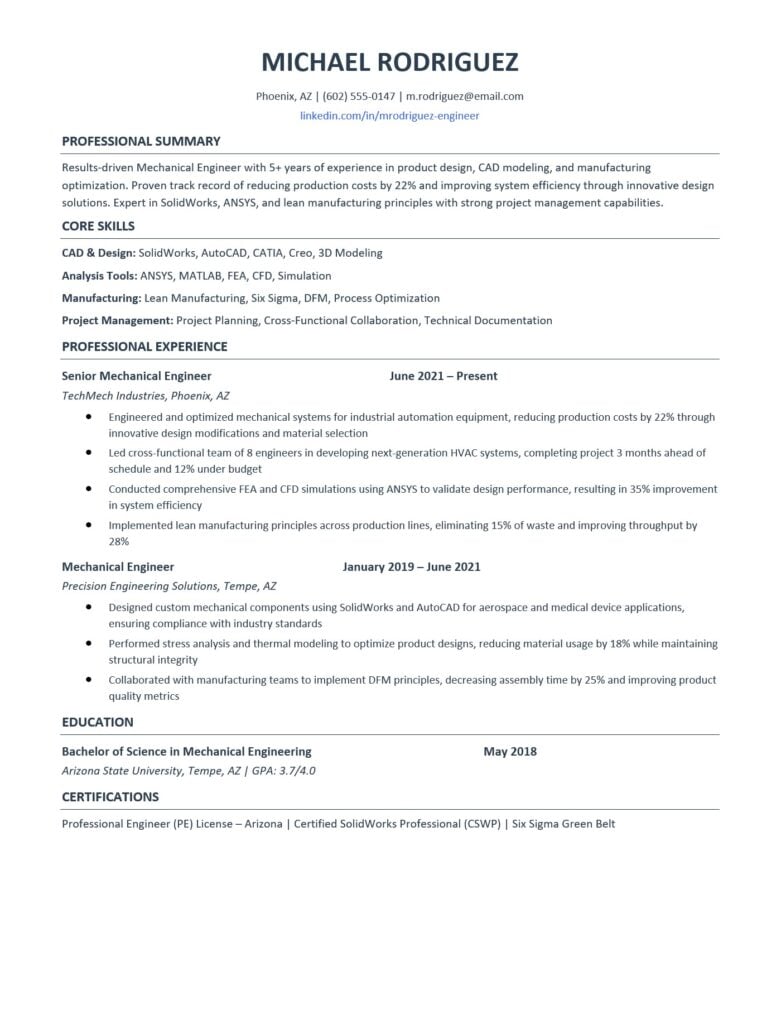
Here’s a professional engineering resume template you can download and customize. This template is designed to be both visually appealing and ATS-friendly, with clean formatting that highlights your strengths.
Blank Customizable Template
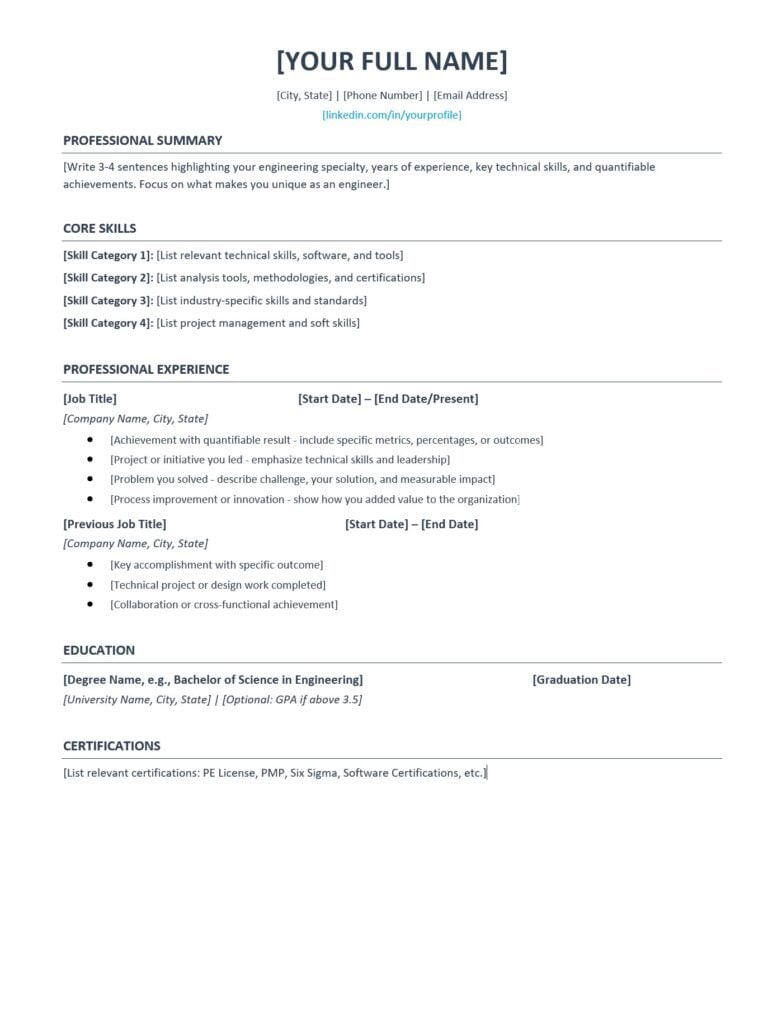
Download Your Free Template:
- Download DOCX Template (fully editable in Microsoft Word)
Interview Guys Tip: The DOCX template is fully editable, allowing you to adjust fonts, colors, and spacing to match your personal brand while maintaining professional formatting. Just replace the placeholder text with your own information.
Essential Components of an ATS-Friendly Engineer Resume
Every effective engineering resume in 2025 needs specific sections arranged in a particular order for optimal ATS parsing. Here’s the winning structure:
- Contact Information should include your full name, city and state (no need for complete address), phone number, professional email, and LinkedIn profile URL. Keep this information in the main body of your document, never in headers or footers where ATS systems often can’t read it.
- Professional Summary is your 30-second elevator pitch. This 3-4 sentence section should highlight your engineering specialty, years of experience, key technical skills, and 1-2 quantifiable achievements. For engineers with 5+ years of experience, this section is essential. New graduates can skip it and lead with education instead.
- Core Skills section is where you list your technical proficiencies in an organized, scannable format. Group skills into categories like “CAD & Design,” “Analysis Tools,” “Manufacturing,” and “Project Management.” Include both acronyms and full terms (e.g., “FEA (Finite Element Analysis)”) to catch all possible keyword variations.
- Professional Experience forms the heart of your resume. List positions in reverse chronological order with your job title, company name, location, and dates. Each role should include 3-5 bullet points focusing on achievements with quantifiable results. For more guidance on crafting compelling resume achievement formulas, explore our proven frameworks.
- Education comes next and should include your degree name, university, graduation date, and GPA if it’s above 3.5. Engineers can also list relevant coursework for entry-level positions or when changing specialties.
- Certifications complete your resume by showcasing professional credentials like PE licenses, PMP certifications, Six Sigma belts, and software-specific certifications like Certified SolidWorks Professional.
How to Write Each Section of Your Engineering Resume
Crafting Your Professional Summary
Your professional summary needs to pack maximum value into minimum space. Start with your engineering discipline and experience level. Then highlight your specialized skills or focus area. Finally, include 1-2 specific achievements with metrics.
Avoid generic phrases like “results-oriented engineer seeking challenging opportunities.” Instead, write something like: “Mechanical Engineer with 5+ years designing HVAC systems for commercial applications. Expert in energy efficiency optimization, reducing client utility costs by an average of 32% through innovative system design.”
Building a Powerful Core Skills Section
Your skills section needs strategic organization. Group related competencies together rather than listing them randomly. For mechanical engineers, this might include categories for CAD software, analysis tools, manufacturing knowledge, and project management capabilities.
Research the specific job posting and mirror their terminology exactly. If they mention “SolidWorks” don’t list “CAD software.” If they want “Lean Manufacturing,” use that exact phrase rather than “manufacturing optimization.”
Interview Guys Tip: Include both acronyms and spelled-out versions of technical terms. Write “FEA (Finite Element Analysis)” the first time you mention it. This ensures you match keyword searches whether the ATS is looking for the acronym or the full phrase.
Writing Achievement-Focused Experience Bullets
This is where most engineering resumes fail. Simply listing job duties doesn’t differentiate you from other candidates. Every bullet point should follow this formula: Action Verb + Technical Task + Quantifiable Result.
- Bad example: “Responsible for designing mechanical components.”
- Good example: “Engineered custom mechanical components using SolidWorks for aerospace applications, reducing material costs by 18% while maintaining structural integrity.”
Focus on impact. Did you reduce costs? Improve efficiency? Accelerate timelines? Increase capacity? Enhance quality? These outcomes matter far more than task descriptions.
Use specific engineering terminology and technical details. Don’t just say you “analyzed systems.” Explain that you “conducted comprehensive FEA simulations using ANSYS to validate thermal performance under extreme operating conditions.”
Highlighting Education and Certifications
For engineers, education matters, but it matters differently depending on your career stage. New graduates should lead with education and include relevant coursework, senior projects, and academic achievements. Experienced engineers can place education after experience and keep it brief.
Certifications deserve their own section because they’re heavily weighted in engineering hiring decisions. Professional Engineer (PE) licenses, Project Management Professional (PMP), Six Sigma certifications, and software-specific credentials (like Certified SolidWorks Professional) all signal competency to both ATS systems and hiring managers.
Common Mistakes That Get Engineering Resumes Rejected
Even qualified engineers sabotage their chances through formatting and content mistakes. Here are the critical errors to avoid:
- Using complex layouts might look impressive, but two-column formats, text boxes, tables, and graphics confuse ATS parsers. These systems read from left to right, top to bottom. Multi-column designs cause your information to be parsed out of order or missed entirely.
- Embedding information in headers or footers is particularly problematic. According to ATS testing research, ATS systems fail to extract contact information from headers and footers up to 25% of the time. Always keep critical details in the main body of your document.
- Keyword stuffing is the opposite problem. Some engineers try to game the system by cramming every possible technical term into their resume, often in white text or hidden sections. Modern ATS systems detect this manipulation and may penalize or flag your application.
- Using the wrong file format can eliminate you instantly. Always submit as either .docx or PDF unless the job posting specifies otherwise. PDFs maintain formatting but require ATS-compatible creation. Never submit .pages, .odt, or other uncommon formats.
- Generic content without quantification fails to impress either ATS or humans. Phrases like “worked on various engineering projects” or “assisted with system design” tell recruiters nothing about your actual capabilities or impact.
- Neglecting to customize for each application significantly reduces your match rate. According to recent data, tailoring your resume to include keywords from the specific job description can boost your ATS score from 60% to 85% or higher.
ATS Optimization Strategies for Engineers
Understanding how ATS systems evaluate engineering resumes helps you optimize strategically. These platforms don’t just count keywords, they analyze context, assess relevance, and even use machine learning to identify patterns in successful candidates.
Match job description terminology exactly. If the posting mentions “AutoCAD,” don’t list “computer-aided design software.” If they want “project management,” don’t substitute “initiative leadership.” ATS systems look for exact phrase matches, not synonyms.
Place keywords strategically throughout your resume. Don’t just dump technical terms in your skills section. Weave them into your professional summary and especially into your experience bullets where you demonstrate proficiency through real achievements.
Use standard section headers like “Professional Experience,” “Education,” “Skills,” and “Certifications.” Creative headers like “My Engineering Journey” or “Technical Expertise” may confuse ATS parsers trying to categorize your information. For comprehensive ATS resume formatting best practices, our detailed guide covers every technical requirement.
Include full terms and acronyms for technical skills. Write “Computer-Aided Design (CAD)” and “Finite Element Analysis (FEA)” rather than assuming the ATS recognizes abbreviations. This captures searches for both versions.
Prioritize recent, relevant experience. ATS systems typically weight recent positions more heavily than older roles. Focus your strongest achievements and most relevant keywords in your current or most recent position.
Save files with professional naming conventions. Use “FirstName_LastName_Resume.pdf” format to avoid parsing issues. Never use generic names like “Resume1.docx” or creative names that don’t clearly identify the document.
Frequently Asked Questions
Should I include a photo on my engineering resume?
No. In the United States, photos on resumes are not standard practice and can actually work against you. Many companies remove photos to avoid bias claims, and ATS systems can’t process images properly. Save the visual elements for your LinkedIn profile.
How long should my engineering resume be?
For engineers with less than 10 years of experience, stick to one page. Those with extensive experience can extend to two pages, but never exceed that length. ATS systems can handle multiple pages, but recruiters prefer concise, relevant information.
Do I need to list every engineering software tool I’ve used?
No. Focus on tools relevant to the position you’re applying for and software you’re genuinely proficient in. Listing every program you’ve touched once creates clutter and dilutes your expertise. Prioritize tools mentioned in the job description.
Should I include my GPA if it’s below 3.5?
Generally no, unless you’re a recent graduate applying for highly competitive positions. If your GPA is below 3.5, simply omit it. Focus instead on relevant projects, internships, and technical skills that demonstrate your capabilities.
How often should I update my engineering resume?
Update your resume every time you complete a significant project, earn a certification, or achieve a measurable result worth highlighting. At minimum, review and refresh your resume quarterly even when you’re not actively job searching. This ensures you capture achievements while details are fresh.
Conclusion
Creating an ATS-friendly engineering resume doesn’t require sacrificing professionalism or impact. By following the strategies in this guide and using our proven templates, you’ll craft a resume that passes automated screening while impressing human decision-makers.
Remember the key principles: clean, single-column formatting for ATS compatibility, quantifiable achievements to demonstrate impact, strategic keyword placement throughout your content, and customization for each specific position you target.
The two downloadable templates we’ve provided give you both a concrete example to model and a blank template ready for your information. Download them both, study the example to understand best practices, then customize the blank template with your unique engineering experience and achievements.
Your technical skills and problem-solving abilities got you this far in your engineering career. Now let your resume showcase those capabilities in a format that gets you past the digital gatekeepers and into interviews. For even more resume resources and templates across different engineering specialties, explore our free resume template library.
Is your resume actually getting through? You’ve read the ATS guides. Now find out if your resume passes. Upload it below for a free score in 60 seconds.
Advice like this is the general version. Longbow scores your actual resume against the actual job you want and shows you what's missing, before the filters decide for you. Here's why we built it.

ABOUT THE INTERVIEW GUYS (JEFF GILLIS & MIKE SIMPSON)
Mike Simpson: Co-founder of The Interview Guys and Longbow. He has been the voice behind our interview advice since 2013 — his work has reached over 100 million job seekers around the world. The strategic mind behind Longbow, our new career platform.
Jeff Gillis: Co-founder of The Interview Guys and Longbow. He built the systems that put our work in front of those readers, and he leads the engineering on Longbow, the cutting edge career platform built for today’s job seeker.