
Free School Nurse Resume Template 2025: ATS Examples & Writing Guide
School nursing offers a unique opportunity to make a lasting difference in children’s lives while enjoying a schedule that actually gives you work-life balance. Unlike hospital nursing with unpredictable shifts and mandatory overtime, school nurses typically work during school hours with summers off.
The challenge? Landing that school nursing position requires a resume that stands out from dozens of other qualified candidates. Your resume needs to demonstrate not just your clinical skills, but also your ability to work independently, communicate with diverse populations, and manage the unique health needs of school-age children.
Many nurses struggle with translating their hospital or clinical experience into school-relevant achievements. They list generic duties instead of showcasing specific outcomes. They forget to highlight their collaboration skills with educators and families, which are just as important as their medical expertise.
By the end of this article, you’ll know exactly how to structure your school nurse resume, which keywords to include for ATS systems, and how to quantify your achievements in ways that make hiring managers take notice. Plus, you’ll get two free downloadable templates: a complete example and a customizable blank version you can edit immediately.
☑️ Key Takeaways
- School nursing requires both clinical expertise and strong communication skills to work effectively with students, families, and school staff in educational settings
- State-specific certifications matter as most states require RN licensure plus additional school nurse credentials or certificates from state education departments
- Quantifying your impact on student health outcomes makes your resume stand out by showing measurable improvements in absenteeism, screening programs, or emergency response
- ATS-optimized keywords from the job description are essential since 75% of resumes never reach human reviewers without proper keyword matching
What Makes a School Nurse Resume Different?
School nursing is a specialized field that requires a unique blend of pediatric clinical skills, educational knowledge, and community health expertise. Your resume needs to reflect this combination.
Unlike traditional nursing resumes that emphasize hospital protocols and patient outcomes, school nurse resumes must highlight your ability to work autonomously. You’re often the only medical professional in the building, making independent clinical judgments throughout the day.
What Hiring Managers Look For
Hiring managers evaluate school nurse candidates on several key factors:
- Individualized healthcare plan development for students with chronic conditions like asthma, diabetes, and seizure disorders
- Knowledge of special education law and the development of IEP and 504 plans
- Health screening program management including vision, hearing, and scoliosis screenings
- Immunization compliance tracking and managing state reporting requirements
- Emergency response capabilities for everything from playground injuries to life-threatening allergic reactions
Interview Guys Tip: If you’re transitioning from hospital nursing to school nursing, reframe your pediatric experience to emphasize the school-relevant aspects. Instead of “administered medications to pediatric patients,” write “administered medications to children ages 5-12 and educated families on proper medication management at home.”
Your resume also needs to demonstrate cultural competency and communication skills. School nurses interact with students from diverse backgrounds, communicate complex health information to non-medical staff, and serve as liaisons between families and healthcare providers.
School Nurse Resume Example
Here’s a professional school nurse resume example. This example gives you an idea of what type of content fits in a good ATS friendly resume.
Example Resume:
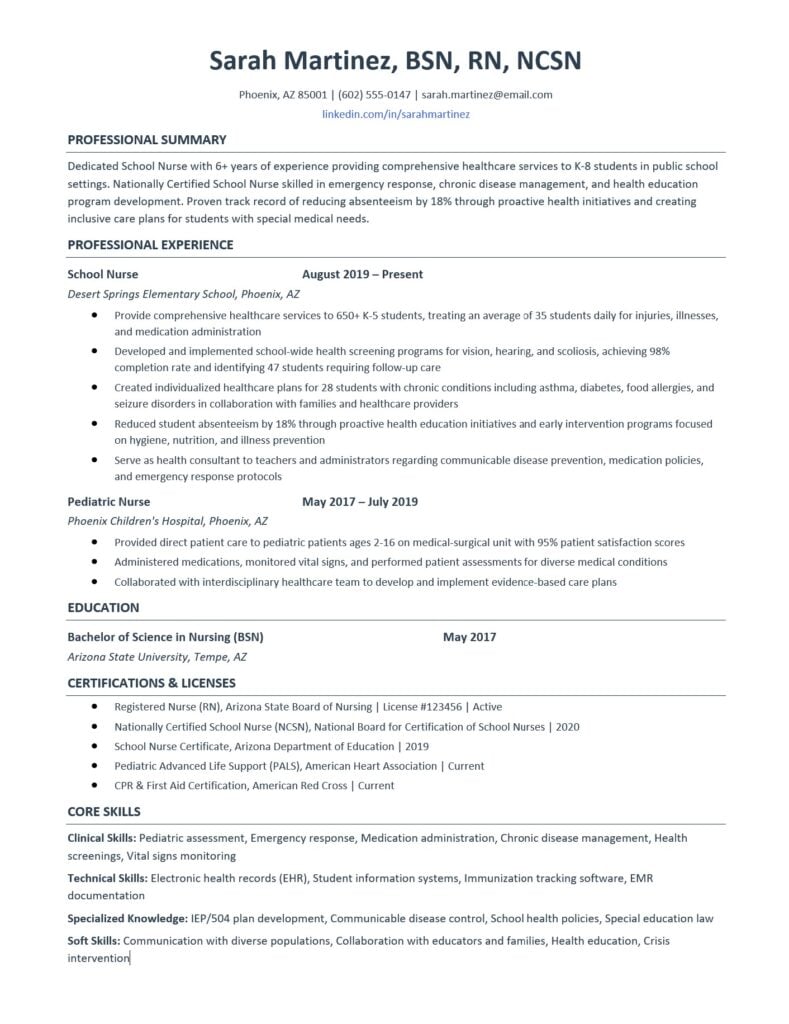
Here’s a professional school nurse resume template you can download and customize. This template is designed to be both visually appealing and ATS-friendly, with clean formatting that highlights your strengths.
Blank Customizable Template
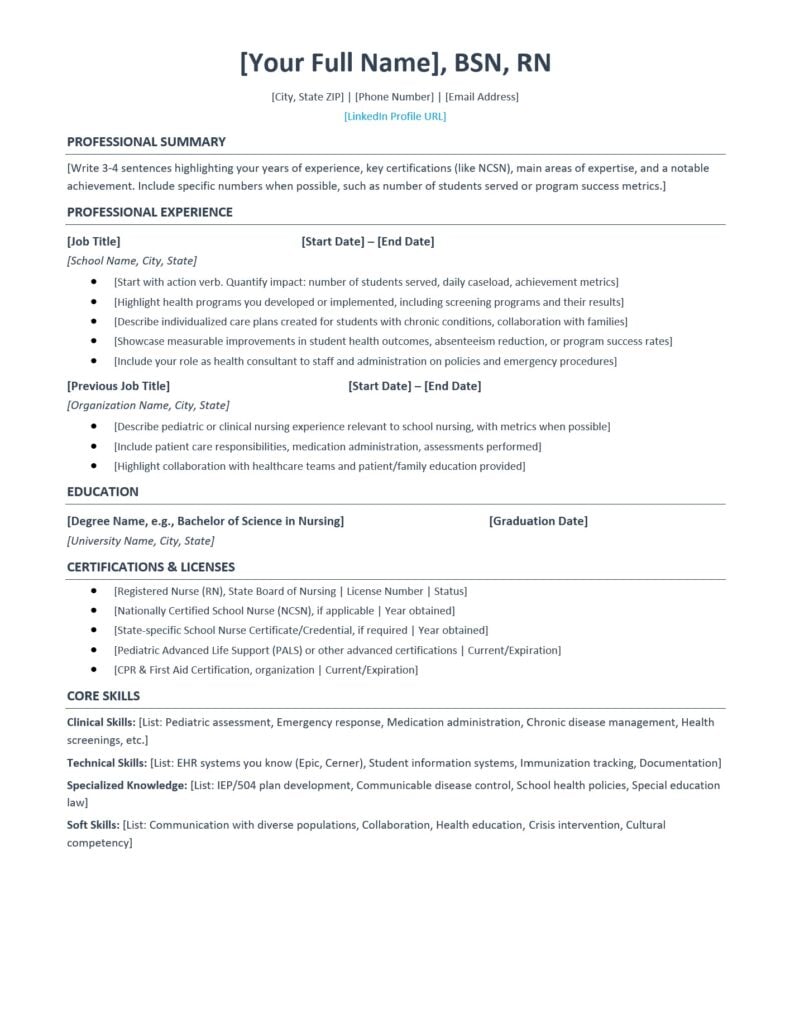
Download Your Free Template:
- Download DOCX Template (fully editable in Microsoft Word)
Interview Guys Tip: The DOCX template is fully editable, allowing you to adjust fonts, colors, and spacing to match your personal brand while maintaining professional formatting. Just replace the placeholder text with your own information.
Not sure if your resume will pass the ATS?
You could have the perfect experience and still get filtered out by automated screening software. The good news? You can test your resume before you apply. Click the button to check out the ATS checker we use and recommend…
Essential Components of a School Nurse Resume
A winning school nurse resume includes six critical sections, each serving a specific purpose in your application.
Professional Summary
Your professional summary sits at the top of your resume, giving hiring managers a 15-second snapshot of your qualifications. This 3-4 sentence paragraph should include:
- Your years of experience in nursing (especially pediatric or school nursing)
- Key certifications (NCSN, PALS, state credentials)
- Main areas of expertise (chronic disease management, emergency response, health education)
- One quantifiable achievement (reduced absenteeism, screening program success, etc.)
Strong summaries immediately establish credibility. They tell the reader “I understand school nursing” rather than “I’m a nurse who wants to work in schools.”
Professional Experience
This section carries the most weight in your application. List your positions in reverse chronological order, with your most recent role first.
For each position, include:
- Job title
- Organization name and location
- Dates of employment
- 3-5 bullet points describing responsibilities and achievements
The key difference between mediocre and exceptional experience sections? Specificity and quantification. Don’t just say you “provided healthcare to students.” Say you “provided comprehensive healthcare services to 650+ K-5 students, treating an average of 35 students daily for injuries, illnesses, and medication administration.”
Interview Guys Tip: Even if you don’t have direct school nursing experience, you can still create a compelling resume. Highlight your pediatric nursing experience, community health work, or any roles where you worked independently, educated patients, or collaborated with diverse teams.
Education
School nursing requires at minimum a Bachelor of Science in Nursing (BSN) from an accredited program. Some states accept Associate Degree in Nursing (ADN) prepared nurses, but most prefer or require the BSN.
List your degree, institution name, location, and graduation date. If you graduated within the last 5 years, you can include relevant coursework like:
- Pediatric nursing
- Community health nursing
- School health policies
- Child development
Certifications & Licenses
This section is non-negotiable for school nurses. At minimum, you need an active RN license in your state. Many states also require additional credentials.
State Requirements Vary Significantly
States Requiring Additional Credentials:
- Arizona: School Nurse Certificate from Arizona Department of Education
- California: Commission-approved credential program completion
- Pennsylvania: Commission-approved credential program completion
- West Virginia: Commission-approved credential program completion
- New Mexico: MSN required for school nurse supervisor roles
Most Other States: Requirements vary. Check with your state board of nursing and department of education for specific requirements.
List your credentials in this order:
- RN license with license number, issuing state board, and current status
- NCSN certification (Nationally Certified School Nurse) if you have it
- State-specific school nurse certificate/credential
- Advanced certifications like PALS or specialized pediatric credentials
- CPR and First Aid certification (most schools require this)
The NCSN credential from the National Board for Certification of School Nurses demonstrates advanced knowledge and can increase your salary potential. It requires a Bachelor’s degree, an RN license, and at least 1,000 hours of clinical experience within three years.
Core Skills
The skills section provides a quick-reference guide to your capabilities. Organize your skills into categories for easy scanning.
Clinical Skills:
- Pediatric assessment
- Emergency response and triage
- Medication administration
- Chronic disease management (asthma, diabetes, seizures)
- Health screenings (vision, hearing, scoliosis)
- Vital signs monitoring
- Wound care and first aid
Technical Skills:
- Electronic health record (EHR) systems (Epic, Cerner, etc.)
- Student information systems
- Immunization tracking software
- Documentation platforms
- Telehealth platforms
Specialized Knowledge:
- IEP/504 plan development and implementation
- Communicable disease control and outbreak management
- School health policies and procedures
- Special education law (IDEA, Section 504)
- FERPA and health information privacy
Soft Skills:
- Communication with diverse populations
- Collaboration with educators and families
- Health education and program development
- Crisis intervention and de-escalation
- Cultural competency
Writing Each Section for Maximum Impact
Let’s break down exactly how to write each section to catch hiring managers’ attention and pass ATS screening.
Crafting Your Professional Summary
Your professional summary needs to pack a punch in just a few sentences. Start with your years of experience and current credentials.
Here’s the progression from good to excellent:
- Good: “Dedicated School Nurse with 6+ years of experience providing comprehensive healthcare services to K-8 students in public school settings.”
- Better: “Dedicated School Nurse with 6+ years of experience providing comprehensive healthcare services to K-8 students in public school settings. Nationally Certified School Nurse skilled in emergency response, chronic disease management, and health education program development.”
- Best: “Dedicated School Nurse with 6+ years of experience providing comprehensive healthcare services to K-8 students in public school settings. Nationally Certified School Nurse skilled in emergency response, chronic disease management, and health education program development. Proven track record of reducing absenteeism by 18% through proactive health initiatives.”
See the progression? Each version adds more specific, quantifiable information that demonstrates actual impact rather than just listing credentials.
Describing Your Professional Experience
Each bullet point in your experience section should follow a simple formula:
Action verb + specific task + quantifiable result
Examples of Weak vs. Strong Bullet Points
Weak Bullet Points:
- “Responsible for student health needs”
- “Provided nursing care to students”
- “Administered medications”
- “Maintained health records”
- “Conducted health screenings”
Strong Bullet Points:
- “Managed comprehensive health needs for 650+ elementary students, conducting 35+ daily assessments for injuries, illnesses, and medication administration”
- “Developed and implemented school-wide health screening programs for vision, hearing, and scoliosis, achieving 98% completion rate and identifying 47 students requiring follow-up care“
- “Administered daily medications to 40+ students with chronic conditions including asthma, diabetes, and seizure disorders, achieving 100% medication compliance and zero adverse events over two school years”
- “Maintained accurate health records for 600+ students with 100% compliance during state audits”
- “Implemented vision and hearing screening program that identified 52 students requiring follow-up care, resulting in improved academic performance for 89% of referred students“
Focus on outcomes that matter to schools:
- Did you reduce absenteeism through health education?
- Did you improve medication compliance for students with chronic conditions?
- Did you create emergency response protocols that improved staff preparedness?
- Did you successfully manage complex medical conditions that allowed students to attend school safely?
When describing your previous roles, prioritize school-relevant experiences. If you worked in a pediatric hospital, emphasize your patient education, family communication, and management of pediatric chronic conditions.
Highlighting Your Education and Certifications
Your education section is straightforward but crucial. Always list your BSN prominently since most school districts require it.
If you completed any specialized coursework related to school nursing, child development, or educational settings, mention it. Courses in school health services, pediatric health assessment, or community health nursing demonstrate relevant preparation.
For certifications, be specific about expiration dates and renewal status. Schools need to know your credentials are current. If you’re due for renewal soon, indicate when you’ll complete it.
Interview Guys Tip: If you’re working toward your NCSN certification but haven’t completed it yet, you can include a line like “NCSN Certification Candidate, Expected completion: [Month Year].” This shows initiative and commitment to the specialty.
Common Mistakes to Avoid
Even experienced nurses make critical errors that can cost them interviews. Here are the mistakes that most commonly sink school nurse applications.
1. Generic, One-Size-Fits-All Resumes
The biggest mistake? Sending the same resume to every school district. Schools have different needs:
- Elementary schools need nurses comfortable with younger children and common childhood illnesses
- Middle schools need nurses who can address developmental health concerns and puberty-related issues
- High schools need nurses who can handle adolescent health concerns, mental health support, and comprehensive health education
The fix: Customize your resume for each application. If the job posting emphasizes experience with students with special needs, make sure your resume prominently features your work developing individualized healthcare plans.
2. Focusing on Hospital Protocols Instead of Educational Outcomes
Hospital nurses often struggle with this transition. They describe their work using hospital-centric language about patient care, admissions, discharges, and hospital protocols.
School administrators don’t speak that language. They care about:
- Student attendance
- Academic performance
- Health screenings
- Parent communication
- Compliance with educational health regulations
The fix: Reframe your experience in educational terms. Instead of “managed patient care for pediatric unit,” try “provided comprehensive health services supporting students’ ability to attend school and participate fully in educational activities.”
3. Listing Duties Without Demonstrating Impact
Weak resumes list what you were supposed to do. Strong resumes show what you actually accomplished. The strong versions provide specific numbers, show the complexity of work, and demonstrate measurable outcomes.
4. Ignoring ATS Requirements
Most school districts use ATS software to manage applications. If your resume doesn’t contain the right keywords, it may never reach a human reviewer.
Research shows that 75% of applications are rejected by ATS before a hiring manager sees them.
The solution? Mirror the language from the job description. If the posting mentions “electronic health records,” use that exact phrase rather than “EMR” or “digital documentation system.”
ATS Optimization and Keywords for School Nurse Resumes
Understanding how ATS software works is essential for modern job searching. These systems scan your resume for specific keywords and rank candidates based on match percentage.
Interview Guys Tip: Before you submit another application, run your resume through an ATS scanner. Most job seekers skip this step and wonder why they never hear back. Check out the free ATS checker we use and recommend →
Top Keywords for School Nurse Resumes
School nurse job postings commonly include these keywords:
Clinical Keywords:
- Registered Nurse (RN)
- Pediatrics/Pediatric nursing
- Medication administration
- Patient care
- Vital signs monitoring
- Emergency response
- First aid
- CPR certified
School-Specific Keywords:
- Health screenings
- Immunization compliance
- IEP/504 plans
- Health education
- Chronic disease management
- School health policies
- Special education
Collaboration Keywords:
- Multidisciplinary team
- Parent communication
- Staff training
- Community partnerships
- Healthcare coordination
Best Practices for ATS-Friendly Resumes
Include both full terms and abbreviations:
- Write “Registered Nurse (RN)” not just “RN”
- Write “Cardiopulmonary Resuscitation (CPR)” not just “CPR”
- Write “Individualized Education Program (IEP)” not just “IEP”
Use standard section headings:
- “Professional Experience” not “My Journey”
- “Education” not “Academic Background”
- “Certifications” not “Credentials”
Stick with simple formatting:
- Use standard fonts (Calibri, Arial, Times New Roman)
- Avoid text boxes or graphics
- Skip tables for your main content
- Use standard bullet points
- Save as .docx unless specifically requested otherwise
Interview Guys Tip: Before submitting your application, try copying your resume into a plain text editor. If the formatting turns into a jumbled mess, an ATS will have trouble reading it too. Simplify your format and try again.
Frequently Asked Questions
Do I need a BSN to be a school nurse?
Most states require a Bachelor of Science in Nursing for school nurse positions. While a few states accept Associate Degree prepared nurses with additional certifications, the BSN is increasingly the standard. If you have an ADN, consider enrolling in an RN-to-BSN bridge program to expand your opportunities.
How important is the NCSN certification?
The Nationally Certified School Nurse credential isn’t required in most states, but it significantly strengthens your application. NCSN-certified nurses often receive higher salaries and more job opportunities. The certification requires a BSN, active RN license, and 1,000 hours of school nursing practice within the past three years.
What if I don’t have school nursing experience?
Focus on transferable skills from your nursing background. Pediatric nursing experience is highly valuable, even if it’s from a hospital setting. Emphasize your patient and family education, communication with diverse families, assessment skills with children, experience managing pediatric chronic conditions, and independent decision-making capabilities.
Should I include references on my school nurse resume?
No. Use the valuable resume space for your qualifications instead. Create a separate reference list to provide when requested. Make sure your references include at least one clinical supervisor who can speak to your nursing skills and preferably someone who can discuss your work with children or in educational settings.
How can I make my resume stand out when I have the same qualifications as other candidates?
Quantify everything possible. Instead of saying you “managed student health records,” specify that you “maintained accurate health records for 600+ students with 100% compliance during state audits.” Show the scope of your work, the complexity of cases you handled, and the measurable outcomes you achieved.
Take the Next Step in Your School Nursing Career
A strong resume is your ticket to landing interviews for school nursing positions. Use the templates provided to create a resume that showcases both your clinical expertise and your passion for supporting student health.
Remember these key strategies:
- Customize your resume for each application
- Incorporate keywords from the job description
- Quantify your achievements wherever possible
- Balance clinical skills with communication abilities
- Demonstrate your understanding of the school environment
Download both templates today and start crafting a resume that opens doors to your ideal school nursing position. And when you land that interview, check out our comprehensive guide to behavioral interview questions to prepare for common questions about your experience working with children, managing emergencies, and collaborating with educational staff.
For more career resources, browse our complete collection of free resume templates for various healthcare roles and industries.
Over 75% of resumes get rejected by ATS software before a human ever sees them…
The good news? You can test your resume before you apply. Want to know where you stand? Test your resume with our recommended ATS scanner →

BY THE INTERVIEW GUYS (JEFF GILLIS & MIKE SIMPSON)
Mike Simpson: The authoritative voice on job interviews and careers, providing practical advice to job seekers around the world for over 12 years.
Jeff Gillis: The technical expert behind The Interview Guys, developing innovative tools and conducting deep research on hiring trends and the job market as a whole.