
Free Sales Resume Template: Examples & ATS Writing Guide [2025]
Landing your next sales role starts with a resume that sells the most important product of all: you.
But here’s the challenge. With hundreds of applications flooding hiring managers’ inboxes for every sales position, your resume has about six seconds to make an impression. That’s barely enough time to scan a single paragraph.
The good news? Sales professionals have a unique advantage when it comes to resume writing. Your entire career is built on quantifiable results. You already speak the language of metrics, ROI, and performance indicators that hiring managers desperately want to see.
This guide provides everything you need to create a sales resume that converts. You’ll get two free downloadable templates (one completed example and one blank template), expert guidance on writing each section, and insider tips on optimizing for applicant tracking systems.
By the end of this article, you’ll have a polished sales resume that highlights your achievements with compelling metrics, passes ATS screening, and positions you as the obvious choice for your target role. Plus, you’ll understand exactly what hiring managers look for when evaluating sales professionals in 2025.
☑️ Key Takeaways
- Quantify everything: Sales resumes must include specific metrics like revenue generated, quota achievement percentages, and client retention rates to prove your impact
- ATS optimization is non-negotiable: With 83% of companies using AI resume screening, your sales resume needs strategic keywords and clean formatting to pass digital gatekeepers
- Lead with results, not responsibilities: Hiring managers want to see “Exceeded quota by 125%” rather than “Responsible for meeting sales targets”
- Skills-based hiring favors sales pros: 65% of managers will hire based on skills alone, making your Core Skills section just as important as your work experience
What Makes a Sales Resume Different?
Sales resumes require a fundamentally different approach than other professional documents. While a marketing manager might emphasize creative campaigns or a project manager focuses on coordination skills, sales resumes must prove one thing above all else: you deliver measurable results.
Every bullet point on your sales resume should answer the question: “What revenue did you generate or what percentage did you exceed expectations?”
The numbers tell your story. When you write “Generated $2.8M in new business revenue” instead of “Responsible for new client acquisition,” you immediately establish credibility. Hiring managers reviewing sales candidates are looking for proof of past performance because it’s the best predictor of future success.
Sales resumes also need to demonstrate your understanding of the complete sales cycle. From prospecting and lead qualification to closing deals and account management, your resume should show you can handle every stage of the process.
Interview Guys Tip: Don’t just list CRM systems you’ve used. Show how you leveraged them: “Implemented Salesforce analytics that increased pipeline conversion rate from 18% to 27%.” This demonstrates both technical proficiency and business impact.
Sales Resume Example
Here’s a professional sales resume example. This example gives you an idea of what type of content fits in a good ATS friendly resume.
Example Resume:
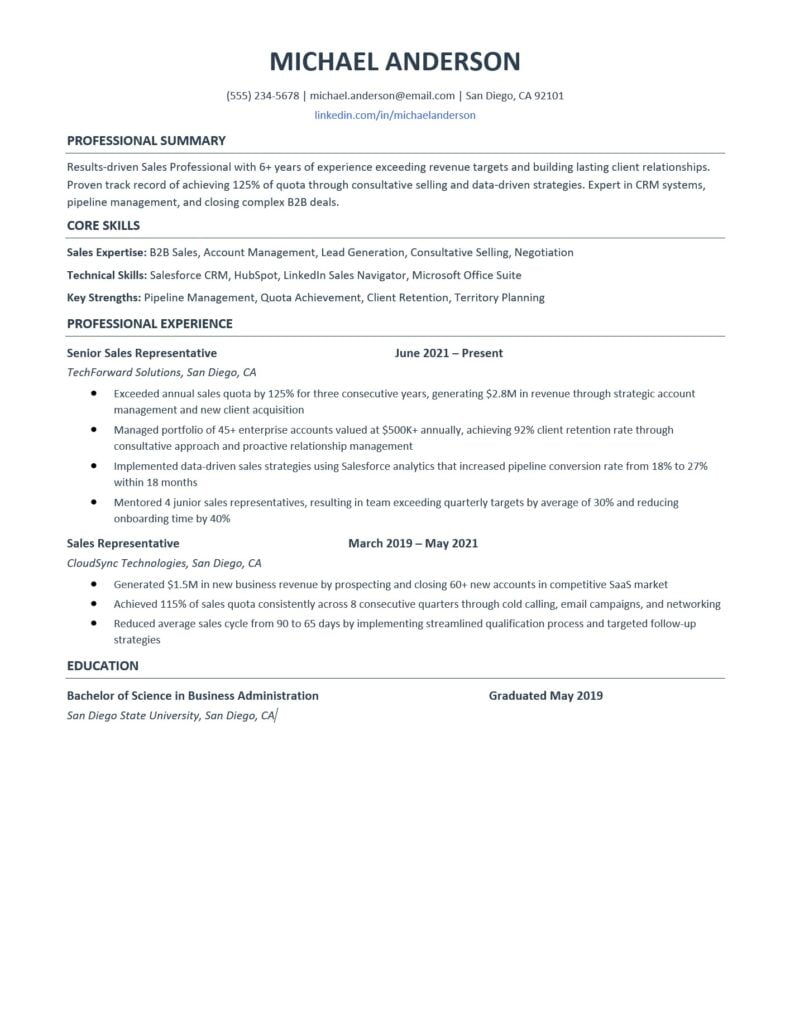
Here’s a professional sales resume template you can download and customize. This template is designed to be both visually appealing and ATS-friendly, with clean formatting that highlights your strengths.
Blank Customizable Template
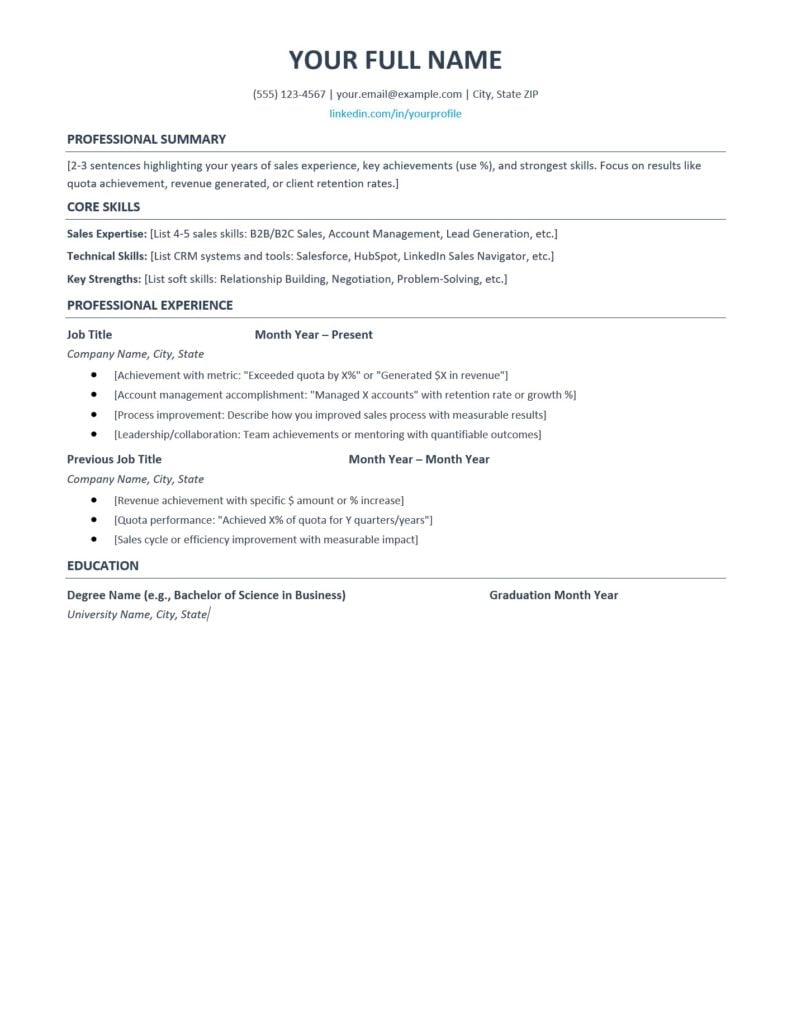
Download Your Free Template:
- Download DOCX Template (fully editable in Microsoft Word)
Interview Guys Tip: The DOCX template is fully editable, allowing you to adjust fonts, colors, and spacing to match your personal brand while maintaining professional formatting. Just replace the placeholder text with your own information.
Here’s what most people don’t realize: employers now expect multiple technical competencies, not just one specialization. The days of being “just a marketer” or “just an analyst” are over. You need AI skills, project management, data literacy, and more. Building that skill stack one $49 course at a time is expensive and slow. That’s why unlimited access makes sense:
Your Resume Needs Multiple Certificates. Here’s How to Get Them All…
We recommend Coursera Plus because it gives you unlimited access to 7,000+ courses and certificates from Google, IBM, Meta, and top universities. Build AI, data, marketing, and management skills for one annual fee. Free trial to start, and you can complete multiple certificates while others finish one.
Essential Components of a Winning Sales Resume
A strong sales resume follows a specific structure that highlights your value proposition immediately. Here’s what needs to be included:
- Contact Information: Your name, phone number, email, location (city and state), and LinkedIn profile URL belong at the top. Make sure your LinkedIn profile is updated and professional since 78% of hiring managers check it before making decisions.
- Professional Summary: This 2-3 sentence section appears right below your contact info. It should capture your years of experience, biggest achievements (with percentages), and key strengths. Think of it as your elevator pitch on paper.
- Core Skills Section: List your technical skills (CRM systems, sales tools), sales expertise (B2B/B2C, account management, lead generation), and soft skills (negotiation, relationship building). This section helps you pass ATS screening and gives hiring managers a quick snapshot of your capabilities.
- Professional Experience: This is where you shine. Each role should include 3-5 bullet points that focus exclusively on achievements, not responsibilities. Start each bullet with a strong action verb and include specific metrics.
- Education: List your degree, institution, and graduation date. If you’re early in your career, you can include relevant coursework or academic achievements. Experienced professionals can keep this section brief.
How to Write Each Section for Maximum Impact
Crafting Your Professional Summary
Your professional summary needs to grab attention immediately. Skip generic phrases like “hardworking sales professional” and lead with your strongest achievement.
Strong example: “Results-driven Sales Professional with 6+ years exceeding revenue targets. Achieved 125% of quota for three consecutive years, generating $5.2M in total revenue through consultative B2B selling and strategic account management.”
This summary works because it quantifies experience, proves consistent high performance, and specifies the sales approach and market segment. When hiring managers see numbers like “125% of quota” and “$5.2M in revenue,” they keep reading.
If you’re transitioning into sales or have less experience, focus on transferable skills and any results you can quantify. Even entry-level candidates can highlight achievements like “Increased customer engagement by 40% through targeted outreach strategies” from internships or related roles.
Building a Results-Focused Experience Section
This section makes or breaks your sales resume. Every bullet point should follow this formula: Action Verb + Specific Task + Quantifiable Result.
Weak bullet: Managed client relationships and met sales targets
Strong bullet: Managed portfolio of 45+ enterprise accounts valued at $500K+ annually, achieving 92% client retention rate through consultative approach and proactive relationship management
Notice how the strong version includes specific numbers (45+ accounts, $500K+, 92% retention) that prove your capability. These metrics answer the hiring manager’s most important question: “Can this person deliver results?”
Interview Guys Tip: If you don’t have exact numbers, estimate conservatively. Use ranges like “30-40 new accounts” or percentage improvements like “increased close rate by approximately 20%.” Just be prepared to discuss these figures in your interview using the SOAR Method.
Focus on achievements that demonstrate the full sales cycle: prospecting success, conversion rates, average deal size, sales cycle length, quota attainment, client retention, and territory growth. These metrics prove you understand every aspect of the sales process.
Selecting the Right Skills
Your Core Skills section serves two critical purposes: passing ATS filters and proving to hiring managers you have the right capabilities. Modern ATS systems scan for specific keywords from the job description, so this section needs strategic planning.
Start by analyzing the job posting. Identify the exact tools and skills mentioned, then include those you genuinely possess. Common categories include:
- Sales Expertise: B2B Sales, B2C Sales, Inside Sales, Outside Sales, Account Management, Lead Generation, Cold Calling, Consultative Selling, Solution Selling, Territory Management
- Technical Skills: Salesforce, HubSpot, Microsoft Dynamics, LinkedIn Sales Navigator, ZoomInfo, Outreach.io, SalesLoft, Gong
- Soft Skills: Negotiation, Relationship Building, Communication, Presentation Skills, Problem-Solving, Time Management, Emotional Intelligence
Don’t claim skills you don’t have just to game the ATS. If your resume says you’re proficient in Salesforce and you’ve never used it, that becomes immediately apparent in interviews. Instead, focus on learning in-demand skills if you’re missing critical ones from your target jobs.
The balance between hard and soft skills matters too. 93% of hiring managers look for soft skills when screening applicants. Your ability to build relationships and communicate effectively is just as valuable as your CRM expertise.
Common Mistakes That Kill Sales Resumes
Even experienced sales professionals make critical errors that derail their applications. Here are the most damaging mistakes to avoid:
- Being vague about results. Writing “Consistently exceeded targets” without specific percentages or dollar amounts makes hiring managers skeptical. They need proof, not claims. Always include concrete numbers.
- Focusing on duties instead of achievements. Your resume isn’t a job description. “Responsible for managing accounts” tells hiring managers nothing. “Grew account portfolio from $1.2M to $3.5M in 18 months through upselling and cross-selling strategies” proves your value.
- Ignoring ATS optimization. Many sales professionals create beautifully designed resumes with graphics, tables, and columns that ATS software can’t parse. Stick to simple, clean formatting with standard fonts. Your resume needs to pass the digital screening before any human sees it.
- Making your resume too long. Unless you have 10+ years of experience, keep it to one page. Even with extensive experience, two pages maximum. Hiring managers spend seconds scanning resumes. Every word should earn its place by demonstrating your value.
- Using the same resume for every application. Each job posting emphasizes different aspects of sales (relationship building vs. new business development, enterprise vs. SMB, industry expertise). Tailoring your resume to match specific requirements dramatically increases your interview rate.
ATS Optimization and Keywords for Sales Resumes
Understanding how ATS systems work is crucial for sales professionals. These software platforms scan your resume for keywords, assess formatting, and rank candidates before any human review occurs.
Start with the job description. Highlight all the required skills, qualifications, and technical terms. If the posting mentions “Salesforce” three times, make sure your resume includes it (assuming you actually use it). If they want “solution selling” experience, use that exact phrase rather than “consultative approach.”
Interview Guys Tip: Before you submit another application, run your resume through an ATS scanner. Most job seekers skip this step and wonder why they never hear back. Check out the free ATS checker we use and recommend →
Critical ATS-friendly practices:
Use standard section headings like “Professional Experience,” “Skills,” and “Education.” Creative headers like “What I’ve Accomplished” confuse ATS software.
Save your resume as a .docx file unless the application specifically requests PDF. Many older ATS systems struggle with PDFs, though this is improving in 2025.
Include keywords naturally throughout your resume, not just in a skills section. When you write “Implemented Salesforce CRM to track 300+ prospects monthly, increasing conversion rate by 23%,” you’ve incorporated the keyword “Salesforce” while demonstrating achievement.
Avoid tables, text boxes, headers, footers, and graphics. ATS software often can’t read these elements, which means critical information disappears during parsing.
Skip acronyms unless they’re widely recognized. Write out “Customer Relationship Management (CRM)” the first time before using “CRM” elsewhere. This ensures both versions get picked up by ATS scanning.
Interview Guys Tip: Test your resume’s ATS compatibility by copying and pasting it into a plain text document. If the formatting looks mangled or information is missing, simplify your design. What looks good to humans might be unreadable to software.
Tailoring Your Sales Resume for Different Roles
Not all sales positions are created equal, and your resume should reflect the specific requirements of your target role. Here’s how to adjust your approach:
- Entry-Level Sales Positions: Focus on transferable skills from internships, part-time jobs, or campus involvement. Highlight any customer-facing experience, even from retail or service positions. Emphasize your eagerness to learn and any relevant coursework or certifications. Include metrics where possible: “Handled 50+ customer interactions daily with 95% satisfaction rating.”
- B2B Sales Roles: Emphasize your understanding of complex sales cycles, relationship building with decision-makers, and account management. Showcase examples of managing enterprise clients, navigating multiple stakeholders, and closing deals with long timelines. Metrics like average deal size and contract value matter here.
- B2C Sales Positions: Highlight volume metrics, conversion rates, and customer satisfaction scores. B2C roles often involve higher transaction volumes with shorter sales cycles. Showcase your ability to handle rapid interactions while maintaining quality relationships.
- Sales Management Roles: Transition from individual achievements to team leadership. Include metrics about team performance: “Led 8-person sales team to 130% of quota, with all members exceeding individual targets.” Demonstrate your coaching abilities, strategic planning, and ability to drive organizational growth. Check out our guide on sales manager interview questions to understand what skills these roles prioritize.
- Industry-Specific Sales: If you’re applying within a specific industry (tech, pharmaceutical, financial services), emphasize relevant domain knowledge and regulatory understanding. Industry-specific terminology and demonstrated expertise matter more than raw sales numbers in specialized fields.
Frequently Asked Questions
How long should my sales resume be?
One page for 0-7 years of experience, maximum two pages for more senior professionals. Sales hiring managers value conciseness because it demonstrates your ability to communicate efficiently. If you can’t sell yourself in one page, they question your ability to deliver concise client presentations.
Should I include my sales quota numbers?
Absolutely. Sharing that you achieved “125% of quota” is more impressive than “$2M in revenue” without context. The percentage shows consistent overperformance relative to expectations. Just ensure you can discuss these numbers confidently when asked about your achievements during interviews.
What if I don’t have a lot of metrics?
Every sales role generates some numbers. Think beyond obvious metrics like revenue. Consider: number of accounts managed, retention rates, customer satisfaction scores, prospecting activities (calls made, emails sent), conversion rates, reduced churn, increased deal velocity, territory expansion. If you truly don’t have metrics from your current role, start tracking them now for future resume updates.
How do I address gaps in my sales career?
Be honest but strategic. If you took time off for family, education, or health reasons, briefly acknowledge it in your cover letter. On your resume, use years only (not months) for dates if the gaps are minor. Focus on maintaining relevance: “Completed advanced sales training certification during career transition” or “Maintained industry knowledge through professional development courses.” Learn more about handling employment gaps effectively.
Should I include references on my sales resume?
No. “References available upon request” wastes valuable space. Prepare a separate references document with 3-4 professional contacts who can speak to your sales performance. Have it ready to share when requested during the interview process.
Conclusion
Creating a winning sales resume comes down to one fundamental principle: prove you deliver results through specific, quantifiable achievements.
Your resume isn’t just a document. It’s your most important sales tool. Every section should reinforce that you’re a top performer who consistently exceeds expectations. From your opening summary through your detailed experience bullets, you’re making the case for why hiring you is a smart business decision.
Remember that landing interviews in 2025 requires both human appeal and ATS compatibility. Structure your resume to pass digital screening while ensuring it resonates with hiring managers who value metrics, proven performance, and sales expertise.
Download our free templates to get started, then customize them with your specific achievements and skills. Focus on quantifying everything, tailoring each application to the specific role, and presenting yourself as the solution to the company’s sales challenges.
Ready to create more career documents? Browse our complete free resume templates library for additional formats and industries. With the right resume in hand, you’ll be securing interviews and closing on your next perfect sales role in no time.
Here’s what most people don’t realize: employers now expect multiple technical competencies, not just one specialization. The days of being “just a marketer” or “just an analyst” are over. You need AI skills, project management, data literacy, and more. Building that skill stack one $49 course at a time is expensive and slow. That’s why unlimited access makes sense:
Your Resume Needs Multiple Certificates. Here’s How to Get Them All…
We recommend Coursera Plus because it gives you unlimited access to 7,000+ courses and certificates from Google, IBM, Meta, and top universities. Build AI, data, marketing, and management skills for one annual fee. Free trial to start, and you can complete multiple certificates while others finish one.

BY THE INTERVIEW GUYS (JEFF GILLIS & MIKE SIMPSON)
Mike Simpson: The authoritative voice on job interviews and careers, providing practical advice to job seekers around the world for over 12 years.
Jeff Gillis: The technical expert behind The Interview Guys, developing innovative tools and conducting deep research on hiring trends and the job market as a whole.