
Free Retail Manager Resume Template 2025: ATS Examples & Writing Guide
Landing a retail manager role requires more than just years of experience. You need a resume that showcases your ability to drive sales, lead teams, and create exceptional customer experiences while navigating the complexities of modern retail operations.
But here’s the challenge: most retail manager resumes fail to stand out because they list responsibilities instead of demonstrating real impact. Your resume needs to prove that you can increase revenue, reduce costs, and build high-performing teams.
By the end of this article, you’ll have access to a free, professional retail manager resume template and a complete understanding of how to craft each section to highlight your unique value. Whether you’re managing a boutique or a big-box store, you’ll learn exactly what hiring managers want to see and how to position yourself as the solution to their staffing needs. Plus, you’ll discover how to optimize your resume to pass through applicant tracking systems that screen 98% of applications before they ever reach human eyes.
Ready to create a resume that opens doors? Let’s dive into what makes a retail manager resume truly effective.
☑️ Key Takeaways
- Retail manager resumes must highlight quantifiable achievements like revenue growth, team size managed, and customer satisfaction improvements to stand out to hiring managers.
- Strategic section ordering matters for retail positions: Professional Summary, Core Skills, Professional Experience, Education, and Certifications showcase your qualifications most effectively.
- ATS optimization requires using industry keywords like inventory management, visual merchandising, team leadership, and loss prevention throughout your resume naturally.
- Leadership metrics are critical: Demonstrate your people management skills by showing team sizes, turnover reduction, training programs, and performance improvements.
What Makes a Retail Manager Resume Different?
Retail management is unique because it combines people leadership, operational excellence, financial acumen, and customer service expertise. Your resume needs to reflect this multifaceted role by demonstrating your ability to juggle competing priorities while driving measurable business results.
The best retail manager resumes tell a story of progressive growth. They show how you’ve moved from managing inventory to managing people, from following procedures to creating strategies, and from handling customer complaints to building loyalty programs that drive repeat business.
Unlike resumes for other industries, retail management documents must emphasize real-time decision-making skills. You’re making dozens of judgment calls daily about staffing, merchandising, pricing, and customer situations. Hiring managers want to see evidence that you can think on your feet while maintaining operational standards.
Your resume should also reflect the reality that retail is a results-driven industry. Sales numbers, profit margins, customer satisfaction scores, and inventory turnover rates are the language of retail leadership. If you can’t quantify your impact, you’re leaving your most compelling evidence of success on the table.
Interview Guys Tip: The retail industry has evolved dramatically in 2025, with technology playing a bigger role than ever. Make sure your resume reflects your comfort with POS systems, inventory management software, sales analytics platforms, and scheduling tools. These technical competencies separate modern retail managers from those stuck in outdated practices.
Retail Manager Resume Example
Here’s a professional retail manager resume example. This example gives you an idea of what type of content fits in a good ATS friendly resume.
Example Resume:
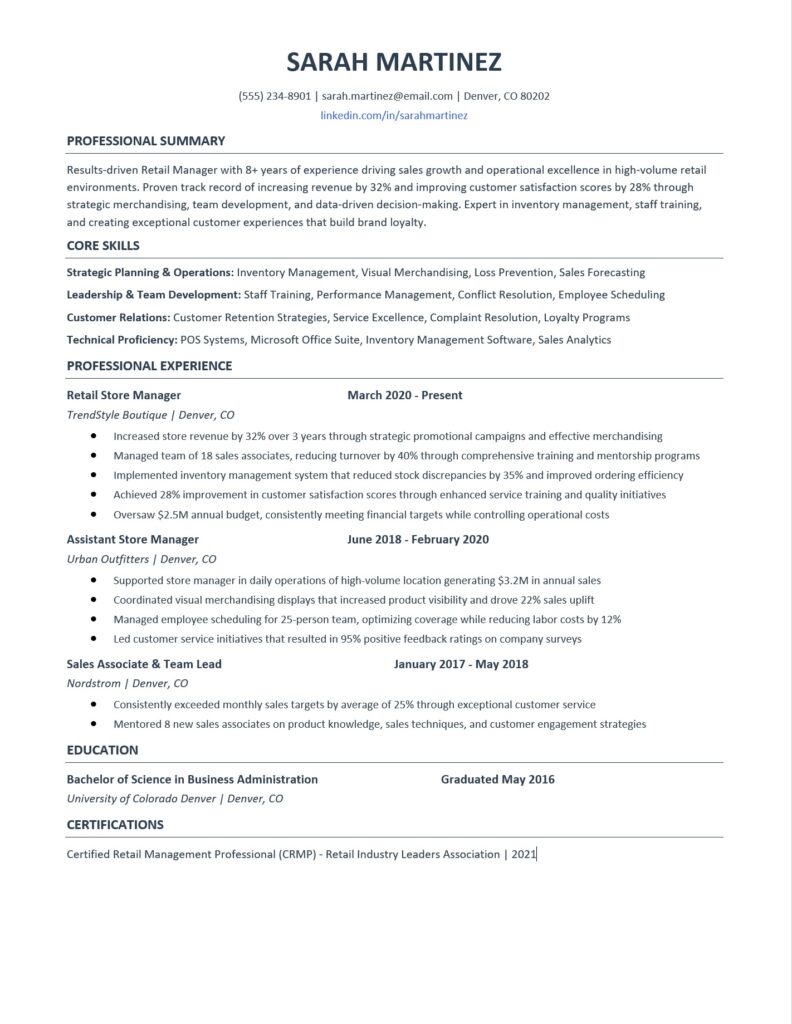
Here’s a professional retail manager resume template you can download and customize. This template is designed to be both visually appealing and ATS-friendly, with clean formatting that highlights your strengths.
Blank Customizable Template
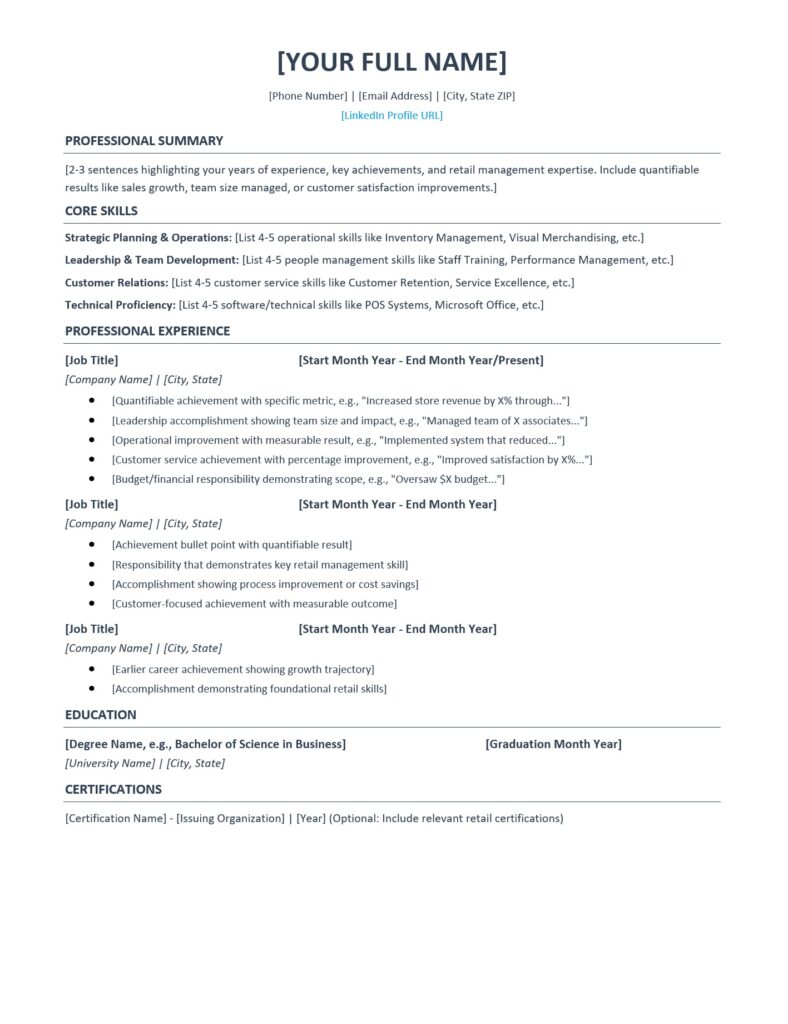
Download Your Free Template:
- Download DOCX Template (fully editable in Microsoft Word)
Interview Guys Tip: The DOCX template is fully editable, allowing you to adjust fonts, colors, and spacing to match your personal brand while maintaining professional formatting. Just replace the placeholder text with your own information.
Here’s what most people don’t realize: employers now expect multiple technical competencies, not just one specialization. The days of being “just a marketer” or “just an analyst” are over. You need AI skills, project management, data literacy, and more. Building that skill stack one $49 course at a time is expensive and slow. That’s why unlimited access makes sense:
Your Resume Needs Multiple Certificates. Here’s How to Get Them All…
We recommend Coursera Plus because it gives you unlimited access to 7,000+ courses and certificates from Google, IBM, Meta, and top universities. Build AI, data, marketing, and management skills for one annual fee. Free trial to start, and you can complete multiple certificates while others finish one.
Essential Components of a Winning Retail Manager Resume
Your retail manager resume needs six core sections arranged strategically to capture attention and demonstrate your qualifications. Let’s break down each component and explore what makes it effective.
Professional Summary: Your 30-Second Pitch
This 3-4 sentence paragraph at the top of your resume is your elevator pitch. It needs to immediately communicate your years of experience, your biggest achievements, and the value you bring to a potential employer.
A strong professional summary includes specific numbers that demonstrate your impact. Instead of saying you’re a “dedicated retail professional with strong leadership skills,” show your results with statements like “increased store revenue by 32% while reducing employee turnover by 40%.”
Think of your professional summary as the preview that convinces hiring managers to keep reading. It should highlight your most impressive metrics and position you as someone who solves the exact problems they’re facing.
Core Skills: The ATS Gateway
Your skills section serves two critical purposes. First, it helps applicant tracking systems identify you as a qualified candidate by matching keywords from the job description. Second, it gives hiring managers a quick snapshot of your capabilities.
Organize your skills into four categories that align with retail management responsibilities: Strategic Planning & Operations, Leadership & Team Development, Customer Relations, and Technical Proficiency. This structure makes it easy for readers to scan your qualifications quickly.
According to research on retail management requirements, 86% of customers will pay more for a great experience, making your customer service and team development skills absolutely critical. Make sure these competencies are prominently featured in your skills section.
Don’t just list generic skills like “communication” or “teamwork.” Get specific with terms like “staff scheduling optimization,” “visual merchandising strategy,” “POS system management,” and “loss prevention protocols.” These detailed skill descriptions resonate better with both ATS systems and human readers.
Professional Experience: Where You Prove Your Worth
This is the heart of your resume. Each job entry needs four elements: your title, the company and location, your employment dates, and 4-6 bullet points highlighting your achievements.
Start each bullet point with a strong action verb and follow it with quantifiable results. Instead of “Responsible for managing a team,” write “Managed team of 18 sales associates, reducing turnover by 40% through comprehensive training programs.”
Your bullet points should answer three questions: What did you do? How did you do it? What was the measurable impact? This formula transforms generic responsibility statements into compelling evidence of your capabilities. For example, check out our guide on how to write a resume summary for more tips on crafting powerful achievement statements.
When describing your experience, focus on the areas that matter most in retail: sales growth, team performance, inventory management, customer satisfaction, and operational efficiency. These are the metrics that keep retail executives awake at night, and you’re showing them you can move the needle in their favor.
Interview Guys Tip: Many retail professionals make the mistake of only highlighting positive customer interactions. While these are important, hiring managers care more about how you handle difficult situations. Include achievements like “Resolved 95% of customer complaints at first point of contact, preventing escalations and maintaining positive online reviews.”
Education: Positioning Your Academic Background
While a bachelor’s degree isn’t always required for retail management positions, having one can give you a competitive advantage, especially for larger retailers or corporate roles. Place your education section after your professional experience unless you’re a recent graduate.
Include your degree, the institution name, location, and graduation year. If you majored in business administration, marketing, or retail management, these credentials add credibility to your application. According to employment data, many successful retail managers have diverse educational backgrounds, proving that practical experience often matters more than formal education.
If you’ve completed any retail-specific training programs or continuing education courses, include them here as well. Certifications from professional organizations demonstrate your commitment to staying current with industry best practices.
Certifications: Professional Development That Sets You Apart
Retail management certifications can differentiate you from other candidates, especially when competition is fierce. The Certified Retail Management Professional (CRMP) credential from the Retail Industry Leaders Association is particularly valuable and recognized across the industry.
Other relevant certifications might include loss prevention credentials, customer service excellence certifications, or specialized training in visual merchandising. These additions show that you’re invested in professional growth and understand the evolving nature of retail management.
Don’t have any certifications yet? That’s okay. This section is optional, but it’s worth considering for your professional development plan after you land your next role.
How to Write Each Resume Section for Maximum Impact
Let’s get tactical about how to craft each section of your retail manager resume to maximize your chances of landing interviews.
Crafting Your Professional Summary
Your professional summary should be the last section you write, even though it appears first on your resume. Why? Because you need to review all your experience first to identify your most compelling achievements.
Use this three-part formula: Start with your title and years of experience, follow with your top 2-3 achievements with specific metrics, and close with your core expertise areas. For example: “Results-driven Retail Manager with 8+ years of experience increasing revenue by 32% and improving customer satisfaction by 28% through strategic merchandising and team development. Expert in inventory management, staff training, and data-driven decision-making.”
Keep your summary between 3-4 sentences or roughly 50-75 words. Any longer and you risk losing the reader’s attention. Any shorter and you haven’t provided enough substance to generate interest.
Building a Keyword-Rich Skills Section
Start by analyzing job descriptions for retail manager positions you’re interested in. Identify the skills mentioned most frequently, then match them against your own capabilities. These become the foundation of your skills section.
Remember that ATS systems scan for specific keywords, so you need to include the exact phrasing used in job postings. If they say “inventory control,” don’t substitute “stock management.” If they mention “POS systems,” include that exact term rather than just “point-of-sale experience.”
Balance is crucial. You need both hard skills (technical abilities like software proficiency and inventory management) and soft skills (interpersonal competencies like conflict resolution and motivational leadership). The most effective retail managers excel at both.
Optimizing Your Professional Experience Bullets
Each bullet point in your experience section should follow the CAR method: Challenge, Action, Result. What problem did you face? What specific actions did you take? What measurable outcome did you achieve?
For example: “Faced declining sales during off-season (Challenge), implemented targeted promotional campaigns and optimized product placement (Action), resulting in 22% sales increase during traditionally slow quarter (Result).”
Always quantify your achievements when possible. Percentages, dollar amounts, team sizes, time savings, and customer satisfaction scores all make your accomplishments more concrete and credible. When you’re preparing for the interview stage, make sure you’re ready to discuss these achievements using the SOAR Method we teach for behavioral questions.
Presenting Your Education and Certifications
List your education in reverse chronological order, starting with your highest degree. If you have a bachelor’s degree or higher, you can omit your high school information to save space.
For certifications, include the full name of the credential, the issuing organization, and the year you earned it. If your certification requires renewal or continuing education, mention when it expires to show it’s current and valid.
If you’re working toward a certification but haven’t completed it yet, you can include it as “In Progress” with an expected completion date. This shows initiative and commitment to professional development.
Common Mistakes to Avoid in Your Retail Manager Resume
Even experienced retail professionals make critical resume mistakes that cost them interviews. Here are the pitfalls to avoid.
Listing Responsibilities Instead of Achievements
The biggest mistake retail managers make is describing what they were supposed to do rather than what they actually accomplished. Your resume shouldn’t read like a job description. It should read like a highlight reel of your greatest hits.
Instead of “Managed store inventory,” write “Optimized inventory management system, reducing stock discrepancies by 35% and preventing $50,000 in annual shrinkage.” The difference is transformative.
Neglecting Leadership Metrics
As a retail manager, your ability to lead and develop people is one of your most valuable assets. Yet many resumes fail to quantify leadership impact with metrics like team size, turnover rates, training completion, or performance improvements.
Always include the size of teams you’ve managed. “Led team of 18 sales associates” is more impressive than just “Led sales team.” Similarly, show how your leadership made a difference with statements like “Reduced employee turnover by 40% through implementation of mentorship program and recognition initiatives.”
Using Generic Language
Words like “responsible for,” “tasked with,” and “duties included” are resume killers. They’re passive, boring, and they don’t demonstrate impact. Replace them with powerful action verbs like “spearheaded,” “implemented,” “optimized,” “increased,” “developed,” and “transformed.”
Your language should be active and confident. You didn’t just “help improve sales,” you “drove 32% sales increase through strategic promotional campaigns and team performance initiatives.”
Ignoring Visual Presentation
A cluttered, difficult-to-read resume gets rejected within seconds. Use consistent formatting, clear section headers, adequate white space, and a professional font like Calibri or Arial. Your resume should be visually appealing and easy to scan.
Avoid fancy graphics, unusual fonts, or elaborate designs that can confuse ATS systems. Keep your formatting simple and professional. If you need inspiration for clean, effective layouts, explore more options in our comprehensive resume formatting guide.
Interview Guys Tip: One-page resumes are ideal for retail managers with less than 10 years of experience. Two pages are acceptable for senior-level managers with extensive accomplishments, but every line must earn its place on your resume. If it doesn’t showcase your value, cut it.
ATS Optimization and Keywords for Retail Managers
Understanding how applicant tracking systems work is essential in 2025, as most retailers use these systems to filter candidates before human review.
How ATS Systems Screen Retail Resumes
ATS software scans your resume for specific keywords and phrases that match the job description. It looks at your work experience, skills section, and even your professional summary to determine if you’re qualified for the role.
The system assigns your resume a score based on keyword matches and relevance. Only the highest-scoring resumes make it to human recruiters. This means your resume needs to be written for both robots and people, striking a balance between keyword optimization and readability.
To pass ATS screening, use standard section headings like “Professional Experience,” “Education,” and “Skills” rather than creative alternatives like “Career Journey” or “Academic Background.” ATS systems are programmed to recognize conventional resume structure.
Essential Keywords for Retail Manager Resumes
Based on analysis of retail manager job postings, certain keywords appear consistently. Include terms like “inventory management,” “team leadership,” “sales forecasting,” “visual merchandising,” “loss prevention,” “customer retention,” “POS systems,” “performance management,” “budget planning,” and “staff scheduling.”
Industry-specific software names are also important. Mention any retail management platforms you’ve used like Lightspeed, Vend, Square, or Shopify. List specific POS systems you’re familiar with, as well as scheduling software, inventory management tools, and customer relationship management (CRM) platforms.
Don’t keyword stuff your resume with terms you don’t actually possess. ATS systems are becoming more sophisticated at detecting unnatural keyword usage, and you’ll need to back up your claims in interviews anyway.
Formatting for ATS Compatibility
Use a simple, clean format without tables, text boxes, headers, footers, or columns. These design elements can confuse ATS systems and cause them to misread your information. Stick with standard bullet points and clear section breaks.
Save your resume as a .docx file rather than a PDF when submitting online, unless the application specifically requests a PDF. Some older ATS systems struggle to parse PDF files accurately, potentially causing your information to be misinterpreted.
Interview Guys Tip: Before you submit another application, run your resume through an ATS scanner. Most job seekers skip this step and wonder why they never hear back. Check out the free ATS checker we use and recommend →
Tailoring Your Resume for Different Retail Environments
Not all retail management positions are identical. Your resume should reflect the specific environment you’re targeting.
Big-Box Retail vs. Specialty Boutique
Large retailers like Target or Walmart look for candidates who can manage large teams, handle high-volume transactions, and navigate corporate hierarchies. Emphasize your experience with systems, processes, and large-scale operations.
Specialty boutiques value product knowledge, personalized customer service, and brand building. Highlight your ability to create intimate customer relationships, curate merchandise selections, and develop local marketing strategies. When you’re ready to apply, make sure you’re also prepared with our guide on retail manager interview questions.
Fast Fashion vs. Luxury Retail
Fast fashion retailers prioritize quick inventory turnover, trend awareness, and rapid decision-making. Showcase your ability to move product quickly, respond to trends, and maintain fast-paced operations.
Luxury retail demands different competencies: exceptional customer service, product expertise, relationship building, and attention to detail. Demonstrate your experience creating elevated shopping experiences and building long-term customer loyalty.
E-Commerce Integration
In 2025, most retail managers need omnichannel experience. Highlight any experience you have with buy-online-pickup-in-store (BOPIS), online order fulfillment, social media marketing, or integrating digital and physical retail experiences.
Mention specific e-commerce platforms, inventory systems that sync online and offline stock, and any experience managing both digital and physical customer touchpoints. This versatility makes you more valuable to modern retailers.
Frequently Asked Questions
What’s the ideal length for a retail manager resume?
One page is ideal for managers with less than 10 years of experience. Two pages are acceptable for senior-level managers with extensive accomplishments, but make sure every word counts. Focus on your most recent and relevant experience, as hiring managers care most about what you’ve done in the last 5-7 years.
Should I include my photo on my retail manager resume?
In the United States, it’s generally better to exclude photos from your resume to avoid potential bias in the hiring process. Focus instead on your achievements and qualifications. However, if you’re applying internationally, check local customs as some countries expect photos on resumes.
How do I address employment gaps on my retail manager resume?
Be honest about gaps but frame them positively. If you took time off for family responsibilities, education, or health reasons, you can briefly mention this in your cover letter or be prepared to discuss it in interviews. Focus on any skills development, volunteer work, or projects you completed during the gap. For more strategies, check our article on career gap strategies.
What if I’m transitioning from another industry to retail management?
Focus on transferable skills like team leadership, customer service, budget management, and operational efficiency. Use your professional summary to position yourself as someone bringing valuable outside perspective to retail. Highlight any retail experience you have, even if it was earlier in your career, and emphasize your understanding of customer-focused business models.
How often should I update my retail manager resume?
Update your resume at least every six months, even if you’re not actively job searching. Add new achievements, completed certifications, and expanded responsibilities as they occur. This makes it easier to apply for unexpected opportunities and keeps your accomplishments fresh in your mind. For more resume tips, explore our guide on how to update your resume for 2025.
Take Action and Land Your Next Retail Manager Role
You now have everything you need to create a compelling retail manager resume that captures attention, passes ATS screening, and demonstrates your value to potential employers. Download your free template, customize it with your unique achievements, and start applying for roles that align with your career goals.
Remember, your resume is a living document that should evolve as your career progresses. Keep it updated with new accomplishments, refine your language to match current job market trends, and continuously optimize it based on the types of positions you’re pursuing.
Ready to explore more professional resume templates for different career paths? Browse our complete collection of free resume templates to find formats that match your experience level and industry focus.
Your next retail management opportunity is waiting. With a polished, professional resume that showcases your leadership, operational expertise, and results-driven approach, you’re positioned to stand out from the competition and secure the interviews that lead to offers.
Here’s what most people don’t realize: employers now expect multiple technical competencies, not just one specialization. The days of being “just a marketer” or “just an analyst” are over. You need AI skills, project management, data literacy, and more. Building that skill stack one $49 course at a time is expensive and slow. That’s why unlimited access makes sense:
Your Resume Needs Multiple Certificates. Here’s How to Get Them All…
We recommend Coursera Plus because it gives you unlimited access to 7,000+ courses and certificates from Google, IBM, Meta, and top universities. Build AI, data, marketing, and management skills for one annual fee. Free trial to start, and you can complete multiple certificates while others finish one.

BY THE INTERVIEW GUYS (JEFF GILLIS & MIKE SIMPSON)
Mike Simpson: The authoritative voice on job interviews and careers, providing practical advice to job seekers around the world for over 12 years.
Jeff Gillis: The technical expert behind The Interview Guys, developing innovative tools and conducting deep research on hiring trends and the job market as a whole.