
Free Restaurant Server Resume Template 2025: ATS Examples & Writing Guide
Landing a restaurant server position in 2025’s competitive market means standing out from hundreds of other applicants. With the restaurant industry projected to employ 15.9 million people by the end of 2025 and adding 200,000 new jobs, there’s opportunity everywhere. But here’s the challenge: how do you make your resume shine when everyone’s competing for the same roles?
The answer lies in having a resume that speaks the language hiring managers want to hear. Not generic descriptions of your duties, but specific achievements that prove you can increase sales, deliver exceptional service, and handle the fast-paced environment that defines restaurant work.
By the end of this article, you’ll have access to professional, ATS-optimized resume templates designed specifically for restaurant servers, plus the insider knowledge to customize them for your unique experience level and target restaurant type.
☑️ Key Takeaways
- Restaurant servers need ATS-optimized resumes that highlight customer service skills, POS system proficiency, and quantifiable achievements like increased sales or satisfaction ratings
- The ideal server resume structure places Professional Summary first, followed by Core Skills, Professional Experience, Education, and Certifications to match hiring manager priorities
- Quantifying your impact matters – servers who include metrics like “served 60+ customers per shift” or “increased check averages by 18%” stand out to employers
- ServSafe certification is your competitive edge – over 77% of restaurant operators cite recruiting challenges, making certified candidates significantly more attractive
What Makes a Restaurant Server Resume Different?
Restaurant server resumes have unique requirements that set them apart from other hospitality positions. The hiring manager reviewing your application isn’t looking for lengthy paragraphs or academic achievements. They’re scanning for proof you can handle customers, manage multiple tables, and contribute to the restaurant’s bottom line.
The most effective server resumes lead with a Professional Summary that immediately communicates your value. This isn’t a career objective about what you want; it’s a results-focused snapshot of what you bring to the table. Think metrics like “95% customer satisfaction rating” or “increased average check size by 18%.”
Next comes your Core Skills section. This is where ATS optimization becomes critical. According to industry data, the most in-demand server skills include customer service, menu knowledge, POS systems, multitasking, and cash handling. Your skills section should mirror the language used in the job description you’re targeting.
Interview Guys Tip: Restaurant managers spend an average of 6 seconds on initial resume reviews. Your Professional Summary and Core Skills sections need to immediately prove you have what they’re looking for, or your resume goes in the “no” pile before they even reach your work history.
Restaurant Server Resume Example
Here’s a professional restaurant server resume example. This example gives you an idea of what type of content fits in a good ATS friendly resume.
Example Resume:

Here’s a professional restaurant server resume template you can download and customize. This template is designed to be both visually appealing and ATS-friendly, with clean formatting that highlights your strengths.
Blank Customizable Template
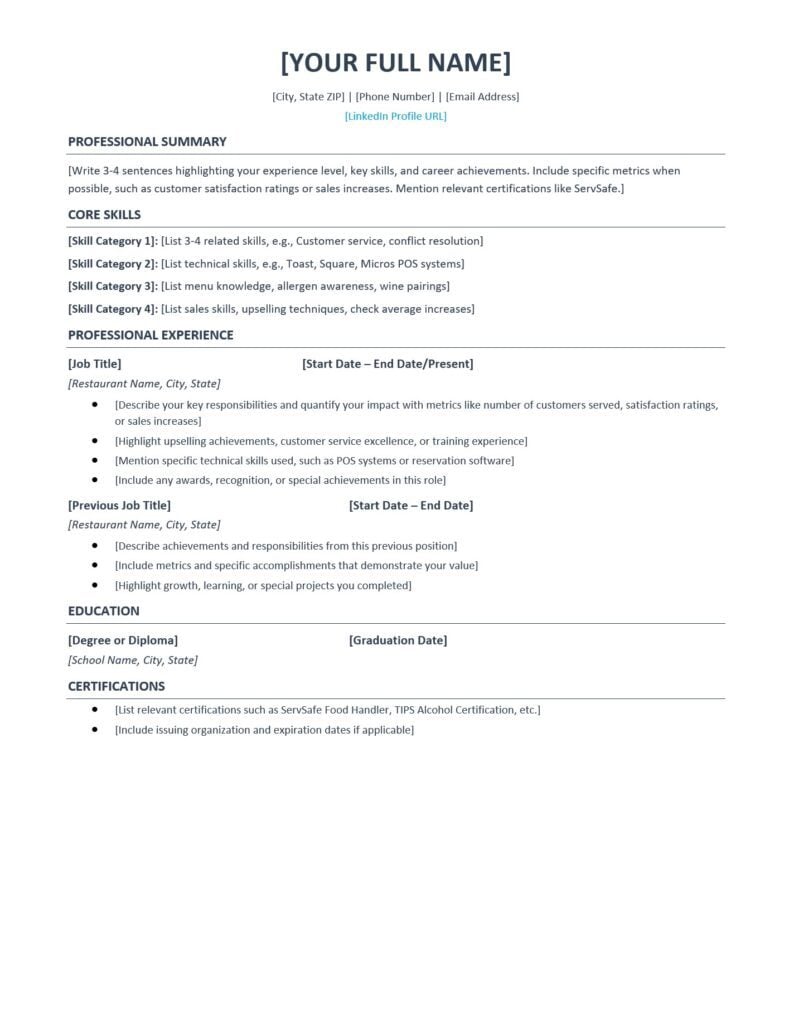
Download Your Free Template:
- Download DOCX Template (fully editable in Microsoft Word)
Interview Guys Tip: The DOCX template is fully editable, allowing you to adjust fonts, colors, and spacing to match your personal brand while maintaining professional formatting. Just replace the placeholder text with your own information.
Here’s what most people don’t realize: employers now expect multiple technical competencies, not just one specialization. The days of being “just a marketer” or “just an analyst” are over. You need AI skills, project management, data literacy, and more. Building that skill stack one $49 course at a time is expensive and slow. That’s why unlimited access makes sense:
Your Resume Needs Multiple Certificates. Here’s How to Get Them All…
We recommend Coursera Plus because it gives you unlimited access to 7,000+ courses and certificates from Google, IBM, Meta, and top universities. Build AI, data, marketing, and management skills for one annual fee. Free trial to start, and you can complete multiple certificates while others finish one.
Essential Components Every Server Resume Needs
Professional Summary: Your 6-Second Elevator Pitch
Your Professional Summary should be 3-4 sentences that pack maximum punch. Start with your experience level and primary role, then highlight 2-3 quantifiable achievements, and close with relevant certifications.
Example: “Energetic and customer-focused Restaurant Server with 4+ years of experience in fast-paced dining environments. Proven track record of delivering exceptional service, increasing table turnover by 20%, and maintaining a 95% customer satisfaction rating. Skilled in menu knowledge, POS systems, and upselling techniques. ServSafe certified with expertise in food safety protocols.”
Notice the specifics? “4+ years” is better than “experienced.” “Increasing table turnover by 20%” beats “improved efficiency.” Numbers matter because they prove impact.
Core Skills: The ATS Gateway
The Core Skills section serves two masters: applicant tracking systems and human hiring managers. Format this section using category-based groupings rather than a simple list. This approach shows depth while maintaining scannability.
Group your skills into 4 categories: Customer Service Excellence (building rapport, handling complaints), Technical Proficiency (POS systems like Toast, Square, or Micros), Menu Expertise (allergen awareness, wine pairings, dietary restrictions), and Sales & Upselling (suggestive selling, increasing check averages).
Research shows that servers with POS system proficiency listed prominently on their resumes are contacted by employers 40% more frequently than those without this skill mentioned.
Professional Experience: Show, Don’t Tell
This is where most server resumes fall flat. Listing job duties like “took orders and served food” tells the hiring manager nothing they don’t already know about the job. Every bullet point should demonstrate impact.
Use the formula: Action Verb + Task + Result. For example:
- “Served an average of 60+ customers per shift in a high-volume casual dining restaurant with a 150-seat capacity”
- “Increased average check size by 18% through effective upselling of appetizers, premium entrees, and desserts”
- “Maintained 95% customer satisfaction rating based on monthly feedback surveys and online reviews”
Start each bullet with strong action verbs: served, increased, maintained, trained, processed, coordinated. Then quantify everything possible. How many customers? What percentage increase? How many new staff members trained?
Interview Guys Tip: If you’re struggling to quantify your achievements, think about capacity (tables served per shift), speed (table turnover rate), quality (customer satisfaction scores or compliments received), financial impact (upselling success or average check increases), and team contributions (training or mentoring).
Education and Certifications: Industry Credentials Matter
While formal education requirements for servers are typically minimal, including your education section provides context and completeness. List your highest level of education with the institution name and graduation date.
More importantly, the Certifications section can be your differentiator. According to restaurant industry statistics, 51% of restaurant operators consider staffing their main challenge, and 35% cite training as a primary concern. Having relevant certifications signals you’ll require less training time.
Essential certifications include:
- ServSafe Food Handler Certification (National Restaurant Association)
- TIPS (Training for Intervention Procedures) Alcohol Certification
- CPR/First Aid Certification
- State-specific alcohol service permits
These credentials show professionalism and demonstrate your commitment to food safety and responsible service, which directly impacts a restaurant’s liability and reputation.
How to Write Each Section for Maximum Impact
Crafting Your Professional Summary
Start by identifying your key selling points. What makes you different from the 100 other applicants? Maybe you’ve consistently maintained high customer satisfaction scores. Perhaps you’ve trained multiple new staff members. Or you might have specialized knowledge in wine service or fine dining protocols.
Your summary should answer three questions in order: Who are you professionally? What have you achieved? What specialized knowledge or certifications do you bring?
For entry-level servers, shift the focus to transferable skills and enthusiasm: “Energetic hospitality professional with 2 years of customer service experience in retail and food service. Known for building rapport with diverse customers and maintaining composure in fast-paced environments. Recently completed ServSafe Food Handler certification.”
Building Your Core Skills Section
Review 5-10 job postings for your target restaurant type (fine dining, casual, fast food) and note the skills mentioned most frequently. Common patterns include customer service, POS systems, menu knowledge, multitasking, cash handling, and upselling.
Organize these into logical categories. Under each category name (bolded), list 3-4 specific skills on the same line. This format is both ATS-friendly and visually scannable for human reviewers.
Avoid soft skills that everyone claims without evidence: “hard worker,” “team player,” or “good communicator.” Instead, demonstrate these qualities through your achievement bullets.
Writing Achievement-Focused Experience Bullets
The transformation from task-listing to achievement-showing is what separates average resumes from interview-winning ones. Let’s see the difference:
- Weak: “Took orders from customers and served food and drinks”
- Strong: “Served 60+ customers per shift with 99% order accuracy in a high-volume establishment”
- Weak: “Responsible for training new servers”
- Strong: “Trained and mentored 8 new servers on menu knowledge, POS systems, and customer service standards”
Notice how the strong versions include specific numbers and demonstrate the impact or quality of the work performed?
For each position, include 3-5 achievement bullets that cover different aspects: customer service excellence, sales/upselling success, operational efficiency, training or leadership, and any special recognition received.
Common Mistakes That Kill Server Resumes
Mistake 1: Generic Job Descriptions
Copying job duties from the restaurant’s server job description onto your resume is the fastest route to the rejection pile. Every hiring manager knows what servers do. They want to know how well you do it.
Mistake 2: Missing Quantification
“Increased sales” is vague. “Increased average check size by 18% through strategic upselling” is powerful. Always ask yourself: by how much, how many, or how often?
Mistake 3: Irrelevant Information
Your resume isn’t your life story. That summer you spent lifeguarding in 2015? Unless you’re applying to a waterfront restaurant, it’s taking up valuable space that should showcase relevant experience.
Keep your resume to one page. For servers, even with 10+ years of experience, one page is ideal. Focus on the most recent and relevant positions.
Mistake 4: Ignoring ATS Optimization
Over 75% of resumes never reach human eyes because they fail to pass through applicant tracking systems. ATS software scans for keywords that match the job description.
Solution: Mirror the language used in the job posting. If they say “Toast POS,” don’t write “point of sale systems.” If they mention “upselling,” use that exact word rather than “suggestive selling.”
Mistake 5: Unprofessional Email Addresses
PartyGirl123@email.com sends the wrong message. Use a simple firstname.lastname@email.com format. This seems obvious, but hiring managers report seeing inappropriate email addresses surprisingly often.
ATS Optimization and Keywords for Server Resumes
Applicant Tracking Systems are gatekeepers. Understanding how they work gives you a significant advantage. ATS software parses your resume, extracting information about your skills, experience, and qualifications, then ranks you against other applicants based on keyword matches with the job description.
Interview Guys Tip: Before you submit another application, run your resume through an ATS scanner. Most job seekers skip this step and wonder why they never hear back. Check out the free ATS checker we use and recommend →
Critical keywords for server resumes include:
- Technical skills: POS systems (Toast, Square, Micros, Aloha), reservation software (OpenTable, Resy), payment processing
- Service skills: customer service, guest relations, hospitality, front-of-house
- Operational terms: table management, order accuracy, food safety, cash handling
- Sales terminology: upselling, cross-selling, suggestive selling, menu recommendations
- Certifications: ServSafe, TIPS, food handler, alcohol service
To maximize your ATS score, create a customized version of your resume for each application. It sounds time-consuming, but the reality is spending 10 minutes tailoring your Core Skills and Professional Summary to mirror the job posting can double your interview callback rate.
Use the exact phrasing from the job description when possible. If they want someone “experienced with high-volume dining,” use those exact words rather than “busy restaurant.”
Interview Guys Tip: Save your resume as “FirstName_LastName_Server_Resume.docx” rather than generic names like “Resume.docx.” This makes you easier to find in a hiring manager’s downloaded files and shows attention to detail.
Tailoring Your Resume for Different Restaurant Types
Fast Casual and Quick Service
Emphasis: speed, efficiency, high-volume service, order accuracy. Highlight your ability to maintain quality during rush periods and your familiarity with quick-service workflows.
Key terms: fast-paced environment, high customer volume, order accuracy, speed of service, efficiency
Casual Dining
Emphasis: customer relationships, upselling, menu knowledge, family-friendly service. Showcase your ability to build rapport and enhance the dining experience.
Key terms: guest satisfaction, relationship building, suggestive selling, menu recommendations, family-friendly
Fine Dining
Emphasis: wine knowledge, formal service protocols, attention to detail, upscale clientele. Highlight any sommelier training, knowledge of fine dining interview protocols, or experience with tasting menus.
Key terms: wine service, formal dining, upscale service, sommelier, tasting menus, refined service
Frequently Asked Questions
How long should a restaurant server resume be?
One page, always. Even with extensive experience, hiring managers prefer concise, relevant information over lengthy documents. Focus on your most recent and impressive achievements.
Should I include high school on my resume if I have college experience?
Generally, no. Once you have college education or significant work experience, high school education becomes less relevant. The exception is if you graduated recently and have limited work history.
What if I don’t have any restaurant experience?
Focus on transferable skills from retail, customer service, or hospitality roles. Emphasize your ability to work in fast-paced environments, handle customer interactions, and manage multiple priorities. Any customer service experience is relevant.
Do I need to include references on my resume?
No. “References available upon request” is outdated and wastes space. Prepare a separate reference list to provide when specifically requested during the interview process.
Should I include a photo on my resume?
In the United States, no. Including photos can actually hurt your chances as many companies have policies against reviewing resumes with photos to prevent discrimination concerns. International applications may differ.
Ready to Land Your Next Server Position?
Creating a standout server resume isn’t about fancy formatting or clever tricks. It’s about clearly communicating your value through quantifiable achievements, relevant skills, and proper optimization for both ATS systems and human hiring managers.
The templates provided give you a professional foundation that’s been designed specifically for restaurant server positions in 2025. Download both the example and blank template, customize them with your specific experience and achievements, and you’ll have a resume that opens doors.
Remember: your resume’s job isn’t to get you hired. Its job is to get you the interview. Once you land that interview, check out our guide on common restaurant interview questions to prepare yourself to ace it.
Don’t stop with just your server resume. Browse our complete collection of free resume templates for other positions you might be targeting, including retail positions, customer service roles, and entry-level opportunities across various industries.
The restaurant industry is growing, opportunities are abundant, and with a professional, optimized resume in hand, you’re positioned to land the server role that fits your career goals. Download your templates, customize them authentically, and start applying with confidence.
Here’s what most people don’t realize: employers now expect multiple technical competencies, not just one specialization. The days of being “just a marketer” or “just an analyst” are over. You need AI skills, project management, data literacy, and more. Building that skill stack one $49 course at a time is expensive and slow. That’s why unlimited access makes sense:
Your Resume Needs Multiple Certificates. Here’s How to Get Them All…
We recommend Coursera Plus because it gives you unlimited access to 7,000+ courses and certificates from Google, IBM, Meta, and top universities. Build AI, data, marketing, and management skills for one annual fee. Free trial to start, and you can complete multiple certificates while others finish one.

BY THE INTERVIEW GUYS (JEFF GILLIS & MIKE SIMPSON)
Mike Simpson: The authoritative voice on job interviews and careers, providing practical advice to job seekers around the world for over 12 years.
Jeff Gillis: The technical expert behind The Interview Guys, developing innovative tools and conducting deep research on hiring trends and the job market as a whole.