
Free Registered Nurse (RN) Resume Template 2025: ATS Examples & Writing Guide
Landing a nursing job in 2025 requires more than clinical expertise and compassionate patient care. You’re competing against hundreds of other qualified nurses, and healthcare facilities use applicant tracking systems that screen out resumes before human recruiters ever see them.
The nursing shortage means there are plenty of opportunities out there. But with hospitals receiving hundreds of applications for every opening, your resume needs to work harder than ever before.
Here’s what makes this challenging: most nurses haven’t updated their resumes since nursing school. The resume that got you through your first job interview five years ago probably won’t cut it today. Healthcare facilities now use sophisticated screening software that automatically filters candidates based on keywords, formatting, and content structure.
By the end of this article, you’ll have access to free, professionally designed nursing resume templates and the exact strategies you need to showcase your clinical experience effectively. Whether you’re a new graduate or an experienced RN looking for your next opportunity, this guide will help you create a resume that gets interviews.
☑️ Key Takeaways
- ATS systems scan for specific keywords like “patient assessment” and “medication administration,” so matching job descriptions exactly is critical for getting past initial screening
- Quantified achievements outperform generic duties because hiring managers prioritize measurable patient outcomes over routine task lists
- Strategic section ordering matters with Contact Info, Professional Summary, Core Skills, and Experience appearing before Education and Licenses for optimal ATS parsing
- Healthcare facilities receive 250+ applications per position, making a professionally formatted, keyword-optimized resume essential for standing out
What Makes a Registered Nurse Resume Different?
Nursing resumes require a unique approach compared to typical job applications. You’re not just listing employment history. You’re demonstrating clinical competency, patient outcomes, and the ability to thrive in high-pressure healthcare environments.
Healthcare recruiters look for specific evidence that you can handle the demands of patient care. They want to see that you’ve worked with real patients in actual clinical settings, managed complex cases, and contributed to positive health outcomes.
Interview Guys Tip: According to research from the Bureau of Labor Statistics, more than 193,000 openings for registered nurses are projected each year through 2032. This sustained demand means qualified nurses with strong resumes have significant leverage in the job market.
Unlike corporate resumes that emphasize career progression and management experience, nursing resumes need to highlight hands-on clinical skills. Your resume should immediately communicate your nursing specialty, years of experience, and key clinical competencies.
The healthcare industry also has specific requirements for credentials and licensure. Your RN license, certifications like BLS and ACLS, and specialty training need prominent placement on your resume. These aren’t optional extras; they’re mandatory qualifications that ATS systems actively scan for.
RN Resume Example
Here’s a professional registered nurse resume example. This example gives you an idea of what type of content fits in a good ATS friendly resume.
Example Resume:

Here’s a professional RN resume template you can download and customize. This template is designed to be both visually appealing and ATS-friendly, with clean formatting that highlights your strengths.
Blank Customizable Template
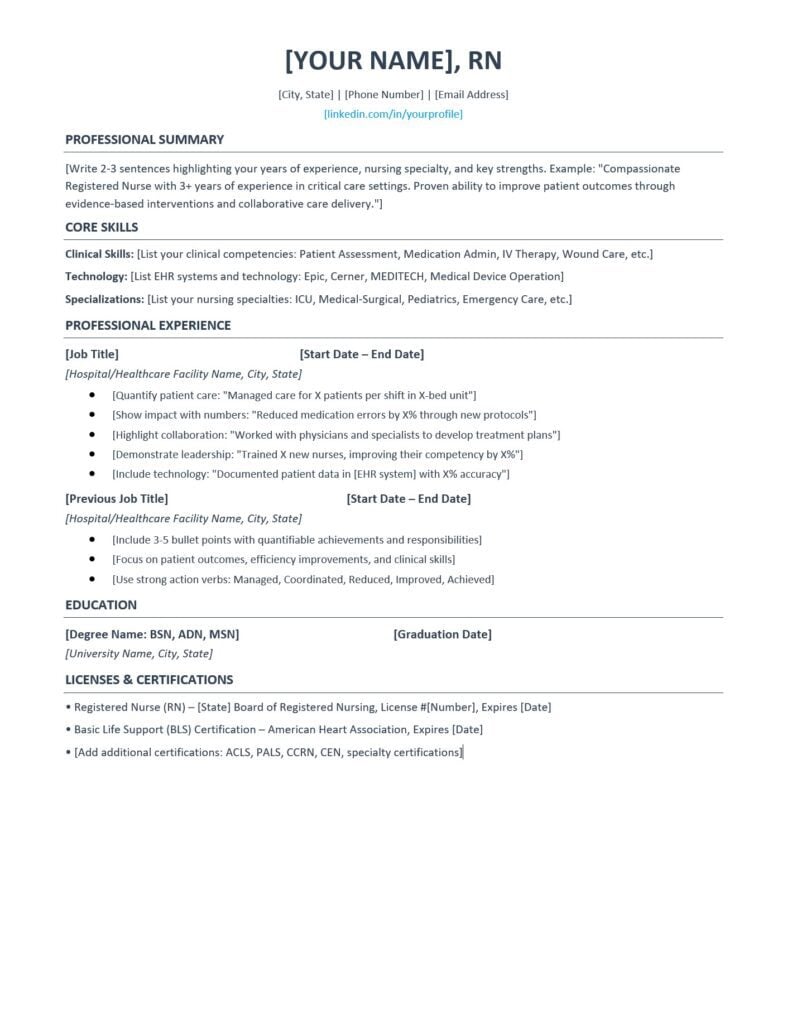
Download Your Free Template:
- Download DOCX Template (fully editable in Microsoft Word)
Interview Guys Tip: The DOCX template is fully editable, allowing you to adjust fonts, colors, and spacing to match your personal brand while maintaining professional formatting. Just replace the placeholder text with your own information.
Here’s what most people don’t realize: employers now expect multiple technical competencies, not just one specialization. The days of being “just a marketer” or “just an analyst” are over. You need AI skills, project management, data literacy, and more. Building that skill stack one $49 course at a time is expensive and slow. That’s why unlimited access makes sense:
Your Resume Needs Multiple Certificates. Here’s How to Get Them All…
We recommend Coursera Plus because it gives you unlimited access to 7,000+ courses and certificates from Google, IBM, Meta, and top universities. Build AI, data, marketing, and management skills for one annual fee. Free trial to start, and you can complete multiple certificates while others finish one.
Essential Components of a Registered Nurse Resume
A strong nursing resume follows a specific structure that both ATS systems and human recruiters expect. Here’s the optimal section order:
1. Contact Information
- Your name
- City and state (full address not required)
- Professional phone number
- Professional email address
- LinkedIn profile URL
2. Professional Summary
- 2-3 sentences highlighting experience and specialty
- Key clinical competencies
- Measurable achievements or unique qualifications
3. Core Skills
- Clinical skills (patient assessment, medication administration)
- Technology proficiency (EHR systems, medical devices)
- Nursing specializations (ICU, medical-surgical, pediatrics)
4. Professional Experience
- Job title, employer, location, dates
- 3-5 bullet points per position
- Quantifiable achievements and outcomes
5. Education
- Degree name and type (BSN, ADN, MSN)
- School name and location
- Graduation date
6. Licenses and Certifications
- RN license with state, number, and expiration
- BLS, ACLS, PALS certifications
- Specialty certifications relevant to your target role
How to Write Your Professional Summary
Your professional summary is prime real estate on your nursing resume. This brief section determines whether recruiters continue reading or move to the next candidate.
What Makes a Strong Professional Summary
Start with your professional title and years of experience. Then highlight your nursing specialty and 1-2 key strengths that align with the position you’re targeting.
- Strong Example: “Compassionate Registered Nurse with 5+ years of experience in acute care settings. Proven track record of improving patient outcomes through evidence-based interventions and collaborative care delivery.”
- Weak Example: “Dedicated nursing professional seeking a fulfilling position where I can utilize my skills and grow professionally.”
The difference? The first example shows specific experience and measurable impact. The second is generic and could apply to any nurse anywhere.
Interview Guys Tip: Match keywords from the job description in your professional summary. If the posting emphasizes “critical thinking skills” or “patient education,” incorporate those exact phrases naturally into your summary.
Crafting Powerful Experience Bullet Points
Your experience section needs to prove you can deliver results, not just perform duties. Healthcare recruiters can spot the difference between impressive achievements and routine task lists in seconds.
The Achievement Formula for Nursing Resumes
Every bullet point should follow this structure:
Action Verb + Specific Task + Quantifiable Result
Before and After Examples
Before (Weak):
- Responsible for patient care
- Worked with doctors and nurses
- Administered medications
After (Strong):
- Managed care for 6-8 patients per shift in 32-bed medical-surgical unit, maintaining 95% patient satisfaction scores
- Collaborated with 12-member interdisciplinary team to develop comprehensive treatment plans, reducing average length of stay by 1.2 days
- Administered medications with 99.8% accuracy rate, implementing double-check protocols that reduced unit medication errors by 23%
Focus on outcomes that matter to healthcare facilities:
- Reduced medication errors
- Improved patient satisfaction scores
- Decreased readmission rates
- Enhanced workflow efficiency
- Mentored new staff successfully
Include technology proficiency in your bullet points. According to a study from the Healthcare Information and Management Systems Society, 98% of hospitals now use electronic health records, making EHR experience essential. Mention specific systems like Epic, Cerner, or MEDITECH when describing your documentation practices.
For behavioral interview preparation after landing that interview, check out our guide on registered nurse interview questions to help you showcase these achievements in person.
Core Skills Section Strategy
The skills section of your nursing resume serves two critical functions. It helps ATS systems identify you as a qualified candidate, and it gives human recruiters a quick snapshot of your clinical competencies.
How to Organize Your Skills
Clinical Skills:
- Patient Assessment
- Medication Administration
- Wound Care
- IV Therapy
- Catheterization
- Phlebotomy
- Vital Signs Monitoring
Technology:
- Epic EMR
- Cerner
- MEDITECH
- Electronic Health Records (EHR)
- Medical Device Operation
- Telemetry Systems
Specializations:
- ICU/Critical Care
- Medical-Surgical Nursing
- Emergency Room
- Pediatric Care
- Post-Operative Care
- Patient Education
Match your skills to each job description you apply for. If a posting emphasizes “ventilator management” or “post-operative care,” those exact phrases should appear in your skills section if you have that experience.
Interview Guys Tip: Review job postings for your target positions and create a master list of the most frequently requested skills. Include the top 10-15 that match your experience on every application, then customize the remaining 5-10 based on each specific role.
Education and Credentials
The education section on nursing resumes requires specific formatting to meet healthcare industry standards. Follow the ANCC preferred order: Highest degree earned, Licensure, National Certification.
How to List Your Nursing Degree
List your nursing degree with the full name spelled out. Bachelor of Science in Nursing (BSN) works better for ATS systems than just “BSN.” Include your university name, location, and graduation date.
Example: Bachelor of Science in Nursing (BSN), Graduated May 2020 University of California, San Francisco, CA
For new graduates without extensive work experience, consider expanding this section with relevant coursework, clinical rotations, or academic honors. Experienced nurses can keep education brief since professional experience takes priority.
Formatting Your RN License
Your RN license deserves its own prominent placement:
Format: Registered Nurse (RN) – California Board of Registered Nursing, License #RN845623, Expires October 2026
Include the following elements:
- License type spelled out (Registered Nurse)
- Issuing state
- License number
- Expiration date
Certifications should be listed with their full names, issuing organizations, and expiration dates. BLS and ACLS are standard expectations. Specialty certifications like CCRN, CEN, or ONS-C demonstrate advanced expertise and can increase your earning potential significantly.
Common Mistakes That Cost Nurses Interviews
The Top 7 Resume Killers
1. Using Graphics, Tables, or Complex Formatting Healthcare facilities’ ATS systems can’t parse these elements correctly, causing qualified candidates to be automatically rejected. Stick to simple, clean formatting with standard fonts.
2. Including a Photo Photos on nursing resumes create bias concerns and increase rejection rates. Focus on your clinical qualifications instead of your appearance.
3. Generic, Mass-Applied Resumes Recruiters can spot a template resume that hasn’t been customized. Take time to tailor each application to the target role.
4. Failing to Quantify Achievements “Provided patient care” tells them nothing. “Managed care for 15+ surgical patients daily with 98% satisfaction scores” demonstrates measurable success.
5. Typos and Grammatical Errors These mistakes suggest carelessness, which raises red flags about your attention to detail in clinical settings.
6. Vague Job Duties “Responsible for various nursing tasks” doesn’t showcase your value. Specify what you accomplished and the results you achieved.
7. Outdated Information Remove expired certifications, outdated technology skills, and jobs from more than 15 years ago unless they’re highly relevant.
ATS Optimization and Keywords
Understanding how applicant tracking systems work is essential for getting your resume to human recruiters. These systems scan for specific keywords, parse your resume into a database, and rank candidates based on how well they match the job requirements.
Interview Guys Tip: Before you submit another application, run your resume through an ATS scanner. Most job seekers skip this step and wonder why they never hear back. Check out the free ATS checker we use and recommend →
ATS Best Practices for Nursing Resumes
Use Exact Phrases: If a posting says “medication administration,” use those exact words rather than “med admin” or “drug dispensing.” ATS systems look for precise matches.
Standard Section Headings: Stick with traditional headers:
- Professional Experience (not “Career Journey”)
- Education (not “Academic Background”)
- Skills (not “Core Competencies”)
- Licenses & Certifications (not “Credentials”)
File Format: Save your resume as a .docx file unless the application specifically requests PDF format. Word documents are universally compatible with ATS systems.
Single-Column Layouts: ATS systems read from left to right, top to bottom. Multi-column formats confuse the parsing software and may cause your information to be scrambled.
Keyword Placement: Place your most important keywords in multiple sections:
- Professional Summary
- Core Skills
- Experience bullet points
Tailoring Your Resume for Different Nursing Specialties
Each nursing specialty has unique requirements that should be reflected in your resume. ICU nurses need to emphasize critical thinking, ventilator management, and rapid response skills. Medical-surgical nurses should highlight patient education, care coordination, and managing diverse patient populations.
Specialty-Specific Keywords to Include
Emergency Room Nurses:
- Triage
- Trauma care
- Rapid assessment
- Emergency protocols
- High-pressure situations
- Life-saving interventions
ICU/Critical Care Nurses:
- Ventilator management
- Hemodynamic monitoring
- Critical thinking
- Advanced cardiac life support
- Multi-organ system failure
- Family crisis management
Pediatric Nurses:
- Family-centered care
- Developmental milestones
- Immunization protocols
- Pediatric assessment
- Parent education
- Child life coordination
Medical-Surgical Nurses:
- Care coordination
- Patient education
- Diverse patient populations
- Discharge planning
- Chronic disease management
- Post-operative monitoring
Research the specific competencies your target specialty values most. Include relevant keywords and demonstrate your experience through specific examples in your bullet points.
Frequently Asked Questions
How long should my nursing resume be?
One page for new graduates and nurses with less than 5 years of experience. Two pages maximum for experienced nurses with extensive clinical background. Healthcare recruiters typically spend only 7 seconds on initial resume screening, so conciseness matters.
Should I include my GPA on my nursing resume?
Only if you’re a recent graduate (within the last 2 years) and your GPA is 3.5 or higher. Experienced nurses should remove GPA and focus on clinical achievements instead.
How do I explain employment gaps on my nursing resume?
Address gaps briefly and positively. If you took time off for continuing education, family care, or health reasons, include a one-line explanation. Focus on any skills maintenance or professional development you pursued during the gap.
Do I need to list every certification I’ve ever earned?
No. Include current, relevant certifications that align with your target position. Expired certifications should be removed. Focus on certifications that demonstrate advanced clinical competency or specialty expertise.
Should I include references on my nursing resume?
No. References belong on a separate document. Use that valuable resume space for showcasing your clinical experience and qualifications instead. Have a prepared reference list ready to provide when requested.
Conclusion
Creating a standout nursing resume in 2025 requires strategic formatting, keyword optimization, and clear demonstration of your clinical impact. The nursing shortage means opportunities exist, but you still need a resume that successfully navigates ATS screening and impresses human recruiters.
Download our free registered nurse resume templates to give yourself a strong foundation. Customize the templates with your specific experience, quantify your achievements, and tailor each application to your target position.
Your clinical skills and compassionate patient care deserve to be showcased effectively. A well-crafted resume opens doors to interviews where you can truly demonstrate your value as a healthcare professional.
Ready to create resumes for other healthcare positions? Browse our complete collection of free resume templates designed for various careers and industries.
Now it’s time to put these strategies into action. Download the templates, customize them with your experience, and start applying to positions that match your career goals. Your next nursing opportunity is waiting.
Here’s what most people don’t realize: employers now expect multiple technical competencies, not just one specialization. The days of being “just a marketer” or “just an analyst” are over. You need AI skills, project management, data literacy, and more. Building that skill stack one $49 course at a time is expensive and slow. That’s why unlimited access makes sense:
Your Resume Needs Multiple Certificates. Here’s How to Get Them All…
We recommend Coursera Plus because it gives you unlimited access to 7,000+ courses and certificates from Google, IBM, Meta, and top universities. Build AI, data, marketing, and management skills for one annual fee. Free trial to start, and you can complete multiple certificates while others finish one.

BY THE INTERVIEW GUYS (JEFF GILLIS & MIKE SIMPSON)
Mike Simpson: The authoritative voice on job interviews and careers, providing practical advice to job seekers around the world for over 12 years.
Jeff Gillis: The technical expert behind The Interview Guys, developing innovative tools and conducting deep research on hiring trends and the job market as a whole.