
Project Engineer Resume Template: ATS Examples & Writing Guide [2025]
Landing a project engineering role requires more than technical expertise. You need a resume that speaks the language of hiring managers while navigating the applicant tracking systems (ATS) that filter 75% of applications before a human ever sees them.
Your resume is competing against hundreds of other candidates, many with similar degrees and certifications. The difference between getting an interview and getting passed over often comes down to how effectively you communicate your project wins, technical skills, and quantifiable results.
By the end of this article, you’ll have a complete understanding of what makes a winning project engineer resume, plus two downloadable templates you can customize immediately. We’ll walk you through every section, share insider tips from hiring managers, and show you exactly how to quantify your achievements in ways that get attention.
Let’s get your resume ready to land that interview.
☑️ Key Takeaways
- Project engineers earn an average of $94,000 per year, with experienced professionals commanding up to $136,000 in competitive markets like San Francisco and Seattle
- Quantify your achievements with project values and cost savings to demonstrate real impact and stand out from 77% of candidates who lack metrics
- ATS systems scan for technical skills like AutoCAD, Primavera P6, and MS Project, so include these keywords naturally throughout your resume
- The optimal section order for project engineering roles is: Professional Summary, Core Skills, Professional Experience, Education, then Certifications
What Makes a Project Engineer Resume Different?
Project engineer resumes require a unique balance between technical competency and project management prowess. You’re not just an engineer, and you’re not just a project manager. You’re the bridge between these two worlds.
Hiring managers look for candidates who can demonstrate both engineering expertise and the ability to coordinate complex projects from conception to completion. This means your resume needs to showcase technical skills like CAD software proficiency alongside soft skills like stakeholder communication and team leadership.
The most successful project engineer resumes focus heavily on quantifiable results. According to PayScale, project engineers oversee technical staff and ensure projects meet specifications, schedules, and budgets. Your resume should prove you can deliver on all three fronts.
Interview Guys Tip: The biggest mistake we see? Generic bullet points that could apply to any engineer. Instead of “Managed construction projects,” try “Led 8-person engineering team on $45M commercial project, delivering 3 weeks ahead of schedule and 15% under budget.”
Project Engineer Resume Example
Here’s a resume example. This example gives you an idea of what type of content fits in a good ATS friendly resume.
Example Resume:
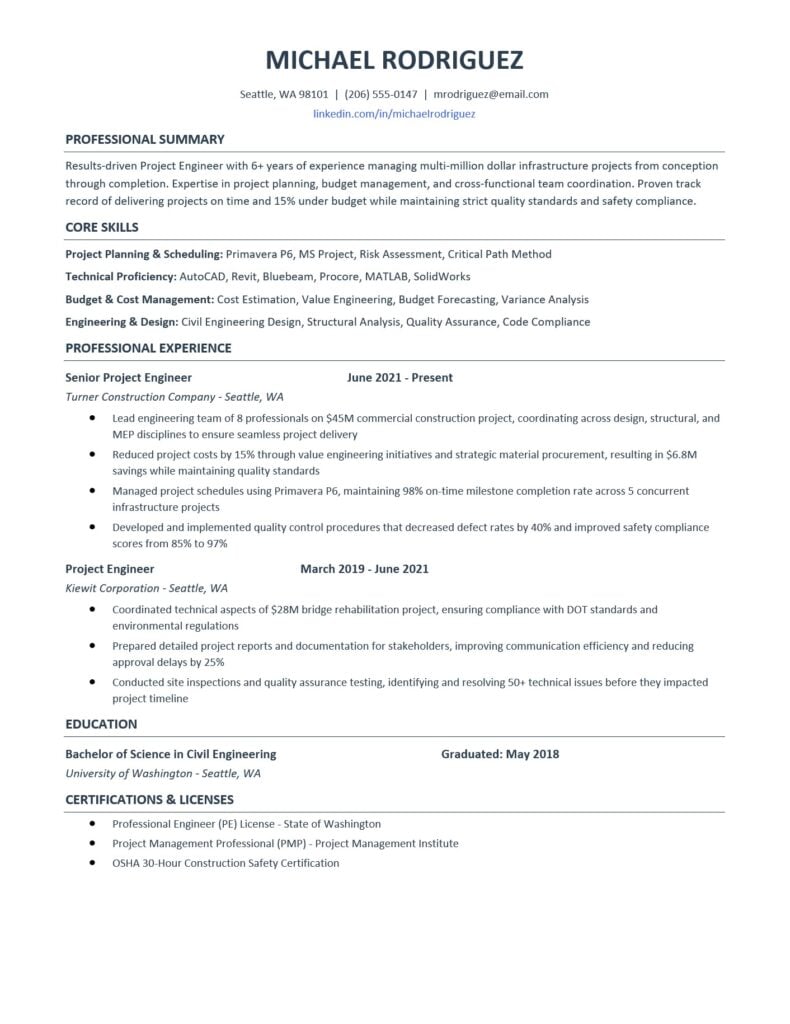
Here’s a professional retail resume template you can download and customize. This template is designed to be both visually appealing and ATS-friendly, with clean formatting that highlights your strengths.
Blank Customizable Template
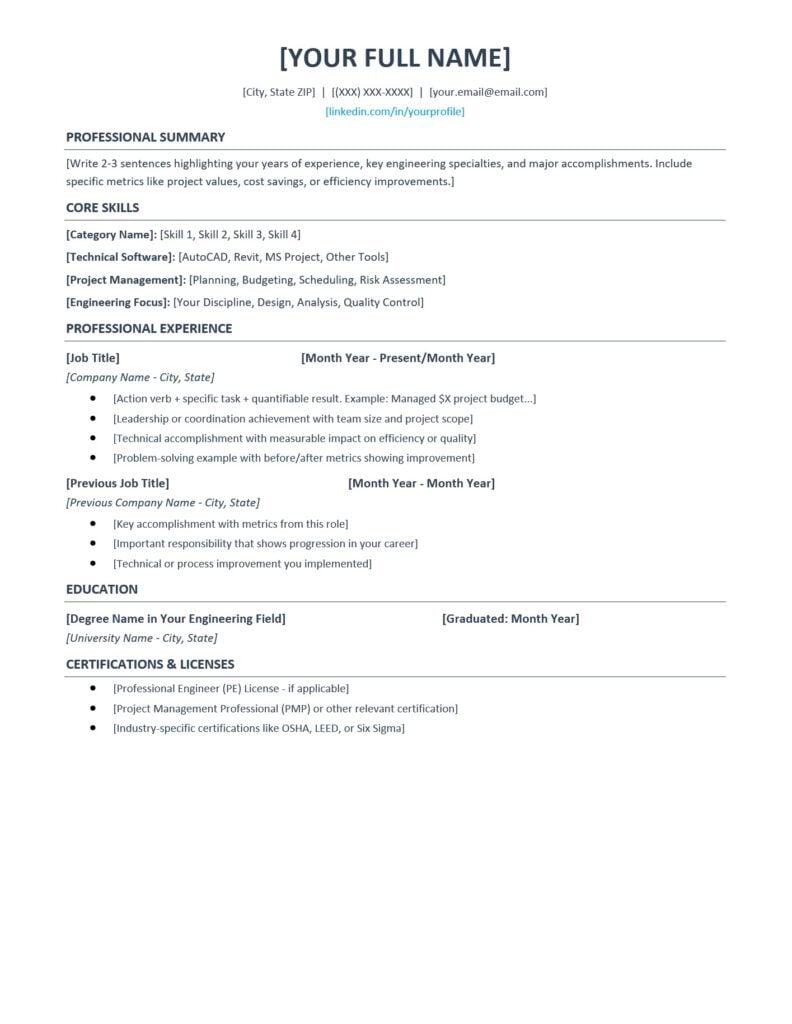
Download Your Free Template:
- Download DOCX Template (fully editable in Microsoft Word)
Interview Guys Tip: The DOCX template is fully editable, allowing you to adjust fonts, colors, and spacing to match your personal brand while maintaining professional formatting. Just replace the placeholder text with your own information.
Here’s what most people don’t realize: employers now expect multiple technical competencies, not just one specialization. The days of being “just a marketer” or “just an analyst” are over. You need AI skills, project management, data literacy, and more. Building that skill stack one $49 course at a time is expensive and slow. That’s why unlimited access makes sense:
Your Resume Needs Multiple Certificates. Here’s How to Get Them All…
We recommend Coursera Plus because it gives you unlimited access to 7,000+ courses and certificates from Google, IBM, Meta, and top universities. Build AI, data, marketing, and management skills for one annual fee. Free trial to start, and you can complete multiple certificates while others finish one.
Essential Components Every Project Engineer Resume Needs
Your project engineer resume should include these sections in this specific order for maximum impact with both ATS systems and human reviewers.
Professional Summary: Your 30-Second Pitch
This 2-3 sentence section sits at the top of your resume and answers one question: why should they keep reading? It’s your elevator pitch in written form.
Include your years of experience, engineering specialty, and 1-2 impressive accomplishments with numbers. Something like “Results-driven Project Engineer with 6+ years managing multi-million dollar infrastructure projects” immediately establishes credibility.
Skip vague language like “hard worker” or “team player.” These phrases waste precious resume real estate and don’t differentiate you from other candidates. Focus on what’s unique about your experience and what value you bring to their organization.
Core Skills: Your ATS Keyword Arsenal
The skills section serves two masters. First, it helps ATS systems match your resume to the job description. Second, it gives hiring managers a quick snapshot of your technical capabilities.
Organize your skills into categories: Project Planning & Scheduling, Technical Proficiency, Budget & Cost Management, and Engineering & Design. Under each category, list specific tools, methodologies, and areas of expertise.
For project engineers, essential technical skills include AutoCAD, Revit, Primavera P6, MS Project, Bluebeam, and Procore. Don’t just list software names, though. If you have advanced proficiency in a particular tool, note it.
Professional Experience: Where You Prove Your Worth
This is where most candidates either shine or stumble. Your experience section needs to tell compelling stories about projects you’ve led, problems you’ve solved, and results you’ve delivered.
Each bullet point should follow the CAR formula: Challenge, Action, Result. What problem did you face? What did you do about it? What measurable outcome did you achieve?
Instead of “Responsible for project budgets,” write “Managed $28M project budget, implementing cost-tracking systems that identified $1.2M in potential overruns before they occurred, keeping project 8% under budget.”
See the difference? The second version quantifies your impact and shows you’re not just doing tasks, you’re driving results. When you prepare for your project engineer interview, these same achievement stories will become your behavioral interview responses.
Interview Guys Tip: If you struggle to quantify achievements, ask yourself: How much money was involved? How many people did you manage? What percentage did you improve? How much time did you save? Every project has numbers, you just need to dig them out.
How to Write Each Section for Maximum Impact
Crafting Your Professional Summary
Your professional summary should be the last thing you write, even though it appears first. Why? Because you need to know what your strongest accomplishments are before you can summarize them effectively.
Start with your title and years of experience, then immediately jump to your most impressive achievement. If you’ve managed projects worth millions of dollars, say so. If you’ve consistently delivered projects ahead of schedule, mention it.
According to Coursera, 77% of project engineers hold bachelor’s degrees, so your education alone won’t differentiate you. Your unique combination of technical expertise, project scale, and measurable results will.
Building a Skills Section That Passes ATS
ATS systems scan for keywords from the job description. This doesn’t mean you should keyword-stuff your resume with every possible skill. It means you should strategically include the skills you actually possess that match what they’re looking for.
Review 3-5 job postings for roles you want. Notice which skills appear repeatedly? Those are your must-have keywords. Common ones for project engineers include project planning, budget management, quality assurance, risk assessment, and specific software like AutoCAD and Primavera P6.
Organize these skills into logical categories. This makes your resume easier to scan for human readers while still capturing all the keywords ATS systems need to see.
Writing Achievement-Focused Experience Bullets
Generic responsibility lists kill resumes. “Managed projects” tells hiring managers nothing about your capabilities. Everyone who applies for the role has managed projects.
Transform responsibilities into achievements by adding context and results. Start each bullet with a strong action verb: led, developed, implemented, optimized, reduced, increased.
Then add the context: what kind of project, how large, in what industry. Finally, close with the measurable result. This formula works every time.
For example: “Developed quality control procedures for $15M hospital construction project, reducing defect rates by 40% and improving final inspection pass rate from 85% to 97%.”
That single bullet tells a complete story about your problem-solving abilities, attention to detail, and impact on project quality.
Education and Certifications: Proving Your Credentials
For project engineers, a bachelor’s degree in engineering is typically the baseline requirement. List your degree, institution, and graduation year. If your GPA was 3.5 or higher, you can include it, but it’s optional for experienced professionals.
Certifications carry significant weight in this field. A Professional Engineer (PE) license can open doors to senior positions and command higher salaries. The Project Management Professional (PMP) certification demonstrates your project management competency beyond technical skills.
Other valuable certifications include OSHA 30-Hour Construction Safety, LEED accreditation, and Six Sigma certifications. List these in a dedicated section below your education, using bullet points for easy scanning.
Common Mistakes Project Engineers Make on Resumes
The first major mistake? Writing a generic resume and using it for every application. Each job posting has unique requirements and keyword priorities. Tailor your resume for each application by emphasizing the skills and experiences most relevant to that specific role.
Another frequent error is burying your most impressive achievements. If you led a $50M project, that information should be prominent, not hidden in the middle of your third bullet point on page two.
Many candidates also fail to demonstrate progression. Your resume should show a clear career trajectory, with increasing responsibility, larger projects, and more complex challenges over time. If you’ve moved from Junior Project Engineer to Senior Project Engineer, your achievements should reflect that growth.
Check out our guide on common resume mistakes to avoid other pitfalls that cost candidates interviews.
ATS Optimization and Keywords for Project Engineers
Applicant tracking systems aren’t trying to reject qualified candidates. They’re designed to efficiently match resumes to job requirements based on keywords and formatting. Understanding how they work gives you a significant advantage.
First, use a clean, simple format. Fancy graphics, tables, and multiple columns confuse ATS systems. Stick to standard section headings: Professional Summary, Core Skills, Professional Experience, Education, Certifications.
Second, match your keywords to the job description. If they ask for “Primavera P6,” don’t assume “P6” will suffice. Use their exact phrasing. If they list “budget management,” include those specific words somewhere in your resume.
Third, include both acronyms and spelled-out versions of technical terms. Write “Project Management Professional (PMP)” rather than just “PMP.” This ensures the ATS catches it regardless of which version they’re searching for.
Interview Guys Tip: Don’t obsess over making your resume 100% ATS-optimized at the expense of human readability. Your resume needs to pass the ATS, but ultimately a person makes the hiring decision. Balance keyword optimization with compelling storytelling.
How to Showcase Technical Proficiency
Project engineers need to demonstrate mastery of industry-standard software and methodologies. But simply listing “proficient in AutoCAD” doesn’t prove anything.
Instead, weave technical skills into your achievement bullets. “Created detailed engineering drawings using AutoCAD for 12-story commercial building, coordinating with structural and MEP teams to identify and resolve 30+ design conflicts before construction.”
This approach accomplishes two things: it includes the keyword “AutoCAD” for ATS purposes, and it shows hiring managers how you actually use the software to solve real problems.
For project management tools like MS Project or Primavera P6, mention how you used them to achieve specific outcomes. “Developed project schedules in Primavera P6 for 5 concurrent projects, maintaining 98% on-time milestone completion across $120M in active construction.”
If you’re looking to strengthen your technical skills section, our article on skills to put on a resume provides additional strategies for highlighting competencies that matter.
Quantifying Your Project Achievements
Numbers transform vague claims into credible proof of your capabilities. Every project generates data, and hiring managers want to see evidence that you drive measurable results.
Consider these dimensions when quantifying achievements: project budgets, cost savings, schedule performance, team size, quality metrics, safety records, and client satisfaction.
If you managed a project budget, state the amount. If you saved money through value engineering, specify the savings. If you led a team, mention how many people. If you improved efficiency, quantify the percentage increase.
For example: “Led cross-functional team of 12 professionals on $35M infrastructure project, implementing lean construction principles that reduced waste by 25% and accelerated timeline by 3 weeks.”
Even soft skills benefit from quantification. Instead of “excellent communication skills,” try “facilitated weekly stakeholder meetings for 20+ project participants, improving decision-making speed and reducing approval delays by 30%.”
FAQ: Project Engineer Resume Questions
How long should a project engineer resume be?
For most project engineers, one page is ideal for early-career professionals with less than 5 years of experience. Two pages work well for experienced engineers with 5+ years and substantial accomplishments to showcase. Never exceed two pages unless you’re applying for an executive role or academic position.
Should I include projects from college on my resume?
If you’re a recent graduate or early-career professional, relevant academic projects can demonstrate technical skills and problem-solving abilities. However, as you gain professional experience, replace academic projects with real-world achievements. Professional experience always trumps coursework.
What’s the best format for a project engineer resume?
Use a reverse-chronological format that lists your most recent experience first. This format works best for project engineers because it clearly shows your career progression and recent accomplishments. Avoid functional or combination formats unless you’re making a significant career change.
How do I handle employment gaps on my project engineer resume?
Address gaps honestly in your cover letter rather than trying to hide them on your resume. If you took time for professional development, family responsibilities, or dealt with unexpected circumstances, a brief explanation demonstrates transparency. Many employers appreciate candidates who can navigate life’s challenges while maintaining their career trajectory.
Do I need to include references on my resume?
No. The phrase “references available upon request” is outdated and wastes space. Employers assume you have references and will ask for them when needed. Use that resume real estate for another achievement or skill instead.
Ready to Land Your Next Project Engineering Role
You now have the framework for a resume that showcases your technical expertise, project management skills, and quantifiable achievements. Remember, your resume isn’t a comprehensive career history. It’s a marketing document designed to earn you an interview.
Start by downloading our free templates and customizing them with your specific experience and accomplishments. Focus on the numbers that prove your impact. Make every bullet point count by demonstrating results, not just responsibilities.
And don’t forget, your resume is just the first step. Once you land that interview, you’ll need to transform these written achievements into compelling verbal stories. Check out our complete interview preparation guide to ensure you’re ready for every question they throw at you.
Want more resume templates for different roles and industries? Browse our free resume template library to find additional resources that fit your career goals.
Download your project engineer resume templates now and take the first step toward your next career opportunity. You’ve got the skills and experience. Now you have the tools to showcase them effectively.
Here’s what most people don’t realize: employers now expect multiple technical competencies, not just one specialization. The days of being “just a marketer” or “just an analyst” are over. You need AI skills, project management, data literacy, and more. Building that skill stack one $49 course at a time is expensive and slow. That’s why unlimited access makes sense:
Your Resume Needs Multiple Certificates. Here’s How to Get Them All…
We recommend Coursera Plus because it gives you unlimited access to 7,000+ courses and certificates from Google, IBM, Meta, and top universities. Build AI, data, marketing, and management skills for one annual fee. Free trial to start, and you can complete multiple certificates while others finish one.

BY THE INTERVIEW GUYS (JEFF GILLIS & MIKE SIMPSON)
Mike Simpson: The authoritative voice on job interviews and careers, providing practical advice to job seekers around the world for over 12 years.
Jeff Gillis: The technical expert behind The Interview Guys, developing innovative tools and conducting deep research on hiring trends and the job market as a whole.