
Free Lab Technician Resume Template: ATS Examples & Writing Guide [2025]
You’ve spent years perfecting your pipetting technique and can identify abnormal cells in your sleep. But when it comes to your resume, are you presenting your lab expertise in a way that actually gets you called for interviews?
Here’s the reality: hiring managers spend just six seconds scanning your resume before deciding whether to keep reading or move on to the next candidate. In those crucial moments, they’re looking for specific certifications, technical skills, and quantifiable achievements that prove you can handle the responsibilities of a lab technician role.
The good news? Creating a standout lab technician resume doesn’t require a chemistry degree to figure out. By the end of this article, you’ll know exactly what to include, how to structure your resume for maximum impact, and you’ll have access to downloadable templates that follow industry best practices.
According to the Bureau of Labor Statistics, there are approximately 22,600 job openings for clinical laboratory technicians projected each year through 2034. With the median annual wage at $61,890, this field offers solid earning potential and job stability. But landing these positions requires a resume that effectively showcases your technical competencies and laboratory experience.
☑️ Key Takeaways
- Lab technician resumes should prioritize certifications and technical skills to pass ATS screening and demonstrate specialized expertise
- Quantifying your laboratory achievements with specific metrics like accuracy rates and daily specimen volume makes your resume stand out
- The right section order matters for lab tech resumes: Summary, Core Skills, Experience, Education, and Certifications work best
- Both NAACLS-accredited education and ASCP certification are critical resume elements that hiring managers scan for immediately
What Makes a Lab Technician Resume Different?
Lab technician resumes aren’t like other healthcare resumes. While nurses might emphasize patient care and bedside manner, your resume needs to demonstrate technical precision, attention to detail, and specialized knowledge of laboratory procedures.
The technical emphasis is what sets you apart. Hiring managers want to see specific equipment you’ve operated, testing methodologies you’re proficient in, and regulatory standards you understand. Generic statements like “performed lab tests” won’t cut it. You need to show proficiency with specific analyzers, demonstrate knowledge of CLIA and CAP compliance, and prove you can maintain the accuracy standards required in clinical settings.
Your certifications carry enormous weight in this field. The American Society for Clinical Pathology (ASCP) MLT certification is often a minimum requirement, and 12 states plus Puerto Rico require licensing to practice. These credentials need prominent placement on your resume, not buried at the bottom.
Interview Guys Tip: Place your MLT(ASCP) certification right after your name in the header or create a dedicated certifications section near the top of your resume. This ensures ATS systems catch it immediately and hiring managers see it during their six-second scan.
Lab Technician Resume Example
Here’s a professional lab tech resume example. This example gives you an idea of what type of content fits in a good ATS friendly resume.
Example Resume:
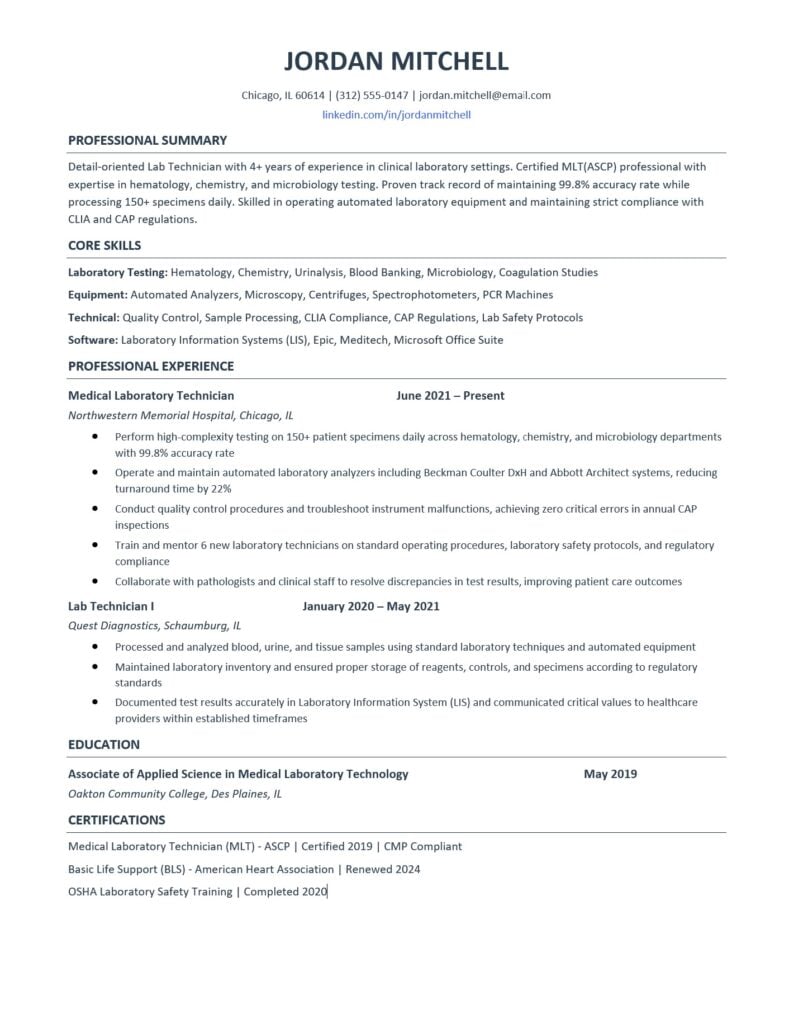
Here’s a professional lab technician resume template you can download and customize. This template is designed to be both visually appealing and ATS-friendly, with clean formatting that highlights your strengths.
Blank Customizable Template

Download Your Free Template:
- Download DOCX Template (fully editable in Microsoft Word)
Interview Guys Tip: The DOCX template is fully editable, allowing you to adjust fonts, colors, and spacing to match your personal brand while maintaining professional formatting. Just replace the placeholder text with your own information.
Here’s what most people don’t realize: employers now expect multiple technical competencies, not just one specialization. The days of being “just a marketer” or “just an analyst” are over. You need AI skills, project management, data literacy, and more. Building that skill stack one $49 course at a time is expensive and slow. That’s why unlimited access makes sense:
Your Resume Needs Multiple Certificates. Here’s How to Get Them All…
We recommend Coursera Plus because it gives you unlimited access to 7,000+ courses and certificates from Google, IBM, Meta, and top universities. Build AI, data, marketing, and management skills for one annual fee. Free trial to start, and you can complete multiple certificates while others finish one.
Essential Components of a Lab Technician Resume
Your lab tech resume should include these core sections in this specific order:
- Professional Summary (3-4 sentences): Open with a compelling summary that highlights your years of experience, key certifications, and specialties. Include metrics when possible. For example: “Certified MLT(ASCP) with 5+ years of experience in clinical laboratory settings, specializing in hematology and microbiology. Consistently maintain 99.7% accuracy rate while processing 200+ specimens daily.”
- Core Skills Section: Create a scannable skills section organized by category. Include Laboratory Testing (specific areas like hematology, chemistry, urinalysis), Equipment (name specific instruments you operate), Technical Knowledge (quality control, compliance standards), and Software (LIS systems, Epic, Meditech).
This organization helps you pass Applicant Tracking Systems while making it easy for hiring managers to quickly assess your qualifications. Many facilities use automated resume screening, so matching the job description’s exact terminology matters.
- Professional Experience: This is where you prove your capabilities with specific achievements. Don’t just list duties. Show impact with quantifiable results.
- Education: List your degree, institution, location, and graduation date. If you completed a NAACLS-accredited program, make that clear because it’s a significant credential.
- Certifications: Include your MLT(ASCP) or MLS(ASCP) certification, BLS certification, OSHA safety training, and any specialized certifications relevant to your target role.
How to Write Your Professional Summary
Your professional summary serves as your elevator pitch. In 3-4 sentences, you need to communicate your experience level, specializations, key achievements, and what makes you valuable to potential employers.
- Start with your credentials and experience. Lead with “Certified MLT(ASCP)” or “Licensed Laboratory Technician” followed by your years of experience. This immediately establishes your credibility.
- Highlight your specialty areas. If you specialize in certain testing areas like blood banking, molecular diagnostics, or clinical chemistry, mention them. Specialized skills make you more attractive to facilities looking for specific expertise.
- Include impressive metrics. Numbers grab attention and prove competence. Mention how many specimens you process daily, your accuracy rate, or process improvements you’ve implemented. For example: “Reduced specimen rejection rate by 18% through implementation of improved labeling protocols.”
- End with a forward-looking statement. Briefly mention what you’re seeking or what value you bring. “Seeking to leverage expertise in automated testing systems to improve laboratory efficiency at a high-volume facility.”
Crafting Achievement-Focused Experience Bullets
The experience section is where most lab tech resumes fall flat. Generic duty descriptions like “performed laboratory tests” or “maintained equipment” tell hiring managers nothing about your actual capabilities.
Use the CAR formula: Context + Action + Result. For each bullet point, provide enough context for the reader to understand the situation, describe the specific action you took, and quantify the result when possible.
- Instead of: “Performed hematology testing”
- Write: “Conducted comprehensive hematology analysis on 150+ specimens daily using Sysmex XN-Series analyzer, maintaining 99.8% accuracy rate and zero critical errors during annual CAP inspection”
Start every bullet with strong action verbs. Words like “performed,” “conducted,” “operated,” “maintained,” “implemented,” “trained,” “analyzed,” and “collaborated” demonstrate your active role in laboratory operations. Check out our resume action verbs guide for more powerful word choices.
Emphasize technical proficiency. Name specific equipment, methodologies, and software you’ve used. This serves dual purposes: it proves your hands-on experience and helps your resume pass ATS screening that searches for these technical terms.
Show compliance knowledge. Mention CLIA regulations, CAP standards, quality control procedures, and safety protocols you’ve followed. Compliance is critical in laboratory settings, and demonstrating this knowledge sets you apart.
Interview Guys Tip: If you’re early in your career without extensive experience, emphasize your clinical rotations, internship responsibilities, relevant coursework, and any specialized projects. The key is showing hands-on laboratory exposure even if it wasn’t in a paid position.
Highlighting Education and Certifications
For lab technicians, education and certifications often carry more weight than in other fields. These credentials directly impact whether you’re legally qualified to perform certain tests and operate specific equipment.
Education formatting: List your most recent degree first with the full degree name (Associate of Applied Science in Medical Laboratory Technology), institution name, location, and graduation date. If you graduated from a NAACLS-accredited program, mention this accreditation because it meets the education requirements for ASCP certification.
Recent graduates can include relevant coursework to demonstrate specialized knowledge. List 4-6 courses relevant to laboratory work like Clinical Hematology, Microbiology, Immunology, or Clinical Chemistry. This helps fill space if your work experience is limited and shows your technical foundation.
Certification formatting matters. Use this format: “Certification Name – Issuing Organization | Year Obtained | Status”
For example: “Medical Laboratory Technician (MLT) – ASCP | Certified 2020 | CMP Compliant”
The CMP (Credential Maintenance Program) status shows you’re actively maintaining your certification through continuing education, which matters to employers.
Don’t forget supporting certifications. BLS certification, OSHA laboratory safety training, phlebotomy certification, and specialized certifications in areas like flow cytometry or molecular diagnostics all strengthen your candidacy. Many interview questions for lab technicians will probe your specialized knowledge, so highlighting these credentials prepares you for that conversation.
Common Lab Technician Resume Mistakes to Avoid
Even experienced lab techs make these resume mistakes that cost them interviews:
- Using generic language instead of technical specifics. Saying you “used laboratory equipment” is meaningless. Specify that you “operated Beckman Coulter DxH 800 hematology analyzer and Abbott Architect c8000 chemistry system.” Technical specificity proves genuine experience.
- Neglecting to quantify achievements. Numbers make your accomplishments concrete. Include metrics like specimens processed per shift, accuracy rates, turnaround time improvements, or cost savings from process optimizations.
- Poor keyword optimization. Many healthcare facilities use Applicant Tracking Systems to screen resumes. If the job description mentions “CLIA compliance,” “quality control procedures,” and “specimen processing,” these exact phrases should appear in your resume. Review our guide on ATS-friendly resumes for more optimization strategies.
- Listing outdated technology or skills. If you learned on manual cell counters in school but haven’t used them in years, don’t lead with that experience. Focus on current, relevant technologies that modern laboratories actually use.
- Including irrelevant work history. Your retail job from five years ago doesn’t belong on a lab tech resume unless you’re very early in your career and need to show work ethic. Keep the focus on laboratory-related experience.
- Typos and formatting inconsistencies. In a field where precision matters, a resume with spelling errors sends the wrong message. Proofread carefully, use consistent formatting throughout, and have someone else review it before submitting.
ATS Optimization and Keywords for Lab Technicians
Approximately 98% of Fortune 500 companies use Applicant Tracking Systems to screen resumes before human eyes ever see them. Your beautifully crafted resume means nothing if it doesn’t make it past this digital gatekeeper.
- Match the job description’s language exactly. If the posting says “hematology testing,” use “hematology testing” in your resume, not “blood testing.” ATS systems look for exact phrase matches.
- Include a robust skills section. ATS systems often scan specifically for a skills section, so create one with relevant technical skills, equipment, methodologies, and compliance standards. Organize by category for better readability.
- Use standard section headings. Stick with conventional headings like “Professional Experience,” “Education,” “Certifications,” and “Skills.” Creative headings like “Where I’ve Made an Impact” confuse ATS systems.
- Save in the right format. Unless specifically requested otherwise, submit your resume as a .docx file. While PDFs maintain formatting, some older ATS systems struggle to parse them correctly.
- Avoid tables, text boxes, and headers/footers. These formatting elements look nice but often cause ATS parsing errors. Stick to simple, clean formatting with standard fonts.
- Incorporate industry-standard acronyms and their spelled-out versions. Include both “MLT” and “Medical Laboratory Technician,” both “ASCP” and “American Society for Clinical Pathology.” This ensures you’re found whether the ATS searches for acronyms or full terms.
Interview Guys Tip: Before you submit another application, run your resume through an ATS scanner. Most job seekers skip this step and wonder why they never hear back. Check out the free ATS checker we use and recommend →
Tailoring Your Resume for Different Lab Settings
Not all laboratory positions are created equal. A resume for a hospital lab position should emphasize different qualities than one for a research laboratory or reference lab.
- Hospital and clinical labs value speed, accuracy under pressure, and the ability to handle diverse testing across multiple departments. Emphasize your experience with high-volume specimen processing, stat testing protocols, and collaboration with medical staff. Mention experience with emergency situations and your ability to prioritize critical results.
- Reference and commercial labs like Quest Diagnostics or LabCorp focus on efficiency, throughput, and cost-effectiveness. Highlight your productivity metrics, experience with automated systems, and any process improvements that enhanced efficiency or reduced costs.
- Research laboratories need technicians who can follow complex protocols precisely and maintain detailed documentation. Emphasize your attention to detail, experience with specialized techniques, data analysis skills, and any published research or presentations.
- Pharmaceutical and biotechnology labs look for compliance expertise and technical sophistication. Highlight knowledge of FDA regulations, GLP/GMP compliance, validation procedures, and experience with advanced analytical techniques.
For career changers looking to enter the laboratory field, our career change resume guide offers strategies for positioning transferable skills effectively.
Frequently Asked Questions
How long should my lab technician resume be?
One page is ideal for technicians with less than 10 years of experience. If you have extensive experience, specialized certifications, and numerous relevant achievements, a two-page resume is acceptable. However, every line should add value. Don’t pad your resume with irrelevant information just to fill space.
Should I include my GPA on my lab tech resume?
Include your GPA only if you’re a recent graduate (within 2 years) and it’s 3.5 or higher. Once you have professional laboratory experience, your GPA becomes less relevant and you should remove it to make room for more impactful content.
What if I don’t have my ASCP certification yet?
If you’re eligible and planning to take the exam, include “ASCP MLT Exam Scheduled for [Month Year]” in your certifications section. This shows you’re committed to obtaining the credential. However, if you’re not yet eligible, don’t mention it. Instead, emphasize your NAACLS-accredited education and clinical training.
How do I handle employment gaps on my lab tech resume?
Be honest about employment gaps but frame them positively. If you took time off for family reasons, continuing education, or health issues, mention it briefly. Use any gap time productively by taking relevant courses, volunteering, or maintaining your certifications through continuing education. Our employment gap strategies guide offers more detailed approaches.
Should I include references on my resume?
Don’t include references or “References available upon request” on your resume. This is outdated advice that wastes valuable space. Have a separate references sheet ready to provide when requested during the interview process. Choose references who can speak specifically to your laboratory skills and work ethic.
Take the Next Step
Landing your ideal lab technician position starts with a resume that effectively communicates your technical expertise, attention to detail, and commitment to quality. By following the strategies in this guide and using the templates provided, you’ll create a resume that passes ATS screening and impresses hiring managers.
Download both resume templates above and customize them with your specific experience, skills, and achievements. Remember to tailor your resume for each application by incorporating keywords from the job description and emphasizing the most relevant aspects of your background.
Once your resume is polished, you’ll be ready to tackle the interview process. When you land that interview, make sure you’re prepared by reviewing common interview questions that hiring managers ask lab technicians.
Looking for more resume templates across different healthcare specialties? Browse our complete free resume template library for additional formats and styles that might better fit your needs.
Your laboratory expertise deserves a resume that showcases it effectively. Start building yours today.
Here’s what most people don’t realize: employers now expect multiple technical competencies, not just one specialization. The days of being “just a marketer” or “just an analyst” are over. You need AI skills, project management, data literacy, and more. Building that skill stack one $49 course at a time is expensive and slow. That’s why unlimited access makes sense:
Your Resume Needs Multiple Certificates. Here’s How to Get Them All…
We recommend Coursera Plus because it gives you unlimited access to 7,000+ courses and certificates from Google, IBM, Meta, and top universities. Build AI, data, marketing, and management skills for one annual fee. Free trial to start, and you can complete multiple certificates while others finish one.

BY THE INTERVIEW GUYS (JEFF GILLIS & MIKE SIMPSON)
Mike Simpson: The authoritative voice on job interviews and careers, providing practical advice to job seekers around the world for over 12 years.
Jeff Gillis: The technical expert behind The Interview Guys, developing innovative tools and conducting deep research on hiring trends and the job market as a whole.