
Free HVAC Technician Resume Template 2025: Download Your ATS-Ready Resume Today
You’ve spent years perfecting your craft. You can diagnose a compressor failure in minutes, install a complete HVAC system blindfolded, and keep commercial buildings running smoothly even during the hottest Arizona summers.
But when it comes to landing your next HVAC position, there’s one problem: your resume isn’t doing you justice.
Maybe you’re staring at a blank Word document, wondering how to translate your hands-on expertise into bullet points. Or perhaps your current resume looks like everyone else’s, buried in a pile of applications that hiring managers will never read. You need a resume that captures attention in six seconds or less, the average time recruiters spend reviewing each application.
That’s exactly why we created this free HVAC technician resume template for 2025. By the end of this article, you’ll have two professionally formatted resume templates (both example and blank versions) and a complete understanding of how to showcase your technical skills, certifications, and experience in a way that gets results.
☑️ Key Takeaways
- HVAC technicians earn a median salary of $57,300 annually with strong job growth projected at 6% through 2033, creating about 37,700 annual openings
- EPA Section 608 and NATE certifications are essential for standing out to employers and commanding higher salaries in today’s competitive market
- Quantifying your achievements with specific metrics (like “improved energy efficiency by 22%” or “maintained 98% first-time fix rate”) dramatically increases interview callbacks
- The right resume section order matters: Professional Summary, Core Skills, Experience, Certifications, then Education works best for experienced HVAC techs
What Makes an HVAC Technician Resume Different?
HVAC resumes have unique requirements that set them apart from other trades. Here’s what hiring managers are really looking for when they review your application.
Technical certifications take center stage. Unlike many professions where education comes last, your EPA Section 608 Universal certification and NATE credentials belong near the top of your resume. These aren’t optional extras. They’re prerequisites that hiring managers scan for within seconds of opening your application.
The HVAC industry demands proof of specialized knowledge. According to industry data, technicians with NATE certification earn 15-20% more than their non-certified peers. Your resume needs to showcase these credentials prominently.
Hands-on experience trumps theory. Hiring managers want to see evidence that you can handle real-world situations. This means your resume should emphasize practical accomplishments over academic achievements. Did you reduce customer callbacks? Improve system efficiency? Complete emergency repairs under pressure? These details belong front and center.
Hvac Technician Resume Example
Here’s a professional hvac tech resume example. This example gives you an idea of what type of content fits in a good ATS friendly resume.
Example Resume:
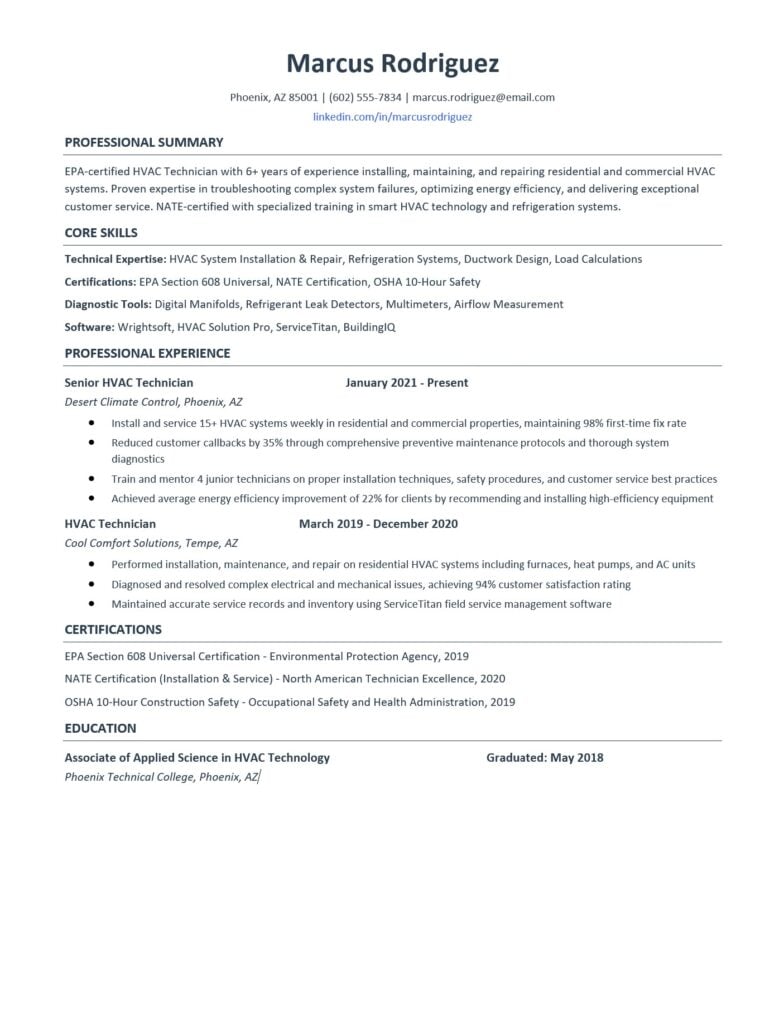
Here’s a professional hvac technician resume template you can download and customize. This template is designed to be both visually appealing and ATS-friendly, with clean formatting that highlights your strengths.
Blank Customizable Template
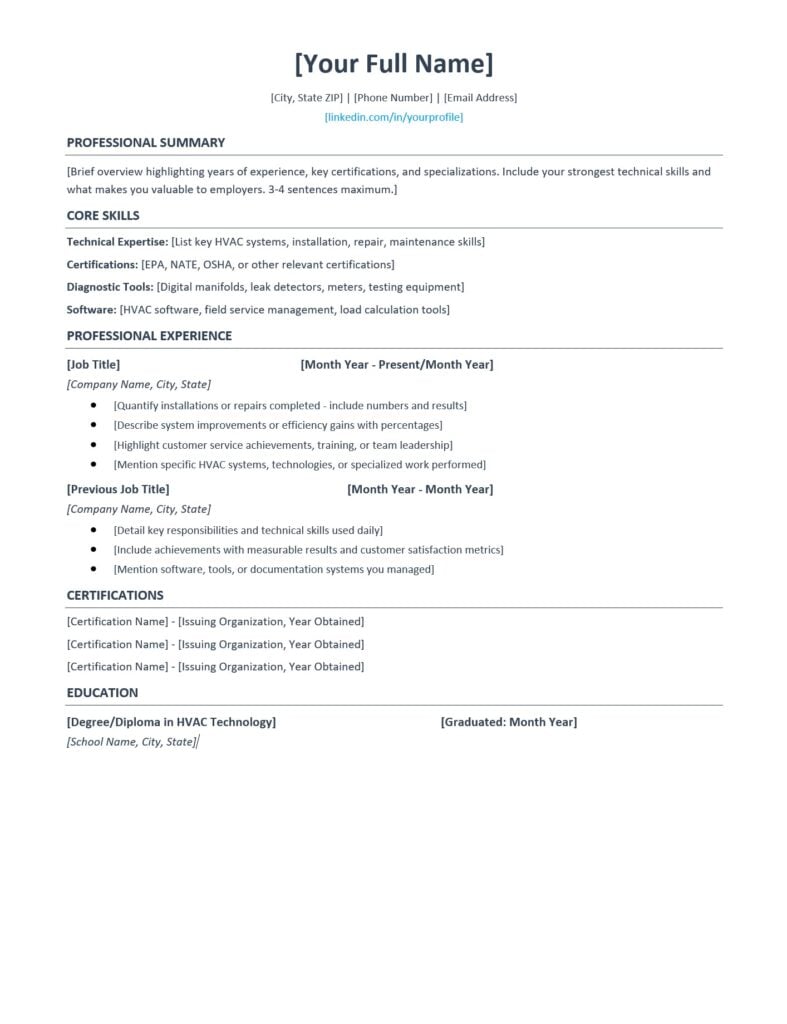
Download Your Free Template:
- Download DOCX Template (fully editable in Microsoft Word)
Interview Guys Tip: The DOCX template is fully editable, allowing you to adjust fonts, colors, and spacing to match your personal brand while maintaining professional formatting. Just replace the placeholder text with your own information.
Here’s what most people don’t realize: employers now expect multiple technical competencies, not just one specialization. The days of being “just a marketer” or “just an analyst” are over. You need AI skills, project management, data literacy, and more. Building that skill stack one $49 course at a time is expensive and slow. That’s why unlimited access makes sense:
Your Resume Needs Multiple Certificates. Here’s How to Get Them All…
We recommend Coursera Plus because it gives you unlimited access to 7,000+ courses and certificates from Google, IBM, Meta, and top universities. Build AI, data, marketing, and management skills for one annual fee. Free trial to start, and you can complete multiple certificates while others finish one.
Essential Components of a Winning HVAC Resume
Your HVAC technician resume needs six core sections, arranged in this specific order for maximum impact.
Professional Summary: Your 30-Second Elevator Pitch
Start strong with a 3-4 sentence summary that highlights your experience level, key certifications, and specialized skills. This isn’t the place for generic phrases like “hard-working team player.” Instead, lead with quantifiable experience and credentials.
Good example: “EPA-certified HVAC Technician with 6+ years of experience installing, maintaining, and repairing residential and commercial HVAC systems. Proven expertise in troubleshooting complex system failures, optimizing energy efficiency, and delivering exceptional customer service. NATE-certified with specialized training in smart HVAC technology and refrigeration systems.”
Notice how this summary immediately establishes credibility with specific certifications, years of experience, and technical specializations. It also hints at soft skills (customer service) without wasting valuable resume space on vague claims.
Interview Guys Tip: Place your EPA and NATE certifications in your professional summary even if you list them again later. This ensures they’re visible even if a hiring manager only skims the top of your resume.
Core Skills: The ATS Keyword Section
This section serves two critical purposes: it passes Applicant Tracking Systems (ATS) and gives hiring managers a quick snapshot of your capabilities. Organize your skills into clear categories.
Include these four categories:
- Technical Expertise: HVAC system types you work with (residential, commercial, industrial), installation, repair, maintenance, and ductwork
- Certifications: All relevant credentials (EPA, NATE, OSHA, manufacturer-specific)
- Diagnostic Tools: Equipment you’re proficient with (digital manifolds, leak detectors, multimeters, airflow measurement devices)
- Software: Field service management platforms, load calculation programs, and diagnostic software
Each category should contain 3-5 specific items. Avoid generic terms like “good communication skills” in this section. Save soft skills for your experience bullets where you can demonstrate them through accomplishments. If you need guidance on how to structure your entire resume effectively, check out our resume sections blueprint.
Professional Experience: Where Numbers Tell Your Story
Your work history should follow reverse chronological order (most recent first). For each position, include your job title, company name, location, and employment dates.
Here’s where many HVAC technicians miss opportunities. Don’t just list your daily responsibilities. Transform routine tasks into achievement statements with quantifiable results.
Weak bullet: “Performed HVAC maintenance and repairs on residential systems”
Strong bullet: “Installed and serviced 15+ HVAC systems weekly in residential and commercial properties, maintaining 98% first-time fix rate”
See the difference? The strong version includes specific numbers (15+ systems weekly), demonstrates reliability (98% first-time fix rate), and shows versatility (both residential and commercial). These metrics prove your value rather than making vague claims.
Interview Guys Tip: Use the CAR formula for your bullet points: Challenge, Action, Result. Start with the situation you faced, explain what you did, and quantify the outcome whenever possible.
Focus on achievements like:
- Systems installed or serviced (daily, weekly, monthly)
- Customer satisfaction ratings or reduced callback percentages
- Energy efficiency improvements you implemented
- Junior technicians you trained or mentored
- Emergency repairs completed within tight timeframes
Include 4-5 bullets for your current role and 3-4 for previous positions. If you need help with what to include, explore our work experience on resume guide.
Certifications: Your Professional Credentials
List certifications in reverse chronological order with the credential name, issuing organization, and date obtained. The most valuable certifications for HVAC technicians in 2025 include:
- EPA Section 608 Universal Certification (required for handling refrigerants)
- NATE Certification in Installation and Service (industry gold standard)
- OSHA 10-Hour Construction Safety (demonstrates safety consciousness)
- Manufacturer-specific certifications (Carrier, Trane, Lennox, etc.)
- Specialized credentials (Building Performance Institute, HVAC Excellence)
If you’re currently pursuing a certification, include it with an expected completion date. This shows initiative and commitment to professional development.
Education: Keep It Concise
For experienced HVAC technicians, education belongs near the bottom of your resume. Include your degree or diploma, school name, location, and graduation date.
Most HVAC positions require an Associate of Applied Science in HVAC Technology or a vocational diploma. If you completed relevant coursework in system installation, preventive maintenance, or electrical work, you can mention it briefly.
However, don’t let education overshadow your certifications and experience. Once you have real-world HVAC experience, your EPA and NATE credentials matter more than where you went to school.
How to Write Each Section for Maximum Impact
Let’s break down exactly how to craft each component of your resume to stand out from the competition.
Crafting Powerful Bullet Points
Every bullet point in your experience section should start with a strong action verb. Avoid weak verbs like “helped with” or “responsible for.” Instead, use impact words that demonstrate leadership and technical skill.
Excellent action verbs for HVAC resumes:
- Installed, maintained, repaired, troubleshot, diagnosed
- Optimized, improved, enhanced, increased, reduced
- Trained, mentored, supervised, coordinated
- Implemented, executed, performed, conducted
Pair these verbs with specific metrics. The hiring manager reading your resume wants to see evidence of your capabilities, not generic descriptions of duties.
Highlighting Your Technical Specializations
The HVAC field encompasses diverse specializations. Your resume should clearly indicate where your expertise lies.
Residential HVAC technicians should emphasize comfort systems, furnaces, heat pumps, and direct customer interaction. Commercial technicians should highlight large-scale installations, building automation systems, and preventive maintenance programs. Industrial specialists need to showcase refrigeration expertise, complex climate control, and compliance with regulations.
Don’t try to be everything to everyone. If you specialize in commercial refrigeration, lean into that expertise rather than spreading yourself thin across all HVAC categories.
Addressing Employment Gaps
Career gaps happen. Maybe you took time off to care for family, dealt with health issues, or simply couldn’t find the right opportunity. The key is addressing gaps honestly without drawing unnecessary attention to them.
If the gap was spent on professional development, mention it briefly: “Completed advanced HVAC certification training (2023-2024).” If you freelanced or worked as an independent contractor, include it as a position with bullet points highlighting projects completed.
For longer gaps without professional relevance, keep your resume focused on what you can offer now. Hiring managers care more about your current capabilities than explaining every month of your work history.
Common HVAC Resume Mistakes to Avoid
Even experienced technicians make critical resume errors that cost them interviews. Here are the biggest mistakes we see and how to avoid them.
Using a generic, one-size-fits-all resume. Every HVAC job is different. A position servicing residential AC units requires different skills than maintaining commercial refrigeration systems. Tailor your resume for each application by emphasizing the most relevant experience and skills for that specific role.
Forgetting to quantify achievements. “Performed HVAC repairs” tells the hiring manager nothing about your capabilities. “Maintained 98% customer satisfaction rating while completing 15+ service calls weekly” demonstrates reliability, efficiency, and customer service excellence. Always ask yourself: Can I add a number to prove this?
Overloading with technical jargon. Yes, hiring managers understand HVAC terminology. But first, your resume needs to pass the HR department and often an ATS. Balance technical accuracy with readability. Instead of “Executed comprehensive diagnostics utilizing advanced psychrometric analysis,” write “Diagnosed system inefficiencies using load calculations and airflow measurements.”
Neglecting soft skills entirely. HVAC work isn’t just about technical expertise. You interact with customers, train junior technicians, and communicate with contractors. Your resume should demonstrate these interpersonal abilities through your achievements: “Trained 4 junior technicians,” “Achieved 94% customer satisfaction rating,” “Coordinated with contractors to complete projects on schedule.”
Including outdated or irrelevant experience. If you’ve been an HVAC technician for 10+ years, your resume doesn’t need details about unrelated jobs from 15 years ago. Focus on the last 10-15 years of relevant experience. Older positions can be summarized briefly: “Earlier Career: Various technical positions in building maintenance and construction.”
ATS Optimization and Keywords for HVAC Resumes
Applicant Tracking Systems scan your resume before human eyes ever see it. Between 75% and 98% of resumes never reach a hiring manager because they fail ATS screening.
Interview Guys Tip: Before you submit another application, run your resume through an ATS scanner. Most job seekers skip this step and wonder why they never hear back. Check out the free ATS checker we use and recommend →
Here’s how to ensure your HVAC resume passes these digital gatekeepers.
Understanding ATS Requirements
ATS software scans resumes for keywords that match the job description. If the posting mentions “EPA Section 608,” “refrigeration systems,” or “preventive maintenance,” your resume should include these exact phrases.
However, keyword stuffing destroys readability and looks desperate. The solution? Integrate keywords naturally throughout your resume, especially in your Core Skills section and experience bullets.
Essential Keywords for HVAC Resumes
Include these high-value keywords where relevant to your experience:
- System types: Residential HVAC, commercial HVAC, industrial refrigeration, heat pumps, furnaces, air handlers, chillers
- Technical skills: Installation, maintenance, repair, troubleshooting, diagnostics, load calculations, ductwork design
- Certifications: EPA 608, NATE, OSHA, HVAC Excellence, BPI
- Soft skills: Customer service, problem-solving, team leadership, training
Match the job description. If the posting emphasizes “energy efficiency,” make sure your resume mentions energy efficiency improvements you’ve achieved. If it requires “emergency repair experience,” highlight times you’ve resolved critical system failures quickly.
Formatting for ATS Compatibility
ATS systems can’t read complex formatting. Stick to standard fonts (Calibri, Arial, Times New Roman), avoid headers and footers, don’t use text boxes or graphics, and save as .docx unless the job posting specifies PDF.
Interview Guys Tip: After customizing your resume for a specific job, copy the job description and your resume into a word cloud generator. If the most common words from the job description don’t appear prominently in your resume, you need to revise it.
For more insights on beating ATS systems, read our comprehensive guide on ATS resume optimization.
From Resume to Interview: What Comes Next
Your resume is just the first step in landing your next HVAC position. Once you’ve perfected your application materials, prepare for the interview process.
Research the company’s HVAC specialization. Do they focus on residential comfort, commercial installations, or industrial refrigeration? Review common HVAC technician interview questions and prepare specific examples from your experience that demonstrate problem-solving abilities.
Practice explaining complex technical concepts in simple terms. You’ll likely interview with both technical supervisors who understand HVAC systems and HR personnel who don’t. Your ability to communicate clearly matters as much as your technical knowledge.
Prepare questions that show genuine interest: “What types of HVAC systems does your company specialize in?” “How does the company support ongoing certification and training?” “What does a typical service route look like?”
Frequently Asked Questions About HVAC Resumes
Should I include references on my HVAC resume?
No. References belong on a separate document, not your resume. Use that valuable space for achievements and skills instead. Simply note “References available upon request” at the bottom, or omit this line entirely since it’s implied.
How long should my HVAC technician resume be?
One page for technicians with less than 10 years of experience. Two pages are acceptable if you have extensive experience, multiple specializations, or numerous certifications. Never exceed two pages.
Do I need a different resume for commercial vs. residential positions?
Absolutely. Customize your resume to emphasize the most relevant experience. For commercial positions, highlight large-scale installations, preventive maintenance programs, and building automation systems. For residential roles, emphasize customer service, emergency repairs, and direct homeowner interaction.
Should I include my high school diploma if I have an HVAC degree?
No. Once you’ve completed postsecondary education or vocational training in HVAC, your high school education is assumed. Save that resume space for more relevant information.
How do I address certifications that have expired?
Don’t list expired certifications. If you’re in the process of renewing, you can note: “EPA 608 Certification (renewal in progress).” Otherwise, focus on current, valid credentials that prove your qualifications today.
Take the Next Step in Your HVAC Career
You now have everything you need to create a resume that showcases your HVAC expertise effectively. Both the example resume and blank template provide professional formatting that passes ATS systems and catches hiring managers’ attention.
Remember: Your resume should evolve with your career. Update it every few months with new certifications, projects, and achievements. This keeps you ready for unexpected opportunities and ensures you never undersell your growing expertise.
Download both templates, customize them with your unique experience, and start landing interviews for positions that value your skills. The HVAC industry is growing, with the Bureau of Labor Statistics projecting 40,100 new jobs by 2033. Your next opportunity is out there, waiting for a resume that finally does justice to your capabilities.
Looking for more professional resume templates across different industries? Check out our complete free resume templates library for additional options.
Here’s what most people don’t realize: employers now expect multiple technical competencies, not just one specialization. The days of being “just a marketer” or “just an analyst” are over. You need AI skills, project management, data literacy, and more. Building that skill stack one $49 course at a time is expensive and slow. That’s why unlimited access makes sense:
Your Resume Needs Multiple Certificates. Here’s How to Get Them All…
We recommend Coursera Plus because it gives you unlimited access to 7,000+ courses and certificates from Google, IBM, Meta, and top universities. Build AI, data, marketing, and management skills for one annual fee. Free trial to start, and you can complete multiple certificates while others finish one.

BY THE INTERVIEW GUYS (JEFF GILLIS & MIKE SIMPSON)
Mike Simpson: The authoritative voice on job interviews and careers, providing practical advice to job seekers around the world for over 12 years.
Jeff Gillis: The technical expert behind The Interview Guys, developing innovative tools and conducting deep research on hiring trends and the job market as a whole.