
Free Vet Tech Resume Template 2025: Examples & Writing Guide That Land Interviews
Landing a veterinary technician position means standing out in a field where compassion meets clinical expertise. Your resume needs to show hiring managers that you’re not just comfortable around animals but also skilled in the technical procedures that keep veterinary practices running smoothly.
Here’s the challenge: most vet tech resumes look identical. They list the same generic duties without showcasing what makes each candidate unique. Veterinary practices receive dozens of applications for each opening, and hiring managers spend an average of 6 seconds on initial resume screening.
That’s where this guide comes in. You’re getting two professionally formatted resume templates designed specifically for veterinary technicians, plus expert guidance on what actually works in 2025. These aren’t generic templates dressed up with animal clipart. They’re ATS-friendly, one-page formats that highlight your clinical skills, certifications, and hands-on experience in ways that catch hiring managers’ attention.
By the end of this article, you’ll understand exactly how to structure your vet tech resume, what sections matter most, which keywords to include, and how to present your experience in ways that demonstrate your value to veterinary teams. Whether you’re a newly certified vet tech or an experienced professional looking for better opportunities, you’ll have everything needed to create a resume that gets interviews.
For additional healthcare career guidance, check out our healthcare interview questions guide to prepare for what comes after your resume lands the interview.
☑️ Key Takeaways
- Veterinary-specific formatting matters more than generic templates because hiring managers scan for clinical skills, certifications, and hands-on experience within seconds
- Your CVT/RVT/LVT license number should appear prominently near your education section to immediately establish your credentials and meet state requirements
- Quantified achievements like “assisted in 20+ surgeries weekly” or “improved client compliance by 35%” demonstrate your tangible impact far better than generic duty lists
- ATS-optimized keywords from the job posting are essential since most veterinary clinics use applicant tracking systems to filter resumes before human review
What Makes a Vet Tech Resume Different From Other Healthcare Resumes?
Veterinary technician resumes require a unique balance that other healthcare positions don’t.
You’re demonstrating clinical competence while also showing you can handle the emotional aspects of animal care. Veterinary practices need technicians who can place IV catheters with precision in the morning, comfort anxious pet owners in the afternoon, and assist in emergency surgeries by evening.
The best vet tech resumes immediately establish credibility through proper certifications and licenses. Most states require veterinary technicians to hold active CVT, RVT, or LVT credentials, and hiring managers look for these qualifications within the first few seconds of scanning your resume.
Your resume also needs to reflect the specific setting where you want to work. Emergency veterinary hospitals prioritize triage skills and the ability to work under pressure. Small animal general practice clinics value client communication and routine care expertise. Specialty practices want technicians with advanced training in areas like dentistry, surgery, or exotic animal care.
Interview Guys Tip: Research shows that vet tech resumes with specific procedure names and equipment mentioned get 40% more interview callbacks than those with generic phrases like “assisted veterinarians.” Include the actual diagnostic equipment you operate, specific surgical procedures you support, and veterinary software systems you know.
Vet Tech Resume Example
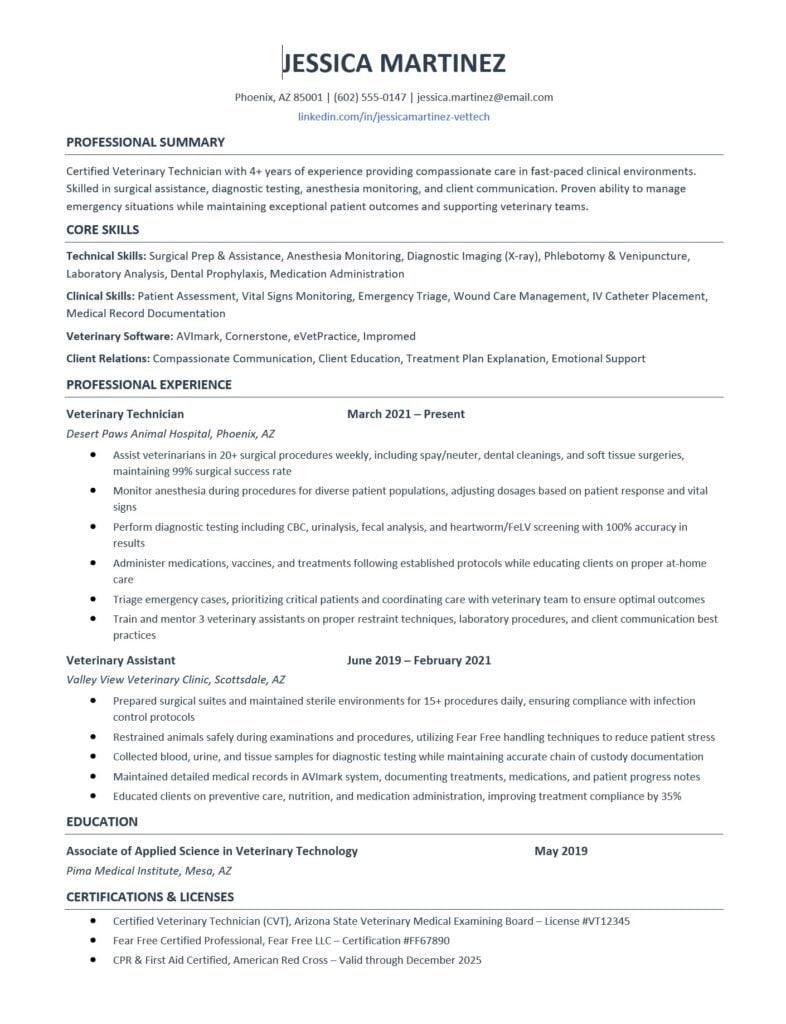
Here’s a professional veterinary technician resume example. This example gives you an idea of what type of content fits in a good ATS friendly resume.
Example Resume:
Here’s a professional vet tech resume template you can download and customize. This template is designed to be both visually appealing and ATS-friendly, with clean formatting that highlights your strengths.
Blank Customizable Template
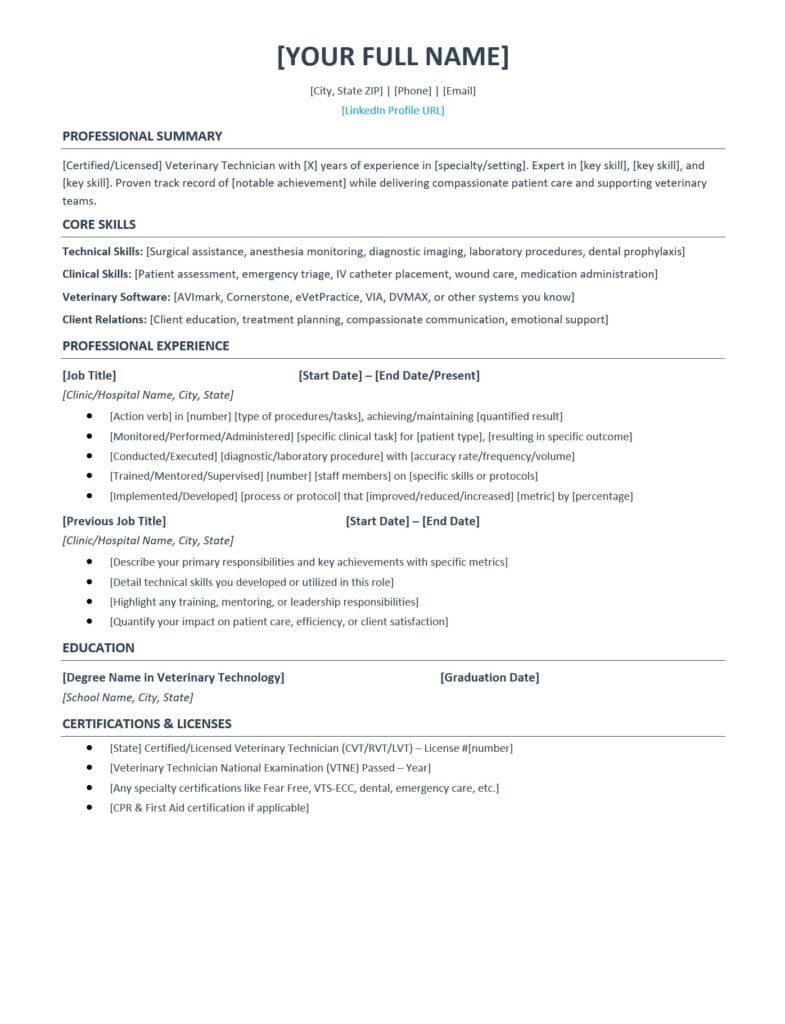
Download Your Free Template:
- Download DOCX Template (fully editable in Microsoft Word)
Interview Guys Tip: The DOCX template is fully editable, allowing you to adjust fonts, colors, and spacing to match your personal brand while maintaining professional formatting. Just replace the placeholder text with your own information.
Here’s what most people don’t realize: employers now expect multiple technical competencies, not just one specialization. The days of being “just a marketer” or “just an analyst” are over. You need AI skills, project management, data literacy, and more. Building that skill stack one $49 course at a time is expensive and slow. That’s why unlimited access makes sense:
Your Resume Needs Multiple Certificates. Here’s How to Get Them All…
We recommend Coursera Plus because it gives you unlimited access to 7,000+ courses and certificates from Google, IBM, Meta, and top universities. Build AI, data, marketing, and management skills for one annual fee. Free trial to start, and you can complete multiple certificates while others finish one.
Essential Components Every Vet Tech Resume Must Include
Your contact information should be clean and professional.
Include your full name, phone number, professional email address, city and state, and LinkedIn profile if you have one. Skip your full street address since modern hiring practices don’t require it and it takes up valuable space.
The professional summary sits right below your contact information and makes your first impression. This 2-3 sentence section should highlight your certification status, years of experience, key specialties, and one standout achievement. Think of it as your elevator pitch in written form.
Your core skills section deserves strategic placement near the top of your resume. Organize skills into categories like Technical Skills, Clinical Skills, Software Proficiency, and Client Relations. This format helps hiring managers quickly scan for the specific capabilities they need while also helping your resume pass through applicant tracking systems.
Professional experience forms the meat of your resume. List positions in reverse chronological order with your job title, clinic name, location, and employment dates clearly visible. Each bullet point should start with a strong action verb and include specific metrics whenever possible.
According to the Bureau of Labor Statistics, employment of veterinary technologists and technicians is projected to grow 21% from 2023 to 2033, much faster than average for all occupations. This growth means competition remains fierce, making your resume’s effectiveness even more critical.
Education and certifications get their own dedicated sections. Most vet tech positions require an Associate’s degree in Veterinary Technology from an AVMA-accredited program. List your degree, school name, location, and graduation date. Your certifications section should prominently feature your CVT/RVT/LVT license with the license number included.
How to Write Each Section for Maximum Impact
Your professional summary needs to pack a punch in just 2-3 sentences.
Start with your certification status and years of experience. Add your primary specialty or the setting where you excel. Finish with a quantified achievement that demonstrates your value. For example: “Certified Veterinary Technician with 4+ years of experience in emergency and critical care. Skilled in advanced life support, anesthesia monitoring, and client crisis communication. Maintained 99% surgical success rate while training 3 veterinary assistants.”
The core skills section should be scannable at a glance. Break technical skills into logical categories rather than creating one long list. Include specific procedures like venipuncture, catheter placement, dental prophylaxis, and radiography. Don’t forget to mention veterinary software systems since most practices use specialized programs like AVImark, Cornerstone, or eVetPractice for patient records and inventory management.
When writing your professional experience section, start each bullet point with strong action verbs like “monitored,” “administered,” “performed,” “assisted,” or “coordinated.” The key is quantifying your impact wherever possible. Instead of “Assisted with surgeries,” write “Assisted in 20+ surgical procedures weekly, including spay/neuter, dental cleanings, and soft tissue surgeries, maintaining 99% surgical success rate.”
Show progression in your roles. If you started as a veterinary assistant and advanced to veterinary technician, make that growth clear. Include any mentoring or training responsibilities since leadership skills matter even in entry-level positions.
Interview Guys Tip: Fear-Free certification has become increasingly valuable in 2025. If you have this credential, feature it prominently. Veterinary practices are prioritizing low-stress handling techniques, and this certification demonstrates your commitment to animal welfare and modern care standards.
For those transitioning into vet tech roles, our guide on how to write a resume with no experience offers strategies for highlighting relevant skills and training when you’re just starting out.
Common Mistakes That Kill Vet Tech Resumes
Generic job descriptions are the biggest resume killer.
Phrases like “responsible for animal care” or “performed various duties” tell hiring managers nothing about your actual capabilities. Every vet tech performs animal care, so these statements waste valuable resume space without differentiating you from other candidates.
Omitting your license number creates unnecessary confusion. Veterinary practices need to verify your credentials before making hiring decisions. Including your CVT, RVT, or LVT license number with your state board saves time and demonstrates transparency.
Focusing solely on technical skills without mentioning client communication abilities misses a critical component of the job. Veterinary technicians spend significant time educating pet owners about treatments, medications, and preventive care. Showing you excel at both clinical procedures and client interactions makes you more valuable.
Using a two-page resume when you have less than 10 years of experience dilutes your strongest qualifications. Hiring managers prefer concise, one-page resumes that highlight your most relevant skills and achievements. Save the second page for when you have extensive specialized experience or advanced certifications that truly warrant the additional space.
Ignoring keywords from the job posting is a critical error. Research indicates that 75% of applications never reach human eyes because applicant tracking systems filter them out first. If the posting mentions “anesthesia monitoring” but your resume only says “surgical assistance,” the ATS might not recognize your relevant experience.
Listing outdated or irrelevant skills wastes space. If you worked retail before becoming a vet tech, briefly mention it to show work history, but don’t dedicate multiple bullet points to cashier responsibilities. Focus your resume real estate on veterinary-specific experience and skills.
ATS Optimization and Keywords That Actually Work
Applicant tracking systems scan your resume for specific keywords before human eyes ever see it.
Understanding how these systems work is essential for getting your resume past the first screening. ATS software looks for exact matches to terms in the job posting, which is why customizing your resume for each application matters.
Interview Guys Tip: Before you submit another application, run your resume through an ATS scanner. Most job seekers skip this step and wonder why they never hear back. Check out the free ATS checker we use and recommend →
Start by carefully reading the job description and identifying hard skills mentioned repeatedly. Common vet tech keywords include specific procedures like venipuncture, catheter placement, radiography, anesthesia monitoring, dental prophylaxis, and laboratory analysis. Software names like AVImark, Cornerstone, or eVetPractice should appear if you have experience with these systems.
Include your certification exactly as it appears in the posting. Some practices search for “CVT” while others look for the full phrase “Certified Veterinary Technician.” Including both the abbreviation and full term helps ensure your resume gets flagged regardless of the search parameters used.
Clinical specialties deserve mention if they align with the position. Emergency and critical care, surgery, dentistry, exotic animal medicine, and laboratory diagnostics are common specializations that practices specifically search for when they need those skills.
The skills section is your primary ATS optimization zone, but don’t stop there. Weave these same keywords naturally throughout your professional experience bullet points. If the job posting mentions “Fear Free handling techniques,” your resume should include that exact phrase when describing your patient care approach.
For more strategies on creating ATS-friendly applications, explore our ATS resume optimization guide that explains exactly how these systems evaluate resumes.
Interview Guys Tip: Most ATS software struggles with tables, text boxes, and graphics. Stick to simple formatting with clear section headings. Use standard fonts like Calibri or Arial at 10-12 point size. This ensures the software can accurately parse your information even if it means your resume looks less visually exciting.
FAQ: Your Vet Tech Resume Questions Answered
Should I include my veterinary assistant experience if I’m now a certified vet tech?
Absolutely. Your veterinary assistant experience demonstrates career progression and shows you understand veterinary practice operations from the ground up. Just make sure your current CVT/RVT/LVT credentials are prominently featured and dedicate more bullet points to your technician-level responsibilities than your assistant duties.
How do I handle employment gaps in my vet tech resume?
Address gaps honestly but briefly. If you took time off for continuing education, family care, or personal reasons, include a brief line in your experience section without over-explaining. Focus on any volunteer work, continuing education, or skills maintenance you did during that time. Many practices value candidates who stay engaged with veterinary medicine even during career breaks.
Should I include species specialization on my resume?
Yes, especially if it aligns with the position. If you’re applying to a practice that sees primarily small animals, emphasize your dog and cat experience. For mixed animal practices, highlight your versatility across species. Exotic animal experience deserves special mention since fewer technicians have hands-on experience with birds, reptiles, or pocket pets.
Is it okay to use a functional resume format instead of chronological?
Generally, no. Veterinary practices prefer chronological resumes because they want to see your career progression and verify that your skills are current. Functional resumes often raise red flags about employment gaps or limited recent experience. Stick with reverse chronological format unless you’re making a significant career change.
How often should I update my vet tech resume?
Update your resume whenever you gain new certifications, learn new procedures, or achieve significant milestones. Even if you’re not actively job searching, keeping your resume current means you’re ready when unexpected opportunities arise. Set a reminder to review and refresh your resume every six months.
Ready to Land Your Dream Vet Tech Position?
Your resume is more than a list of duties and dates.
It’s your professional story told in a way that demonstrates your value to veterinary practices. The right resume opens doors to interviews, and interviews lead to job offers in this rapidly growing field.
Take time to customize these templates for your unique experience. Replace the placeholder text with your specific achievements, skills, and certifications. Quantify your accomplishments wherever possible. Make sure your personality and passion for veterinary medicine shine through while maintaining professional formatting and language.
Remember that your resume works alongside your interview preparation. Once you land that interview, you’ll need to articulate why you chose veterinary technology and how you handle the emotional and physical demands of the job. Practice your responses using the SOAR method we teach in our behavioral interview preparation guides.
Looking for more resume templates across different specialties? Browse our free resume templates library for additional formats and industry-specific examples that can help accelerate your job search.
Download your free vet tech resume templates today and take the first step toward landing your ideal veterinary technician position. Your future patients and their grateful owners are waiting.
Here’s what most people don’t realize: employers now expect multiple technical competencies, not just one specialization. The days of being “just a marketer” or “just an analyst” are over. You need AI skills, project management, data literacy, and more. Building that skill stack one $49 course at a time is expensive and slow. That’s why unlimited access makes sense:
Your Resume Needs Multiple Certificates. Here’s How to Get Them All…
We recommend Coursera Plus because it gives you unlimited access to 7,000+ courses and certificates from Google, IBM, Meta, and top universities. Build AI, data, marketing, and management skills for one annual fee. Free trial to start, and you can complete multiple certificates while others finish one.

BY THE INTERVIEW GUYS (JEFF GILLIS & MIKE SIMPSON)
Mike Simpson: The authoritative voice on job interviews and careers, providing practical advice to job seekers around the world for over 12 years.
Jeff Gillis: The technical expert behind The Interview Guys, developing innovative tools and conducting deep research on hiring trends and the job market as a whole.