
Free Event Planner Resume Template: ATS Examples & Writing Guide [2025]
You’ve orchestrated flawless weddings, corporate galas, and conferences that left attendees raving. But when it comes to your own resume, you’re staring at a blank page wondering how to showcase your skills without making it look like a generic event checklist.
Here’s the problem: most event planner resumes blend into the background because they focus on responsibilities instead of results. Hiring managers review hundreds of resumes for each position, and they’re looking for concrete proof that you can deliver exceptional events on time and under budget.
The solution? A strategically crafted resume that highlights your unique value through quantifiable achievements, industry-specific skills, and ATS-friendly formatting that gets past automated screening systems.
By the end of this article, you’ll have a complete understanding of how to structure your event planner resume, what hiring managers actually want to see, and how to avoid the most common mistakes that kill your chances. Plus, you’ll get access to our free downloadable templates that you can customize immediately.
Let’s transform your event planning experience into a resume that opens doors to your next opportunity.
☑️ Key Takeaways
- Event planner resumes need quantifiable results like budget sizes, attendee numbers, and client satisfaction ratings to stand out
- The professional summary should highlight your event specialty (corporate, weddings, conferences) and biggest achievements in 3-4 sentences
- ATS optimization requires strategic keyword placement from the job description throughout your skills, experience, and summary sections
- Industry certifications like CMP or CSEP can boost your resume’s credibility and set you apart from non-certified candidates
What Makes an Event Planner Resume Different?
Event planning sits at the intersection of logistics, creativity, and people management. Your resume needs to reflect this unique skill combination.
The biggest mistake? Listing duties like “coordinated vendors” or “managed budgets” without showing the impact. Hiring managers already know what event planners do. They want to see how well you do it.
Your resume should answer three questions within the first 10 seconds: What types of events do you plan? How large are your budgets? What results have you achieved?
According to recent industry data, event planners manage an average of 15-40 events per year, with budgets ranging from small nonprofit fundraisers to million-dollar corporate conferences. Your resume should clearly communicate where you fit in this spectrum.
Interview Guys Tip: Event planning employers care about three metrics above everything else: budget adherence, client satisfaction, and on-time delivery. If you can quantify these in your resume, you’ll immediately stand out from candidates who just list responsibilities.
Event Planner Resume Example
Here’s a professional event planner resume example. This example gives you an idea of what type of content fits in a good ATS friendly resume.
Example Resume:
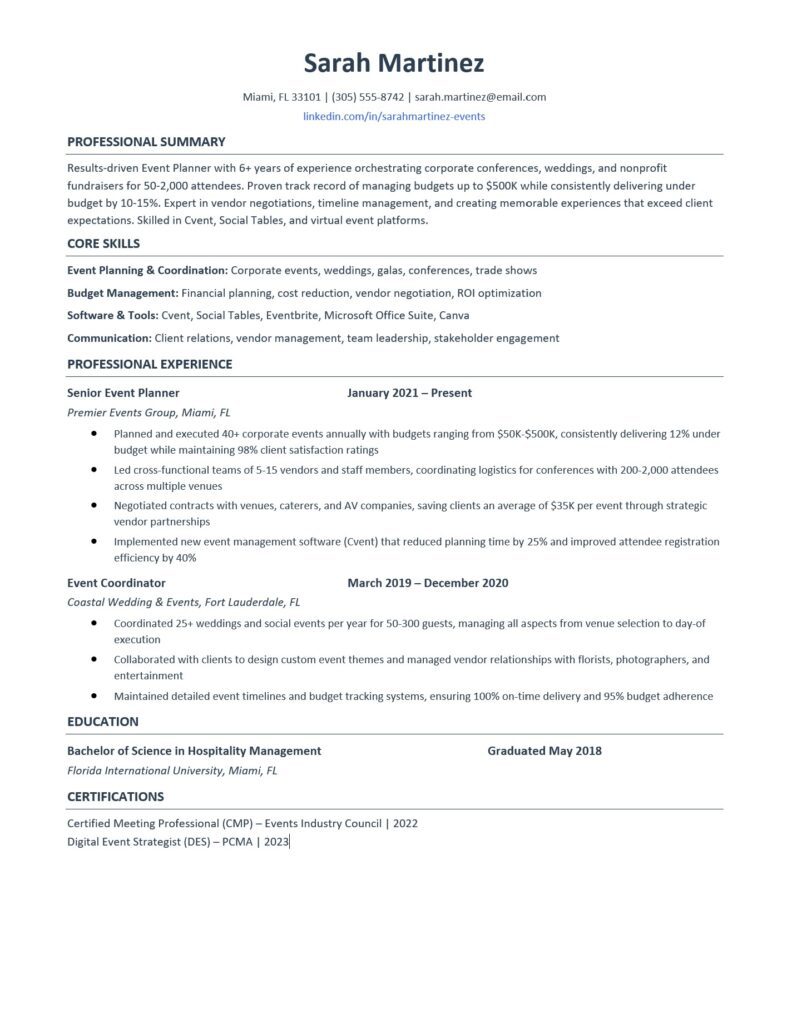
Here’s a professional event planner resume template you can download and customize. This template is designed to be both visually appealing and ATS-friendly, with clean formatting that highlights your strengths.
Blank Customizable Template
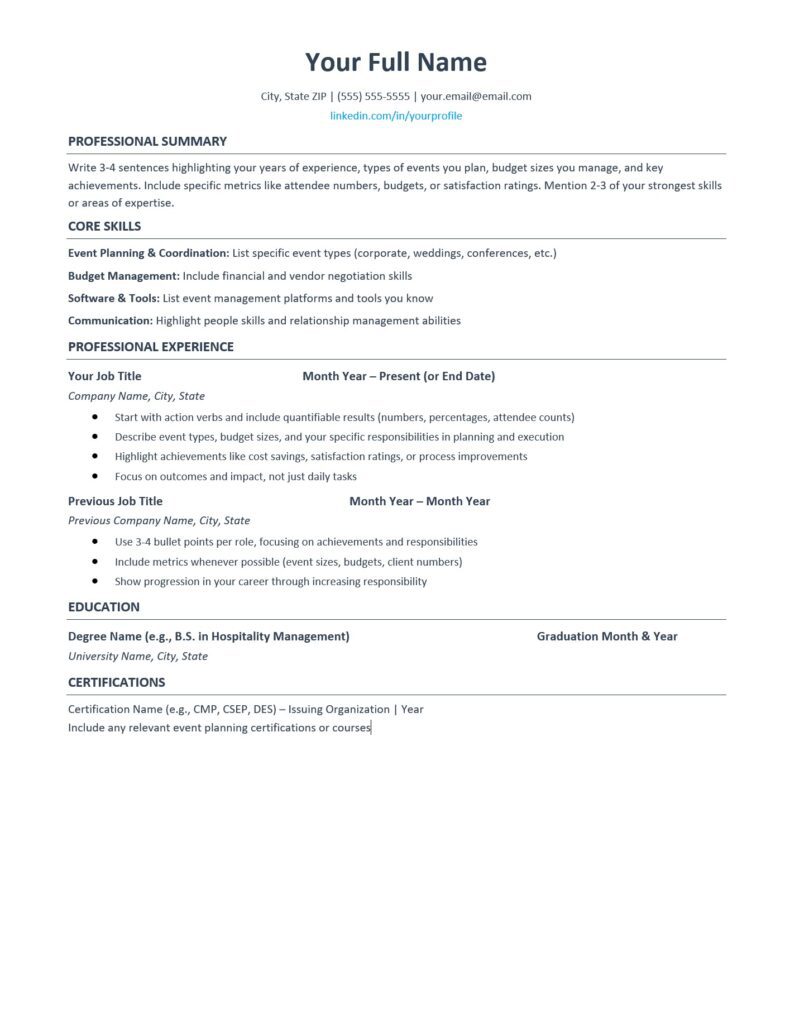
Download Your Free Template:
- Download DOCX Template (fully editable in Microsoft Word)
Interview Guys Tip: The DOCX template is fully editable, allowing you to adjust fonts, colors, and spacing to match your personal brand while maintaining professional formatting. Just replace the placeholder text with your own information.
Over 75% of resumes get rejected by ATS software before a human ever sees them…
The good news? You can test your resume before you apply. Want to know where you stand? Test your resume with our recommended ATS scanner →
Essential Components of an Event Planner Resume
The most effective event planner resumes follow a strategic structure that puts your strongest qualifications front and center.
Professional Summary
This is your elevator pitch in 3-4 sentences. Skip the generic “detail-oriented professional” language. Instead, open with your years of experience and event specialty.
Here’s what works: “Results-driven Event Planner with 6+ years orchestrating corporate conferences and nonprofit fundraisers for 100-1,500 attendees. Proven track record managing budgets up to $350K while consistently delivering 10-15% under budget.”
Notice how this immediately tells the hiring manager what types of events you handle, your experience level, and your track record with budgets. That’s powerful positioning in just two sentences.
Core Skills Section
Event planning requires both hard skills (software proficiency, budget management) and soft skills (client relations, problem-solving). Organize your skills into clear categories that align with the job description.
Most modern companies use Applicant Tracking Systems (ATS) to screen resumes, so including relevant keywords here is critical. Look at the job posting and mirror the language they use for required skills.
Technical skills might include Cvent, Social Tables, Eventbrite, or virtual event platforms. Don’t just list them. Show proficiency levels when possible, like “Expert in Cvent event management platform for registration and attendee tracking.”
Professional Experience
This is where many event planners lose the plot. Your experience section should read like a highlight reel, not a job description.
Each bullet point should follow a simple formula: Action verb + specific task + quantifiable result. For example: “Negotiated vendor contracts for 30+ annual events, reducing costs by $45K while maintaining service quality.”
Strong bullet points include:
- Event types and sizes (corporate conferences for 500 attendees, weddings for 150 guests)
- Budget amounts you managed
- Percentage of budget savings or efficiency improvements
- Client satisfaction scores or retention rates
- Team sizes you coordinated
- Process improvements you implemented
Focus on your most recent and relevant positions. If you’re applying for corporate event roles, emphasize your corporate experience even if you’ve also done weddings. Tailor your resume to match the opportunity.
For those transitioning into event planning from other fields, check out our guide on how to write a resume with no experience to learn how to highlight transferable skills effectively.
Education Section
While you don’t need a specific degree to become an event planner, relevant education strengthens your candidacy. Hospitality management, business administration, communications, and marketing degrees all apply to event planning roles.
Include your degree, institution, graduation year, and any relevant coursework or honors. If you participated in event planning activities during college (student organization events, fundraisers), consider adding a brief bullet point.
Certifications
Industry certifications can give you a significant edge, especially for corporate event planning positions. The most recognized certifications include:
- Certified Meeting Professional (CMP) from the Events Industry Council
- Certified Special Events Professional (CSEP) from the International Live Events Association
- Digital Event Strategist (DES) from PCMA
Research shows that CMP-certified planners earn approximately $10,700 more annually than non-certified peers. If you’re working toward a certification, include it as “In Progress” with your expected completion date.
How to Write Each Resume Section
Crafting Your Professional Summary
Start with your job title and experience level. Then add your specialization and biggest achievement.
Avoid vague statements like “passionate about creating memorable experiences.” Everyone says that. Instead, use concrete details: “Specialized in sustainable event practices, reducing event waste by 35% while maintaining attendee satisfaction above 95%.”
Keep it to 3-4 sentences maximum. This isn’t the place to tell your life story. Think of it as your career’s greatest hits.
Building Your Skills Section
Create clear categories that match how the industry thinks about event planning:
- Event Planning & Coordination: List event types
- Budget Management: Financial skills
- Software & Tools: Technical proficiencies
- Communication: People skills
When you’re applying for specific roles, review our resume keywords by industry guide to ensure you’re using terms that will pass ATS screening.
Interview Guys Tip: Don’t just copy the skills from the job description verbatim. Use them as a guide, but phrase them in ways that show depth. Instead of “vendor management,” write “vendor relationship management and contract negotiation.” It’s more specific and shows a higher level of expertise.
Writing Compelling Experience Bullets
Every bullet point should start with a strong action verb. Avoid repetition by varying your verbs: orchestrated, coordinated, managed, negotiated, implemented, streamlined, led, executed.
- Here’s a weak bullet point: “Responsible for planning company events.”
- Here’s a strong one: “Planned and executed 12 quarterly all-hands meetings for 800+ employees, implementing new interactive formats that increased engagement scores by 40%.”
The difference? Specificity and results. The second bullet tells you exactly what was done, how many people were involved, and what improved as a result.
When describing your achievements, use the framework from our SOAR Method guide to structure your accomplishments in a way that tells a compelling story while keeping bullets concise.
Common Mistakes to Avoid
Mistake #1: Generic Language
Words like “detail-oriented,” “team player,” and “hardworking” appear on virtually every resume. They don’t differentiate you. Instead of saying you’re detail-oriented, prove it with an example: “Maintained 100% accuracy in event timelines across 45 events, resulting in zero missed deadlines.”
Mistake #2: Focusing on Tasks Instead of Results
Nobody cares that you “managed vendor relationships.” They care that you “negotiated contracts with 15+ vendors, achieving 18% cost savings while improving service delivery ratings.”
Mistake #3: Including Irrelevant Information
That retail job from 10 years ago? Unless you’re entry-level, it probably doesn’t belong on your event planning resume. Keep your experience relevant to the role you’re pursuing.
Mistake #4: Poor Formatting
Dense blocks of text, inconsistent formatting, and cluttered layouts make your resume hard to scan. Remember that hiring managers spend an average of 7 seconds on initial resume screening. Make those seconds count with clean, organized formatting.
Mistake #5: Ignoring Keywords
If the job description emphasizes “corporate event management” and you only write “event coordination,” the ATS might filter you out. Use the actual language from the job posting throughout your resume where it genuinely applies.
For more resume pitfalls to avoid, explore our comprehensive guide on the top 10 resume mistakes.
ATS Optimization and Keywords
Understanding how ATS software works is crucial for event planners in 2025. These systems scan your resume for specific keywords before a human ever sees it.
How to optimize your resume for ATS:
- First, carefully read the job description and identify the most important terms. These typically include required skills, software platforms, and event types they’re looking for.
- Second, incorporate these keywords naturally throughout your resume. Don’t just stuff them in a skills section. Weave them into your professional summary and experience bullets where they make sense.
- Third, use standard section headings like “Professional Experience” and “Education” rather than creative alternatives like “My Journey” or “Where I’ve Been.” ATS systems are programmed to recognize conventional headings.
- Fourth, avoid complex formatting elements like tables, text boxes, headers, and footers. While these might look attractive to human readers, they can confuse ATS software and cause your information to be parsed incorrectly.
- Fifth, save your resume as a .docx file rather than a PDF unless the job posting specifically requests PDF. Many ATS systems handle Word documents more reliably.
Event planning keywords to consider including:
- Event types: corporate events, conferences, trade shows, galas, fundraisers, weddings, virtual events, hybrid events
- Technical skills: Cvent, Social Tables, Eventbrite, Zoom Events, Microsoft Office, Canva
- Hard skills: budget management, contract negotiation, vendor management, logistics coordination, timeline development, risk management
- Soft skills: communication, problem-solving, multitasking, attention to detail, client relations
When you land that interview, check out our article on event planner interview questions and answers to prepare for common questions about your experience and approach to event coordination.
Interview Guys Tip: Before you submit another application, run your resume through an ATS scanner. Most job seekers skip this step and wonder why they never hear back. Check out the free ATS checker we use and recommend →
Tailoring Your Resume for Different Event Planning Roles
Not all event planning positions are created equal. A corporate event planner role requires different emphasis than a wedding coordinator position.
Corporate Event Planning
Emphasize your experience with business events, conferences, and company gatherings. Highlight your understanding of corporate culture, ROI metrics, and professional stakeholder management. Include any experience with virtual or hybrid events, as these have become essential in corporate settings.
Wedding Planning
Focus on your creativity, client relationship management, and ability to handle emotionally charged situations with grace. Emphasize vendor networks in the wedding industry and any specialized knowledge like destination weddings or cultural ceremonies.
Nonprofit Event Planning
Highlight fundraising experience, volunteer coordination, and budget constraints management. Nonprofit organizations value planners who can deliver impressive results with limited resources.
Virtual and Hybrid Events
If you’re targeting roles that involve digital events, emphasize your technical proficiency with platforms like Zoom, Hopin, or Airmeet. Mention any experience with virtual engagement strategies and metrics tracking.
FAQ
How long should my event planner resume be?
For most event planners with less than 10 years of experience, stick to one page. If you have extensive experience across multiple event types or senior-level positions, two pages is acceptable. The key is ensuring every line adds value.
Should I include a portfolio or photos of events I’ve planned?
While you shouldn’t include actual photos on your resume, mention that you have a portfolio available upon request. Consider including a link to your LinkedIn profile or professional website where you showcase event highlights.
What if I’m transitioning into event planning from a different career?
Focus on transferable skills like project management, client relations, budget oversight, and coordination abilities. Any volunteer experience planning events for community organizations, schools, or religious institutions counts. Even if you haven’t been paid to plan events, you’ve likely organized activities that demonstrate relevant skills.
How do I address gaps in my employment history?
If you took time off and planned events during that period (family gatherings, community events, volunteer work), you can include a brief entry showing you maintained your skills. For longer gaps, our career gap strategies guide provides detailed approaches to address this effectively.
Should I use a creative resume design or stick with traditional formatting?
For event planning, you can afford slightly more visual interest than conservative fields like finance or law. However, don’t sacrifice readability for creativity. A clean design with strategic use of color and clear section divisions works best. Remember that ATS systems need to parse your information correctly, so save the most creative designs for your portfolio or personal website.
Conclusion
Your event planner resume is more than a list of past jobs. It’s a strategic document that positions you as the solution to a hiring manager’s staffing needs.
Focus on quantifiable achievements that demonstrate your ability to deliver exceptional events on time and under budget. Use industry-specific keywords that help your resume pass ATS screening. And most importantly, tailor every application to emphasize the experience most relevant to each specific role.
The templates provided here give you a solid foundation, but remember to customize them for your unique experience and the positions you’re targeting. Your resume should tell your story in a way that makes hiring managers eager to learn more.
Ready to explore more resume resources? Browse our free resume template library for templates across dozens of industries and career levels.
Start building your resume today, and take the first step toward landing that dream event planning role in 2025.
Not sure if your resume will pass the ATS?
You could have the perfect experience and still get filtered out by automated screening software. The good news? You can test your resume before you apply. Click the button to check out the ATS checker we use and recommend…

BY THE INTERVIEW GUYS (JEFF GILLIS & MIKE SIMPSON)
Mike Simpson: The authoritative voice on job interviews and careers, providing practical advice to job seekers around the world for over 12 years.
Jeff Gillis: The technical expert behind The Interview Guys, developing innovative tools and conducting deep research on hiring trends and the job market as a whole.