
Free Elementary School Teacher Resume Template 2026: ATS Examples & Writing Guide
Landing an elementary teaching position in 2026 means crafting a resume that speaks directly to what school administrators need right now. With over 106,500 kindergarten and elementary teaching positions projected to open each year, you’d think getting hired would be straightforward. But here’s the reality check: those positions attract thousands of qualified applicants, and most schools filter candidates through applicant tracking systems before anyone with hiring power sees your resume.
Your elementary teacher resume needs to do more than list where you’ve taught. It needs to prove you can manage diverse classrooms, integrate technology seamlessly, support students with different learning needs, and deliver measurable results. Whether you’re a first-year teacher fresh out of your certification program or a veteran educator looking for your next opportunity, the right resume format makes the difference between landing interviews and getting lost in the pile.
By the end of this article, you’ll have access to professionally designed elementary teacher resume templates, understand exactly what hiring committees look for in 2026, and know how to tailor your experience to match specific job postings. Plus, you’ll learn the crucial elements that help your resume pass ATS screening and catch principals’ attention. For when you land that interview, check out our elementary school teacher interview questions and answers guide.
☑️ Key Takeaways
- Elementary teacher resumes must highlight student outcomes with specific metrics like improved test scores or engagement rates to stand out to hiring committees
- State teaching licensure and certifications belong front and center since approximately 106,500 teaching positions open annually with strict credential requirements
- ATS optimization is critical as most schools use applicant tracking systems to screen resumes before human review
- Differentiated instruction and technology integration skills are now baseline expectations for elementary educators in 2026
What Makes an Elementary Teacher Resume Different in 2026
Elementary teacher resumes in 2026 face unique expectations that set them apart from other education roles. School districts want to see evidence that you can handle the complete elementary curriculum while supporting students at vastly different developmental stages, all in one classroom.
The key differentiators? First, principals expect to see your classroom management philosophy in action through concrete examples. Second, they’re looking for proof you can use educational technology not just for remote learning but as an everyday teaching tool. Third, data literacy matters more than ever because schools operate on outcome-based models where student progress drives funding and program decisions.
Your resume must also demonstrate cultural competency and differentiated instruction skills. Modern elementary classrooms include English language learners, students with IEPs, gifted learners, and everything in between. Showing you can reach all these students simultaneously is non-negotiable.
Finally, elementary teacher resumes need strong evidence of parent communication skills. Unlike secondary teachers who might interact with parents quarterly, elementary teachers typically maintain weekly or even daily contact with families. Your resume should reflect this collaborative approach to education.
Elementary School Teacher Resume Example
Here’s a professional resume example. This example gives you an idea of what type of content fits in a good ATS friendly resume.
Example Resume:

Here’s a professional elementary school teacher resume template you can download and customize. This template is designed to be both visually appealing and ATS-friendly, with clean formatting that highlights your strengths.
Blank Customizable Template
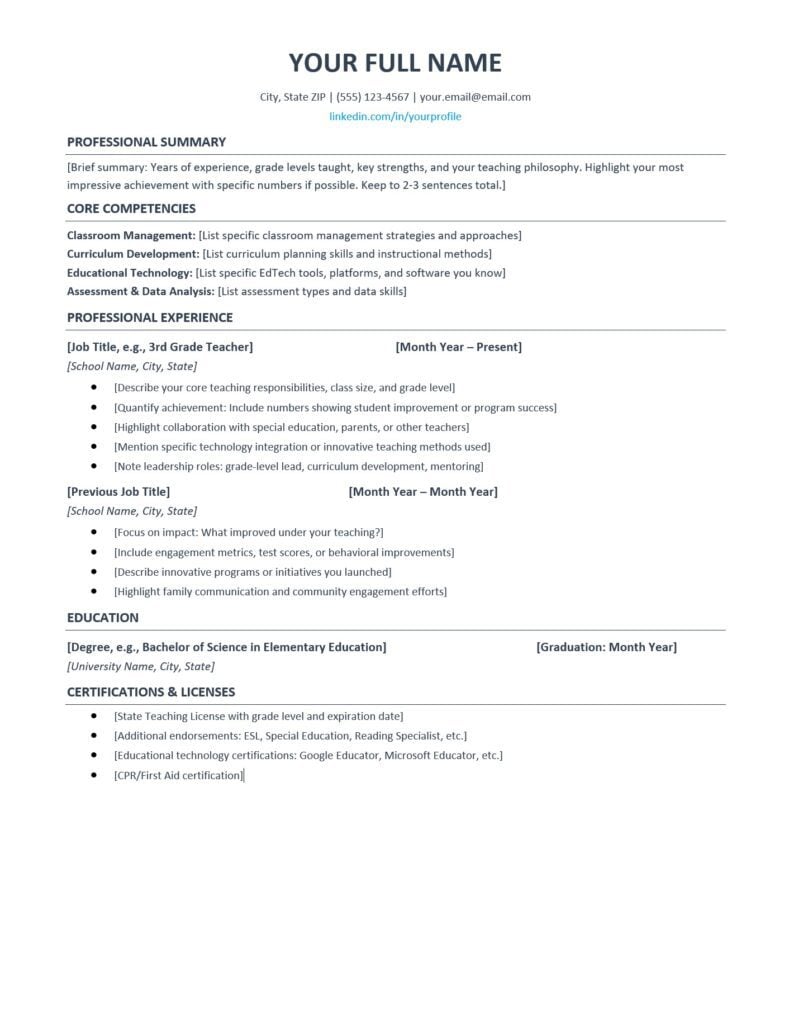
Download Your Free Template:
- Download DOCX Template (fully editable in Microsoft Word)
Interview Guys Tip: The DOCX template is fully editable, allowing you to adjust fonts, colors, and spacing to match your personal brand while maintaining professional formatting. Just replace the placeholder text with your own information.
Here’s what most people don’t realize: employers now expect multiple technical competencies, not just one specialization. The days of being “just a marketer” or “just an analyst” are over. You need AI skills, project management, data literacy, and more. Building that skill stack one $49 course at a time is expensive and slow. That’s why unlimited access makes sense:
Your Resume Needs Multiple Certificates. Here’s How to Get Them All…
We recommend Coursera Plus because it gives you unlimited access to 7,000+ courses and certificates from Google, IBM, Meta, and top universities. Build AI, data, marketing, and management skills for one annual fee. Free trial to start, and you can complete multiple certificates while others finish one.
Essential Components Every Elementary Teacher Resume Needs
Professional Summary That Captures Your Teaching Identity
Your professional summary sits at the top of your resume and determines whether administrators keep reading. Skip generic statements like “dedicated teacher who loves working with children.” Instead, lead with your years of experience, specific grade levels you’ve taught, and your most impressive quantifiable achievement.
A strong summary might read: “Elementary educator with 5 years of experience creating inclusive learning environments for grades 2-4. Increased student reading proficiency by 32% through implementation of guided reading groups and family literacy partnerships. Skilled in integrating Google Classroom and Seesaw to enhance student engagement and provide real-time feedback.”
Notice how this summary establishes expertise, provides concrete results, and demonstrates current technology skills. That’s what gets principals interested.
Interview Guys Tip: Your summary should match the specific grade level mentioned in the job posting. If they’re hiring for third grade, emphasize your third-grade experience even if you’ve taught other levels.
Core Competencies Section
Create a dedicated skills section that highlights your most relevant teaching competencies. Organize these strategically using categories that align with what schools need most:
- Classroom Management: Positive behavior interventions, restorative practices, collaborative learning environments
- Curriculum Development: Standards-aligned lesson planning, differentiated instruction, project-based learning
- Educational Technology: Google Classroom, Seesaw, Canvas LMS, interactive whiteboards, Kahoot
- Assessment & Data Analysis: Formative assessment, benchmark testing, data-driven instruction, IEP development
This format makes your resume scannable for both ATS systems and busy hiring committees. It also provides natural opportunities to include keywords from job descriptions, which dramatically improves your chances of making it through initial screening.
Professional Experience With Quantified Impact
Your work history section should read like a highlight reel of your teaching career, not a job description. For each position, include your title, school name, location, and employment dates. Then craft 4-6 bullet points that showcase your impact.
The secret to powerful experience bullets? Start with action verbs, include specific numbers, and focus on outcomes rather than responsibilities. Compare these two examples:
- Weak: “Taught fourth-grade students reading, writing, and math”
- Strong: “Improved student math proficiency scores by 24% over one academic year through implementation of small-group instruction and hands-on manipulatives for 26 fourth-graders”
The strong version tells employers exactly what you accomplished and proves you can deliver results. When possible, include metrics about student achievement, engagement rates, parent satisfaction, or program outcomes. Even rough estimates work better than vague claims.
For those without extensive teaching experience, highlight student teaching placements, tutoring roles, or educational volunteer work using the same results-focused approach. Schools understand everyone starts somewhere and want to see potential alongside accomplishment. Learn more about how to write a resume with no experience if you’re just starting your teaching career.
Education and Certifications
Your education section should lead with your most recent and relevant degree. Elementary teachers typically need at least a bachelor’s degree in elementary education or a related field. List your degree name, institution, location, and graduation date.
The certifications section is where elementary teacher resumes get serious attention. According to National Center for Education Statistics data, all public school teachers must hold state licensure, and hiring committees verify credentials immediately. List your teaching license prominently, including the specific grade levels it covers and expiration date.
Also include any additional endorsements like ESL, Special Education, Reading Specialist, or STEM certifications. These endorsements significantly expand your hiring opportunities and often come with salary increases. Don’t forget professional development certifications like Google Certified Educator or other EdTech credentials that demonstrate your commitment to staying current.
Interview Guys Tip: If your license is from a different state than where you’re applying, research reciprocity agreements. Many states have partnerships that allow credential transfer, but you’ll need to address this proactively in your application materials.
How to Write Each Resume Section for Maximum Impact
Creating Your Professional Summary
Your summary needs to accomplish three things in about 50-75 words: establish your credentials, highlight your teaching approach, and prove your impact. Think of it as your elevator pitch to the principal.
Begin by stating your years of experience and grade-level expertise. Then identify your teaching philosophy or specialization in one clear phrase. For example: “data-driven instruction,” “project-based learning,” or “inclusive classroom practices.” Finally, include one concrete achievement with numbers that proves you get results.
Avoid buzzwords without backing them up. Saying you’re “passionate about education” doesn’t differentiate you from anyone else. Saying you “increased student engagement by 40% through gamified learning activities” does.
Optimizing Your Skills Section
Your skills section needs to walk a fine line between being comprehensive and staying focused. Include 12-16 skills maximum, organized into logical categories. Draw directly from the job posting but only list skills you actually possess.
For ATS optimization, include both the full term and acronyms where relevant. For example: “Individualized Education Program (IEP) development” covers more keyword variations than just “IEP development.”
Balance hard skills (specific tools, methodologies, certifications) with soft skills (communication, empathy, collaboration). Elementary teaching requires both technical knowledge and interpersonal abilities, so your resume should reflect this dual focus.
Writing Achievement-Focused Experience Bullets
Transform your daily teaching responsibilities into compelling achievement statements using this formula: Action Verb + Specific Task + Quantified Result + Method or Context.
For example: “Increased reading fluency scores by 28% for 24 third-graders by implementing daily guided reading sessions and partnering with families on at-home reading goals.”
This bullet includes everything: what you did (increased scores), who it affected (24 third-graders), the result (28% improvement), and how you achieved it (guided reading and family partnerships).
When quantifying achievements, consider these metrics: student test scores, engagement rates, parent satisfaction surveys, behavioral incident reductions, program participation numbers, or grant funding secured. Even approximate numbers strengthen your resume significantly.
For more insights on presenting your teaching experience effectively, explore our guide on work experience on resume best practices.
Common Mistakes to Avoid on Elementary Teacher Resumes
Mistake 1: Generic Job Descriptions Instead of Achievements
Too many elementary teachers list responsibilities that apply to literally every teaching position. “Planned and delivered daily lessons” tells hiring committees nothing about your unique value. Instead, focus on what made your teaching exceptional. What innovative approaches did you try? What measurable improvements did your students show? What challenges did you overcome?
Mistake 2: Ignoring ATS Optimization
Applicant tracking systems scan resumes for specific keywords before human eyes ever see them. If your resume lacks the terms from the job posting, it might get filtered out automatically regardless of your qualifications. Study each job description carefully and naturally incorporate relevant keywords throughout your resume, especially in your skills and experience sections.
Interview Guys Tip: Don’t keyword stuff your resume with terms you can’t back up. ATS systems are sophisticated enough to detect unnatural keyword density, and if you get past the system, you’ll need to discuss these skills in your interview anyway.
Mistake 3: Skipping Quantifiable Results
Numbers make your achievements credible and memorable. Without metrics, hiring committees can’t gauge your impact. But don’t limit yourself to test scores. Track engagement rates, attendance improvements, parent conference participation, or classroom library usage. Any data point that shows positive change belongs on your resume.
Mistake 4: Poor Formatting That Confuses ATS
Complex resume templates with text boxes, tables, graphics, or multiple columns often crash ATS systems. Stick with clean, simple formatting using standard section headers like “Professional Experience,” “Education,” and “Certifications.” Use a common font like Calibri or Arial, and save your resume as both DOCX and PDF versions.
Mistake 5: Outdated Skills and Methods
Listing overhead projectors or chalkboard techniques signals you’re not keeping pace with modern teaching. Focus on current educational technology, contemporary classroom management strategies, and recent professional development. Schools want teachers who embrace innovation and continuous learning. Our how to update your resume for 2025 guide provides additional modernization tips.
ATS Optimization and Keywords for Elementary Teachers
Most school districts use applicant tracking systems to manage the flood of applications for each opening. According to industry research, over 98% of Fortune 500 companies use ATS, and school districts have rapidly adopted similar systems for efficiency.
Understanding how ATS works helps you optimize without sacrificing readability. These systems scan for keywords matching job requirements, then rank candidates based on how many relevant terms appear in their resumes. However, they also penalize obvious keyword stuffing and can’t parse overly complex formatting.
To optimize your elementary teacher resume for ATS:
- Use exact phrases from the job posting. If the listing mentions “differentiated instruction,” use that exact phrase rather than synonyms like “individualized learning” even though they mean similar things.
- Include both acronyms and full terms. Write “Individualized Education Program (IEP)” instead of just “IEP” to capture more search variations.
- Place keywords naturally in context. Don’t create a separate keyword dump section. Instead, weave terms throughout your summary, skills, and experience sections where they make sense.
- Stick to standard section headers. Use “Professional Experience” instead of creative alternatives like “My Teaching Journey.” ATS systems look for conventional section names.
- Save your resume in common formats. DOCX and PDF work best. Avoid unusual file types that might not parse correctly.
Interview Guys Tip: Before you submit another application, run your resume through an ATS scanner. Most job seekers skip this step and wonder why they never hear back. Check out the free ATS checker we use and recommend →
FAQ: Elementary Teacher Resume Questions
How long should my elementary teacher resume be?
Keep your resume to one page if you have less than 10 years of experience. Teachers with extensive careers can extend to two pages, but only if every line adds value. Hiring committees typically spend less than 10 seconds on initial resume reviews, so concise, impactful content wins.
Should I include my student teaching experience?
Absolutely, especially for new teachers. Student teaching demonstrates practical classroom experience even without paid employment. List it under Professional Experience with the same format as regular positions, including specific achievements and responsibilities.
What if I’m changing grade levels?
Emphasize transferable skills that apply across elementary grades: classroom management, parent communication, curriculum planning, and student assessment. In your summary, explain why you’re excited about the new grade level and how your experience prepares you for it.
Do I need a different resume for each application?
Yes. Tailoring your resume for each position significantly improves your chances. This doesn’t mean rewriting everything, but you should adjust your summary, reorder skills to match job posting priorities, and emphasize relevant experience. The extra 15 minutes per application pays off with more interview invitations.
How recent should my certifications be?
Current certifications matter most. If licenses or endorsements have expired, either renew them before applying or clearly note “pending renewal” with expected dates. Schools need teachers who can start immediately with all credentials in order.
Conclusion
Your elementary teacher resume opens doors to classrooms where you’ll shape young minds and build educational foundations that last a lifetime. But first, it needs to pass ATS screening and convince hiring committees you’re the educator their students need.
Focus on quantifiable achievements that prove your teaching impact. Optimize for ATS without sacrificing readability for human reviewers. Tailor each application to highlight your most relevant skills and experience for that specific position. And most importantly, let your genuine passion for elementary education shine through in concrete examples of student success.
Download our free templates to get started, and remember that your resume is just the first step. Once you land that interview, you’ll need to bring these accomplishments to life with confident, authentic communication. For more resume resources across different formats and industries, browse our free resume template library.
Interview Guys Tip: After customizing your resume, read it aloud to catch awkward phrasing or unclear statements. If something sounds off when spoken, it needs revision. Your resume should read as naturally as you’d speak about your teaching experience in an interview.
Now you have everything you need to create an elementary teacher resume that gets results. Download the templates, follow the strategies in this guide, and start applying to positions where you’ll make the biggest impact. Those eager students and appreciative parents are waiting for an educator just like you.
The reality is that most resume templates weren’t built with ATS systems or AI screening in mind, which means they might be getting filtered out before a human ever sees them. That’s why we created these free ATS and AI proof resume templates:
Still Using An Old Resume Template?
Hiring tools have changed — and most resumes just don’t cut it anymore. We just released a fresh set of ATS – and AI-proof resume templates designed for how hiring actually works in 2026 all for FREE.

BY THE INTERVIEW GUYS (JEFF GILLIS & MIKE SIMPSON)
Mike Simpson: The authoritative voice on job interviews and careers, providing practical advice to job seekers around the world for over 12 years.
Jeff Gillis: The technical expert behind The Interview Guys, developing innovative tools and conducting deep research on hiring trends and the job market as a whole.