
Free Correctional Officer Resume Template: ATS Examples & Writing Guide [2025]
Landing a correctional officer position requires more than just meeting the basic qualifications. You need a resume that immediately communicates your ability to maintain security, handle high-stress situations, and work effectively in one of the most challenging environments in law enforcement.
The reality is that your resume has about 6 seconds to make an impression before a hiring manager moves on to the next candidate. In corrections, where safety and reliability are paramount, your resume needs to quickly demonstrate that you have the right combination of vigilance, communication skills, and crisis management abilities.
By the end of this article, you’ll know exactly how to structure your correctional officer resume, which skills and keywords to emphasize, and how to showcase your experience in a way that stands out to both hiring managers and applicant tracking systems.
☑️ Key Takeaways
- Quantify your impact by including specific numbers like inmates supervised, incident reduction rates, and compliance percentages to demonstrate your effectiveness
- Lead with security-focused skills including crisis intervention, contraband detection, and emergency response that align with correctional facility requirements
- Structure matters for ATS by using clear section headings, relevant keywords from job descriptions, and standard formatting that passes automated screening
- Certifications give you an edge with corrections academy training, CPR/First Aid, and Crisis Intervention Team credentials prominently displayed
What Makes a Correctional Officer Resume Different?
Correctional officer resumes require a unique approach compared to other law enforcement positions. You’re not just showing that you can enforce rules. You’re demonstrating that you can maintain order in an unpredictable environment while balancing security concerns with rehabilitation goals.
The key difference is emphasis on crisis management over traditional law enforcement. While police officers focus on community interaction and criminal investigations, correctional officers need to highlight their ability to supervise large groups, conduct thorough searches, and respond to emergencies within confined spaces.
Your resume should reflect the reality of corrections work. Hiring managers at correctional facilities across the country are looking for candidates who can handle the daily grind of inmate supervision, the vigilance required for security protocols, and the composure needed when situations escalate.
Interview Guys Tip: Always tailor your resume to the specific facility type mentioned in the job posting. Maximum-security prisons require different skill emphasis than county jails or juvenile facilities. Highlight experience that matches the security level and inmate population of your target position.
Correctional Officer Resume Example
Here’s a professional resume example. This example gives you an idea of what type of content fits in a good ATS friendly resume.
Example Resume:
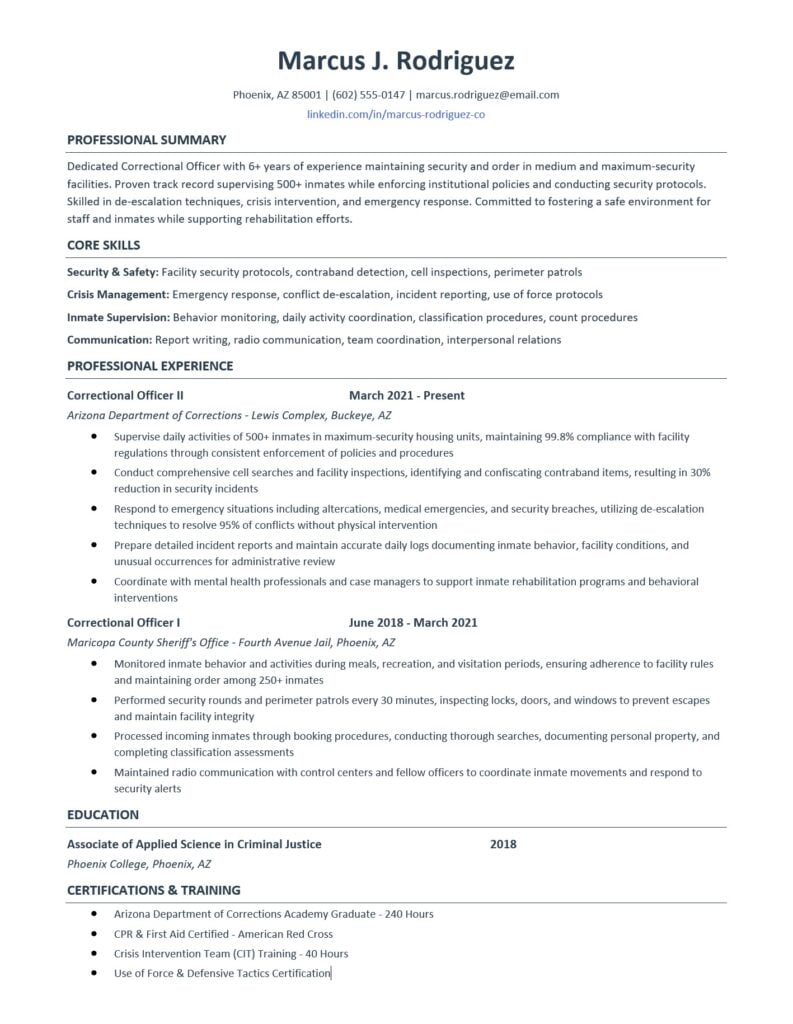
Here’s a professional correctional officer resume template you can download and customize. This template is designed to be both visually appealing and ATS-friendly, with clean formatting that highlights your strengths.
Blank Customizable Template
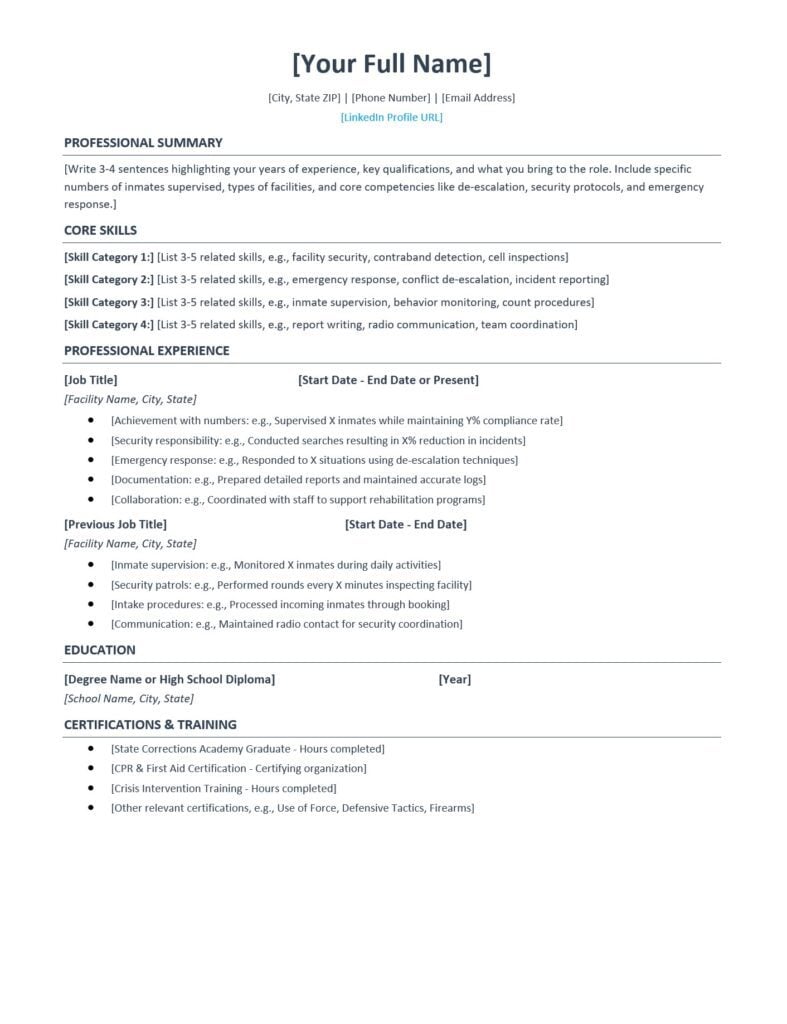
Download Your Free Template:
- Download DOCX Template (fully editable in Microsoft Word)
Interview Guys Tip: The DOCX template is fully editable, allowing you to adjust fonts, colors, and spacing to match your personal brand while maintaining professional formatting. Just replace the placeholder text with your own information.
Here’s what most people don’t realize: employers now expect multiple technical competencies, not just one specialization. The days of being “just a marketer” or “just an analyst” are over. You need AI skills, project management, data literacy, and more. Building that skill stack one $49 course at a time is expensive and slow. That’s why unlimited access makes sense:
Your Resume Needs Multiple Certificates. Here’s How to Get Them All…
We recommend Coursera Plus because it gives you unlimited access to 7,000+ courses and certificates from Google, IBM, Meta, and top universities. Build AI, data, marketing, and management skills for one annual fee. Free trial to start, and you can complete multiple certificates while others finish one.
Essential Components of a Correctional Officer Resume
Every strong correctional officer resume includes these core sections in a specific order that makes sense for the corrections field.
Professional Summary
Your professional summary sits at the top of your resume and serves as your elevator pitch. This 3-4 sentence section should immediately establish your experience level, core competencies, and what you bring to the role.
Don’t write a generic objective statement. Instead, lead with specific numbers and concrete achievements. For example: “Dedicated Correctional Officer with 6+ years of experience maintaining security and order in medium and maximum-security facilities. Proven track record supervising 500+ inmates while enforcing institutional policies and conducting security protocols.”
Include quantifiable metrics whenever possible. Did you maintain a certain compliance rate? Reduce security incidents? Supervise a specific number of inmates? These numbers give hiring managers immediate context about your level of responsibility.
Core Skills Section
The skills section is critical for getting past applicant tracking systems (ATS) that screen resumes before human eyes see them. Organize your skills into categories that align with correctional work.
Security and Safety skills should include facility security protocols, contraband detection, cell inspections, and perimeter patrols. Crisis Management covers emergency response, conflict de-escalation, incident reporting, and use of force protocols. Inmate Supervision encompasses behavior monitoring, daily activity coordination, classification procedures, and count procedures.
Don’t just list random skills. Each skill should be something you can back up with specific examples in your work experience section. The skills section acts as a preview of what you’ll demonstrate throughout your resume.
Professional Experience
This section carries the most weight on your resume. Structure each position with the job title and dates right-aligned, followed by the facility name and location in italics below.
Use bullet points that start with strong action verbs and include specific metrics. Instead of “Responsible for inmate supervision,” write “Supervised daily activities of 500+ inmates in maximum-security housing units, maintaining 99.8% compliance with facility regulations through consistent enforcement of policies and procedures.”
Each bullet point should follow the CAR format: Context (what was the situation), Action (what you did), and Result (what was the outcome). This approach works even better than the traditional STAR method for corrections because it focuses on the tangible impact of your work.
The most effective bullet points combine your responsibilities with measurable outcomes. “Conducted comprehensive cell searches and facility inspections, identifying and confiscating contraband items, resulting in 30% reduction in security incidents” tells a complete story of your effectiveness.
Interview Guys Tip: If you’re switching from a related field like security or military service, emphasize transferable skills like surveillance, access control, and emergency response. Many corrections departments value military experience and recognize how those skills translate to the corrections environment.
How to Write Each Section for Maximum Impact
Crafting Your Professional Summary
Your summary needs to establish credibility immediately. Start with your job title and years of experience, then move into your most relevant qualifications.
Be specific about facility types and inmate populations you’ve worked with. “Experience in maximum-security environments” tells hiring managers more than generic “corrections experience.” If you’ve worked with special populations like juveniles, mental health units, or segregation units, mention it.
Include your core competencies that align with the job posting. If the position emphasizes crisis intervention, make sure that shows up in your summary. If it’s a supervisory role, mention your leadership experience and team coordination abilities.
Selecting and Presenting Your Skills
The skills you highlight should mirror the job description while remaining truthful about your actual experience. Read through several correctional officer job postings and note which skills appear repeatedly.
Common high-value skills include emergency management, law enforcement procedures, criminal justice knowledge, public safety protocols, physical security, detention procedures, surveillance techniques, defensive tactics, first aid, and report writing.
Organize skills strategically. Put the most relevant skills for the position at the top of each category. If the job emphasizes de-escalation, make sure “conflict de-escalation” appears prominently rather than buried at the bottom of a long list.
Writing Powerful Experience Bullets
Every bullet point in your experience section should demonstrate your value through specific examples and outcomes. Avoid passive language like “was responsible for” or “duties included.”
Strong bullets follow this pattern: Action verb + specific task + quantifiable result. “Responded to emergency situations including altercations, medical emergencies, and security breaches, utilizing de-escalation techniques to resolve 95% of conflicts without physical intervention.”
Include details that show your understanding of corrections work. Don’t just say you “conducted searches.” Explain that you “performed security rounds and perimeter patrols every 30 minutes, inspecting locks, doors, and windows to prevent escapes and maintain facility integrity.”
Numbers matter enormously in corrections resumes. How many inmates did you supervise? What was your facility’s capacity? How often did you conduct counts or patrols? What percentage of incidents did you successfully de-escalate? These specifics separate you from candidates who only provide vague descriptions.
Education and Certifications
For correctional officers, your certifications often matter more than your degree. Most positions require at least a high school diploma, but specialized training and certifications demonstrate your commitment to the profession.
List your corrections academy training prominently with the number of hours completed. Include CPR and First Aid certification, Crisis Intervention Team (CIT) training, Use of Force certification, Defensive Tactics training, and any firearms qualifications.
If you have a degree in Criminal Justice, Psychology, or a related field, list it with the institution name, location, and graduation year. However, don’t worry if you don’t have a college degree. Relevant certifications and experience often carry more weight in corrections hiring.
Common Mistakes to Avoid
Many correctional officer candidates sabotage their chances with easily avoidable resume mistakes.
- Using generic language is the biggest error. Phrases like “hard worker” or “team player” tell hiring managers nothing specific about your qualifications. Instead, demonstrate these qualities through concrete examples of your work.
- Failing to quantify achievements is another common problem. When you write “supervised inmates,” the hiring manager has no context for the scope of your responsibility. “Supervised 250+ inmates during meals, recreation, and visitation periods” provides much clearer information.
- Listing job duties without showing results misses the point of a resume. Your experience section should show not just what you did, but what you accomplished and how well you did it. Focus on outcomes and impacts, not just responsibilities.
- Don’t neglect ATS optimization. Many corrections departments use applicant tracking systems to screen resumes before human review. If your resume doesn’t include the right keywords from the job description, it might get filtered out before anyone reads it.
Other mistakes include poor formatting that’s hard to read, spelling and grammar errors that suggest carelessness, including irrelevant work history that doesn’t relate to corrections, and making your resume longer than one page when you have less than 10 years of experience.
ATS Optimization and Keywords for Correctional Officers
Understanding how applicant tracking systems work gives you a significant advantage in the application process.
ATS software scans your resume for specific keywords that match the job description. These systems look for skills, certifications, and experience markers that align with the position requirements. If your resume doesn’t contain enough relevant keywords, it gets ranked lower or filtered out entirely.
Interview Guys Tip: Before you submit another application, run your resume through an ATS scanner. Most job seekers skip this step and wonder why they never hear back. Check out the free ATS checker we use and recommend →
The key is to naturally incorporate important terms throughout your resume without keyword stuffing. Read the job posting carefully and note which skills and qualifications are emphasized. Then ensure your resume includes those exact terms where they honestly apply to your experience.
Common ATS keywords for correctional officers include: facility security, inmate supervision, emergency response, crisis intervention, report writing, security protocols, contraband detection, behavior monitoring, conflict resolution, defensive tactics, use of force, classification procedures, radio communication, and incident reporting.
Use both the full term and common abbreviations when relevant. For example, write “Crisis Intervention Team (CIT)” to ensure the ATS recognizes both versions. Include specific systems or protocols mentioned in the job description, such as particular inmate management software or security procedures.
Interview Guys Tip: Mirror the language used in the job posting. If it says “detention facility,” use that exact term rather than substituting “correctional facility” or “jail.” ATS systems often look for exact phrase matches, so matching the employer’s terminology improves your chances of passing the automated screening.
Frequently Asked Questions
What’s the ideal length for a correctional officer resume?
One page is standard for correctional officers with less than 10 years of experience. The one-page limit forces you to focus on your most relevant and impressive qualifications. If you have 10+ years of experience or extensive relevant certifications, a two-page resume is acceptable, but make sure every line adds value.
Should I include military experience on my corrections resume?
Absolutely. Military experience is highly valued in corrections because it demonstrates discipline, ability to follow protocols, experience with chain of command, and often includes relevant skills like weapons handling and crisis response. Translate your military experience into civilian terms and emphasize aspects that align with corrections work.
How do I address employment gaps in my corrections career?
Be honest but strategic. If you have gaps, focus attention on your strongest, most recent experience. Consider including relevant activities during gaps such as additional training, volunteer work, or professional development. A brief explanation in your cover letter can provide context without dwelling on the gap.
What if I’m transitioning from security or law enforcement to corrections?
Emphasize transferable skills like surveillance, access control, emergency response, report writing, and working with difficult populations. Many security and police officers successfully transition to corrections by highlighting how their current skills apply to the corrections environment. Focus on relevant experience rather than listing duties that don’t translate.
Do I need a different resume for different types of correctional facilities?
Yes, tailoring your resume to the specific facility type significantly improves your chances. A federal prison job posting might emphasize different skills than a county jail position. Juvenile facilities focus more on rehabilitation and counseling skills, while maximum-security prisons prioritize security protocols and crisis management. Adjust your skills emphasis and experience bullets to match each application.
Ready to Land Your Next Corrections Position
Creating a strong correctional officer resume takes effort, but the payoff is worth it when you land interviews at top facilities. Remember to quantify your achievements, use relevant keywords throughout, and structure your resume for both human readers and ATS systems.
Start with one of our professionally designed templates, then customize it with your specific experience and accomplishments. Focus on demonstrating your ability to maintain security, handle crisis situations, and contribute to a safe facility environment.
Once you’ve perfected your resume, prepare for correctional officer interview questions to complete your application strategy. Browse our complete collection of free resume templates for additional formats and career fields.
Your next corrections career opportunity is waiting. Use these templates and strategies to create a resume that gets you to the interview stage, where you can demonstrate in person why you’re the right fit for the position.
Here’s what most people don’t realize: employers now expect multiple technical competencies, not just one specialization. The days of being “just a marketer” or “just an analyst” are over. You need AI skills, project management, data literacy, and more. Building that skill stack one $49 course at a time is expensive and slow. That’s why unlimited access makes sense:
Your Resume Needs Multiple Certificates. Here’s How to Get Them All…
We recommend Coursera Plus because it gives you unlimited access to 7,000+ courses and certificates from Google, IBM, Meta, and top universities. Build AI, data, marketing, and management skills for one annual fee. Free trial to start, and you can complete multiple certificates while others finish one.

BY THE INTERVIEW GUYS (JEFF GILLIS & MIKE SIMPSON)
Mike Simpson: The authoritative voice on job interviews and careers, providing practical advice to job seekers around the world for over 12 years.
Jeff Gillis: The technical expert behind The Interview Guys, developing innovative tools and conducting deep research on hiring trends and the job market as a whole.