
Free CNA Resume Template 2025: ATS Examples & Writing Guide
You’ve completed your CNA training, passed your state certification exam, and you’re ready to start making a difference in patients’ lives. There’s just one obstacle standing between you and that perfect nursing assistant position: your resume.
Here’s the challenge. The Bureau of Labor Statistics reports that nursing assistant positions will see over 211,800 openings annually through 2034, yet many qualified CNAs struggle to get interview callbacks because their resumes don’t effectively showcase their patient care skills and certifications. Your resume has about six seconds to capture a hiring manager’s attention, and if it doesn’t immediately highlight your credentials and experience, you’re out of the running.
The good news? Creating a standout CNA resume doesn’t require expensive resume writers or complicated templates. With the right structure, strategic keyword placement, and clear demonstration of your patient care abilities, you can build a resume that gets you noticed.
By the end of this article, you’ll have a complete, professional CNA resume template you can download and customize, plus expert guidance on writing each section to showcase your skills effectively. We’ll cover everything from proper certification formatting to quantifying your patient care achievements, ensuring your resume passes both applicant tracking systems and impresses human hiring managers.
☑️ Key Takeaways
- Certifications belong front and center on CNA resumes since employers verify state credentials before considering other qualifications
- Quantify your patient care experience with specific numbers like “provided care for 15+ residents daily” rather than vague descriptions
- Use the SOAR Method to structure your achievements, showing how you overcame obstacles to deliver excellent patient outcomes
- ATS-friendly formatting matters because 75% of CNA applications are initially screened by applicant tracking systems before human review
What Makes a CNA Resume Different From Other Healthcare Resumes?
CNA resumes have unique requirements that set them apart from other healthcare positions. Unlike RN or LPN resumes that emphasize clinical decision-making and medication administration, your CNA resume should highlight hands-on patient care, ADL assistance, and your ability to work under nursing supervision.
The most critical distinction is certification prominence. Employers verify your state CNA certification before reviewing anything else on your resume. According to CNA certification requirements, every state mandates active certification on the Nurse Aide Registry, making this your most important credential.
Another key difference is the emphasis on soft skills alongside technical abilities. While you need to demonstrate proficiency in vital signs monitoring and medical documentation, hiring managers equally value your compassion, patience, and ability to maintain patient dignity during personal care tasks. This balance between clinical competence and interpersonal excellence defines successful CNA resumes.
Interview Guys Tip: Don’t bury your CNA certification in a long list of credentials. Place it prominently in its own section near the top of your resume, including your state license number and expiration date. This shows employers you understand regulatory compliance from the start.
CNA Resume Example
Here’s a professional CNA resume example. This example gives you an idea of what type of content fits in a good ATS friendly resume.
Example Resume:
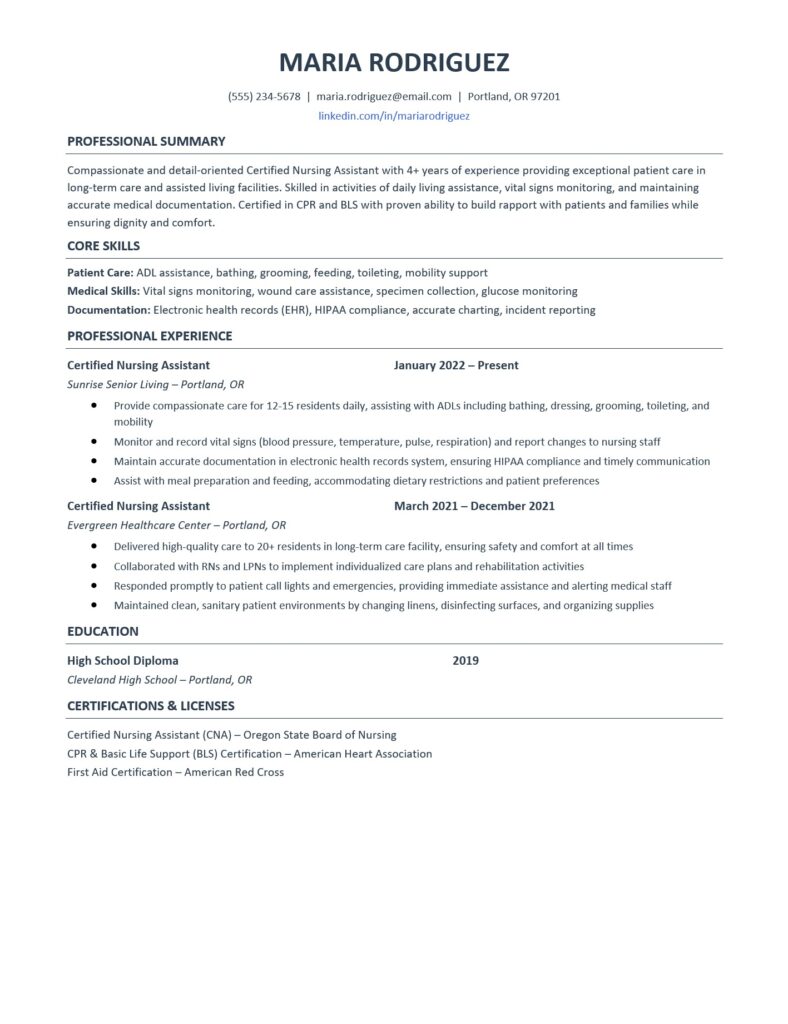
Here’s a professional CNA resume template you can download and customize. This template is designed to be both visually appealing and ATS-friendly, with clean formatting that highlights your strengths.
Blank Customizable Template
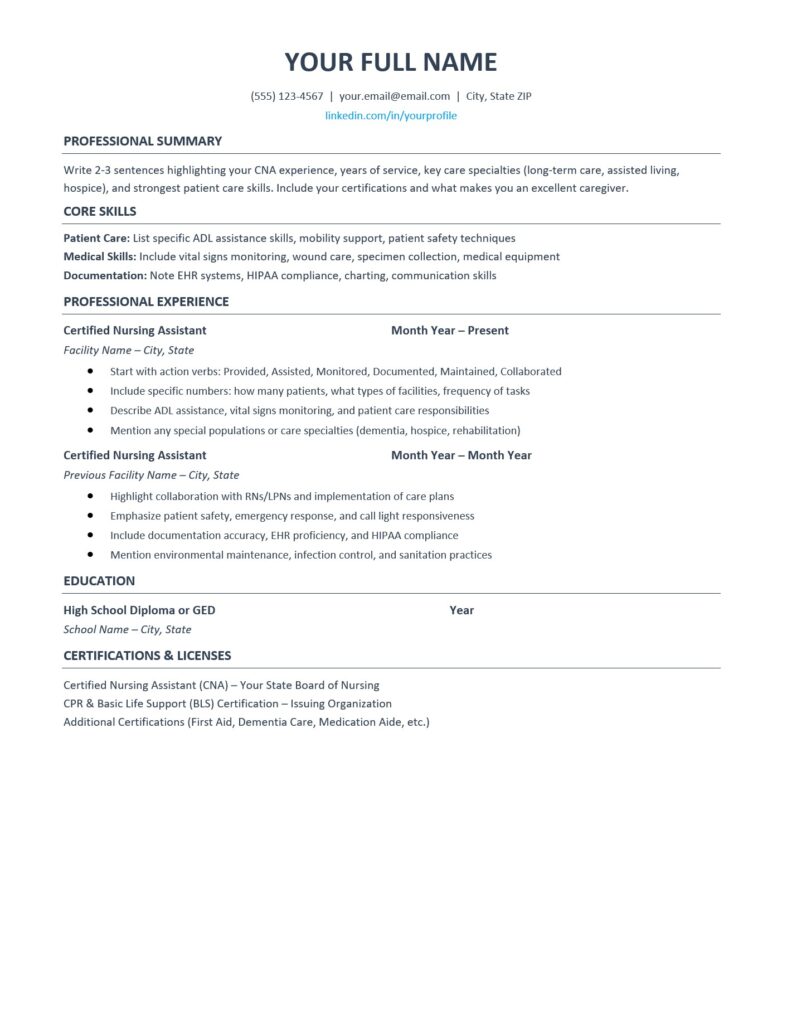
Download Your Free Template:
- Download DOCX Template (fully editable in Microsoft Word)
Interview Guys Tip: The DOCX template is fully editable, allowing you to adjust fonts, colors, and spacing to match your personal brand while maintaining professional formatting. Just replace the placeholder text with your own information.
Here’s what most people don’t realize: employers now expect multiple technical competencies, not just one specialization. The days of being “just a marketer” or “just an analyst” are over. You need AI skills, project management, data literacy, and more. Building that skill stack one $49 course at a time is expensive and slow. That’s why unlimited access makes sense:
Your Resume Needs Multiple Certificates. Here’s How to Get Them All…
We recommend Coursera Plus because it gives you unlimited access to 7,000+ courses and certificates from Google, IBM, Meta, and top universities. Build AI, data, marketing, and management skills for one annual fee. Free trial to start, and you can complete multiple certificates while others finish one.
Essential Components of a CNA Resume
Every effective CNA resume includes six core sections that work together to tell your professional story. Let’s break down what belongs in each section and why it matters.
Professional Summary
Your professional summary is your elevator pitch in 2-3 sentences. This section appears right below your contact information and should immediately establish your experience level, care specialties, and key qualifications.
Focus on measurable experience (years worked, types of facilities, patient populations served) and your strongest care competencies. Mention your certifications here since they’re your most important qualifications. Avoid generic phrases like “hardworking” or “team player” without specific evidence.
Core Skills Section
Your Core Skills section serves two purposes: it helps your resume pass applicant tracking systems by including relevant keywords, and it gives hiring managers a quick snapshot of your capabilities.
Organize skills into logical categories like Patient Care, Medical Skills, and Documentation. Use specific terminology that appears in CNA job descriptions: ADL assistance, vital signs monitoring, EHR systems, HIPAA compliance, mobility support, and specimen collection.
Professional Experience
This section carries the most weight on your resume. Each position should include your job title, facility name, location, and employment dates. Use 3-5 bullet points per position to describe your responsibilities and achievements.
Start each bullet point with strong action verbs like Provided, Assisted, Monitored, Documented, Maintained, or Collaborated. More importantly, quantify your experience whenever possible. Instead of “Assisted patients with daily activities,” write “Provided compassionate ADL assistance to 12-15 residents daily, including bathing, dressing, grooming, and mobility support.”
Interview Guys Tip: When describing achievements, use the SOAR Method (Situation, Obstacle, Action, Result) rather than just listing duties. For example: “When staffing shortages created patient care delays (Situation/Obstacle), reorganized workflow and prioritized tasks by urgency (Action), maintaining 100% on-time medication assistance and zero patient complaints (Result).”
Looking to ace your interview once your resume lands you a callback? Check out our guide to CNA interview questions to prepare winning answers.
Education
For CNAs, education is straightforward. List your high school diploma or GED, including the school name, location, and graduation year. If you completed your CNA training through a specific program (community college, vocational school, or healthcare facility), you can include this as well, though your certification proves completion.
Certifications & Licenses
This section is non-negotiable for CNAs. List your state CNA certification first, followed by CPR/BLS certification, and any additional credentials like First Aid, Dementia Care, or Medication Aide certifications.
Include the full certification name, issuing organization, and current status. If your certifications require renewal dates, ensure they’re current before submitting your resume. Expired certifications are red flags that can immediately disqualify your application.
Optional Sections
Depending on your experience, you might include additional sections for Languages (critical in diverse patient populations), Professional Affiliations (like the National Association of Health Care Assistants), or Volunteer Work (especially if it demonstrates healthcare experience).
How to Write Each Resume Section for Maximum Impact
Let’s dive deeper into writing each section with examples that demonstrate best practices.
Crafting Your Professional Summary
Your summary should answer three questions: Who are you professionally? What makes you qualified? What value do you bring?
Strong example: “Compassionate and detail-oriented Certified Nursing Assistant with 4+ years of experience providing exceptional patient care in long-term care and assisted living facilities. Skilled in ADL assistance, vital signs monitoring, and maintaining accurate EHR documentation. Certified in CPR and BLS with proven ability to build rapport with patients and families while ensuring dignity and comfort.”
This summary works because it includes specific experience duration (4+ years), care settings (long-term care, assisted living), key skills (ADL assistance, vital signs, EHR), and certifications (CPR, BLS). It also emphasizes patient-centered care values.
Weak example: “Hard-working nursing assistant looking for a position where I can use my skills. Good with people and very responsible.”
This fails because it’s vague, focuses on what you want rather than what you offer, and provides no specific evidence of qualifications.
Optimizing Your Skills Section
Organize skills into 3-4 categories that reflect CNA job requirements. Under each category, list 4-6 specific skills using language from healthcare job descriptions.
- Patient Care: ADL assistance, bathing, grooming, feeding, toileting, mobility support, transfer assistance, fall prevention
- Medical Skills: Vital signs monitoring (blood pressure, temperature, pulse, respiration), glucose monitoring, catheter care assistance, wound care assistance, specimen collection, oxygen equipment monitoring
- Documentation & Communication: Electronic health records (EHR systems like Epic, Meditech), HIPAA compliance, accurate charting, incident reporting, patient advocacy, interdisciplinary team collaboration
- Specialized Care: Dementia care, hospice support, rehabilitation assistance, pediatric care, post-operative care
Writing Compelling Experience Bullets
The difference between an average CNA resume and an exceptional one often comes down to how you describe your experience. Follow this formula for each bullet point:
Action Verb + Specific Task + Quantifiable Detail + Patient Impact
Strong example: “Monitored and recorded vital signs for 20+ residents four times daily, promptly reporting abnormal readings to nursing staff, resulting in early intervention for three potentially serious health events.”
This bullet includes the action (Monitored), what you did (recorded vital signs), how often and for how many patients (20+ residents, four times daily), and the positive outcome (early intervention).
Compare this to a weak bullet: “Took vital signs and reported to nurses.” This version lacks specificity, numbers, and demonstrated impact.
For new CNAs with limited work experience, draw from your clinical training rotations. Describe the same types of tasks and responsibilities, just frame them as training experience rather than employment.
Formatting Your Certifications Properly
State CNA Certification Format: Certified Nursing Assistant (CNA) – [Your State] Board of Nursing License #[Your Number] | Valid through [Expiration Date]
BLS/CPR Format: CPR & Basic Life Support (BLS) Certification – American Heart Association Valid through [Expiration Date]
Always include expiration dates for time-sensitive certifications. This demonstrates attention to detail and shows you understand regulatory compliance. If a certification is expiring soon, renew it before job searching.
Common Mistakes That Kill CNA Resumes
Even qualified CNAs make resume mistakes that cost them interviews. Avoid these common pitfalls:
Using Generic Job Descriptions
Don’t just copy your official job description onto your resume. Hiring managers can spot templated language immediately. Instead, personalize each bullet point with specific examples from your experience.
Leaving Out Quantifiable Details
Numbers make your experience concrete and memorable. Whenever possible, include:
- Number of patients/residents you cared for
- Frequency of tasks (daily, per shift, weekly)
- Size of care teams you worked with
- Specific improvements or outcomes you contributed to
Forgetting to Tailor for Each Application
The CNA resume that works for a hospital position might not work for a nursing home role. Review each job posting carefully and adjust your skills and experience highlights to match what that specific employer values most.
Assisted living facilities often prioritize ADL assistance and creating a homelike environment. Hospitals emphasize vital signs monitoring, mobility assistance, and working with acute care patients. Long-term care facilities value dementia care experience and building long-term patient relationships.
Omitting Soft Skills Evidence
Technical skills get you through the ATS, but soft skills get you hired. Instead of just listing “compassionate” or “patient,” demonstrate these qualities through your achievement bullets. Show how you handled challenging patient situations, built trust with families, or went above and beyond for patient comfort.
Including Irrelevant Information
Your resume should focus on healthcare-relevant experience. Unless your previous non-healthcare job demonstrates transferable skills like customer service, time management, or working under pressure, leave it off or minimize it to one line.
ATS Optimization for CNA Resumes
According to industry research, approximately 75% of resumes are rejected by applicant tracking systems before a human ever sees them. Understanding how these systems work helps you optimize your resume for success.
Interview Guys Tip: Before you submit another application, run your resume through an ATS scanner. Most job seekers skip this step and wonder why they never hear back. Check out the free ATS checker we use and recommend →
How ATS Systems Screen CNA Resumes
ATS software scans your resume for keywords that match the job description. For CNA positions, systems look for terms like “certified nursing assistant,” “patient care,” “ADL assistance,” “vital signs,” “BLS certification,” and specific care settings mentioned in the posting.
The system also evaluates your resume format. Complex designs, tables, headers/footers, text boxes, and graphics confuse ATS software and may cause your resume to be rejected for formatting issues rather than lack of qualifications.
Essential Keywords for CNA Resumes
Include these high-value keywords naturally throughout your resume:
- Certified Nursing Assistant (CNA)
- Activities of Daily Living (ADL)
- Patient care
- Vital signs monitoring
- Electronic Health Records (EHR)
- HIPAA compliance
- Long-term care / Assisted living / Skilled nursing
- CPR/BLS certified
- Patient safety
- Infection control
- Medical documentation
Interview Guys Tip: Don’t just stuff keywords into your resume hoping to beat the ATS. Use them naturally in context, describing actual skills and responsibilities. Modern ATS systems are sophisticated enough to recognize keyword stuffing and may penalize your application.
Formatting Best Practices for ATS
Use a clean, single-column layout with standard fonts (Calibri, Arial, Times New Roman). Stick to standard section headings like “Professional Experience,” “Education,” and “Certifications” rather than creative alternatives that ATS might not recognize.
Save your resume as a .docx file unless the job posting specifically requests PDF format. Some older ATS systems have trouble parsing PDFs, though this is becoming less common.
Want to compare your resume against specific job descriptions? Our resume optimization resources can help you identify missing keywords and formatting issues.
Special Situations: Adapting Your CNA Resume
Not every CNA follows the traditional career path. Here’s how to handle common resume challenges:
New CNAs With No Professional Experience
Just completed your training? Focus heavily on your clinical rotations. Treat your hands-on training experience like a job, describing the same tasks and responsibilities you performed in clinical settings.
Include volunteer work, internships, or any patient-facing experience, even if unpaid. Emphasize your fresh training and current knowledge of best practices. New certifications with no renewal needed can actually be a selling point.
Career Changers Transitioning to CNA Work
Highlight transferable skills from previous careers. Customer service experience translates to patient interaction skills. Food service demonstrates attention to hygiene and safety protocols. Retail shows ability to work varied shifts and handle physically demanding work.
Create a skills-focused resume format that emphasizes your CNA training and certifications at the top, followed by relevant transferable skills, then employment history.
Returning CNAs Re-entering the Field
If you’re returning after a career break, address the gap honestly but briefly. You can use a summary statement mentioning your total years of CNA experience (combining your previous and current work) to minimize attention on the gap.
Emphasize that your certifications are current and you’ve completed any required continuing education. Consider taking a refresher course if you’ve been away from patient care for several years.
Frequently Asked Questions
How long should a CNA resume be?
Keep your resume to one page, especially if you have less than 10 years of experience. Focus on your most recent and relevant positions, using the strongest achievements from each role. Hiring managers spend only seconds on initial resume reviews, so concise, impactful content beats comprehensive detail.
Should I include references on my CNA resume?
No. The phrase “references available upon request” is outdated and wastes valuable resume space. Prepare a separate reference list with 3-4 professional contacts, but only provide it when specifically requested by the employer. Make sure you’ve asked permission from your references beforehand.
What if my CNA certification is from a different state than where I’m applying?
Many states have reciprocity agreements allowing you to transfer your CNA certification. Research CNA reciprocity requirements for your target state. On your resume, list your current state certification and add a note that you’re eligible for reciprocity transfer or in the process of transferring your credentials.
How often should I update my CNA resume?
Update your resume every 3-6 months, even when you’re not actively job searching. Add new achievements, skills, or certifications as you earn them. This approach ensures you don’t forget important accomplishments and keeps your resume ready for unexpected opportunities.
Can I use the same resume for hospital, nursing home, and home health positions?
While the core content stays the same, you should customize your resume for each care setting. Emphasize hospital-relevant skills (acute care, mobility assistance, vital signs monitoring) for hospital positions, or highlight ADL assistance, dementia care, and building long-term relationships for nursing home roles. This targeted approach significantly improves your interview callback rate.
Conclusion
Your CNA resume is more than just a list of jobs and certifications. It’s your professional introduction, demonstrating not just what you’ve done but how effectively you care for patients. By following the templates and guidance in this article, you’ve learned how to structure each resume section, quantify your patient care achievements, optimize for applicant tracking systems, and avoid common mistakes that kill applications.
Remember to download both our example resume for inspiration and our blank template for easy customization. Keep your resume updated regularly, tailor it for each application, and ensure all certifications remain current.
Ready to build your complete job search toolkit? Browse our free resume template library for additional healthcare and general employment templates.
Your compassionate patient care deserves a resume that opens doors. Download your free CNA resume template today and take the next step toward landing the nursing assistant position you deserve.
The reality is that most resume templates weren’t built with ATS systems or AI screening in mind, which means they might be getting filtered out before a human ever sees them. That’s why we created these free ATS and AI proof resume templates:
Still Using An Old Resume Template?
Hiring tools have changed — and most resumes just don’t cut it anymore. We just released a fresh set of ATS – and AI-proof resume templates designed for how hiring actually works in 2026 all for FREE.

BY THE INTERVIEW GUYS (JEFF GILLIS & MIKE SIMPSON)
Mike Simpson: The authoritative voice on job interviews and careers, providing practical advice to job seekers around the world for over 12 years.
Jeff Gillis: The technical expert behind The Interview Guys, developing innovative tools and conducting deep research on hiring trends and the job market as a whole.