
Free Hospitality Resume Template 2025: ATS Example + Complete Writing Guide

Getting your hospitality resume noticed in 2025 requires more than just listing your work history. With the industry experiencing a surge in hiring as travel rebounds, hotels and resorts are flooded with applications for every open position.
Your resume needs to immediately demonstrate your ability to deliver exceptional guest experiences while managing the operational complexities that keep properties running smoothly.
The hospitality industry is unique. Hiring managers aren’t just looking for someone who can show up on time. They want professionals who can turn a frustrated guest into a loyal customer, who understand revenue management principles, and who can seamlessly coordinate with multiple departments to ensure flawless service delivery.
Your resume needs to prove you’re that person within the first six seconds of review.
By the end of this article, you’ll have access to professionally designed hospitality resume templates and understand exactly how to showcase your guest service excellence, operational achievements, and industry certifications in a way that gets you interviews at top properties. Whether you’re applying for front desk roles, management positions, or specialized hospitality careers, these templates will help you stand out from other candidates and land your dream job in this exciting industry.
☑️ Key Takeaways
- Quantified achievements showing guest satisfaction scores and operational improvements are essential for hospitality resumes
- Industry-specific certifications like CGSP or CHA can increase your interview chances by demonstrating commitment to excellence
- ATS-optimized formatting with proper keywords from job descriptions helps you pass initial resume screenings
- Front-loaded skills sections that highlight both guest relations and technical proficiencies make hiring managers take notice
What Makes a Hospitality Resume Different?
Hospitality resumes require a careful balance between demonstrating people skills and operational competency. Unlike corporate roles where technical expertise dominates, hospitality positions demand proven ability to create memorable guest experiences while simultaneously managing logistics, budgets, and teams.
Your resume needs to speak the language of the hospitality industry. This means using metrics that matter to hotel operators:
- Guest satisfaction scores
- Occupancy rates
- Revenue per available room
- Upsell conversion percentages
- Complaint resolution rates
Generic statements about being a “team player” or “hard worker” won’t cut it when you’re competing against candidates who can demonstrate they increased upsell revenue by 32% or maintained 98% positive guest feedback scores.
The best hospitality resumes also adapt to the specific role you’re targeting. A front desk position emphasizes customer interaction and system proficiency, while a management role highlights leadership achievements and financial performance. Understanding these nuances and tailoring your resume accordingly makes the difference between getting the interview and getting passed over.
Is your resume actually getting through? You’ve read the ATS guides. Now find out if your resume passes. Upload it below for a free score in 60 seconds.
Hospitality Resume Example
Here’s a professional hospitality resume example. This example gives you an idea of what type of content fits in a good ATS friendly resume.
Example Resume:

Here’s a professional hospitality resume template you can download and customize. This template is designed to be both visually appealing and ATS-friendly, with clean formatting that highlights your strengths.
Blank Customizable Template
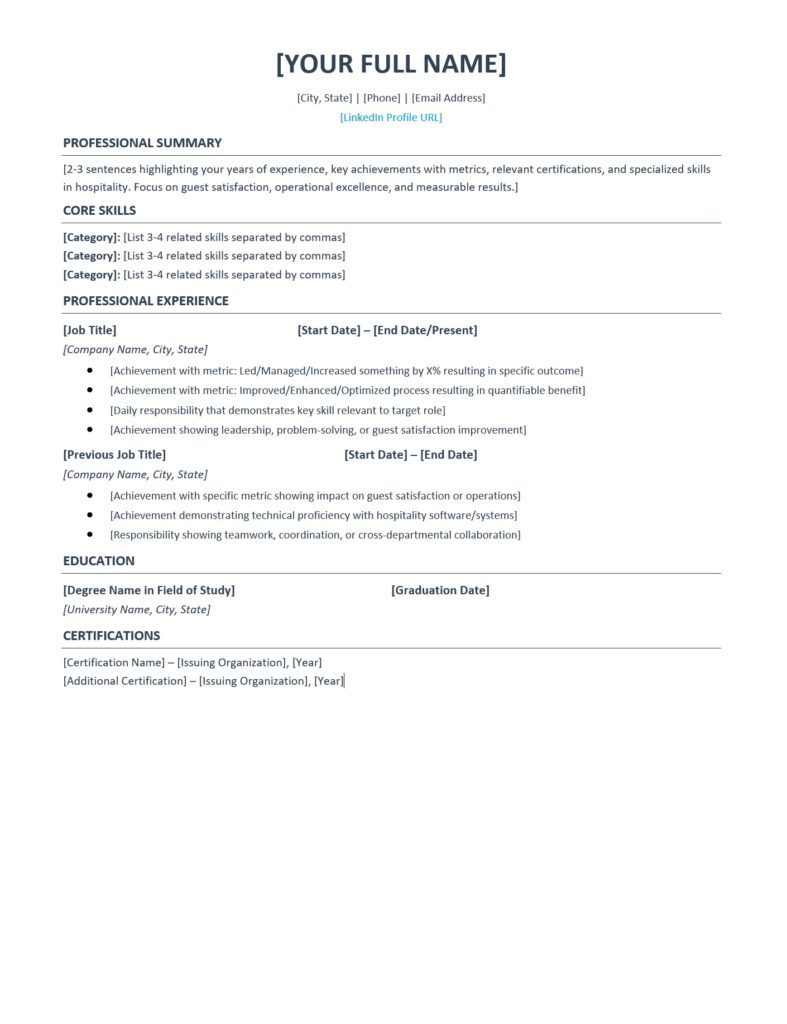
Download Your Free Template:
- Download DOCX Template (fully editable in Microsoft Word)
Interview Guys Tip: The DOCX template is fully editable, allowing you to adjust fonts, colors, and spacing to match your personal brand while maintaining professional formatting. Just replace the placeholder text with your own information.
Here’s what most people don’t realize: employers now expect multiple technical competencies, not just one specialization. The days of being “just a marketer” or “just an analyst” are over. You need AI skills, project management, data literacy, and more. Building that skill stack one $49 course at a time is expensive and slow. That’s why unlimited access makes sense:
Your Resume Needs Multiple Certificates. Here’s How to Get Them All…
We recommend Coursera Plus because it gives you unlimited access to 7,000+ courses and certificates from Google, IBM, Meta, and top universities. Build AI, data, marketing, and management skills for one annual fee. Free trial to start, and you can complete multiple certificates while others finish one.
Essential Components of a Hospitality Resume
Every effective hospitality resume includes several critical sections that work together to tell your professional story.
Professional Summary
This 2-3 sentence section appears first and serves as your elevator pitch to hiring managers. It should highlight:
- Your years of hospitality experience
- Your most impressive quantified achievement
- Specialized skills or certifications that set you apart
Core Skills Section
Organize skills into clear categories that make it easy for hiring managers to quickly identify your capabilities:
- Guest Relations: Customer service excellence, conflict resolution, VIP management
- Operations: Front desk management, revenue optimization, staff scheduling
- Technical: Property management systems, POS systems, booking platforms
This structure also helps your resume pass through applicant tracking systems that scan for specific keywords.
Professional Experience
The heart of your resume. Each position should include 3-5 bullet points that emphasize measurable achievements rather than basic job duties.
- Instead of: “Managed front desk operations”
- Write: “Led team of 12 front desk associates at 350-room luxury property, achieving 95% guest satisfaction rating”
Education and Certifications
These sections validate your knowledge and commitment to professional development. In hospitality, relevant certifications from organizations like the American Hotel & Lodging Educational Institute can significantly strengthen your candidacy, especially for supervisory and management roles.
How to Write Your Professional Summary
Your professional summary needs to capture attention immediately. Follow this three-part formula:
1. Start with your experience and specialization
Begin with your years of hospitality experience and the specific segment you specialize in, whether that’s luxury hotels, resort operations, or boutique properties. This immediately tells hiring managers whether you’re the right fit for their environment.
2. Include your most impressive quantified achievement
Did you increase guest satisfaction scores? Reduce operational costs? Improve staff retention? Choose the metric that best demonstrates your value and directly relates to the position you’re targeting. Numbers provide concrete evidence of your capabilities in ways that qualitative statements never can.
Interview Guys Tip: If you’re new to hospitality and lack extensive metrics, focus on transferable skills from other customer service roles and emphasize your education or recent certifications. Highlight any internships, volunteer work at events, or relevant coursework that demonstrates your commitment to the industry.
3. Close with specialized skills or certifications
Mention what sets you apart:
- Fluency in multiple languages
- Expertise with specific property management systems
- Credentials like the Certified Guest Service Professional designation
These details help you stand out in a sea of generic applications.
Crafting Your Core Skills Section
The skills section requires strategic thinking about both what hiring managers want and what ATS systems scan for. Review the job description carefully and identify keywords that appear repeatedly.
How to organize your skills:
Create 3-4 logical categories instead of presenting a random list:
Guest Relations
- Customer Service Excellence
- VIP Guest Management
- Complaint Resolution
- Multilingual Communication
Operations Management
- Front Desk Coordination
- Revenue Optimization
- Staff Scheduling
- Inventory Control
Technical Proficiencies
- Opera PMS or OnQ Systems
- Point of Sale Systems
- Reservation Platforms
- Microsoft Office Suite
The sweet spot: Include approximately 9-12 skills total, distributed across your categories. This demonstrates breadth of capability without overwhelming the reader.
Remember that every skill you list should be something you’re prepared to discuss in detail during an interview. Don’t include skills you used years ago or only have superficial knowledge of.
Writing Achievement-Focused Experience Bullets
Transforming your job responsibilities into achievement-focused bullets requires a specific formula:
The Achievement Formula:
[Action Verb] + [Specific Task] + [Quantified Result]
Examples:
✓ “Implemented new check-in procedures that reduced wait times by 40% and increased guest satisfaction scores from 87% to 95%”
✓ “Trained 15 new hires on property management systems, resulting in 30% faster processing times and zero booking errors in first month”
✓ “Coordinated with housekeeping and maintenance departments to optimize room turnover, improving efficiency by 28%”
When you lack specific metrics:
Estimate based on the scope of your work. If you managed the front desk at a 200-room hotel with average 80% occupancy, you can calculate that you:
- Checked in approximately 160 guests daily
- Processed 58,000 guest interactions annually
- Managed room inventory worth $2.5+ million in revenue
These numbers provide context about the scale of your responsibilities.
Interview Guys Tip: Use the SOAR Method when preparing to discuss your achievements in interviews. Describe the Situation you faced, the Obstacles you encountered, the Actions you took, and the Results you achieved. This structured approach helps you tell compelling stories about your experience that resonate with hiring managers.
Focus on these high-value achievement areas:
- Guest satisfaction improvements
- Revenue increases through upselling
- Operational efficiency gains
- Successful team leadership
- Problem resolution metrics
- Staff retention improvements
When you’re ready for your interview, having these quantified stories prepared will set you apart from other candidates.
Education and Certification Strategy
Recent graduates: Position education near the top of your resume, immediately after the skills section. This highlights your fresh, current knowledge and compensates for limited work experience.
Experienced professionals: Place education after the experience section since work achievements carry more weight.
What to include in your education section:
- Degree name
- Institution name and location
- Graduation date
- Relevant coursework (if graduated within 5 years)
- Academic achievements or hospitality projects
Example: “Capstone project designing revenue management system for boutique hotel” shows applied knowledge that employers value.
Certifications deserve their own dedicated section
In hospitality, credentials significantly impact hiring decisions. According to the American Hotel & Lodging Educational Institute, industry certifications demonstrate commitment to professional standards and can accelerate career advancement.
Top hospitality certifications to consider:
- Certified Guest Service Professional (CGSP) – Demonstrates service excellence
- Certified Hospitality Supervisor (CHS) – Shows supervisory competency
- Certified Hotel Administrator (CHA) – Prestigious credential for managers
- ServSafe Food Handler – Essential for food service operations
- Certified Hospitality Revenue Manager (CHRM) – Validates revenue optimization skills
Even if not required for your target role, these credentials show initiative and industry knowledge that separate you from candidates who only have experience.
ATS Optimization and Keywords
Understanding applicant tracking systems is non-negotiable in 2025. Research indicates that over 98% of Fortune 500 companies use ATS to screen resumes before human eyes ever see them.
Your beautifully designed resume won’t matter if it never reaches a hiring manager because it failed the automated screening.
How ATS systems work:
ATS scans resumes for keywords that match the job description. When a hotel posts a job seeking someone with “Opera PMS experience” and “conflict resolution skills,” those exact phrases need to appear in your resume.
ATS-friendly formatting rules:
✓ Use standard section headings: “Professional Experience” and “Education” ✓ Stick with standard fonts: Calibri, Arial, or Times New Roman (10-12 pt) ✓ Avoid tables, text boxes, headers, and footers ✓ Skip graphics and images ✓ Save as DOCX or PDF (per job posting instructions)
Test your resume: Save it as plain text to see what an ATS might extract. If the formatting looks jumbled or information disappears, simplify your layout.
Clean, straightforward formatting ensures both ATS systems and humans can easily read your resume.
Common Hospitality Resume Mistakes to Avoid
Mistake #1: Generic job descriptions instead of specific achievements
❌ “Provided excellent customer service” ✓ “Maintained 96% positive guest feedback rating across 500+ monthly interactions”
Mistake #2: Inconsistent verb tenses
Current positions need present tense. Past positions require past tense. This seemingly minor detail matters because inconsistency suggests carelessness, a trait hotels cannot afford.
Mistake #3: Overlooking relevant volunteer experience
If you volunteered to coordinate a charity event serving 500 guests, that’s highly relevant hospitality experience even though it wasn’t paid work. Focus on relevance to your target role rather than only including traditional employment.
Mistake #4: Using the same resume for every application
When you apply to both a luxury resort and a budget hotel with identical resumes, you’re ignoring the distinct priorities of each property type. Tailoring your resume to emphasize the specific skills and experience each employer values dramatically increases your interview chances.
Mistake #5: Unexplained employment gaps
Never leave gaps unexplained. Brief, honest explanations work best:
- “Career break to care for family member”
- “Professional development period completing hospitality certifications”
- “Travel sabbatical to gain international hospitality perspective”
Interview Guys Tip: Address the gap briefly in a way that shows it’s behind you and you’re ready to contribute fully to your next role.
Industry-Specific Keywords That Get Results
Guest-focused keywords:
These represent the core mission of hospitality operations and should appear multiple times throughout your resume:
- Guest satisfaction
- Service excellence
- Customer experience
- Guest relations
- Hospitality standards
Operational keywords:
Show you understand the business side of hospitality:
- Revenue management
- Inventory control
- Staff scheduling
- Vendor relations
- Occupancy optimization
- Cost control
Technology keywords:
Increasingly important as properties modernize:
- Opera PMS
- Maestro PMS
- Cloudbeds
- Point of sale systems
- Reservation platforms
- Guest feedback management tools
Soft skills integration:
Rather than simply listing “leadership” or “communication,” incorporate these concepts into your achievement bullets:
❌ Skills: “Leadership, Communication, Problem-solving”
✓ Experience: “Led cross-functional team of 15 staff members to implement new guest communication protocol, reducing response times by 50%”
This approach satisfies ATS keyword requirements while providing meaningful context for human readers.
Leveraging Your Hospitality Resume for Career Growth
Your resume serves as more than just a job application tool. It’s also a strategic document for career planning and advancement.
Use your resume to:
Track your professional growth Regularly update your resume with new achievements, certifications, and skills. This helps you identify areas for development and see patterns in your career trajectory.
Identify skill gaps Compare your resume to job postings for your target roles. Notice gaps in certifications or technical proficiencies? You’ve identified clear development opportunities worth pursuing.
Prepare for networking Maintaining a current, achievement-focused resume means you’re ready to share your professional story when opportunities arise at conferences, through former colleagues, or via industry connections.
Target different hospitality segments Consider creating multiple versions optimized for different segments:
- Luxury hotels: Emphasize refined service and VIP guest management
- Resorts: Highlight recreation programming and event coordination
- Boutique properties: Focus on personalized service and unique guest experiences
This targeted approach dramatically improves your relevance for specific opportunities and shows you understand the distinct priorities of each property type. It’s worth the extra effort when it helps you advance toward your career goals.
FAQ: Hospitality Resume Questions
How long should a hospitality resume be?
One page is ideal for professionals with less than 10 years of experience. You can extend to two pages if you have extensive relevant experience, multiple certifications, or significant achievements that warrant the space. However, ensure every line provides value and directly supports your candidacy. Hiring managers spend limited time reviewing each resume, so conciseness matters.
Should I include references on my hospitality resume?
No, references don’t belong on your resume in 2025. Instead, prepare a separate reference sheet to provide when requested. Use the valuable resume space to showcase your achievements and skills. The phrase “References available upon request” is also unnecessary and outdated.
How do I address employment gaps in hospitality?
Be honest but brief. If you took time off to travel, pursue education, or handle family matters, include a brief line explaining the gap with dates. For example, “Professional Development Period (2023): Completed Certified Hospitality Manager certification while caring for family member.” This shows the gap was purposeful and you remained professionally engaged.
What if I’m changing careers into hospitality?
Focus your resume on transferable skills like customer service, problem-solving, team collaboration, and adaptability. Emphasize any volunteer experience with events, customer-facing retail work, or service industry roles. Include relevant hospitality coursework or certifications that demonstrate your commitment to the industry. Position yourself as bringing valuable outside perspectives that can benefit hospitality operations.
Do hospitality employers care about cover letters?
Yes, especially for management positions and luxury properties. A well-crafted cover letter demonstrates communication skills and genuine interest in the specific property. It’s your opportunity to explain why you’re passionate about their brand and how your experience aligns with their values. Never send a generic cover letter when a thoughtful, customized one could set you apart.
Your hospitality resume represents your professional brand and opens doors to rewarding career opportunities in one of the world’s most dynamic industries. The templates provided give you a strong foundation, but success comes from customizing them to reflect your unique achievements and the specific requirements of your target roles.
Remember that quantified achievements always trump generic responsibilities. Demonstrate your impact through numbers whenever possible, whether that’s guest satisfaction scores, revenue increases, or operational improvements. These concrete metrics prove your value in ways that adjectives never can.
Take advantage of industry certifications to strengthen your credibility and show commitment to professional excellence. Credentials like CGSP or CHA signal to employers that you’re serious about your hospitality career and willing to invest in your development. Combined with a well-crafted, achievement-focused resume, these certifications significantly improve your interview prospects.
Ready to explore more resume templates for different career paths? Check out our comprehensive free resume template library to find the perfect format for your needs.
Is your resume actually getting through? You’ve read the ATS guides. Now find out if your resume passes. Upload it below for a free score in 60 seconds.
Advice like this is the general version. Longbow scores your actual resume against the actual job you want and shows you what's missing, before the filters decide for you. Here's why we built it.

ABOUT THE INTERVIEW GUYS (JEFF GILLIS & MIKE SIMPSON)
Mike Simpson: Co-founder of The Interview Guys and Longbow. He has been the voice behind our interview advice since 2013 — his work has reached over 100 million job seekers around the world. The strategic mind behind Longbow, our new career platform.
Jeff Gillis: Co-founder of The Interview Guys and Longbow. He built the systems that put our work in front of those readers, and he leads the engineering on Longbow, the cutting edge career platform built for today’s job seeker.