
Free Medical Receptionist Resume Template 2025: Examples & ATS Writing Guide

Getting hired as a medical receptionist in 2025 means your resume needs to speak two languages fluently: healthcare and technology.
Healthcare facilities receive hundreds of applications for each front desk position. Most never make it past the initial screening because they’re missing critical keywords, lack measurable achievements, or fail to demonstrate the unique blend of skills medical receptionists need. Your resume has about six seconds to convince a hiring manager you’re worth an interview.
The good news? You don’t need to start from scratch.
This guide walks you through creating a standout medical receptionist resume using our free downloadable templates. Whether you’re transitioning from retail or have years of healthcare experience, you’ll learn exactly what to include, how to format it for both human readers and applicant tracking systems, and which skills matter most to hiring managers in 2025.
By the end of this article, you’ll have a complete resume that positions you as the organized, tech-savvy, patient-focused professional every healthcare facility desperately needs.
☑️ Key Takeaways
- Medical receptionist resumes require specific healthcare skills including EHR proficiency, insurance verification, and HIPAA compliance to pass ATS systems
- Quantify your patient impact with metrics like number of patients managed daily, wait time reductions, or appointment accuracy rates to stand out
- Front desk experience translates directly to medical reception when you emphasize customer service, multitasking, and attention to detail
- Certifications boost your competitiveness with CMAA, HIPAA compliance training, or CPR certification demonstrating commitment to healthcare standards
What Makes a Medical Receptionist Resume Different?
Medical receptionist resumes require more than standard administrative skills. Healthcare facilities need proof you can handle protected health information responsibly, navigate complex insurance systems, and maintain composure in high-stress situations.
The three pillars of a strong medical receptionist resume are healthcare administration knowledge, technical proficiency, and patient care skills. Generic receptionist experience matters, but you need to translate it into healthcare-specific language that resonates with medical office managers.
Unlike corporate reception roles, medical receptionists must demonstrate understanding of HIPAA compliance, medical terminology, and electronic health record systems. Over 98% of healthcare organizations use some form of EHR system, making technical proficiency non-negotiable.
Interview Guys Tip: Even if you’re new to healthcare, highlight transferable skills from customer service roles. Fast-paced retail or hospitality experience demonstrates the multitasking abilities and stress management crucial for busy medical offices.
Your resume also needs to pass applicant tracking systems before any human sees it. These software programs scan for specific keywords from the job description. A resume stuffed with generic phrases like “hardworking” or “team player” gets filtered out immediately.
Before you send that resume: most Medical Receptionist resumes get filtered out by ATS before a human ever sees them. Upload yours and find out your score. It takes 60 seconds and it’s free.
Medical Receptionist Resume Example
Here’s a professional resume example. This example gives you an idea of what type of content fits in a good ATS friendly resume.
Example Resume:
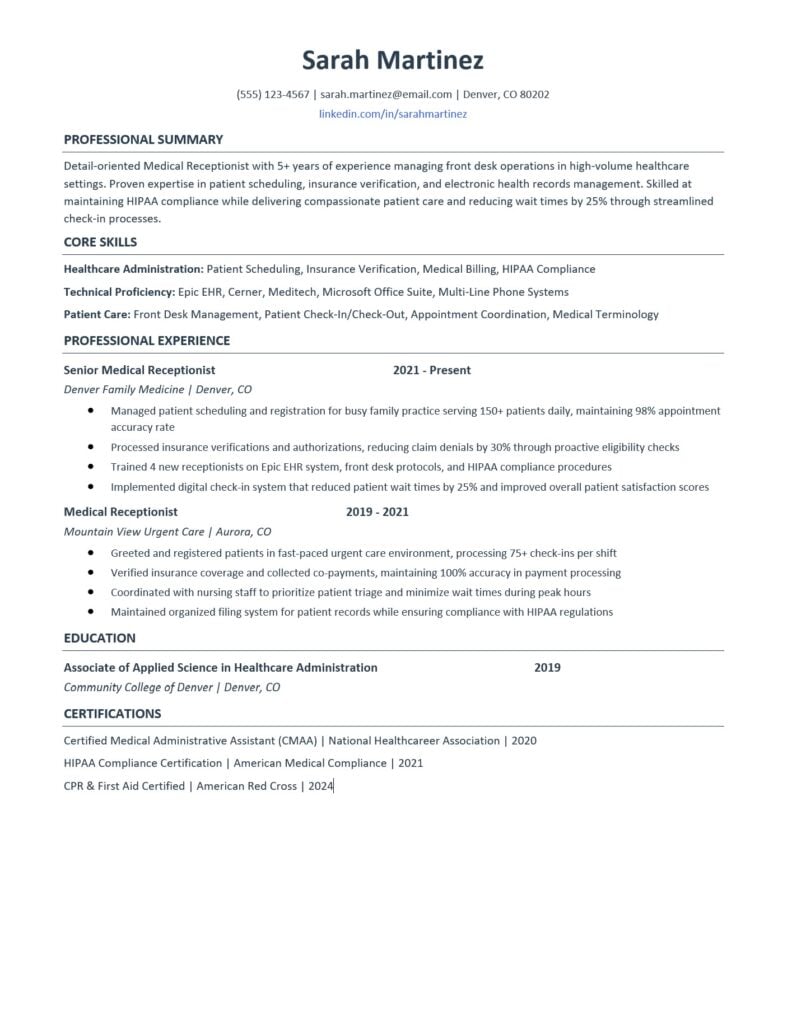
Here’s a professional medical receptionist resume template you can download and customize. This template is designed to be both visually appealing and ATS-friendly, with clean formatting that highlights your strengths.
Blank Customizable Template

Download Your Free Template:
- Download DOCX Template (fully editable in Microsoft Word)
Interview Guys Tip: The DOCX template is fully editable, allowing you to adjust fonts, colors, and spacing to match your personal brand while maintaining professional formatting. Just replace the placeholder text with your own information.
Here’s what most people don’t realize: employers now expect multiple technical competencies, not just one specialization. The days of being “just a marketer” or “just an analyst” are over. You need AI skills, project management, data literacy, and more. Building that skill stack one $49 course at a time is expensive and slow. That’s why unlimited access makes sense:
Your Resume Needs Multiple Certificates. Here’s How to Get Them All…
We recommend Coursera Plus because it gives you unlimited access to 7,000+ courses and certificates from Google, IBM, Meta, and top universities. Build AI, data, marketing, and management skills for one annual fee. Free trial to start, and you can complete multiple certificates while others finish one.
Essential Resume Components for Medical Receptionists
Your medical receptionist resume needs five core sections arranged strategically to maximize impact.
Start with contact information prominently displayed at the top, including your phone number, professional email address, city and state, and LinkedIn profile. Never include your full street address for privacy reasons.
Next comes your professional summary, a 2-3 sentence snapshot of your qualifications. This section should immediately establish your years of experience, highlight key technical skills, and include at least one quantifiable achievement. Think of it as your elevator pitch on paper.
The core skills section follows, organized into clear categories that match the job description. Healthcare administration skills, technical proficiencies, and patient care abilities should each get their own subsection for easy scanning. If you’re looking for comprehensive guidance on how to structure your resume sections, we have a detailed blueprint that breaks down every component.
Professional experience forms the heart of your resume. List positions in reverse chronological order, with your most recent role first. Each job needs the title, employer name, location, and dates. More importantly, your bullet points must showcase specific achievements rather than generic duties.
Finally, include education and certifications. A high school diploma or equivalent is the minimum requirement, but relevant coursework or healthcare certifications significantly strengthen your application.
How to Write Your Professional Summary
Your professional summary needs to accomplish three things in just 50-75 words: establish credibility, showcase relevant skills, and prove measurable impact.
Start with your experience level and specialty. “Detail-oriented Medical Receptionist with 5+ years in high-volume primary care settings” immediately tells hiring managers you’re not entry-level and you understand their environment.
Next, highlight your technical competencies. Mention specific EHR systems you’ve used like Epic, Cerner, or Meditech. Reference insurance verification, patient scheduling, or medical billing expertise. These keywords help you pass ATS screening.
End with a quantifiable achievement that demonstrates your value. “Reduced patient wait times by 25% through streamlined check-in processes” or “Maintained 98% appointment accuracy across 150+ daily patient interactions” proves you deliver results.
Avoid vague statements like “hardworking receptionist with good communication skills.” Every candidate claims those qualities. Your summary should feel specific to you and immediately relevant to the position you’re applying for.
Interview Guys Tip: Tailor your professional summary for each application by pulling 2-3 key requirements from the job description and weaving them naturally into your summary. This customization dramatically improves your chances of passing ATS screening.
Building Your Core Skills Section
The skills section functions as your keyword optimization tool and your quick-reference guide for busy hiring managers.
Organize skills into three clear categories: Healthcare Administration, Technical Proficiency, and Patient Care. This structure helps both humans and ATS systems quickly identify your qualifications.
Under Healthcare Administration, list competencies like patient scheduling, insurance verification, medical billing, HIPAA compliance, and prior authorization processing. These prove you understand the business side of healthcare.
Your Technical Proficiency category should name specific systems. Don’t just say “EHR experience.” List actual platforms like Epic, Cerner, Meditech, or Allscripts. Include Microsoft Office Suite, multi-line phone systems, and any practice management software you’ve used. For a comprehensive list of skills that belong on healthcare resumes, check out our guide on the best skills to put on a resume.
Patient Care skills demonstrate your interpersonal abilities. Front desk management, patient check-in and check-out, appointment coordination, medical terminology knowledge, and customer service excellence all belong here.
Never lie about your skills. If you don’t know a system, leave it off your resume. Claiming proficiency in Epic when you’ve never used it becomes painfully obvious during interviews or on your first day.
Crafting Achievement-Focused Experience Bullets
The biggest mistake medical receptionist candidates make is listing job duties instead of accomplishments.
“Answered phones and scheduled appointments” tells hiring managers nothing useful. Every receptionist does that. “Managed 150+ daily appointment requests across 8 providers while maintaining 98% scheduling accuracy” proves you can handle high-volume operations without errors.
Start every bullet point with a strong action verb. Managed, coordinated, processed, implemented, trained, and streamlined all convey competence and initiative. Avoid weak verbs like “helped” or “assisted.”
Include numbers wherever possible. How many patients did you check in daily? By what percentage did you reduce wait times? How many staff members did you train? What was your payment processing accuracy rate? Quantifiable achievements make your experience concrete and memorable.
Structure your bullets to show both action and impact. “Implemented digital check-in system that reduced patient wait times by 25% and improved overall satisfaction scores” demonstrates problem-solving ability and patient-focused thinking.
Interview Guys Tip: Use the SOAR Method when crafting your experience bullets. Describe the Situation, the Obstacle you faced, the Action you took, and the Result you achieved. This storytelling approach makes your accomplishments more compelling.
Focus especially on achievements related to efficiency, accuracy, patient satisfaction, and revenue cycle management. These areas matter most to healthcare administrators making hiring decisions.
Education and Certifications That Boost Your Resume
While most medical receptionist positions require only a high school diploma, additional education and certifications significantly strengthen your candidacy.
List your highest level of education first. Include the degree or diploma name, institution, location, and graduation year. If you completed relevant coursework in healthcare administration, medical terminology, or business, mention it.
Associate degrees in Healthcare Administration, Medical Office Management, or related fields demonstrate commitment to the profession. These programs typically cover medical terminology, healthcare law, insurance processing, and electronic health records.
Certifications prove specialized knowledge and dedication to professional development. The Certified Medical Administrative Assistant (CMAA) credential from the National Healthcareer Association is highly valued. It validates your knowledge of medical office procedures, insurance processing, and patient interaction.
HIPAA compliance certification is increasingly expected rather than optional. This training proves you understand how to protect patient privacy and handle protected health information responsibly.
CPR and First Aid certification shows you’re prepared to assist during medical emergencies. While not always required, it demonstrates initiative and readiness to support clinical staff when needed.
Format certifications clearly with the credential name, issuing organization, and date obtained. If certifications require renewal, include your current expiration date to prove they’re active.
Common Resume Mistakes to Avoid
Even experienced healthcare professionals make critical resume errors that cost them interviews.
The biggest mistake is using a generic resume for every application. Healthcare facilities use sophisticated ATS systems that scan for specific keywords. If the job description mentions “Epic experience” and your resume says “EHR systems,” you might get filtered out despite having the exact skill they need.
Focusing on duties instead of achievements makes you blend into the crowd. Every medical receptionist checks in patients and verifies insurance. What sets you apart is how well you did it and what improvements you made.
Ignoring HIPAA compliance on your resume signals either lack of experience or lack of awareness. Healthcare employers need absolute confidence you understand patient privacy requirements. Mention HIPAA compliance explicitly in your skills section and reference it in your experience bullets.
Poor formatting creates immediate negative impressions. Inconsistent fonts, weird spacing, walls of text, or creative layouts that ATS systems can’t parse all hurt your chances. Stick to clean, professional formats with clear section headings and plenty of white space. If you’re wondering about the best format for healthcare resumes, our article on resume formatting best practices covers everything you need to know.
Typos and grammatical errors are especially damaging for medical receptionists. Your role requires meticulous attention to detail when handling patient information and medical records. A resume with errors suggests you might be careless with more important documentation.
Finally, including irrelevant information dilutes your message. Your high school graduation year, unrelated hobbies, or references available upon request all waste valuable space. Focus exclusively on qualifications that support your candidacy for medical reception roles.
ATS Optimization and Keywords
Applicant tracking systems determine whether human eyes ever see your resume. Understanding how they work helps you optimize without resorting to keyword stuffing.
- ATS software scans resumes for specific terms from the job description. If an employer wants someone with “insurance verification experience” and you wrote “insurance processing,” the system might not recognize them as equivalent. Use exact phrasing from job postings when describing your skills and experience.
- Section headings matter to ATS systems. Use standard labels like “Professional Experience,” “Education,” and “Skills” rather than creative alternatives like “My Journey” or “What I Bring.” The software looks for conventional organizational patterns.
- Simple formatting passes through ATS cleanly. Avoid tables, text boxes, headers, footers, and graphics that confuse parsing software. Stick to standard fonts like Calibri, Arial, or Times New Roman. Use bullet points rather than special characters.
- Submit your resume in the requested format, typically .docx or PDF. Some older ATS systems struggle with PDFs, so when in doubt, use .docx unless the job posting specifies otherwise.
- Don’t try to game the system by hiding keywords in white text or stuffing them unnaturally. Modern ATS software and human reviewers recognize these tactics. Focus instead on naturally incorporating relevant terminology throughout your resume.
The best ATS optimization happens when you genuinely possess the skills employers want and describe them using industry-standard language. Our complete guide to beating ATS systems explains exactly how to structure your resume for maximum visibility.
FAQ: Medical Receptionist Resume Questions
Do I need a cover letter with my medical receptionist resume?
Yes, especially when applying to competitive positions. A cover letter lets you explain your interest in the specific facility, highlight relevant experiences in more detail, and demonstrate your communication skills. Healthcare employers value candidates who take time to personalize applications.
How long should my medical receptionist resume be?
One page is ideal for most candidates. Only extend to two pages if you have 10+ years of relevant healthcare experience with substantial achievements to showcase. Hiring managers spend seconds scanning resumes, so concise presentation matters more than comprehensive detail.
Should I include my photo on my resume?
No. Photos increase the risk of unconscious bias and take up valuable space. Focus that real estate on your qualifications and achievements instead. The only exception might be if you’re applying internationally where photo resumes are cultural norms.
What if I have no medical receptionist experience?
Emphasize transferable skills from other customer service or administrative roles. Fast-paced retail, hospitality, or office environments all develop relevant capabilities. Highlight your organizational skills, multitasking abilities, technology proficiency, and any volunteer work in healthcare settings. Consider getting HIPAA compliance certification before applying to demonstrate commitment to healthcare standards.
How often should I update my resume?
Update your resume immediately after completing certifications, learning new systems, or achieving significant milestones. When actively job searching, customize your resume for each application by emphasizing the most relevant skills and experiences for that specific position.
Your Next Steps
You now have everything you need to create a medical receptionist resume that gets interviews. Download our free templates below and start building your professional resume today.
Both templates are fully editable and ATS-friendly, formatted to pass applicant tracking systems while looking professional to hiring managers. The example resume shows you exactly how to structure your information with realistic content, while the blank template includes helpful guidance in each section.
Once your resume is ready, start preparing for interviews. Medical receptionists face specific questions about HIPAA compliance, insurance verification, and handling difficult patients. Our comprehensive medical receptionist interview questions guide walks you through the most common scenarios and proven answer strategies.
Remember, your resume is just the first step. Pair it with targeted cover letters, active job searching on multiple platforms, and thorough preparation for interviews. Healthcare facilities are actively hiring medical receptionists, and with a strong resume, you’re positioning yourself as the organized, tech-savvy, patient-focused professional they desperately need.
For additional free templates across different healthcare roles and industries, browse our complete resume template library to find resources that match your career goals.
Before you send that resume: most Medical Receptionist resumes get filtered out by ATS before a human ever sees them. Upload yours and find out your score. It takes 60 seconds and it’s free.
Advice like this is the general version. Longbow scores your actual resume against the actual job you want and shows you what's missing, before the filters decide for you. Here's why we built it.

ABOUT THE INTERVIEW GUYS (JEFF GILLIS & MIKE SIMPSON)
Mike Simpson: Co-founder of The Interview Guys and Longbow. He has been the voice behind our interview advice since 2013 — his work has reached over 100 million job seekers around the world. The strategic mind behind Longbow, our new career platform.
Jeff Gillis: Co-founder of The Interview Guys and Longbow. He built the systems that put our work in front of those readers, and he leads the engineering on Longbow, the cutting edge career platform built for today’s job seeker.