
Free Maintenance Technician Resume Template: Examples & 2025 ATS Writing Guide

Landing a maintenance technician job in 2025 requires more than just technical skills. You need a resume that works for both the machines screening applications and the humans making hiring decisions.
Here’s the challenge: 99% of Fortune 500 companies now use Applicant Tracking Systems to filter resumes before anyone reads them. If your resume isn’t optimized for these systems, it gets rejected automatically regardless of your qualifications.
But there’s good news. We’ve created two completely free, ATS-optimized maintenance technician resume templates that follow 2025 best practices. One shows you exactly what a winning resume looks like with real examples, and the other is a blank template you can customize immediately.
By the end of this article, you’ll understand exactly how to structure your maintenance technician resume, which skills to highlight, and how to quantify your achievements in ways that make hiring managers take notice. Plus, you’ll have access to professional templates you can download and customize right now.
Let’s get your resume working as hard as you do.
☑️ Key Takeaways
- Strategic section ordering matters – place Certifications before Education for maintenance roles to highlight your technical credentials immediately
- Quantify your impact with metrics – resumes with specific numbers (like “reduced downtime by 35%”) perform 40% better in both ATS systems and with hiring managers
- HVAC and electrical skills dominate – 88% of maintenance job postings specifically require these technical competencies, so feature them prominently
- One-page resumes win – 75% of maintenance technician resumes that secure interviews fit on a single page while still showcasing comprehensive experience
What Makes a Maintenance Technician Resume Different?
Maintenance technician resumes require a unique approach compared to other professions. Technical skills must take center stage, often appearing before work experience to immediately showcase your capabilities.
The most effective maintenance resumes follow a specific structure: Professional Summary, Core Skills, Professional Experience, Certifications, then Education. Notice that Certifications come before Education. Why? Because hiring managers care more about your OSHA certification and EPA credentials than where you went to school.
41% of recruiters look at the skills section first when screening maintenance technician applications. This means your technical competencies need prominent placement near the top of your resume, not buried at the bottom.
Industrial roles emphasize different priorities than residential or commercial positions. Manufacturing facilities want to see PLC programming and hydraulic systems experience. Property management companies prioritize HVAC expertise and tenant relations. Tailor your resume to match the specific environment you’re targeting.
Interview Guys Tip: Create a master resume with all your skills and achievements, then customize it for each application. This takes 10 minutes per application but increases your interview rate by over 50%.
Before you send that resume: most Maintenance Technician resumes get filtered out by ATS before a human ever sees them. Upload yours and find out your score. It takes 60 seconds and it’s free.
Maintenance Technician Resume Example
Here’s a professional resume example. This example gives you an idea of what type of content fits in a good ATS friendly resume.
Example Resume:
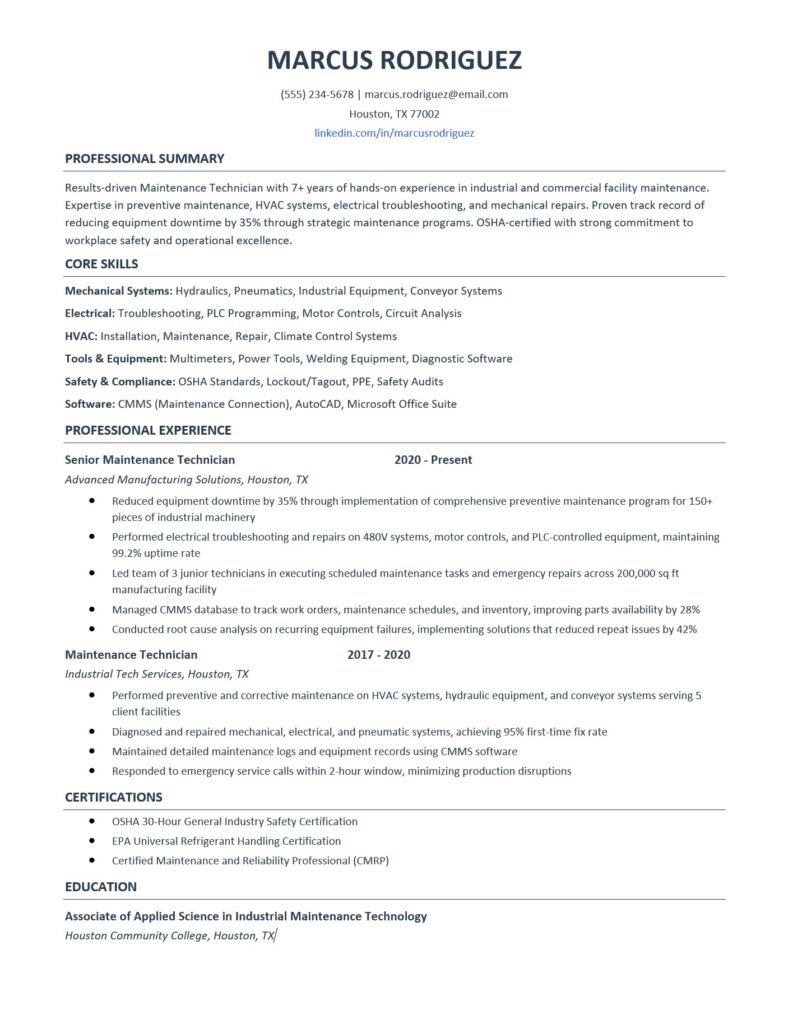
Here’s a professional maintenance technician resume template you can download and customize. This template is designed to be both visually appealing and ATS-friendly, with clean formatting that highlights your strengths.
Blank Customizable Template
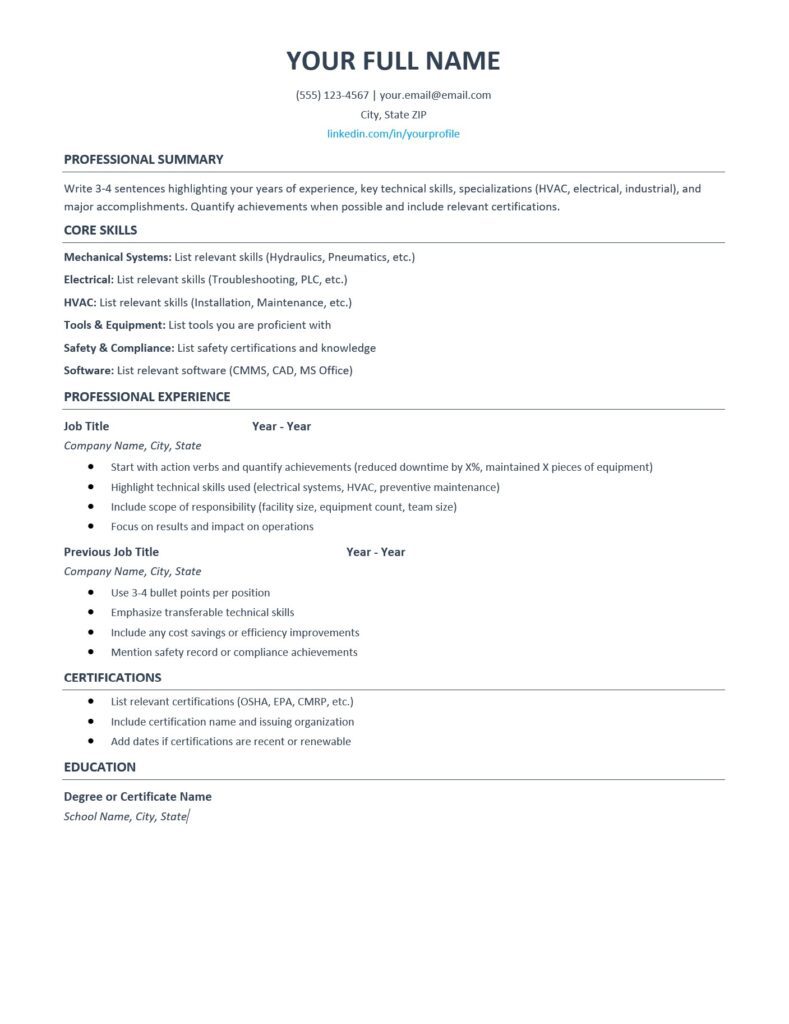
Download Your Free Template:
- Download DOCX Template (fully editable in Microsoft Word)
Interview Guys Tip: The DOCX template is fully editable, allowing you to adjust fonts, colors, and spacing to match your personal brand while maintaining professional formatting. Just replace the placeholder text with your own information.
Here’s what most people don’t realize: employers now expect multiple technical competencies, not just one specialization. The days of being “just a marketer” or “just an analyst” are over. You need AI skills, project management, data literacy, and more. Building that skill stack one $49 course at a time is expensive and slow. That’s why unlimited access makes sense:
Your Resume Needs Multiple Certificates. Here’s How to Get Them All…
We recommend Coursera Plus because it gives you unlimited access to 7,000+ courses and certificates from Google, IBM, Meta, and top universities. Build AI, data, marketing, and management skills for one annual fee. Free trial to start, and you can complete multiple certificates while others finish one.
Essential Components of Your Maintenance Technician Resume
Your resume needs six core sections, each serving a specific purpose in convincing employers you’re the right fit.
Professional Summary
Start with a compelling 3-4 sentence summary that positions you as the solution to their problems. Include your years of experience, key specializations, and one quantifiable achievement that proves your value.
Instead of writing “Experienced maintenance technician with strong skills,” try something like: “Results-driven Maintenance Technician with 7+ years of hands-on experience in industrial facility maintenance. Expertise in preventive maintenance, HVAC systems, and electrical troubleshooting. Proven track record of reducing equipment downtime by 35% through strategic maintenance programs.”
The difference? Specificity and results. Generic summaries get ignored. Quantified achievements get interviews.
Core Skills Section
This section needs careful construction because it directly impacts your ATS score. Understanding resume keywords can make the difference between getting filtered out and getting called in.
Organize your skills into categories: Mechanical Systems, Electrical, HVAC, Tools & Equipment, Safety & Compliance, and Software. This structure helps both ATS systems and hiring managers quickly identify your qualifications.
Don’t just list skills. Match them to the job description. If the posting mentions “pneumatic systems” three times, make sure that exact phrase appears in your skills section.
Professional Experience
This is where you prove you can actually do the work. Each position should include 3-5 achievement-focused bullet points that start with strong action verbs and include specific metrics.
- Bad bullet point: “Responsible for maintaining equipment in the facility.”
- Good bullet point: “Performed preventive and corrective maintenance on 150+ pieces of industrial machinery, reducing equipment downtime by 35% and saving $120,000 annually in repair costs.”
See the difference? The second example shows scope (150+ pieces), impact (35% reduction), and business value ($120,000 savings).
Interview Guys Tip: Use the XYZ formula for bullet points: “Accomplished X by doing Y, resulting in Z.” This structure forces you to include measurable outcomes that hiring managers care about.
Certifications
Certifications can make or break maintenance technician applications. According to hiring managers we surveyed, 81% will reject resumes lacking required certifications.
Place your certifications section prominently, right after your work experience. List the most relevant certifications first, typically OSHA safety credentials, EPA refrigerant handling, and any specialized technical certifications like CMRP (Certified Maintenance and Reliability Professional).
Don’t have formal certifications yet? List any you’re currently pursuing or planning to obtain. This shows hiring managers you’re committed to professional development.
Education
For maintenance technician roles, education matters less than experience and certifications, which is why it appears last. You don’t need a four-year degree to excel in this field.
If you have an Associate’s degree in Industrial Maintenance Technology or a related field, list it. If you completed a trade school program, include it. Even relevant high school vocational training deserves mention if you’re early in your career.
Skip the graduation year unless you’re a recent graduate. Dates can inadvertently reveal your age and potentially trigger bias, even though age discrimination is illegal.
How to Write Each Resume Section
Let’s break down exactly what to include in each section with specific examples you can adapt for your own resume.
Crafting Your Professional Summary
Your summary needs to accomplish three things in under 100 words: establish credibility, showcase specialization, and prove value.
Entry-level example: “Detail-oriented Maintenance Technician with hands-on training in electrical systems, HVAC, and preventive maintenance. Completed 2-year Industrial Maintenance Technology program with emphasis on manufacturing equipment. Eager to apply technical knowledge and strong problem-solving skills to support operational excellence.”
Experienced example: “Senior Maintenance Technician with 10+ years managing preventive and corrective maintenance across 200,000 sq ft industrial facilities. Expertise in 480V electrical systems, PLC troubleshooting, and CMMS database management. Reduced equipment failures by 42% through implementation of predictive maintenance protocols.”
Notice how both examples avoid generic phrases and include specific technical knowledge relevant to maintenance work.
Building Your Core Skills Arsenal
Your skills section should include a mix of hard technical skills and industry-specific knowledge. Here’s what maintenance job postings most frequently require:
- Mechanical Skills: Hydraulics, pneumatics, conveyor systems, pumps, bearings, alignment, welding
- Electrical Skills: Circuit analysis, motor controls, PLC programming, 480V systems, troubleshooting
- HVAC Skills: Installation, maintenance, repair, refrigeration, climate control systems
- Safety & Compliance: OSHA standards, lockout/tagout procedures, PPE protocols, hazardous materials handling
- Software & Tools: CMMS platforms (like Maintenance Connection or SAP PM), AutoCAD, multimeters, diagnostic equipment
Research from resume optimization experts shows that including 15-20 relevant skills increases your interview callback rate by 60% compared to generic skills lists.
Optimizing Your Professional Experience
This section determines whether hiring managers see you as a qualified candidate or just another applicant. Follow these resume bullet point best practices to make every word count.
Start each bullet point with a strong action verb: performed, reduced, implemented, managed, diagnosed, maintained, improved, coordinated, led, executed.
Then add specificity and impact. Instead of “Maintained HVAC systems,” write “Maintained 25 commercial HVAC units across 5 buildings, achieving 99% uptime and reducing energy costs by 18% through proactive maintenance scheduling.”
Include scope indicators whenever possible: number of facilities, equipment count, budget size, team size, square footage. These details help hiring managers understand the scale of your responsibilities.
Highlighting Certifications That Matter
Different maintenance specializations require different certifications. Here are the most valuable credentials for 2025:
- Universal certifications: OSHA 30-Hour General Industry, EPA Universal Refrigerant Handling
- Industrial maintenance: Certified Maintenance and Reliability Professional (CMRP), PLC programming certifications
- HVAC specialists: NATE certification, EPA Section 608 certification
- Electrical focus: Journeyman Electrician license (state-specific), National Electrical Code knowledge
List certifications with their full names and issuing organizations. If certifications expire, include the expiration date to show they’re current.
Interview Guys Tip: Pursuing a valuable certification but haven’t finished yet? List it as “In Progress” with an expected completion date. This demonstrates initiative and commitment to professional growth.
Common Mistakes to Avoid
Even experienced maintenance technicians make resume mistakes that cost them interviews. Here are the most common errors and how to fix them.
Mistake #1: Using Functional Resume Format
Functional resumes list only skills without showing work history details. This format immediately raises red flags with hiring managers who wonder what you’re trying to hide.
Stick with reverse-chronological format that lists your most recent job first, then works backward. This is what hiring managers expect and what ATS systems parse most accurately.
Mistake #2: Including Irrelevant Experience
Your summer job as a lifeguard in high school? Probably not relevant to your maintenance technician application. Focus on experience that demonstrates technical skills, problem-solving ability, or relevant customer service.
One exception: if you’re entry-level with limited maintenance experience, include positions that show transferable skills like mechanical aptitude, following safety protocols, or working independently.
Mistake #3: Neglecting to Quantify Achievements
Generic descriptions like “responsible for equipment maintenance” tell hiring managers nothing about your actual impact. Recruiters spend just 7 seconds scanning resumes, according to recent hiring research.
Always include numbers: percentages, dollar amounts, equipment counts, timeframes. These metrics make your accomplishments concrete and memorable.
Mistake #4: Ignoring ATS Optimization
75% of resumes don’t make it past ATS screening because they lack the right keywords or use incompatible formatting.
Use standard section headings (Professional Experience, not Work History). Avoid tables, images, and complex formatting. Save your resume as a .docx file, not PDF (unless the application specifically requests PDF).
Mistake #5: Listing Duties Instead of Achievements
Hiring managers know what maintenance technicians do. They want to know how well YOU do it. Transform duty-focused bullets into achievement-focused statements.
- Before: “Performed routine maintenance on facility equipment”
- After: “Executed preventive maintenance program for 120+ pieces of equipment, extending average equipment lifespan by 3 years and avoiding $200,000 in premature replacement costs”
The second version shows initiative, scope, and business impact.
ATS Optimization and Keywords
Understanding how ATS systems evaluate resumes is critical for maintenance technicians in 2025. These systems don’t just scan for keywords – they analyze context, relevance, and how well your qualifications match the job requirements.
Modern ATS systems use AI technology to evaluate resumes more sophisticatedly than earlier versions. They can identify synonyms, understand context, and even assess the quality of your achievements. This means keyword stuffing doesn’t work anymore.
Instead, naturally incorporate keywords from the job description throughout your resume. If the posting mentions “preventive maintenance” and “equipment troubleshooting,” make sure those exact phrases appear in your Professional Summary, Skills section, and work experience bullets.
Pay attention to acronyms. The job posting might use “HVAC” while your resume says “heating, ventilation, and air conditioning.” Use both versions to cover all bases: “HVAC (heating, ventilation, and air conditioning) systems.”
Technical terms matter most. When job postings mention specific equipment brands, systems, or certifications, include those exact terms if you have that experience. “Allen-Bradley PLC programming” beats generic “PLC experience” when that’s what they’re looking for.
Research on ATS performance shows that 62% of hiring managers using ATS systems find better quality candidates when the technology is properly utilized. Your job is to make their technology work in your favor by providing clear, relevant information in expected formats.
Frequently Asked Questions
How long should my maintenance technician resume be?
One page is ideal for maintenance technicians with less than 10 years of experience. If you have extensive experience spanning multiple facilities or specializations, two pages is acceptable. However, every word must earn its place on the page.
Hiring managers spend 6-8 seconds on initial resume scans. Make those seconds count by keeping content tight and focused on your most impressive, relevant achievements.
Should I include a photo on my resume?
No. Photos on U.S. resumes can actually hurt your chances because they may trigger unconscious bias or raise concerns about discrimination. Let your qualifications speak for themselves.
How do I handle employment gaps on my maintenance technician resume?
Be honest but strategic. If you took time off for education, training, or caregiving, include that information briefly. “Professional Development: Completed OSHA 30-Hour Certification and Advanced HVAC Training (2023-2024)” turns a gap into evidence of skill-building.
For longer gaps, focus hiring managers’ attention on your skills and certifications rather than chronology. Our guide on career gap strategies provides detailed approaches for various situations.
What if I’m switching from residential to industrial maintenance?
Emphasize transferable skills while acknowledging the transition. Your electrical troubleshooting skills work in both environments. Your HVAC experience applies across facility types. Your safety training matters everywhere.
In your Professional Summary, directly address the transition: “Residential Maintenance Technician with 5+ years of HVAC and electrical experience, seeking to leverage technical expertise in industrial manufacturing environment.”
How important are certifications really?
Extremely important. Certifications validate your technical knowledge and demonstrate commitment to professional standards. Many maintenance positions require specific certifications as minimum qualifications.
If you lack key certifications, that’s often an automatic disqualification. However, listing certifications you’re actively pursuing can show hiring managers you’re serious about meeting their requirements.
Now that you understand what makes a winning maintenance technician resume, it’s time to put these principles into action. Use our free example template to see these strategies in context, then customize the blank template with your own experience.
Remember the key principles: quantify your achievements, optimize for ATS systems, and tailor every application to the specific job description. Your resume isn’t just a list of jobs – it’s a marketing document that proves you’re the solution to their maintenance challenges.
Once your resume is ready, prepare for the next step. Our comprehensive guide to maintenance technician interview questions and answers will help you ace the interview and land the offer.
Looking for more resume templates? Browse our complete free resume template library for additional formats and industries.
Your next maintenance technician opportunity is waiting. Get your resume in shape and start applying with confidence.
Before you send that resume: most Maintenance Technician resumes get filtered out by ATS before a human ever sees them. Upload yours and find out your score. It takes 60 seconds and it’s free.
Advice like this is the general version. Longbow scores your actual resume against the actual job you want and shows you what's missing, before the filters decide for you. Here's why we built it.

ABOUT THE INTERVIEW GUYS (JEFF GILLIS & MIKE SIMPSON)
Mike Simpson: Co-founder of The Interview Guys and Longbow. He has been the voice behind our interview advice since 2013 — his work has reached over 100 million job seekers around the world. The strategic mind behind Longbow, our new career platform.
Jeff Gillis: Co-founder of The Interview Guys and Longbow. He built the systems that put our work in front of those readers, and he leads the engineering on Longbow, the cutting edge career platform built for today’s job seeker.