
Free Store Manager Resume Template 2025: ATS Examples & Writing Guide

Your Store Manager Resume Needs to Be Interview-Worthy (Not Just Application-Ready)
Landing a store manager position in 2025 means competing against hundreds of applicants for each opening. Your resume has about six seconds to grab a hiring manager’s attention before they move on to the next candidate.
The harsh reality? Most store manager resumes look identical. They list “responsible for managing staff” and “oversaw daily operations” without showing the actual impact. Hiring managers aren’t looking for task lists. They want proof you can drive revenue, build teams, and run profitable operations.
That’s exactly why we created these free store manager resume templates. By the end of this article, you’ll have access to both a professionally designed example resume and a customizable blank template, plus insider strategies that transform your retail experience into interview-generating content.
☑️ Key Takeaways
- Quantify your retail achievements with specific metrics like sales increases, team size, and shrinkage reduction to stand out from generic applicants
- Strategic section ordering matters for store manager resumes with professional summary first, followed by core skills, then experience showcasing leadership
- ATS optimization is non-negotiable as 98% of retail employers use applicant tracking systems to filter resumes before human review
- Free downloadable templates include both completed examples and editable blanks in professional DOCX format ready to customize
Before you send that resume: most Store Manager resumes get filtered out by ATS before a human ever sees them. Upload yours and find out your score. It takes 60 seconds and it’s free.
What Makes a Store Manager Resume Different from Other Retail Positions?
Store manager resumes require a different approach than sales associate or assistant manager applications. You’re not just demonstrating customer service skills anymore. You’re positioning yourself as a business operator who drives profitability.
The critical difference lies in scope and accountability. While other retail resumes focus on individual contributions, your store manager resume must showcase enterprise-level thinking. You managed P&L statements. You built and developed teams. You implemented systems that improved operations.
Retail hiring managers scan for three specific proof points. First, they want revenue impact. How much did you increase sales? Second, they’re looking for operational excellence. Did you reduce shrinkage, improve inventory turnover, or optimize labor costs? Third, they need evidence of leadership capability measured through team size, turnover reduction, or training program success.
The numbers tell your story. A resume stating “managed retail operations” means nothing. But “increased store revenue by 28% ($2.3M to $2.95M) while reducing shrinkage from 3.2% to 1.8%” immediately proves you’re worth interviewing.
Store Manager Resume Example
Here’s a professional store manager resume example. This example gives you an idea of what type of content fits in a good ATS friendly resume.
Example Resume:
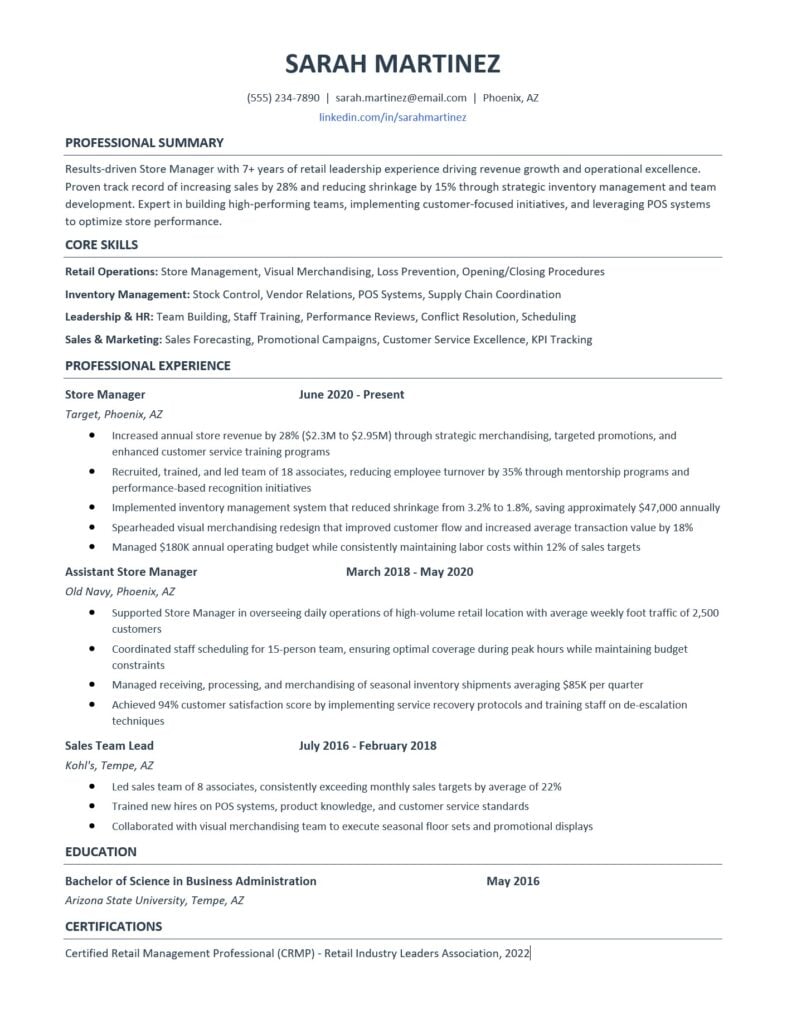
Here’s a professional store manager resume template you can download and customize. This template is designed to be both visually appealing and ATS-friendly, with clean formatting that highlights your strengths.
Blank Customizable Template
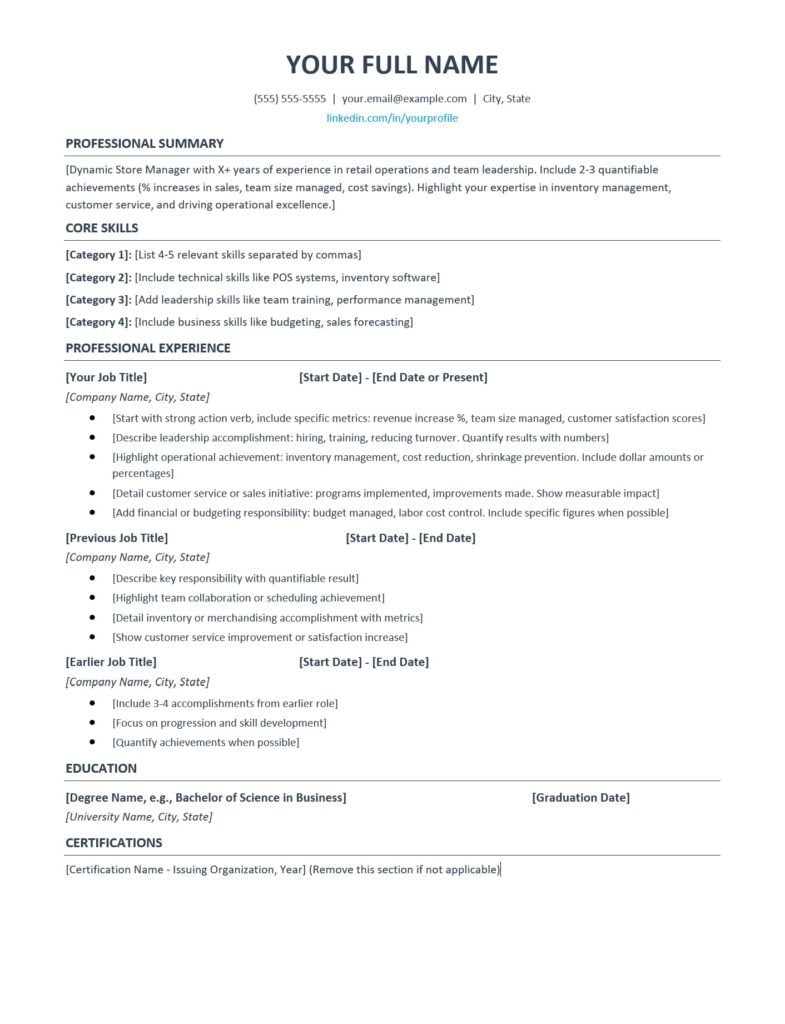
Download Your Free Template:
- Download DOCX Template (fully editable in Microsoft Word)
Interview Guys Tip: The DOCX template is fully editable, allowing you to adjust fonts, colors, and spacing to match your personal brand while maintaining professional formatting. Just replace the placeholder text with your own information.
Here’s what most people don’t realize: employers now expect multiple technical competencies, not just one specialization. The days of being “just a marketer” or “just an analyst” are over. You need AI skills, project management, data literacy, and more. Building that skill stack one $49 course at a time is expensive and slow. That’s why unlimited access makes sense:
Your Resume Needs Multiple Certificates. Here’s How to Get Them All…
We recommend Coursera Plus because it gives you unlimited access to 7,000+ courses and certificates from Google, IBM, Meta, and top universities. Build AI, data, marketing, and management skills for one annual fee. Free trial to start, and you can complete multiple certificates while others finish one.
Essential Components Every Store Manager Resume Must Include
Your store manager resume needs five core sections arranged strategically for maximum impact. Professional summary comes first because it’s your elevator pitch proving you’re qualified within those critical six seconds.
This summary should be 3-4 sentences highlighting your years of experience, biggest quantifiable achievements, and relevant expertise. Skip generic phrases like “results-driven professional” unless you immediately follow with specific results. Our resume summary examples show exactly how to craft compelling opening statements.
Core skills section sits immediately below your summary for a crucial reason. Both ATS systems and human readers scan this area for relevant keywords. Organize your skills into clear categories like Retail Operations, Inventory Management, Leadership & HR, and Sales & Marketing. Each category should contain 4-5 specific skills or software platforms you’ve mastered.
Professional experience forms the meat of your resume and deserves the most space. List positions in reverse chronological order, using 4-5 achievement-focused bullet points per role. Each bullet should start with a strong action verb and include quantifiable results. Generic statements like “responsible for staff scheduling” should become “coordinated scheduling for 18-person team, reducing labor costs from 14% to 12% of sales while maintaining coverage.”
Interview Guys Tip: Structure every experience bullet using this formula: Action Verb + Specific Task + Quantifiable Result. For example: “Implemented inventory management system that reduced shrinkage from 3.2% to 1.8%, saving $47,000 annually.” This approach immediately shows your value.
Your education section can be brief unless you’re a recent graduate. Include your degree, institution, and graduation year. Certifications should get their own section if you’ve earned relevant credentials like Certified Retail Management Professional (CRMP) or completed company-specific leadership programs. These prove ongoing professional development.
According to recent retail management research, employers increasingly value technical certifications in POS systems, inventory management software, and omnichannel retail alongside traditional business degrees.
How to Write Your Professional Summary (With Proven Formulas)
Your professional summary is the make-or-break element of your store manager resume. This 3-4 sentence section must immediately answer: “Why should I interview this person?”
Start with your job title and years of experience, but avoid being generic. “Store Manager with 7+ years of retail leadership experience” works better than simply “Experienced retail professional.” The specificity matters.
Your second sentence must include your biggest quantifiable achievement. This is where you prove you’re not just another applicant. “Proven track record of increasing sales by 28% and reducing shrinkage by 15%” tells a story that “strong sales skills” never will.
The third sentence highlights your technical expertise and leadership capabilities. Mention specific systems you’ve mastered (POS platforms, inventory software) and your team management experience. “Expert in building high-performing teams of 15+ associates while leveraging Shopify POS and Lightspeed to optimize store performance” positions you as both a technical expert and people leader.
Many applicants wonder whether to include an objective statement versus a summary. Here’s the truth: objectives are outdated for experienced store managers. Summaries demonstrate what you bring to the role, while objectives focus on what you want. Hiring managers care about your value, not your career goals.
The summary should mirror the job description without copying it verbatim. If the posting emphasizes loss prevention, your summary should highlight shrinkage reduction. If they want someone to grow revenue in underperforming locations, lead with your sales turnaround success.
Crafting Achievement-Focused Experience Bullets That Command Attention
Most store manager resumes fail in the experience section because they describe responsibilities instead of showcasing achievements. The difference between getting interviews and getting ignored lives in how you frame your bullet points.
Every bullet should answer: “So what?” Don’t just state what you did. Explain the impact it created. “Managed inventory” tells hiring managers nothing useful. But “Implemented inventory management system that reduced shrinkage from 3.2% to 1.8%, saving approximately $47,000 annually” proves you solve problems and add value.
When describing your achievements, use the SOAR Method we teach at The Interview Guys. Start with the Situation you faced, identify the Obstacles you encountered, explain the Actions you took, and showcase the Results you achieved. This creates compelling narratives instead of bland task lists.
Let’s transform weak bullets into powerful ones. Weak: “Responsible for training new employees.” Strong: “Recruited, trained, and led team of 18 associates, reducing employee turnover by 35% through mentorship programs and performance-based recognition initiatives.” The second version quantifies team size, shows the outcome, and explains your methodology.
Interview Guys Tip: Hiring managers love seeing dollar amounts and percentages. When you increased sales, by what percentage? When you managed budgets, what was the dollar amount? When you reduced costs, how much did you save? Specific numbers make your achievements believable and impressive.
For behavioral interview questions about your experience, you’ll want to reference these achievements. Check out our comprehensive guide on how to answer tell me about a time interview questions to see how resume achievements translate to interview success.
Some achievement categories perform especially well on store manager resumes. Revenue growth and sales increases always grab attention. Shrinkage reduction and loss prevention success prove operational competence. Team development and turnover reduction demonstrate leadership capability. Customer satisfaction improvements show you understand retail’s core mission.
Pull specific metrics from your past roles. Review old performance reviews, sales reports, or simply estimate based on what you remember. Even approximate figures are better than none as long as they’re honest. “Increased sales by approximately 25%” is more credible than “significantly increased sales.”
Core Skills That Hiring Managers Actually Search For
The core skills section serves two critical purposes. It helps ATS systems identify you as a qualified candidate, and it gives hiring managers a quick snapshot of your capabilities. Both matter equally.
Organize skills into logical categories instead of creating one overwhelming list. Retail Operations might include Store Management, Visual Merchandising, Loss Prevention, and Opening/Closing Procedures. Inventory Management could feature Stock Control, Vendor Relations, POS Systems, and Supply Chain Coordination.
Your Leadership & HR category should highlight Team Building, Staff Training, Performance Reviews, Conflict Resolution, and Scheduling. Sales & Marketing might showcase Sales Forecasting, Promotional Campaigns, Customer Service Excellence, and KPI Tracking.
Be strategic about which skills you emphasize. Read the job description carefully and mirror their language without lying about your capabilities. If they mention “Shopify POS,” include it in your skills list if you’ve used it. If they want “P&L management experience,” make sure it appears in both your skills section and your experience bullets.
Research from retail management experts shows that hiring managers prioritize different skill categories based on store type. High-volume locations emphasize operational efficiency and labor cost control. Luxury retail focuses on customer experience and brand standards. Grocery and convenience prioritize inventory turnover and shrinkage prevention.
Technical skills are increasingly important in 2025. Modern store managers need proficiency in POS systems, inventory management software, scheduling platforms, and basic data analytics. Mention specific platforms you’ve used like Shopify, Lightspeed, Square, Workday, or industry-specific systems.
Don’t forget soft skills that matter in retail leadership. Communication, adaptability, problem-solving under pressure, and emotional intelligence all belong on your resume. However, these work better when demonstrated through experience bullets rather than just listed as skills.
Before you send that resume: most Store Manager resumes get filtered out by ATS before a human ever sees them. Upload yours and find out your score. It takes 60 seconds and it’s free.
Common Mistakes That Get Store Manager Resumes Rejected
The fastest way to end up in the rejection pile is submitting a resume that looks like every other generic application. Hiring managers can spot cookie-cutter resumes instantly.
- Mistake one: Using the same resume for every application. Each job posting has unique priorities. A discount retailer wants different capabilities than a luxury boutique. Tailor your resume by emphasizing relevant experience and matching their specific language. This doesn’t mean rewriting everything, just adjusting emphasis.
- Mistake two: Writing paragraphs instead of bullets. Dense blocks of text never get read. Hiring managers scan resumes in seconds. They need white space, clear headings, and scannable bullet points to quickly extract key information.
- Mistake three: Including irrelevant experience. Your barista job from 10 years ago doesn’t need to be on a store manager resume unless you have limited retail experience. Focus on the most recent and relevant 10-15 years of your career.
- Mistake four: Forgetting to quantify achievements. “Managed daily operations” means nothing without context. How large was the store? What was the annual revenue? How many employees reported to you? Numbers transform vague statements into proof of capability.
- Mistake five: Using an unprofessional email address. YourName@gmail.com works fine. PartyGirl2000@yahoo.com does not. This seems obvious, but it happens more than you’d think.
- Mistake six: Ignoring formatting consistency. If you bold one job title, bold them all. If you use bullet points in one section, use them throughout. Inconsistent formatting suggests carelessness, which is the last quality a hiring manager wants in a store manager.
- Mistake seven: Including “references available upon request.” This outdated phrase wastes valuable space. Employers assume you’ll provide references when asked. You can learn more about this in our guide on whether to put references on a resume.
ATS Optimization: Getting Past the Robots Before Reaching Humans
Here’s the uncomfortable truth about applying for store manager positions in 2025. Your resume must impress software before it ever reaches a human. Most retailers use Applicant Tracking Systems that automatically filter applications based on keyword matching and formatting.
ATS systems scan your resume looking for specific terms from the job description. They also check for proper formatting that their software can parse correctly. Fancy graphics, tables, and unusual fonts confuse these systems and often result in automatic rejection.
Use standard section headings that ATS software recognizes. “Professional Experience” works better than “Where I’ve Made an Impact.” “Education” should be labeled clearly, not “Academic Background.” These systems look for conventional resume sections.
Incorporate keywords naturally throughout your resume, especially in your core skills section and experience bullets. If the job posting mentions “inventory management,” “loss prevention,” and “team leadership,” make sure those exact phrases appear in your resume (assuming you have that experience).
Save your resume as a .docx file unless the application specifically requests a PDF. Many older ATS systems struggle with PDFs. The templates we’re providing come in DOCX format specifically for this reason.
Don’t try to game the system by hiding white text with keywords or stuffing your resume with every possible retail term. Modern ATS software flags these tactics, and even if it doesn’t, hiring managers will reject your resume once they see it.
According to ATS research data, approximately 75% of resumes get rejected by ATS systems before any human reviews them. The most common reasons are missing keywords, poor formatting, and lack of quantifiable achievements that trigger ranking algorithms.
Frequently Asked Questions About Store Manager Resumes
How long should a store manager resume be?
One page is ideal for store managers with less than 10 years of experience. Two pages work for senior retail leaders with extensive accomplishments. Never exceed two pages. Hiring managers won’t read beyond that, and it suggests you can’t prioritize information effectively.
Should I include my high school education?
Only if you don’t have a college degree. Once you have any higher education, high school becomes irrelevant. List your highest level of education only unless you have a specific retail management certification that deserves highlighting.
What if I don’t have exact metrics for my achievements?
Estimate based on what you remember, then add “approximately” to maintain credibility. “Increased sales by approximately 25%” is better than no metrics at all. You can also request performance data from former employers or check old reviews and reports.
How do I explain employment gaps?
Address them briefly without oversharing. “Career break for family care” or “Professional development period” works fine. Focus more on what you accomplished during your working periods. Our detailed guide to career gaps provides specific strategies.
Should I include jobs from 15+ years ago?
Generally no, unless they’re highly relevant or you have limited retail management experience. Focus on your most recent and impressive roles. Older positions can be summarized in one line: “Additional experience includes retail leadership positions at [Company Names], 2005-2010.”
Your Next Steps: Download, Customize, and Start Applying
You now have everything you need to create an interview-generating store manager resume. The templates we’ve provided are professionally designed, ATS-optimized, and ready for your customization.
Download both the example resume and the blank template. Study the example to understand how to structure your content, then use the blank template to create your personalized version. Replace the placeholder text with your specific achievements, metrics, and experience.
Customize your resume for each position you apply to. This doesn’t mean starting from scratch every time. It means adjusting your professional summary and emphasizing the most relevant experience for that specific role. Spend 10-15 minutes tailoring each application instead of sending identical resumes everywhere.
Once your resume is polished, you’ll want to prepare for the interviews it generates. Our comprehensive guide to store manager interview questions and answers will help you ace those conversations and land the offer.
Remember that your resume is just one piece of your job search toolkit. You’ll also need a strong cover letter, optimized LinkedIn profile, and interview preparation. Browse our complete collection of free resume templates for other positions as you advance your career.
Your store manager position is waiting. Download these templates, customize them with your achievements, and start applying with confidence. The hiring managers are looking for someone exactly like you. They just need your resume to prove it.
Here’s what most people don’t realize: employers now expect multiple technical competencies, not just one specialization. The days of being “just a marketer” or “just an analyst” are over. You need AI skills, project management, data literacy, and more. Building that skill stack one $49 course at a time is expensive and slow. That’s why unlimited access makes sense:
Your Resume Needs Multiple Certificates. Here’s How to Get Them All…
We recommend Coursera Plus because it gives you unlimited access to 7,000+ courses and certificates from Google, IBM, Meta, and top universities. Build AI, data, marketing, and management skills for one annual fee. Free trial to start, and you can complete multiple certificates while others finish one.
Advice like this is the general version. Longbow scores your actual resume against the actual job you want and shows you what's missing, before the filters decide for you. Here's why we built it.

ABOUT THE INTERVIEW GUYS (JEFF GILLIS & MIKE SIMPSON)
Mike Simpson: Co-founder of The Interview Guys and Longbow. He has been the voice behind our interview advice since 2013 — his work has reached over 100 million job seekers around the world. The strategic mind behind Longbow, our new career platform.
Jeff Gillis: Co-founder of The Interview Guys and Longbow. He built the systems that put our work in front of those readers, and he leads the engineering on Longbow, the cutting edge career platform built for today’s job seeker.