
Free Occupational Therapy Resume Template 2025: ATS Examples & Writing Guide

Landing your dream occupational therapy position starts with a resume that showcases your clinical expertise and genuine impact on patients’ lives. You know you’re a skilled OT who helps people regain independence and improve quality of life. But does your resume reflect that?
Here’s the reality. Hiring managers spend just six seconds scanning your resume before deciding whether to continue. That’s barely enough time to read your name and summary. If your resume doesn’t immediately highlight your specialized OT skills, measurable outcomes, and proper credentials, it’s heading straight to the rejection pile.
The good news? You’re in the right place. By the end of this article, you’ll have access to a free, professionally designed occupational therapy resume template that you can download and customize. You’ll also learn exactly what hiring managers look for in OT resumes, how to showcase your clinical skills effectively, and the common mistakes that tank otherwise qualified candidates.
Whether you’re a recent graduate preparing for your first OT role or an experienced therapist switching specialties, this guide will help you create a resume that opens doors. Let’s dive in and build a resume that gets you hired for the occupational therapy position you deserve.
☑️ Key Takeaways
- Occupational therapy is one of the fastest-growing healthcare fields, with 14% projected job growth through 2034 and a median salary of $98,340
- Your OT resume must emphasize clinical skills and measurable outcomes like goal achievement rates, patient improvements, and caseload sizes
- NBCOT certification and state licensure belong at the top of your resume right after your name to immediately establish credibility
- School-based and pediatric settings dominate OT employment, so highlighting IEP development and sensory integration skills gives you a competitive edge
What Makes an Occupational Therapy Resume Different?
Occupational therapy resumes require a unique approach compared to other healthcare positions. While nurses and physical therapists focus heavily on clinical procedures, your OT resume must demonstrate your ability to assess functional limitations, develop personalized treatment plans, and help patients achieve independence in daily activities.
The field is booming right now. Employment of occupational therapists is projected to grow 14% from 2024 to 2034, which is much faster than the average for all occupations. This translates to roughly 10,200 job openings annually. With such strong demand, you might think any resume will do. Wrong.
Hiring managers in occupational therapy have specific expectations. They want to see your NBCOT certification immediately. They need to know which populations you work with best. They’re looking for evidence that you can actually improve patient outcomes, not just perform evaluations.
Your resume also needs to reflect the diverse settings where OTs work. About 35% of occupational therapists work in hospitals, but many others thrive in schools, rehabilitation centers, nursing homes, and private practices. Each setting values slightly different skills, so tailoring your resume to match the specific job posting is critical.
Interview Guys Tip: Always include your OTR/L credential directly after your name in the header. This immediately signals to hiring managers and ATS systems that you’re a licensed professional, saving them the trouble of searching for this crucial information.
Before you send that resume: most Occupational Therapist resumes get filtered out by ATS before a human ever sees them. Upload yours and find out your score. It takes 60 seconds and it’s free.
Occupational Therapy Resume Example
Here’s a professional OT resume example. This example gives you an idea of what type of content fits in a good ATS friendly resume.
Example Resume:
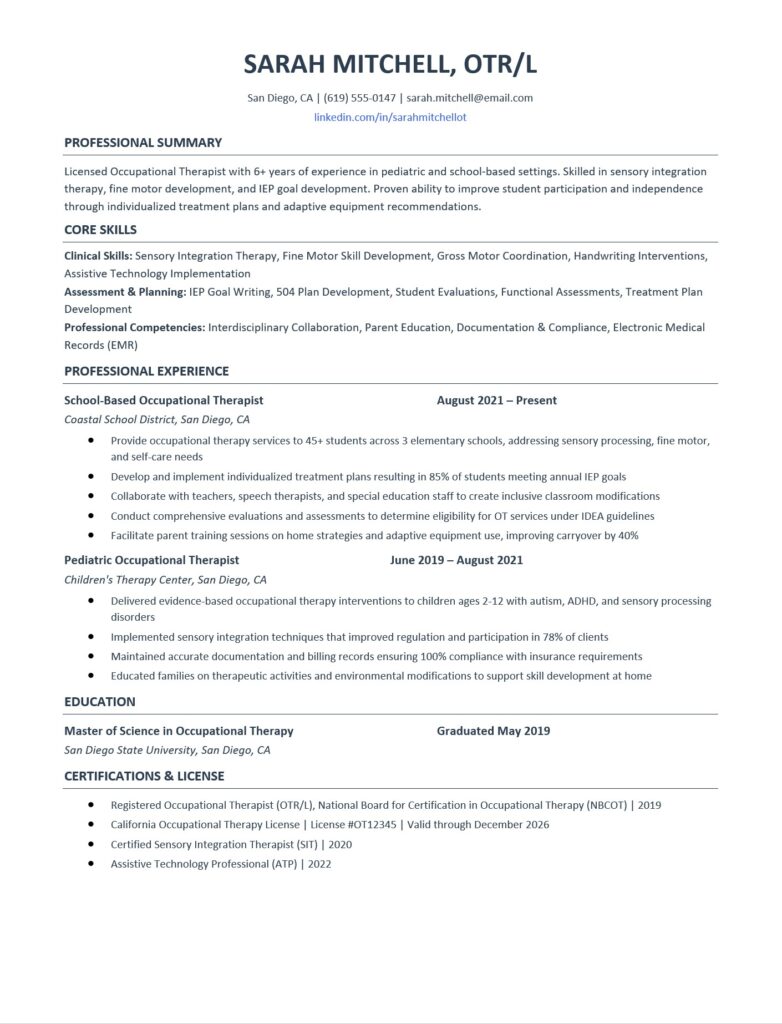
Here’s a professional OT resume template you can download and customize. This template is designed to be both visually appealing and ATS-friendly, with clean formatting that highlights your strengths.
Blank Customizable Template
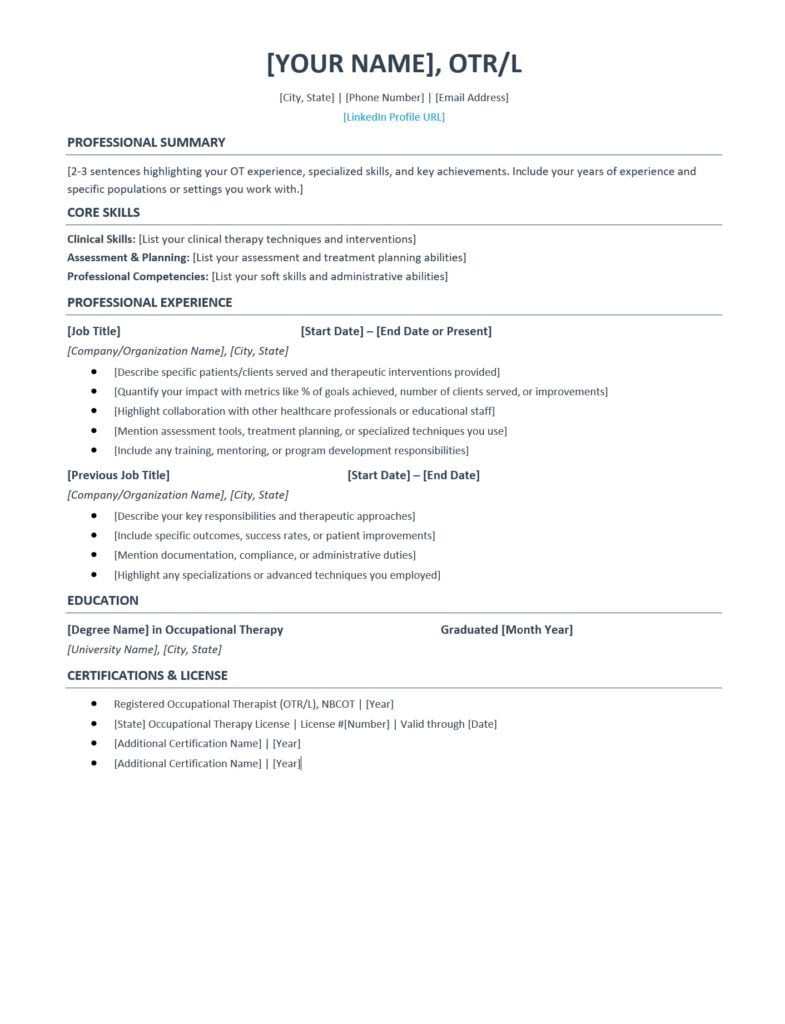
Download Your Free Template:
- Download DOCX Template (fully editable in Microsoft Word)
Interview Guys Tip: The DOCX template is fully editable, allowing you to adjust fonts, colors, and spacing to match your personal brand while maintaining professional formatting. Just replace the placeholder text with your own information.
Essential Components of an Occupational Therapy Resume
Your OT resume should include these sections in this specific order for maximum impact:
- Contact Information: Start with your full name followed by your OTR/L credential. Include your city and state, phone number, professional email address, and LinkedIn profile. Skip your full street address unless specifically requested.
- Professional Summary: This 2-3 sentence section is your elevator pitch. Highlight your years of experience, specialty areas, and most impressive achievement. For example: “Licensed Occupational Therapist with 6+ years of experience in pediatric and school-based settings. Skilled in sensory integration therapy, fine motor development, and IEP goal development.”
- Core Skills: Organize your skills into categories like Clinical Skills, Assessment & Planning, and Professional Competencies. This format makes it easy for both humans and ATS systems to quickly identify your capabilities.
- Professional Experience: List your work history in reverse chronological order. Each position should include your job title, company name, location, and employment dates. Use 3-5 bullet points focusing on specific accomplishments rather than generic duties.
- Education: Your Master’s or Doctorate in Occupational Therapy belongs here, along with your undergraduate degree if relevant. Include your graduation date, school name, and location.
- Certifications & License: This section is non-negotiable. List your NBCOT certification, state license with number and expiration date, and any specialty certifications like Sensory Integration or Assistive Technology Professional credentials.
How to Write Your Professional Summary
Your professional summary is prime real estate on your resume. This is where you make your first impression and convince hiring managers to keep reading.
Start by identifying your specialty. Are you a pediatric OT? Do you specialize in hand therapy or geriatric rehabilitation? Leading with your niche helps the right employers find you quickly.
Next, quantify your experience. Instead of “experienced occupational therapist,” write “Licensed Occupational Therapist with 8+ years in acute care settings.” Numbers add credibility and context.
Then highlight your biggest achievement or specialty skill. Maybe you’ve helped 90% of your stroke patients regain independence in activities of daily living. Perhaps you developed an innovative sensory integration program that improved student participation by 40%. Whatever your standout accomplishment is, put it front and center.
Keep it concise. Your summary should be 2-3 sentences maximum. Hiring managers don’t have time to wade through paragraphs of background information. Get to the point and make every word count.
Showcasing Your Clinical Skills and Achievements
Here’s where most OT resumes fail. They list responsibilities instead of results. They say “provided occupational therapy services to patients” instead of showing the actual impact of those services.
Transform your experience section from a list of duties into a showcase of achievements. Use the CAR method: Context, Action, Result.
- Bad bullet point: “Worked with pediatric patients on fine motor skills”
- Good bullet point: “Developed individualized fine motor treatment plans for 35+ elementary students, resulting in 82% meeting their annual IEP goals for handwriting and self-care tasks”
See the difference? The second version provides context (35+ students), describes the action (developed individualized plans), and quantifies the result (82% goal achievement).
Include metrics wherever possible. How many patients do you see per week? What percentage achieve their goals? How have you improved efficiency or outcomes? Numbers make your achievements concrete and memorable. According to research on occupational therapy outcomes, goal achievement rates reach 77% when written in measurable terms versus just 43% for non-measurable goals. Demonstrating that you use evidence-based, measurable approaches signals your professionalism.
Interview Guys Tip: Use strong action verbs like “implemented,” “developed,” “facilitated,” “collaborated,” and “assessed” to begin each bullet point. This creates a sense of active contribution rather than passive participation.
Highlighting Education and Certifications
Your education section serves two purposes: proving you have the required credentials and showcasing any additional training that sets you apart.
List your highest degree first. For most OTs, this will be your Master of Science in Occupational Therapy (MSOT) or Doctor of Occupational Therapy (OTD). Include the school name, location, and graduation date.
If you’re a recent graduate, you can include relevant coursework, honors, or your GPA if it’s 3.5 or higher. Once you have a few years of experience, remove these details to make room for more relevant professional information.
The certification section is where you really shine. Every OT must include their NBCOT certification and state license. Format it clearly with the certification name, issuing organization, and year obtained. For your state license, include the license number and expiration date to show it’s current.
Don’t stop there. Specialty certifications dramatically increase your marketability. Certified Sensory Integration Therapist (SIT), Assistive Technology Professional (ATP), Certified Hand Therapist (CHT), or pediatric feeding certifications all demonstrate advanced expertise. List these prominently.
Continuing education matters too. While you don’t need to list every CE course, highlighting recent specialized training shows you’re committed to staying current in the field.
Common Mistakes to Avoid
Let’s talk about the resume killers that get even qualified OTs rejected.
Mistake #1: Generic job descriptions. Saying you “provided occupational therapy services” tells hiring managers nothing about your actual capabilities. Every OT provides services. What makes yours special?
Mistake #2: Missing credentials. Forgetting to include your OTR/L designation or license number is amateur hour. These are the first things hiring managers look for.
Mistake #3: Ignoring ATS optimization. About 75% of resumes never reach human eyes because they fail ATS screening. If you’re not including keywords from the job description, your resume is getting automatically rejected.
Mistake #4: Resume too long or too short. One page works for new graduates. Two pages is perfect for experienced OTs. Three pages? Unless you’re applying for a leadership role, that’s too much. Edit ruthlessly and keep only the most relevant information.
Mistake #5: Typos and formatting inconsistencies. Your resume represents your attention to detail. If it contains spelling errors, inconsistent fonts, or formatting mistakes, hiring managers will question your documentation skills.
Mistake #6: Vague skill listings. Writing “good communication skills” doesn’t cut it. Instead, demonstrate those skills through examples: “Educated 50+ families on home exercise programs and adaptive equipment use, improving treatment carryover by 35%.”
ATS Optimization and Keywords for OT Resumes
Applicant Tracking Systems scan your resume before any human sees it. If your resume doesn’t contain the right keywords, it gets filtered out automatically.
Start by carefully reading the job description. Pull out specific skills, certifications, and qualifications mentioned. These are your keywords. Now strategically incorporate them throughout your resume.
For occupational therapy positions, essential keywords include: sensory integration, fine motor skills, gross motor coordination, activities of daily living (ADLs), treatment planning, patient evaluation, IEP development, assistive technology, documentation, and collaboration.
Don’t just list these terms. Use them naturally in your experience descriptions. Instead of “helped children improve coordination,” write “implemented sensory integration techniques to improve fine motor coordination in children with developmental delays.”
Mention specific assessment tools you use: Beery-Buktenica Developmental Test, Peabody Developmental Motor Scales, Sensory Profile, or Canadian Occupational Performance Measure. These demonstrate technical expertise and provide valuable ATS keywords.
Include setting-specific terms based on where you’re applying. School-based positions need keywords like IEP, 504 plans, IDEA compliance, and educational modifications. Hospital roles should emphasize acute care, discharge planning, interdisciplinary teams, and EMR systems.
Your resume format matters for ATS too. Use standard section headings like “Professional Experience” and “Education” rather than creative alternatives. Stick with common fonts like Calibri or Arial. Avoid tables, text boxes, and graphics that confuse ATS software.
Interview Guys Tip: Save your resume as “FirstName_LastName_OT_Resume.pdf” for optimal ATS compatibility. PDF format preserves your formatting while remaining ATS-friendly, unlike some Word documents that may display differently across systems.
Tailoring Your Resume for Different OT Settings
Not all OT jobs are created equal. A resume that works beautifully for a school-based position might fall flat for a hospital role. Here’s how to tailor your resume for different settings.
- For school-based positions: Emphasize IEP development, 504 plan expertise, and collaboration with teachers and special education staff. Highlight experience with school-age children, classroom modifications, and sensory regulation strategies. Mention your understanding of IDEA guidelines.
- For hospital and acute care roles: Focus on patient evaluations, discharge planning, interdisciplinary collaboration, and experience with specific diagnoses like stroke, traumatic brain injury, or orthopedic conditions. Include your proficiency with electronic medical records systems.
- For pediatric clinic settings: Showcase developmental assessments, family education, sensory processing treatment, and your ability to make therapy fun and engaging for children. Mention any play-based therapy expertise.
- For geriatric or skilled nursing facilities: Highlight fall prevention programs, functional mobility training, cognitive assessment, and experience helping older adults maintain independence. Emphasize your patience and communication with families.
- For hand therapy positions: This specialization requires different emphasis. Feature your splinting skills, post-surgical rehabilitation experience, and knowledge of orthopedic conditions affecting the upper extremities.
The key is reading the job description carefully and matching your resume to their specific needs. Use their language. If they emphasize sensory integration, make sure that appears prominently in your resume. If they want someone experienced with assistive technology, provide concrete examples of your AT implementation.
FAQ: Occupational Therapy Resume Questions
How long should my occupational therapy resume be?
One page for new graduates or OTs with less than 3 years of experience. Two pages for experienced professionals with multiple positions and specialized certifications. Never exceed two pages unless applying for an academic or leadership position.
Should I include my clinical fieldwork experiences?
Yes, if you’re a new graduate. List them under Professional Experience with the same format as paid positions. Once you have 2-3 years of paid experience, remove fieldwork rotations to make room for more recent relevant experience.
Do I need to list every continuing education course I’ve taken?
No. Only include CE courses if they’re highly relevant to the position you’re applying for or demonstrate specialized expertise. A general statement like “Complete 24+ hours of continuing education annually” is sufficient.
How do I address employment gaps on my OT resume?
Be honest and brief. If you took time off for family care, travel, or additional education, mention it in a single line without elaborating. Focus the bulk of your resume on what you accomplished before and after the gap. If you maintained your skills during the gap through volunteer work or part-time contracts, include those.
Should my resume look different if I’m applying for travel OT positions?
Yes. For travel positions, emphasize your adaptability, quick learning abilities, and experience in diverse settings. Highlight that you’re comfortable with different EMR systems, protocols, and patient populations. Mention any previous travel assignments or float pool experience.
Conclusion
Creating an outstanding occupational therapy resume doesn’t have to be overwhelming. Focus on quantifiable achievements, optimize for ATS with relevant keywords, and tailor your content to match each job description. Remember that your NBCOT certification and state license should be prominently displayed, and every bullet point should demonstrate the real-world impact of your clinical skills.
Download our free occupational therapy resume templates to get started immediately. The example resume shows you exactly how to structure your content, while the blank template makes customization simple. Both are ATS-friendly and designed to get your resume past the initial screening and onto a hiring manager’s desk.
Ready to explore more resume resources? Check out our complete library of free resume templates for additional industry-specific formats and examples.
Your next OT position is waiting. With the right resume, you’ll be hearing “when can you start?” in no time.
Before you send that resume: most Occupational Therapist resumes get filtered out by ATS before a human ever sees them. Upload yours and find out your score. It takes 60 seconds and it’s free.
Advice like this is the general version. Longbow scores your actual resume against the actual job you want and shows you what's missing, before the filters decide for you. Here's why we built it.

ABOUT THE INTERVIEW GUYS (JEFF GILLIS & MIKE SIMPSON)
Mike Simpson: Co-founder of The Interview Guys and Longbow. He has been the voice behind our interview advice since 2013 — his work has reached over 100 million job seekers around the world. The strategic mind behind Longbow, our new career platform.
Jeff Gillis: Co-founder of The Interview Guys and Longbow. He built the systems that put our work in front of those readers, and he leads the engineering on Longbow, the cutting edge career platform built for today’s job seeker.