
Free Case Manager Resume Template: ATS Examples & Writing Guide [2025]

You’ve spent years helping people navigate complex healthcare systems, coordinating care plans, and advocating for clients who need it most. But when it comes to marketing yourself on paper, suddenly you’re stuck staring at a blank document.
Here’s the challenge that makes case manager resumes tricky. You’re juggling clinical skills, administrative expertise, and interpersonal abilities that don’t always translate neatly into bullet points. You need to show hiring managers that you can handle crisis interventions while maintaining meticulous documentation. You have to prove you’re organized enough to manage 40+ cases but compassionate enough to truly connect with clients.
That’s exactly where this guide comes in. We’ll walk you through creating a case manager resume that showcases your unique blend of clinical knowledge, coordination skills, and genuine care for people. By the end of this article, you’ll have downloadable templates in hand and a clear understanding of how to position yourself as the ideal candidate for your next case management role.
Before we dive into the specifics, let’s make sure you’re prepared for the entire interview process by checking out our comprehensive case manager interview questions guide.
☑️ Key Takeaways
- Case managers earn an average of $61,706 per year, with top earners making over $75,000, making strong resume presentation essential for securing competitive positions
- Quantifying client outcomes is critical since hiring managers want to see retention rates, caseload sizes, and measurable improvements in care coordination
- Professional certifications like CCM can boost your resume, as certified case managers typically earn higher salaries and stand out in applicant tracking systems
- Your resume should emphasize collaboration skills because case management requires coordinating with healthcare providers, social services, and families across multiple settings
What Makes a Case Manager Resume Different?
Case management sits at the intersection of healthcare, social services, and advocacy work. Your resume needs to reflect this unique position by demonstrating both clinical competence and relationship-building abilities.
Unlike purely clinical roles where technical skills dominate, case manager resumes must balance hard skills like treatment planning with soft skills like crisis intervention. Hiring managers want to see evidence that you can coordinate care across multiple providers while maintaining compliance with regulatory standards.
The most successful case manager resumes tell a story of impact. They don’t just list responsibilities like “managed caseload” or “coordinated services.” Instead, they quantify outcomes with specific metrics that matter to employers.
Interview Guys Tip: Case management has evolved significantly in recent years. Modern resumes should highlight experience with electronic health records (EHR) systems, telehealth coordination, and value-based care models. Employers increasingly look for candidates who can demonstrate tech-savviness alongside traditional case management skills.
According to data from the Bureau of Labor Statistics, employment of social workers (which includes many case management positions) is projected to grow 7% through 2033, faster than the average for all occupations. This growth means competition for the best positions will be fierce, making a standout resume essential.
Before you send that resume: most Case Manager resumes get filtered out by ATS before a human ever sees them. Upload yours and find out your score. It takes 60 seconds and it’s free.
Case Manager Resume Example
Here’s a professional case manager resume example. This example gives you an idea of what type of content fits in a good ATS friendly resume.
Example Resume:
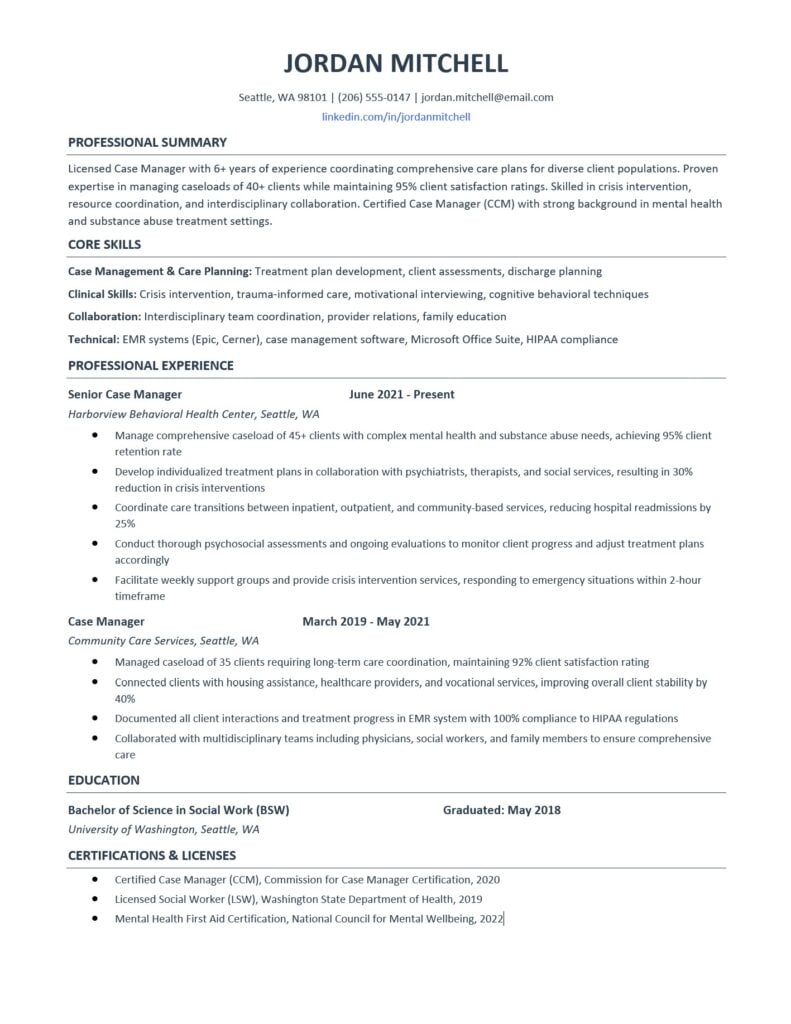
Here’s a professional case manager resume template you can download and customize. This template is designed to be both visually appealing and ATS-friendly, with clean formatting that highlights your strengths.
Blank Customizable Template
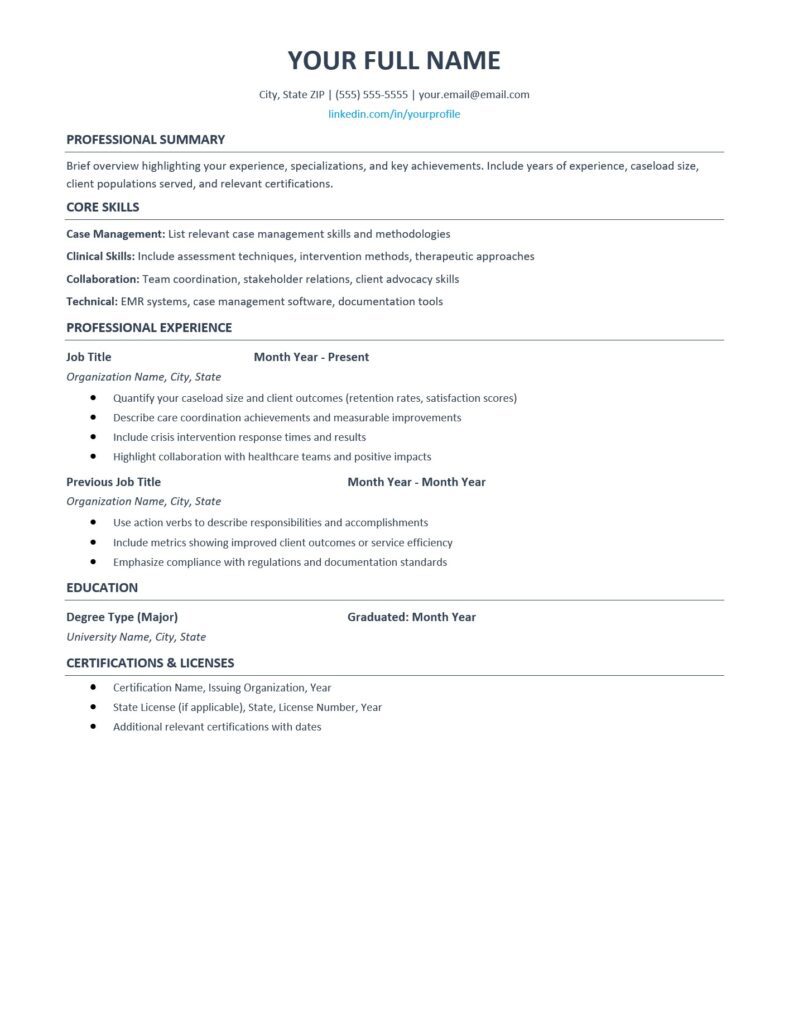
Download Your Free Template:
- Download DOCX Template (fully editable in Microsoft Word)
Interview Guys Tip: The DOCX template is fully editable, allowing you to adjust fonts, colors, and spacing to match your personal brand while maintaining professional formatting. Just replace the placeholder text with your own information.
Essential Components Every Case Manager Resume Needs
Your case manager resume should include these core sections in this specific order for maximum impact:
- Professional Summary: This 3-4 sentence snapshot appears at the top of your resume and serves as your elevator pitch. It should highlight your years of experience, specialty areas, caseload management capabilities, and key achievements. Think of it as your chance to immediately show hiring managers you’re qualified.
- Core Skills: This section organizes your abilities into clear categories like clinical skills, case management competencies, collaboration abilities, and technical proficiencies. Breaking skills into categories makes your resume more scannable for both human reviewers and applicant tracking systems.
- Professional Experience: The heart of your resume showcases your career progression with emphasis on measurable achievements. Each position should include your title, organization name, location, and dates, followed by 3-5 achievement-focused bullet points.
- Education: List your degree, major, institution, and graduation date. For case management positions, having a bachelor’s degree in social work, psychology, nursing, or a related field is typically required.
- Certifications & Licenses: This critical section demonstrates your professional credentials. Include any relevant certifications like Certified Case Manager (CCM), state social work licenses, or specialized training in areas like mental health first aid.
How to Write Each Section Effectively
Crafting Your Professional Summary
Your professional summary should immediately establish your value. Start with your title and years of experience, then move to your specialty and key strengths.
Strong example: “Licensed Case Manager with 6+ years of experience coordinating comprehensive care plans for diverse client populations. Proven expertise in managing caseloads of 40+ clients while maintaining 95% client satisfaction ratings. Skilled in crisis intervention, resource coordination, and interdisciplinary collaboration.”
Notice how this example quantifies experience and includes specific numbers that demonstrate capability. Avoid generic statements like “hardworking professional seeking opportunities.” Instead, lead with concrete evidence of your expertise.
Building Your Core Skills Section
Organize your skills into logical categories that align with case management competencies. Consider these groupings:
- Case Management & Care Planning should include treatment plan development, client assessments, discharge planning, and care coordination. These are your bread-and-butter skills that every case management position requires.
- Clinical Skills might encompass crisis intervention, trauma-informed care, motivational interviewing, and specific therapeutic techniques you’ve mastered. These demonstrate your clinical judgment capabilities.
- Collaboration shows your ability to work across teams, including phrases like interdisciplinary team coordination, stakeholder engagement, family education, and provider relations.
- Technical proves you can handle the administrative side of case management. List specific EMR systems you’ve used (like Epic or Cerner), case management software, and your proficiency with Microsoft Office Suite and HIPAA compliance procedures.
Writing Powerful Experience Bullets
The difference between an average resume and an outstanding one often comes down to how you describe your experience. Strong bullet points follow a simple formula: action verb + specific task + measurable result.
- Weak: “Responsible for managing client caseload.”
- Strong: “Managed comprehensive caseload of 45+ clients with complex mental health and substance abuse needs, achieving 95% client retention rate.”
See the difference? The strong version specifies caseload size, client population, and quantifies success with a retention metric. When describing your work on resumes, you want to check out our guide on resume achievement formulas for more strategies on quantifying your impact.
Use action verbs that convey impact: coordinated, facilitated, implemented, advocated, collaborated, developed, monitored, evaluated, and improved. These words show active contribution rather than passive responsibility.
Interview Guys Tip: If you’re struggling to find metrics, think about client outcomes you influenced, time savings you created, compliance rates you maintained, or resources you secured. Even if you don’t have exact numbers, you can use qualifiers like “significantly reduced,” “consistently maintained,” or “improved by approximately.”
Highlighting Education and Certifications
For case management positions, your education section is straightforward but important. Most employers require at least a bachelor’s degree in social work, psychology, nursing, healthcare administration, or a related field.
List your degree with the major in parentheses, followed by your institution and graduation date. If you graduated within the last five years, you might include relevant coursework, academic honors, or a high GPA (if 3.5 or above).
Your certifications section often carries significant weight in case management. The Certified Case Manager (CCM) credential from the Commission for Case Manager Certification is highly valued across healthcare settings. State licensure as a Licensed Social Worker (LSW) or Licensed Clinical Social Worker (LCSW) may be required depending on your location and specialty.
Additional certifications that strengthen your resume include Mental Health First Aid, Certified Advanced Social Work Case Manager (C-ASWCM), or specialized credentials in areas like substance abuse counseling or geriatric care management.
Common Mistakes That Sink Case Manager Resumes
- Listing duties instead of achievements remains the most common resume mistake. When you write “coordinated client services,” hiring managers have no context for the scope or success of your work. Transform these generic statements into achievement-focused bullets that show impact.
- Ignoring ATS optimization can get your resume filtered out before any human sees it. Many healthcare organizations use applicant tracking systems to screen resumes for relevant keywords. Include specific terms from the job description naturally throughout your resume. For more strategies, read our detailed guide on ATS resume optimization.
- Failing to tailor your resume for each application wastes opportunities. Case management spans diverse settings from hospitals to community mental health centers to insurance companies. A resume for a hospital-based role should emphasize clinical coordination and discharge planning, while one for a community mental health position should highlight outreach and long-term support.
- Using outdated formatting makes your resume look unprofessional. Stick with clean, modern layouts using standard fonts like Calibri, Arial, or Times New Roman in 10-12 point size. Avoid graphics, photos, columns, or creative designs that confuse applicant tracking systems. If you’re unsure about formatting, check our comprehensive resume formatting guide for best practices.
- Overlooking the power of your summary statement represents a missed opportunity. Many candidates either skip this section entirely or fill it with generic platitudes. Your professional summary is prime real estate that should immediately communicate your value proposition.
ATS Optimization and Keywords for Case Managers
Understanding how applicant tracking systems work helps you beat them. These software programs scan resumes for keywords and phrases that match job requirements before any recruiter sees your application.
Critical keywords for case management include the obvious ones: case management, care coordination, treatment planning, discharge planning, client assessment, and care plan development. But don’t stop there.
Add specific populations you’ve served: elderly, pediatric, mental health, substance abuse, chronic disease, disability services, or rehabilitation. Include methodologies like trauma-informed care, motivational interviewing, strength-based approaches, or solution-focused therapy.
Technical systems matter too. Name specific EMR platforms you’ve used, case management software, documentation systems, and compliance frameworks like HIPAA, HITECH, or CARF accreditation.
Here’s the key to ATS success: mirror the language in the job description. If the posting says “discharge planning,” use that exact phrase rather than “transition coordination.” If they want “interdisciplinary collaboration,” don’t substitute “team coordination.”
However, avoid keyword stuffing, which means cramming your resume with terms that don’t naturally fit. ATS systems have become sophisticated enough to recognize when keywords appear in context versus when they’re randomly inserted. Focus on naturally incorporating relevant terms throughout your professional summary, skills section, and experience bullets.
Frequently Asked Questions
What certifications should I include on my case manager resume?
Include any active professional certifications relevant to case management. The Certified Case Manager (CCM) credential carries the most weight across healthcare settings. State social work licenses (LSW, LCSW, MSW) are essential if you hold them. Specialized certifications like Certified Advanced Social Work Case Manager (C-ASWCM), Certified Disability Management Specialist (CDMS), or Accredited Case Manager (ACM) should definitely be listed. Also include relevant clinical training certificates such as Mental Health First Aid, Crisis Intervention Training, or trauma-informed care certifications.
How long should my case manager resume be?
For most case managers with 10 years or less of experience, one page is ideal. If you have extensive experience, multiple specializations, or numerous publications and presentations, a two-page resume is acceptable. However, ensure every line adds value. Cut anything that doesn’t directly support your candidacy for the specific position you’re targeting.
Should I include volunteer experience on my case manager resume?
Absolutely, especially if it’s relevant to case management or demonstrates skills employers value. Volunteer crisis counseling, community outreach, advocacy work, or mentoring programs all strengthen your resume. List volunteer experience in a separate section or incorporate it into your professional experience if it’s substantial and recent. This is particularly important for career changers or recent graduates who may have limited paid case management experience.
How do I address employment gaps on my case manager resume?
Be honest and brief about gaps. If you took time for family care, education, health issues, or sabbatical, you can include a one-line explanation in your employment section. Focus the bulk of your resume on what you accomplished during your working periods. If you engaged in relevant activities during your gap (continuing education, volunteer work, professional development), definitely highlight these. For more strategies, read our guide on how to deal with employment gaps in your resume.
What makes case manager resumes stand out to hiring managers?
Quantified outcomes make the biggest difference. Specific metrics about caseload sizes, client retention rates, satisfaction scores, or measurable improvements in client outcomes immediately catch attention. Evidence of specialized training in high-demand areas like substance abuse treatment or geriatric care management also helps. Finally, demonstrated proficiency with modern case management technologies and electronic health records shows you can hit the ground running.
Conclusion
Creating a standout case manager resume requires balancing clinical expertise with measurable outcomes, showcasing both your technical competencies and your genuine care for client wellbeing. The templates we’ve provided give you a professional foundation, but the real power comes from tailoring your resume to highlight your unique strengths and accomplishments.
Remember the core principles: quantify your impact wherever possible, optimize for applicant tracking systems by using relevant keywords naturally, and tell a cohesive story of your career progression. Your resume should immediately communicate that you can handle the complexity of case management while maintaining the empathy and advocacy skills that make you effective.
Download the templates, customize them with your specific experience and achievements, and position yourself as the solution to an employer’s case management needs. When you’re ready to explore more resume resources for different career stages and industries, browse our comprehensive free resume templates library for additional options.
With a polished, achievement-focused resume in hand, you’re ready to take the next step in your case management career. Now get out there and land that position where you can make a real difference in people’s lives.
Before you send that resume: most Case Manager resumes get filtered out by ATS before a human ever sees them. Upload yours and find out your score. It takes 60 seconds and it’s free.
Advice like this is the general version. Longbow scores your actual resume against the actual job you want and shows you what's missing, before the filters decide for you. Here's why we built it.

ABOUT THE INTERVIEW GUYS (JEFF GILLIS & MIKE SIMPSON)
Mike Simpson: Co-founder of The Interview Guys and Longbow. He has been the voice behind our interview advice since 2013 — his work has reached over 100 million job seekers around the world. The strategic mind behind Longbow, our new career platform.
Jeff Gillis: Co-founder of The Interview Guys and Longbow. He built the systems that put our work in front of those readers, and he leads the engineering on Longbow, the cutting edge career platform built for today’s job seeker.