
Free Principal Resume Template: 2026 ATS Examples & Writing Guide

Landing a principal position is one of the most competitive challenges in education. With an average of only 20,800 annual openings projected through 2033 and requirements that include master’s degrees, state certifications, and typically 5-10 years of classroom experience, your resume needs to immediately demonstrate that you’re exceptionally qualified.
The stakes couldn’t be higher. You’re competing against dozens of candidates who also have the required credentials, teaching experience, and administrative background. What separates principals who get interviews from those who don’t? A resume that transforms your educational leadership experience into quantifiable achievements that hiring committees can’t ignore.
By the end of this article, you’ll have access to both a completed principal resume example and a fully customizable template, plus expert strategies for showcasing your leadership impact in ways that resonate with superintendents and school boards. We’ll cover exactly what makes a principal’s resume different from other educational roles, how to structure each section for maximum impact, and the specific metrics that demonstrate you’re ready to lead a school community.
☑️ Key Takeaways
- School principals need quantifiable achievements that demonstrate measurable improvements in student performance, teacher retention, and school culture
- The right resume structure prioritizes leadership impact by leading with a professional summary that highlights your years of experience and most impressive metrics
- State-specific certifications and master’s degrees in educational leadership are non-negotiable requirements that must be prominently displayed
- Budget management and staff supervision numbers give hiring committees concrete evidence of your capacity to lead a school of their size
What Makes a Principal Resume Different?
Principal resumes require a fundamentally different approach than teacher or assistant principal resumes. You’re no longer highlighting classroom management skills or lesson planning expertise. Instead, you’re demonstrating your ability to be the ultimate decision-maker for an entire school community.
Think about what school boards are actually hiring for. They need someone who can improve student achievement across all grade levels and demographics, manage multi-million dollar budgets without incident, manage parent and community relationships effectively, and provide visionary leadership that transforms the entire school culture. Your resume needs to prove you can deliver on all of these fronts simultaneously.
The most effective principal resumes lead with impact metrics rather than responsibilities. Instead of saying you “managed school operations,” you’ll show that you “led comprehensive school improvement initiatives that increased student proficiency scores by 18% in math and 15% in reading within three years.” Notice how that second version gives hiring committees actual proof of your effectiveness?
Interview Guys Tip: Every bullet point on your principal resume should answer the question “So what?” If you supervised 35 teachers, what was the result? If you managed a $4.2 million budget, what did that enable? Always connect your actions to measurable outcomes.
Before you send that resume: most Principal resumes get filtered out by ATS before a human ever sees them. Upload yours and find out your score. It takes 60 seconds and it’s free.
Principal Resume Example
Here’s a professional principal resume example. This example gives you an idea of what type of content fits in a good ATS friendly resume.
Example Resume:
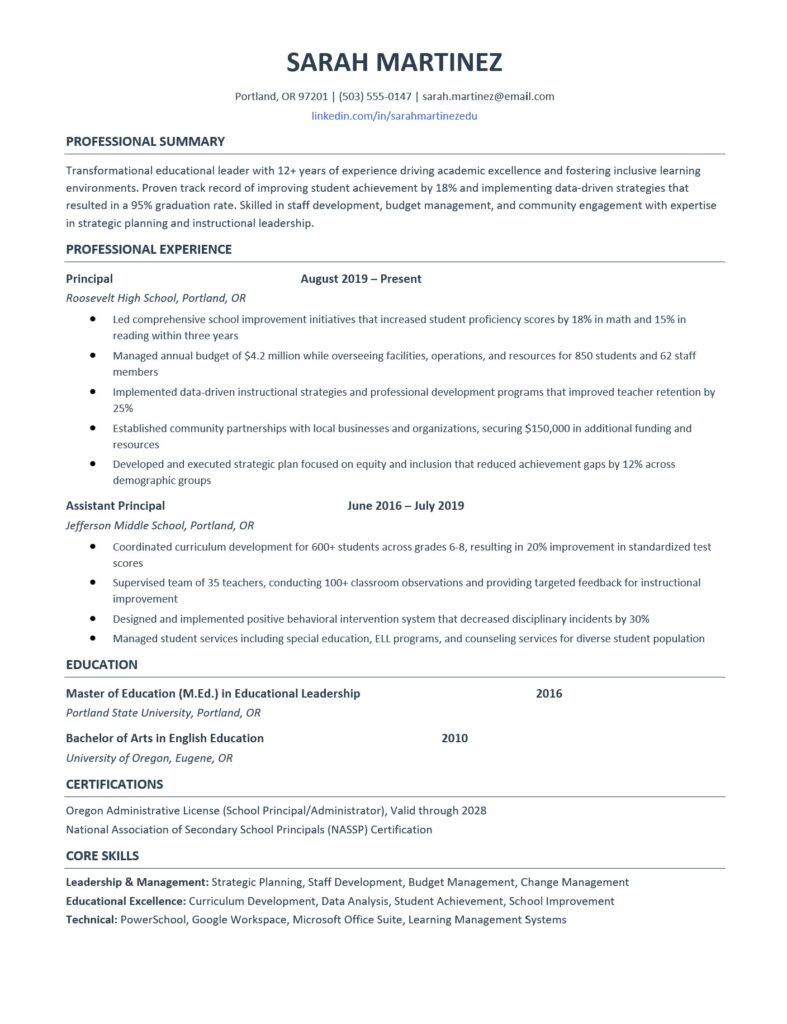
Here’s a professional principal resume template you can download and customize. This template is designed to be both visually appealing and ATS-friendly, with clean formatting that highlights your strengths.
Blank Customizable Template

Download Your Free Template:
- Download DOCX Template (fully editable in Microsoft Word)
Interview Guys Tip: The DOCX template is fully editable, allowing you to adjust fonts, colors, and spacing to match your personal brand while maintaining professional formatting. Just replace the placeholder text with your own information.
Essential Components of a Principal Resume
Your principal resume should include these critical sections in this specific order for maximum impact.
Professional Summary
This 3-4 sentence section at the top of your resume is arguably your most valuable real estate. It’s where you immediately establish your credibility by highlighting your years of educational leadership, most impressive quantified achievements, and core competencies.
The key is being specific rather than generic. Don’t write “experienced educational leader with strong communication skills.” Instead, try something like: “Transformational educational leader with 12+ years of experience driving academic excellence and building inclusive learning environments. Proven track record of improving student achievement by 18% and implementing data-driven strategies that resulted in a 95% graduation rate.”
See the difference? The second version gives hiring committees concrete evidence of your impact before they even reach your work experience.
Professional Experience
This is where you’ll spend most of your resume real estate, and rightfully so. For each position, you need the job title, school name and location, and dates of employment. But the real magic happens in your bullet points.
Structure your experience with your current or most recent principal role first, followed by assistant principal positions, and then other relevant administrative or teaching roles. Most principals should include 2-3 leadership positions to show career progression.
Each bullet point should follow this formula: Action verb + specific responsibility + quantified result. For example: “Implemented data-driven instructional strategies and professional development programs that improved teacher retention by 25%.”
Interview Guys Tip: If you’re currently an assistant principal applying for principal positions, emphasize whole-school initiatives you led, not just your departmental responsibilities. Hiring committees need to see you thinking at the building level.
Education
As a principal candidate, your education section carries significant weight. Most positions require at minimum a Master’s degree in Educational Leadership, Educational Administration, or a related field. Some principals also hold Ed.D. or Ph.D. degrees, which can be advantageous for certain positions.
List your highest degree first (Master’s or Doctorate), followed by your bachelor’s degree. Include the full degree name, institution, location, and graduation year. You can omit your GPA unless you graduated recently and it’s above 3.5.
Certifications
This section is non-negotiable for principal positions. Every state has specific administrative certification or licensure requirements that you must meet to be legally eligible for the role.
List your state administrative license or certification first, including the expiration or renewal date. Then include any additional relevant certifications like National Association of Secondary School Principals (NASSP) certification, trauma-informed schools training, or specialized leadership programs.
Keep your teaching license current even as a principal. Many states require principals to maintain active teaching licenses, and it demonstrates your commitment to staying connected to classroom practice.
Core Skills
This final section should be concise but strategic. Organize your skills into 2-3 categories that align with what principal positions require: leadership and management, educational excellence, and technical proficiencies.
Under each category, list 4-6 specific skills. These might include strategic planning, staff development, budget management, curriculum development, data analysis, and student achievement. Also include the specific software and systems you’re proficient with, such as PowerSchool, Google Workspace, or learning management systems.
How to Write Each Resume Section
Crafting Your Professional Summary
Your professional summary needs to accomplish three things in under 100 words: establish your experience level, showcase your biggest wins, and preview your areas of expertise.
Start with your years of experience and current role or most recent title. Then immediately pivot to your most impressive quantified achievements. These should be school-wide metrics like improvements in test scores, graduation rates, teacher retention, or student attendance.
Finally, close with a sentence about your specialized skills or leadership philosophy. This might reference your expertise in areas like equity and inclusion, community partnerships, instructional leadership, or school turnaround.
Writing Powerful Experience Bullets
The difference between mediocre and exceptional principal resumes often comes down to how you write your bullet points. Weak bullets simply list responsibilities. Strong bullets demonstrate impact through specific, quantified achievements.
Begin each bullet with a strong action verb. Use words like led, implemented, developed, established, coordinated, or managed. Then describe what you did and who it affected. Finally, quantify the results whenever possible.
Numbers are your best friend. How many students attend your school? How many staff members report to you? What was your budget? By what percentage did test scores improve? How much funding did you secure through partnerships?
When you don’t have exact numbers, use ranges or estimates. “Supervised team of 35 teachers” is much stronger than “supervised teaching staff.” “Managed annual budget of $4.2 million” proves your experience at a specific scale.
Highlighting Your Leadership Impact
School boards don’t hire principals who maintain the status quo. They hire leaders who drive improvement and transformation. Your resume needs to showcase how you’ve elevated every school where you’ve worked.
Focus on three key areas: student achievement, staff development, and community engagement. Under student achievement, include improvements in test scores, graduation rates, college acceptance rates, or reduction in achievement gaps. For staff development, highlight teacher retention improvements, professional development programs you’ve implemented, or recognition your teachers have received.
Community engagement might include partnerships you’ve established, funding you’ve secured, or parent satisfaction improvements. These elements demonstrate that you understand a principal’s role extends far beyond the school building.
Common Mistakes to Avoid
Even experienced administrators make critical errors that cost them interview opportunities. Here are the most common pitfalls and how to avoid them.
Listing Responsibilities Instead of Achievements
This is by far the most common mistake. Your resume shouldn’t read like a job description. Phrases like “responsible for overseeing school operations” or “managed daily school activities” tell hiring committees nothing about your effectiveness.
Instead, transform every responsibility into an achievement. If you managed operations, what improved because of your management? Did budgets run more efficiently? Did facility maintenance issues decrease? Did parents report higher satisfaction with school communication?
Forgetting to Quantify Your Impact
Numbers provide objective evidence of your leadership effectiveness. Without them, hiring committees have no way to assess the scale of your experience or the magnitude of your achievements.
Interview Guys Tip: Go back through your performance evaluations, school improvement plans, and strategic planning documents to find specific metrics you can include. Test score improvements, attendance rates, discipline incident reductions, and budget figures are all powerful quantifiers.
Using Generic Leadership Language
Terms like “excellent communicator,” “team player,” or “visionary leader” are so overused they’ve become meaningless. Everyone claims these qualities. What matters is proving them through specific examples and results.
Instead of saying you have “strong leadership skills,” describe how you “led comprehensive school improvement initiatives that increased student proficiency scores by 18%.” The second version proves your leadership through concrete outcomes.
Overlooking the ATS Factor
Many school districts now use Applicant Tracking Systems (ATS) to screen resumes before human eyes ever see them. These systems scan for specific keywords from the job posting to determine which candidates match the requirements.
This doesn’t mean awkwardly stuffing keywords into your resume. It means carefully reading the job description and naturally incorporating relevant terms into your experience bullets and skills section. If the posting mentions “instructional leadership,” “budget management,” and “data-driven decision making,” make sure those exact phrases appear in your resume where truthful and relevant.
ATS Optimization and Keywords
Speaking of ATS systems, let’s dive deeper into optimization strategies. According to 2026 industry research, over 99% of Fortune 500 companies use ATS software, and this technology has increasingly spread to school districts as well.
Understanding compensation expectations helps you evaluate opportunities and negotiate effectively once your resume lands interviews. Principal salaries vary significantly based on school size, location, and your experience level.
According to 2026 Bureau of Labor Statistics data, the median annual salary for elementary, middle, and high school principals is $103,460. However, this number masks substantial regional variation. Principals in metropolitan areas and high-cost-of-living states often earn $120,000 to $150,000 or more, while rural districts may offer $75,000 to $95,000.
Experience matters tremendously. First-time principals typically start near the lower end of their district’s salary schedule, while principals with 10+ years of administrative experience and proven track records of school improvement can command top-tier compensation packages that include performance bonuses.
School level also affects compensation. High school principals generally earn more than elementary principals due to larger student populations, more complex scheduling, and broader administrative responsibilities. National Center for Education Statistics 2026 data shows high school principals earn approximately 8-12% more than their elementary counterparts in comparable districts.
| Experience level | Typical salary range | Key factors | Negotiation leverage |
|---|---|---|---|
| First-time principal | $75,000 – $95,000 | School size, location, prior assistant principal experience | Limited, focus on professional development support |
| 3-5 years as principal | $90,000 – $115,000 | Demonstrated student achievement gains, retention rates | Moderate, cite specific school improvement metrics |
| 8+ years as principal | $110,000 – $150,000+ | Turnaround experience, large school management, awards/recognition | Strong, especially with competing offers or specialized expertise |
Beyond base salary, consider the total compensation package. Many districts offer performance bonuses tied to school improvement metrics, typically $5,000 to $15,000 annually. Administrative contracts often include benefits like extended contract days (220-240 days versus teacher contracts of 180-190 days), administrative leave, professional development allowances, and technology stipends.
Interview Guys Tip: When researching specific districts, request their administrative salary schedule during the application process. This transparency helps you understand where you’d fall on their compensation structure and prevents wasted time on positions that don’t meet your salary requirements.
The good news? ATS optimization for principal resumes is straightforward. These systems primarily look for matches between the job posting and your resume content, focusing on specific qualifications, certifications, and experience markers.
Start by creating a master resume document with all your experiences, achievements, and skills. Then, for each position you apply to, customize your resume by incorporating language directly from the job description. If they’re looking for someone with “experience implementing MTSS frameworks,” use that exact phrasing rather than a variation like “multi-tiered support systems.”
Focus your keyword optimization on three areas: your professional summary, experience bullets, and core skills section. These are the sections ATS systems scan most heavily for keyword matches.
Pay special attention to certification requirements. If the posting specifies “state administrative licensure” or names a specific certification, include the exact terminology in your certifications section.
One warning: never lie or exaggerate to include keywords you don’t actually possess. ATS optimization means presenting your genuine qualifications in language that matches what hiring committees are searching for, not fabricating experience you don’t have.
FAQ Section
How long should a principal resume be?
Principal resumes should typically be one to two pages. One page works well for assistant principals or principals with 5-7 years of administrative experience. Two pages is appropriate for experienced principals with 10+ years of leadership roles, multiple principalships, or significant accomplishments that require more space to adequately describe.
Should I include my teaching experience on a principal resume?
Yes, but be selective. Include your most recent teaching position or the role immediately before you moved into administration, as it demonstrates your classroom credibility. You don’t need to list every teaching job if you’ve been in administration for many years. Focus on leadership roles like department chair, team lead, or mentor teacher that show your trajectory toward administration.
What’s the best way to address employment gaps?
If you took time away from education for parental leave, sabbatical, or professional development, include a brief line in your experience section explaining the gap. For example: “Professional Development Sabbatical (2019-2020): Completed Ed.D. dissertation research and obtained NASSP certification.” This turns a potential red flag into evidence of your commitment to professional growth.
Do I need to include references on my resume?
No. Save valuable resume space for your qualifications and achievements. Create a separate references document with 3-4 professional references (ideally current or former superintendents, assistant superintendents, or school board members) that you can provide when requested during the interview process.
Should my resume format differ for elementary vs. high school principal positions?
The format stays consistent, but you should tailor your accomplishments to match the grade level. Elementary principal resumes might emphasize early literacy programs, social-emotional learning initiatives, and parent engagement. High school principal resumes might focus more on college readiness, career pathway programs, and post-secondary outcomes. Review our principal interview questions guide to understand how interview expectations also vary by level, and adjust your resume to prepare for those conversations.
Conclusion
Your principal resume is more than a document. It’s your first opportunity to demonstrate the visionary leadership, data-driven decision-making, and transformational impact that define exceptional school leaders. By quantifying your achievements, structuring your experience strategically, and tailoring your content to each position, you’ll position yourself as the candidate hiring committees can’t afford to overlook.
The templates we’ve provided give you the professional formatting and organizational structure that principals need. Now it’s your job to fill them with the specific metrics and achievements that showcase your unique leadership story. Remember that every number, every percentage improvement, and every dollar you managed tells hiring committees something important about your capacity to lead their school.
Ready to take the next step? Download both resume templates and start crafting your leadership narrative today. And when you’re preparing for the interviews those resumes will generate, explore our complete collection of free resume templates designed for education professionals at every career stage.
Before you send that resume: most Principal resumes get filtered out by ATS before a human ever sees them. Upload yours and find out your score. It takes 60 seconds and it’s free.
Advice like this is the general version. Longbow scores your actual resume against the actual job you want and shows you what's missing, before the filters decide for you. Here's why we built it.

ABOUT THE INTERVIEW GUYS (JEFF GILLIS & MIKE SIMPSON)
Mike Simpson: Co-founder of The Interview Guys and Longbow. He has been the voice behind our interview advice since 2013 — his work has reached over 100 million job seekers around the world. The strategic mind behind Longbow, our new career platform.
Jeff Gillis: Co-founder of The Interview Guys and Longbow. He built the systems that put our work in front of those readers, and he leads the engineering on Longbow, the cutting edge career platform built for today’s job seeker.