
Free CFO Resume Template: ATS Examples & Writing Guide [2025]

Your CFO resume is competing against hundreds of other highly qualified financial executives. That’s not an exaggeration. The average C-level position receives 250 applications, and executive recruiters spend just 30 seconds on the initial scan. In that brief window, your resume needs to prove you can drive financial strategy, manage risk, and deliver measurable business impact.
Here’s the challenge most CFO candidates face: they’ve managed multimillion-dollar budgets, led successful IPOs, and transformed financial operations. But when it comes to condensing 15-20 years of executive leadership onto two pages, many struggle to highlight what truly matters.
By the end of this article, you’ll have a clear roadmap for creating a CFO resume that positions you as the strategic financial leader companies desperately need. You’ll learn exactly what to include, how to structure your achievements, and which mistakes could cost you the interview. Plus, you’ll get two free downloadable templates (a completed example and a customizable blank version) to jumpstart your application.
Want to make sure your resume formatting is on point? Let’s dive in.
☑️ Key Takeaways
- CFO resumes require strategic focus on quantifiable achievements like cost reductions, revenue growth, and successful M&A deals rather than listing basic responsibilities
- Use reverse-chronological format with sections prioritized as: Professional Summary, Core Competencies, Experience, Education, then Certifications to pass ATS and appeal to executive recruiters
- Quantify everything with specific metrics showing financial impact: dollar amounts saved, percentage improvements, team sizes managed, and deals closed
- Tailor your resume for each application by incorporating keywords from the job description while maintaining authentic language that reflects your actual expertise
What Makes a CFO Resume Different?
Unlike mid-level finance roles, a CFO resume must demonstrate C-suite capabilities. You’re not just showcasing technical accounting skills; you’re proving you can shape company strategy, manage investor relations, and lead organizations through complex financial transformations.
The best CFO resumes tell a story of progressive financial leadership. They show how you’ve evolved from managing budgets to driving enterprise-wide strategic initiatives. Every bullet point should answer the question: “How did this executive create value?”
According to the Bureau of Labor Statistics, employment of top executives is projected to grow 6% through 2031, which means competition remains fierce. The executives who land interviews are those who can quantify their strategic impact immediately.
Interview Guys Tip: Never start a bullet point with “Responsible for” or “Duties included.” CFOs are action-takers who drive results. Use power verbs like spearheaded, orchestrated, transformed, and optimized to demonstrate leadership.
Before you send that resume: most CFO resumes get filtered out by ATS before a human ever sees them. Upload yours and find out your score. It takes 60 seconds and it’s free.
CFO Resume Example
Here’s a professional CFO resume example. This example gives you an idea of what type of content fits in a good ATS friendly resume.
Example Resume:

Here’s a professional CFO resume template you can download and customize. This template is designed to be both visually appealing and ATS-friendly, with clean formatting that highlights your strengths.
Blank Customizable Template
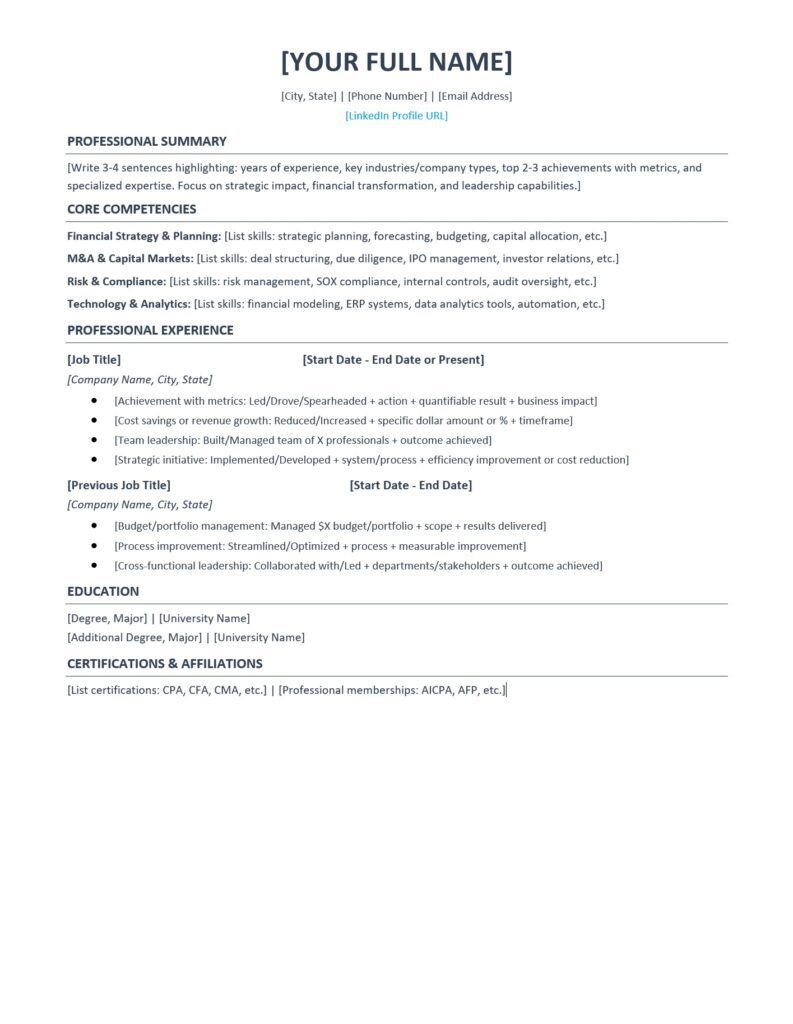
Download Your Free Template:
- Download DOCX Template (fully editable in Microsoft Word)
Interview Guys Tip: The DOCX template is fully editable, allowing you to adjust fonts, colors, and spacing to match your personal brand while maintaining professional formatting. Just replace the placeholder text with your own information.
Essential Resume Components for CFOs
Professional Summary: Your 30-Second Pitch
Your professional summary sits right below your contact information and delivers maximum impact in 3-4 sentences. This is where you establish yourself as a strategic financial executive, not just another finance professional.
Focus on these elements: total years of experience, specific industries or company types, your top 2-3 quantified achievements, and specialized expertise that sets you apart. For example: “Strategic CFO with 15+ years driving financial transformation for Fortune 500 tech companies. Led $500M IPO and reduced operational costs by 35% while scaling finance team from 8 to 40 professionals. Expert in M&A integration, predictive analytics, and building high-performing teams that deliver measurable ROI.”
Core Competencies: ATS-Friendly Skills Section
The Core Competencies section serves two critical purposes: it helps your resume pass Applicant Tracking Systems (ATS), and it gives recruiters a quick snapshot of your expertise. Over 83% of companies now use ATS systems, according to recent hiring research, which means keyword optimization is non-negotiable.
Organize skills into 4-5 categories that reflect the CFO role’s breadth: Financial Strategy & Planning, M&A & Capital Markets, Risk & Compliance, and Technology & Analytics. Under each category, list 4-6 specific skills that match the job description. This approach ensures ATS compatibility while demonstrating your multifaceted expertise to human reviewers.
Looking for more guidance on what skills to include on your resume? We’ve got you covered.
Professional Experience: Where You Prove Your Worth
Your experience section is the heart of your CFO resume. This is where most candidates either shine or stumble. The difference between an average resume and an exceptional one comes down to one thing: quantification.
Every achievement should include specific metrics. Instead of “Managed company budget,” write “Managed $850M budget across 12 business units, delivering 8.5% YoY revenue growth for four consecutive years.” The numbers tell the story of your impact.
Use this formula for crafting powerful bullet points: [Action Verb] + [What You Did] + [Quantifiable Result] + [Business Impact]. For example: “Spearheaded M&A integration of three acquisitions totaling $180M, achieving 98% retention of key talent and exceeding synergy targets by $12M.”
Interview Guys Tip: CFO resumes should show strategic thinking, not just financial management. Include achievements that demonstrate how you influenced business strategy, built organizational capabilities, or positioned the company for long-term growth.
Focus on accomplishments from the past 10-15 years. Earlier roles can be condensed or omitted unless they demonstrate a critical capability. Two pages is the sweet spot for CFO resumes, this gives you enough space to showcase depth without overwhelming readers.
Education and Certifications: Credibility Markers
Place your education section after your experience unless you recently completed a prestigious MBA or specialized finance certification. For CFO roles, your track record of results matters more than where you went to school 20 years ago.
List your degrees in reverse chronological order: degree type, major, university name, and graduation year (optional for roles 15+ years out). If you graduated with honors, include it.
Certifications belong in a separate section because they validate your technical expertise. The most valued credentials for CFOs include: Certified Public Accountant (CPA), Chartered Financial Analyst (CFA), Certified Management Accountant (CMA), and Chartered Global Management Accountant (CGMA). If you have these certifications, feature them prominently. Many job descriptions explicitly require them.
Professional memberships also add credibility. List affiliations with organizations like the American Institute of Certified Public Accountants (AICPA), Association for Financial Professionals (AFP), or Financial Executives International (FEI).
How to Optimize Your CFO Resume for ATS
Applicant Tracking Systems are gatekeepers between you and the interview. Research shows that 75% of resumes never reach human eyes because they fail ATS screening. Here’s how to make sure yours passes through.
Keyword Strategy That Works
Start by analyzing the job description. Identify specific technical skills, software systems, and competencies mentioned. Then naturally incorporate these terms throughout your resume in the Professional Summary, Core Competencies, and Experience sections.
For CFO roles, common keywords include: financial planning and analysis (FP&A), budget management, financial modeling, risk management, M&A, IPO, SOX compliance, GAAP, investor relations, and specific ERP systems like SAP, Oracle, or NetSuite.
But here’s the crucial part: use these keywords authentically. Don’t stuff your resume with terms you don’t actually have experience with. ATS algorithms are increasingly sophisticated and can detect keyword spamming. Plus, if you get the interview, you’ll need to discuss these competencies in depth.
Format for Both Robots and Humans
Use a clean, reverse-chronological format with clearly labeled sections. Avoid tables, text boxes, headers, and footers, these elements confuse ATS parsers. Stick with standard section headings: Professional Summary (not “About Me”), Professional Experience (not “Career Journey”), and Education (not “Academic Background”).
Save your resume as both a DOCX and PDF. While most modern ATS systems can read PDFs, some older systems prefer DOCX files. When applying online, follow the application instructions exactly. If they request a specific format, use it.
Common CFO Resume Mistakes to Avoid
Mistake #1: Leading With Responsibilities Instead of Results
“Oversaw financial operations” tells recruiters nothing about your capabilities. Transform this into: “Overhauled financial operations, implementing automated reporting systems that reduced close time from 15 days to 5 days and improved forecast accuracy by 40%.”
The pattern here is simple: every line should answer “So what?” If you managed a budget, what impact did your management have? If you led a team, what did that team accomplish under your leadership?
Mistake #2: Using Vague Language
Phrases like “significant cost savings,” “substantial revenue growth,” or “major improvement” are meaningless without numbers. Executives deal in specifics. Replace vague language with precise metrics: “Reduced operating expenses by $28M (35% reduction)” or “Increased revenue by $15M through strategic pricing optimization.”
Mistake #3: Ignoring Industry Context
A CFO who led a manufacturing company through supply chain disruptions has different expertise than a tech startup CFO who managed hypergrowth scaling. Tailor your resume to highlight experiences relevant to the target company’s industry and stage.
If you’re transitioning industries, emphasize transferable skills like financial modeling, M&A experience, or team leadership that apply across sectors. Check out our guide on how to change careers for more strategies.
Mistake #4: Neglecting the Visual Hierarchy
Wall-of-text resumes get rejected. Use white space strategically, keep paragraphs short (2-3 lines maximum), and ensure your most impressive achievements are immediately visible. Bold key numbers to draw the eye: “Reduced costs by $28M annually” makes the impact jump off the page.
Mistake #5: Forgetting to Proofread
At the CFO level, a single typo can disqualify you. It signals carelessness and lack of attention to detail. These traits are dealbreakers for financial leadership roles. Have at least two people review your resume before submission.
Tailoring Your CFO Resume for Maximum Impact
Generic resumes don’t land CFO interviews. The most successful candidates customize their applications for each opportunity, highlighting the most relevant experiences and using language that resonates with the hiring company’s culture.
Start by researching the company. Review their annual reports, recent press releases, and financial filings. What challenges are they facing? What strategic initiatives have they announced? Then position yourself as the solution to their specific needs.
If the company just raised Series B funding, emphasize your experience scaling finance operations and managing investor relations. If they’re preparing for an IPO, highlight your capital markets expertise and regulatory compliance experience. If they’re pursuing aggressive M&A strategy, lead with your deal integration successes.
Interview Guys Tip: Mirror the language used in the job description. If they emphasize “data-driven decision making,” use that exact phrase when describing how you implemented analytics-powered financial forecasting. This creates natural keyword matches while demonstrating you speak their language.
When you’re ready for the next step, check out our comprehensive guide to CFO interview questions and answers to prepare for what comes after your resume lands the interview.
FAQ: CFO Resume Questions Answered
How long should a CFO resume be?
Two pages is the standard length for CFO resumes. This gives you enough space to detail 15-20 years of progressive leadership without overwhelming readers. Focus on the most recent 10-15 years, with earlier roles condensed to 1-2 lines if they’re still relevant.
Should I include a cover letter with my CFO resume?
Yes, absolutely. While 82.8% of recruiters read cover letters, they’re particularly important for executive roles. Your cover letter should explain why you’re interested in this specific opportunity and how your experience aligns with the company’s strategic needs. Learn how to write a cover letter that complements your resume.
What’s the best resume format for CFOs?
Reverse-chronological format works best for CFO roles. It clearly shows career progression and makes it easy for recruiters to scan your most recent (and typically most relevant) experience first. Functional or hybrid formats often raise red flags about employment gaps or lack of recent experience.
How many years of experience should I include?
Include your last 10-15 years in detail. Earlier positions can be summarized in a “Prior Experience” section with just company names, titles, and dates. The exception: if you have a notable achievement from earlier in your career that’s highly relevant to the target role, include it.
Do I need to include references on my CFO resume?
No. “References available upon request” is outdated and wastes valuable space. Prepare a separate reference sheet to provide when specifically requested, typically during later interview stages.
Your Next Steps
You now have everything you need to create a CFO resume that stands out from the hundreds of other applications. Download both templates above: the completed example shows you exactly what a strong CFO resume looks like, while the blank template provides the structure you need with helpful guidance in each section.
Start by tailoring your professional summary to match your unique value proposition. Then work through your experience section, transforming each bullet point into a quantified achievement. Don’t forget to optimize for ATS by incorporating relevant keywords naturally throughout your resume.
The CFO role requires strategic thinking, financial expertise, and proven leadership. Make sure your resume demonstrates all three. Need more templates for different positions? Browse our free resume template library for additional options.
Your resume is your ticket to the interview room. Make it count.
Before you send that resume: most CFO resumes get filtered out by ATS before a human ever sees them. Upload yours and find out your score. It takes 60 seconds and it’s free.
Advice like this is the general version. Longbow scores your actual resume against the actual job you want and shows you what's missing, before the filters decide for you. Here's why we built it.

ABOUT THE INTERVIEW GUYS (JEFF GILLIS & MIKE SIMPSON)
Mike Simpson: Co-founder of The Interview Guys and Longbow. He has been the voice behind our interview advice since 2013 — his work has reached over 100 million job seekers around the world. The strategic mind behind Longbow, our new career platform.
Jeff Gillis: Co-founder of The Interview Guys and Longbow. He built the systems that put our work in front of those readers, and he leads the engineering on Longbow, the cutting edge career platform built for today’s job seeker.