
Vet Assistant Resume Template: ATS Friendly Examples & 2025 Writing Guide

Landing your dream job as a veterinary assistant starts with a resume that captures your unique blend of animal care skills, clinical expertise, and compassionate patient handling. But here’s the thing: most vet assistant resumes look exactly the same, which makes it nearly impossible to stand out in a stack of applications.
You love animals. You’ve got the technical skills. You can keep your cool when a nervous German Shepherd is thrashing on the exam table. But none of that matters if your resume doesn’t communicate your value in the first six seconds a hiring manager looks at it.
The veterinary field is booming right now. Employment for veterinary assistants is projected to grow 19% from 2020 to 2030, much faster than average for all occupations. With pet ownership at record highs and Americans expected to spend $157 billion on their pets in 2025, veterinary clinics are desperate for qualified assistants who can hit the ground running.
By the end of this article, you’ll have two downloadable resume templates (a completed example and an editable blank version), a clear understanding of what makes a vet assistant resume stand out, and specific strategies for beating applicant tracking systems. Plus, you’ll learn exactly what hiring managers look for when they’re scanning through dozens of applications.
☑️ Key Takeaways
- A strong vet assistant resume highlights both clinical skills and compassionate animal care, showing you can handle medical procedures while keeping pets and owners calm
- Quantify your experience with specific numbers like “assisted with 40+ examinations daily” rather than vague descriptions of your duties
- AVA certification can increase your starting salary and should be prominently featured in both your summary and certifications section
- ATS-friendly formatting is critical since most veterinary practices use applicant tracking systems to screen resumes before human eyes see them
What Makes a Vet Assistant Resume Different?
A veterinary assistant resume isn’t just another healthcare document. It requires a careful balance between demonstrating your clinical competencies and showcasing your ability to create a calming, compassionate environment for anxious animals and worried pet parents.
The dual-focus approach is what separates winning resumes from the rest. You need to prove you can handle the technical aspects, like administering medications and assisting with surgical procedures, while also excelling at the interpersonal side, like educating clients and providing emotional support during difficult moments.
Unlike other entry-level healthcare positions, vet assistant roles often require you to demonstrate physical capabilities too. Hiring managers want to know you can safely restrain a 70-pound dog, lift heavy supply boxes, and stay on your feet for eight-hour shifts without breaking a sweat.
Interview Guys Tip: If you’ve worked with exotic animals, large animals, or specialized species, make this prominently visible on your resume. Most candidates only have experience with cats and dogs, so broader animal handling experience instantly makes you more valuable to diverse veterinary practices.
Before you send that resume: most Vet Assistant resumes get filtered out by ATS before a human ever sees them. Upload yours and find out your score. It takes 60 seconds and it’s free.
Veterinary Assistant Resume Example
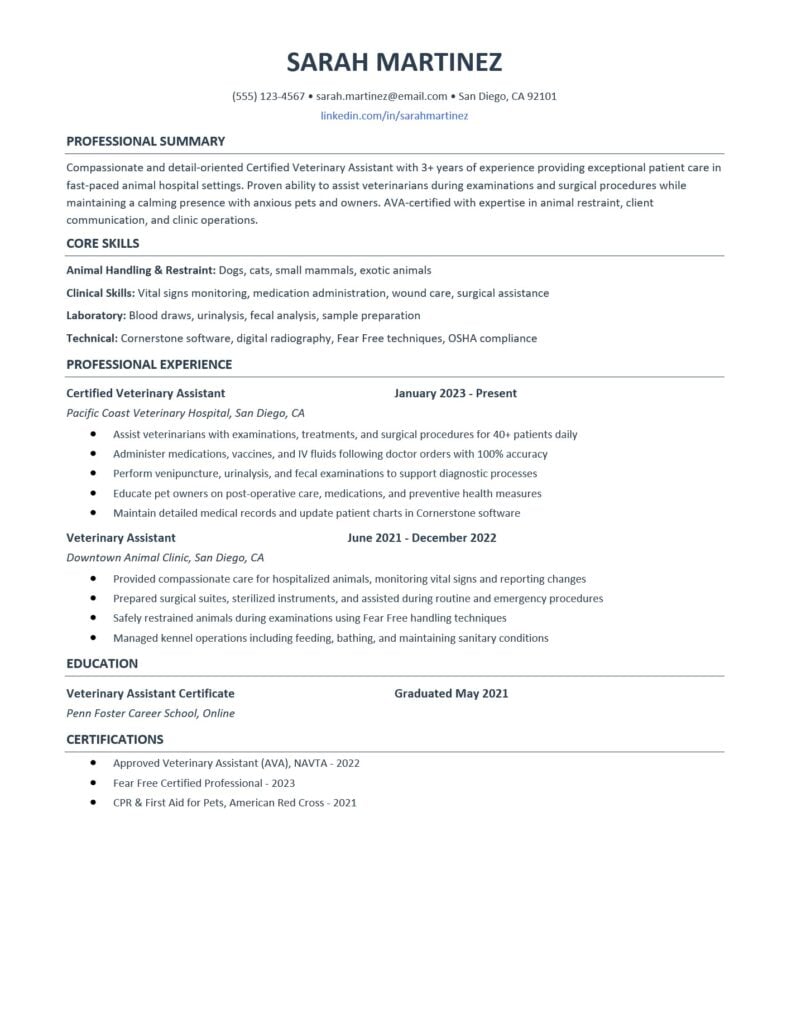
Here’s a professional vet assistant resume example. This example gives you an idea of what type of content fits in a good ATS friendly resume.
Example Resume:
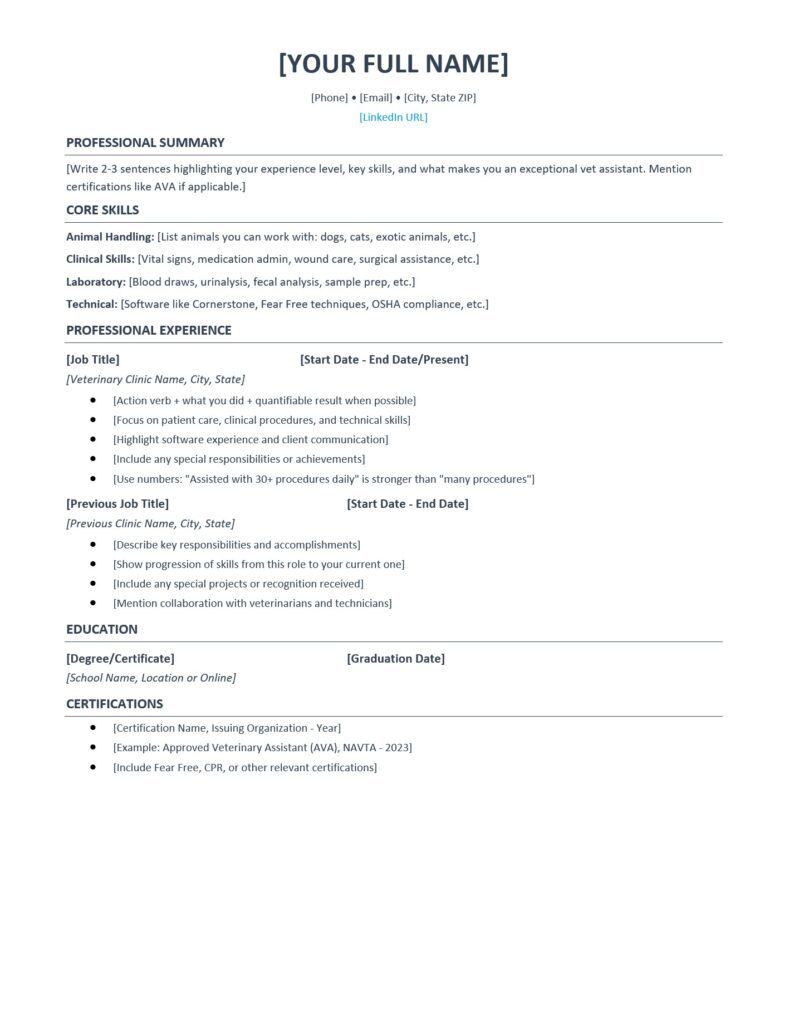
Here’s a professional vet assistant resume template you can download and customize. This template is designed to be both visually appealing and ATS-friendly, with clean formatting that highlights your strengths.
Blank Customizable Template
Download Your Free Template:
- Download DOCX Template (fully editable in Microsoft Word)
Interview Guys Tip: The DOCX template is fully editable, allowing you to adjust fonts, colors, and spacing to match your personal brand while maintaining professional formatting. Just replace the placeholder text with your own information.
Essential Components Every Vet Assistant Resume Needs
Your resume should include these six core sections in this specific order: Professional Summary, Core Skills, Professional Experience, Education, and Certifications. This structure ensures the most important information appears at the top where hiring managers look first.
Professional Summary: Your 30-Second Pitch
Start with a compelling 2-3 sentence summary that captures your experience level, strongest skills, and what makes you uniquely valuable. This isn’t the place for generic statements like “hardworking team player.” Instead, lead with concrete details.
Good example: “Compassionate and detail-oriented Certified Veterinary Assistant with 3+ years of experience providing exceptional patient care in fast-paced animal hospital settings. Proven ability to assist veterinarians during examinations and surgical procedures while maintaining a calming presence with anxious pets and owners.”
Notice how this summary immediately establishes credibility with years of experience, mentions AVA certification (which matters for salary negotiations), and highlights both technical and soft skills.
Core Skills: Keywords That Beat the ATS
The skills section serves two critical purposes: getting past applicant tracking systems (ATS) and giving hiring managers a quick snapshot of your capabilities. Over 98% of Fortune 500 companies use ATS software, and many veterinary practices have adopted these systems too.
Organize your skills into categories like Animal Handling, Clinical Skills, Laboratory, and Technical. This structure makes it scannable while incorporating keywords from the job posting.
Include specific software names (like Cornerstone, AVImark, or ezyVet), animal types you can work with (dogs, cats, exotics, large animals), and any specialized techniques you know (Fear Free, Low Stress Handling).
Professional Experience: Show, Don’t Tell
Your work experience section needs to do more than list your responsibilities. Every bullet point should start with a strong action verb and, whenever possible, include quantifiable results.
- Weak bullet point: “Responsible for assisting veterinarians during examinations”
- Strong bullet point: “Assisted veterinarians with examinations, treatments, and surgical procedures for 40+ patients daily”
The difference? The strong version gives hiring managers context about the volume and pace of your work environment. It proves you can handle a busy practice.
For each position, include 4-6 bullet points that showcase your most impressive contributions. If you helped implement a new system, reduced wait times, improved client satisfaction scores, or trained new team members, these achievements deserve prominent placement.
Interview Guys Tip: If you’re transitioning from a veterinary receptionist or kennel worker role, focus your bullets on any clinical exposure you gained, even if it wasn’t your primary responsibility. Hiring managers value candidates who showed initiative to learn hands-on skills.
Education: Keep It Concise
For most vet assistant positions, your education section can be brief. List your highest level of education first. If you completed a NAVTA-approved veterinary assistant program, make sure this is clearly visible as it demonstrates formal training versus on-the-job learning alone.
Include your high school diploma only if you don’t have any postsecondary education or training certificates. If you completed relevant coursework (like biology, animal science, or anatomy), you can mention it, but don’t let this section dominate your resume.
Certifications: Your Competitive Advantage
Certifications can significantly boost your earning potential and job prospects. The Approved Veterinary Assistant (AVA) credential from NAVTA is the gold standard in this field. Certified vet assistants often command higher starting salaries than their non-certified peers.
List each certification with its full name, issuing organization, and year obtained. If you’re currently pursuing a certification, you can include it as “AVA Certification (In Progress – Expected 2025).”
Other valuable certifications include Fear Free Certified Professional, Pet CPR and First Aid, and specialized credentials for working with exotic animals or emergency care.
How to Write Each Section (Step-by-Step)
Let’s break down exactly what to write in each section, starting from the top of your resume.
Crafting Your Header
Your header seems simple, but many candidates make critical mistakes here. Center your full name at the top in a larger, bold font (22pt works well). Directly below, include your phone number, professional email address, and city/state (full address isn’t necessary anymore).
Add your LinkedIn profile URL if you have one. Make sure it’s updated and matches the information on your resume. About 87% of recruiters use LinkedIn to vet candidates, so this small detail matters.
Writing a Compelling Professional Summary
Your professional summary should answer three questions in 2-3 sentences: How much relevant experience do you have? What are your strongest skills? What makes you valuable to this specific employer?
Start with your current title or years of experience. Follow with your most marketable credential or skill. End with what you bring to the role, particularly focusing on outcomes or impact.
Avoid fluffy language like “passionate animal lover seeking opportunities.” Instead, get specific about your capabilities: “AVA-certified assistant with expertise in dental prophylaxis, digital radiography, and Fear Free handling techniques.”
Selecting the Right Skills
Review the job posting carefully and identify which skills the employer emphasizes. These should appear in your Core Skills section, assuming you legitimately possess them. Never lie about skills you don’t have, but do prioritize the ones that match what they’re seeking.
Technical skills every vet assistant resume should consider including:
- Animal restraint and handling (specify which species)
- Vital signs monitoring
- Medication administration and dosing calculations
- Venipuncture and sample collection
- Surgical preparation and assistance
- Laboratory procedures (urinalysis, fecal analysis, blood work)
- Radiology assistance
- Dental procedures
- Client education and communication
- Medical records management
- Practice management software proficiency
Interview Guys Tip: If you’re applying to specialty practices (like emergency clinics, exotic animal hospitals, or orthopedic specialists), adjust your skills section to emphasize relevant experience in these areas. A one-size-fits-all resume rarely wins job offers.
Building Strong Experience Bullets
Each bullet point in your experience section should follow the CAR formula: Challenge, Action, Result. What problem existed? What did you do about it? What was the outcome?
- Instead of: “Cleaned and maintained kennel areas”
- Try: “Maintained sanitary kennel conditions for 20+ hospitalized patients, preventing cross-contamination and supporting faster recovery times”
The second version transforms a mundane task into a meaningful contribution that shows you understand why this work matters.
Use these powerful action verbs to start your bullets: Assisted, Administered, Performed, Monitored, Educated, Maintained, Prepared, Collaborated, Implemented, Coordinated.
Common Mistakes That Kill Vet Assistant Resumes
Even qualified candidates sabotage their chances with easily avoidable mistakes. Here are the most common resume killers I see.
Mistake #1: Generic, Cookie-Cutter Content
Your resume shouldn’t read like every other vet assistant resume. Avoid overused phrases like “team player,” “hard worker,” or “animal lover.” These tell hiring managers nothing about your actual capabilities.
Mistake #2: Missing Quantification
Numbers make your experience concrete and believable. How many patients did you assist daily? How many procedures have you participated in? What percentage of clients left positive reviews?
Even approximations work. “Assisted with 30-50 examinations daily” is infinitely stronger than “helped with many examinations.”
Mistake #3: Including Irrelevant Information
Your high school honor roll achievement from 2015? Not relevant. Your complete work history going back to your first job at 16? Unnecessary. Keep your resume focused on the last 5-10 years of relevant experience.
Skip the “References Available Upon Request” line. It’s understood. Use that valuable space for more accomplishments instead.
Mistake #4: Poor Formatting Choices
Fancy fonts, multiple colors, graphics, and creative layouts might look pretty, but they confuse ATS software. Stick with clean, professional fonts like Calibri, Arial, or Times New Roman in 10-12pt.
Use consistent formatting throughout. If you bold one job title, bold them all. If you use bullet points in one section, use them in similar sections.
Mistake #5: Typos and Grammar Errors
A single typo can derail your entire application. Veterinary work requires precision and attention to detail. A careless error on your resume suggests you might be careless with patient care too.
Proofread multiple times. Read it backwards to catch spelling errors. Use spell-check, but don’t rely on it exclusively. Have someone else review it with fresh eyes.
ATS Optimization: Getting Your Resume Past the Robots
Most veterinary practices, especially larger hospitals and corporate chains, use applicant tracking systems to filter resumes before humans ever see them. Understanding how these systems work is critical to getting your resume in front of hiring managers.
How ATS Software Screens Resumes
ATS programs scan your resume for keywords that match the job description. They look for specific skills, credentials, job titles, and experience markers. Resumes that don’t contain enough relevant keywords get automatically rejected, even if the candidate is perfectly qualified.
The system also evaluates your resume’s format. Complex layouts, tables, text boxes, headers, and footers can confuse the software, causing it to misread or skip important information.
Strategies for Beating the ATS
- Use keyword-rich content throughout your resume. If the job posting mentions “Fear Free techniques,” include exactly that phrase (assuming you have this training). Don’t use synonyms like “low-stress handling” instead. The ATS is looking for exact matches.
- Include both acronyms and spelled-out versions of credentials. Write “Approved Veterinary Assistant (AVA)” rather than assuming the system knows what AVA means.
- Stick to standard section headings. Use “Professional Experience” instead of creative alternatives like “My Journey” or “Where I’ve Made Impact.” ATS software expects conventional headers and may not recognize unique ones.
- Save your resume as a .docx file unless the application specifically requests a PDF. Some older ATS systems struggle with PDFs, while .docx files are universally compatible.
- Match the job title in your experience section to what’s in the job posting when appropriate. If the posting is for a “Veterinary Assistant” and your previous title was “Animal Care Technician” but you performed vet assistant duties, consider using “Veterinary Assistant / Animal Care Technician” to capture both.
Testing Your Resume’s ATS Compatibility
Before submitting your application, run your resume through a free ATS checker tool online. These tools simulate how tracking systems read your document and flag potential issues.
You can also copy your resume text and paste it into a plain text editor. If it looks jumbled or important information is missing, the ATS is probably having similar problems reading it.
Frequently Asked Questions
How long should my vet assistant resume be?
Keep it to one page, especially if you have less than 10 years of experience. Hiring managers spend an average of 6-7 seconds on initial resume scans. A concise, well-organized single page is far more effective than a rambling two-page document.
Should I include volunteer experience at animal shelters?
Absolutely, especially if you’re early in your career. Volunteer experience demonstrates your commitment to animal welfare and can showcase relevant skills like animal handling, cleaning protocols, and client interaction. List it under a “Volunteer Experience” section or incorporate it into your Professional Experience section.
What if I don’t have any veterinary experience yet?
Focus on transferable skills from other roles. Customer service experience, healthcare work, childcare, or any position requiring attention to detail and empathy can be relevant. Emphasize your education, certifications, and any hands-on externship or volunteer hours you’ve completed.
Is it okay to use a resume template?
Yes! Using a well-designed, ATS-friendly template saves time and ensures professional formatting. Just make sure to customize every section with your unique experience and qualifications. The templates provided with this article are optimized for both ATS screening and hiring manager review.
How do I address gaps in employment?
Be honest but strategic. If you took time off for family care, education, or health reasons, you can include a brief line in your resume or cover letter. Focus on any skills you developed or volunteer work you did during that time. Most hiring managers understand that gaps happen, and they care more about what you can do now than your complete work history.
Should I include a photo on my resume?
In the United States, it’s not standard practice to include photos on resumes, and some employers actually prefer you don’t to avoid potential bias claims. Skip the photo unless you’re specifically asked for one.
Ready to Land Your Vet Assistant Job?
You’ve got the templates, the strategies, and the insider knowledge to create a resume that gets results. Now it’s time to put it into action.
Start by downloading both the completed example and the blank template from this article. Use the example as a reference guide while you fill in the blank template with your own information. Remember to tailor your resume for each position you apply to, emphasizing the skills and experiences most relevant to that specific practice.
Once your resume is ready, check out our comprehensive guide on vet assistant interview questions to prepare for the next step in your job search. And if you’re looking for more resume resources, browse our free resume template library for additional formats and styles.
Your perfect vet assistant position is waiting. With a standout resume that showcases your unique value, you’re one step closer to making a real difference in the lives of animals and the people who love them.
Before you send that resume: most Vet Assistant resumes get filtered out by ATS before a human ever sees them. Upload yours and find out your score. It takes 60 seconds and it’s free.
Advice like this is the general version. Longbow scores your actual resume against the actual job you want and shows you what's missing, before the filters decide for you. Here's why we built it.

ABOUT THE INTERVIEW GUYS (JEFF GILLIS & MIKE SIMPSON)
Mike Simpson: Co-founder of The Interview Guys and Longbow. He has been the voice behind our interview advice since 2013 — his work has reached over 100 million job seekers around the world. The strategic mind behind Longbow, our new career platform.
Jeff Gillis: Co-founder of The Interview Guys and Longbow. He built the systems that put our work in front of those readers, and he leads the engineering on Longbow, the cutting edge career platform built for today’s job seeker.