
Free Restaurant Manager Resume Template: Examples & Writing Guide [2025]

Why Restaurant Manager Resumes Fail (And How to Fix Yours)
You’ve got years of experience managing dining operations, training teams, and keeping customers happy. You’ve juggled kitchen chaos during dinner rushes, turned around underperforming locations, and built staff cultures that people actually want to be part of. But when you apply for that next management role, you hear nothing back.
Here’s the brutal truth. Most restaurant manager resumes fail because they read like job descriptions instead of achievement stories. Hiring managers see hundreds of resumes claiming “managed daily operations” or “supervised staff.” What they don’t see enough of are the numbers that prove you actually moved the needle.
The restaurant industry is incredibly competitive in 2025. You’re not just competing with other experienced managers. You’re competing with applicant tracking systems that reject 75% of qualified candidates before a human ever sees your resume. That’s right, three out of four great candidates get filtered out because their resumes don’t speak ATS language.
By the end of this article, you’ll have two professionally formatted resume templates (one filled example and one blank template), insider knowledge on what restaurant hiring managers actually want to see, and the exact framework for turning your experience into interview-generating achievements. Let’s get you noticed.
☑️ Key Takeaways
- Restaurant manager resumes need quantifiable achievements showing revenue growth, cost reductions, and team leadership metrics to stand out
- ATS optimization is critical as 98% of Fortune 500 companies use applicant tracking systems that scan for specific keywords
- The right resume structure matters with Professional Summary at the top, followed by Core Skills, Experience, Education, and Certifications
- Action verbs and metrics beat generic descriptions every time when describing your operational impact and management success
Before you send that resume: most Restaurant Manager resumes get filtered out by ATS before a human ever sees them. Upload yours and find out your score. It takes 60 seconds and it’s free.
What Makes a Restaurant Manager Resume Different?
Restaurant management resumes require a unique balance. You need to demonstrate both hard operational skills (P&L management, inventory control, cost reduction) and soft leadership abilities (team development, conflict resolution, customer service excellence). Unlike corporate management roles, restaurant positions demand proof that you can handle the chaos of a live service environment while keeping numbers in the black.
The biggest mistake candidates make is treating all management experience equally. Your resume needs to specifically highlight restaurant industry metrics that hiring managers recognize instantly. Revenue per seat, labor cost percentages, food waste reduction, customer satisfaction scores, and staff retention rates speak directly to what matters in food service operations.
According to recent data from Jobscan, 97.8% of Fortune 500 companies use ATS to screen resumes in 2025. In the restaurant industry, major chains like Chipotle, Olive Garden, and The Cheesecake Factory all use these systems. Your resume must pass digital screening before any human consideration happens.
If you’re targeting a position at Olive Garden specifically, prepare for their screening process by reviewing the top 10 Olive Garden interview questions for 2026 to understand what their hiring managers prioritize.
Restaurant Manager Resume Example
Here’s a professional resume example. This example gives you an idea of what type of content fits in a good ATS friendly resume.
Example Resume:
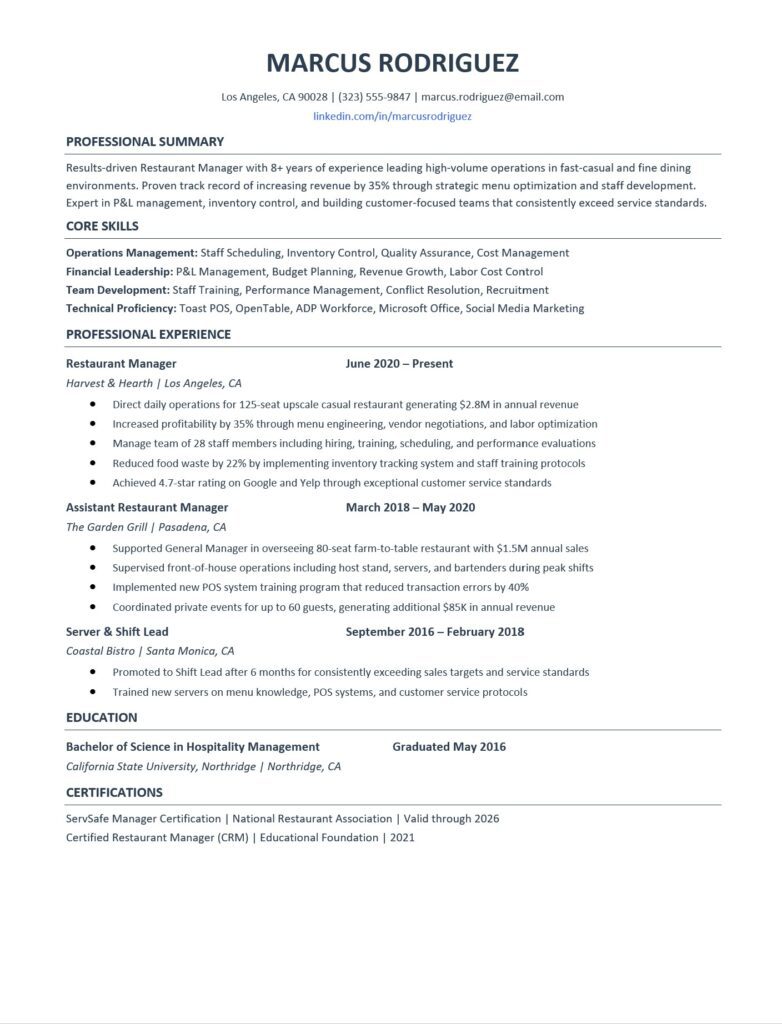
Here’s a professional restaurant manager resume template you can download and customize. This template is designed to be both visually appealing and ATS-friendly, with clean formatting that highlights your strengths.
Blank Customizable Template
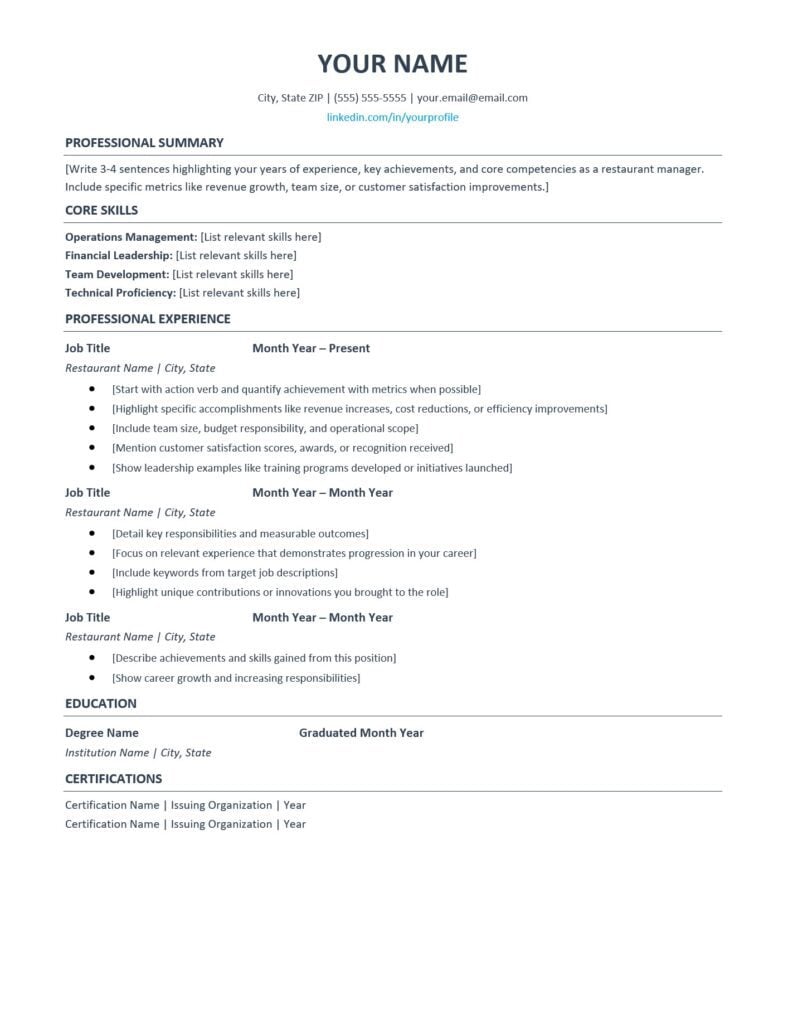
Download Your Free Template:
- Download DOCX Template (fully editable in Microsoft Word)
Interview Guys Tip: The DOCX template is fully editable, allowing you to adjust fonts, colors, and spacing to match your personal brand while maintaining professional formatting. Just replace the placeholder text with your own information.
Here’s what most people don’t realize: employers now expect multiple technical competencies, not just one specialization. The days of being “just a marketer” or “just an analyst” are over. You need AI skills, project management, data literacy, and more. Building that skill stack one $49 course at a time is expensive and slow. That’s why unlimited access makes sense:
Your Resume Needs Multiple Certificates. Here’s How to Get Them All…
We recommend Coursera Plus because it gives you unlimited access to 7,000+ courses and certificates from Google, IBM, Meta, and top universities. Build AI, data, marketing, and management skills for one annual fee. Free trial to start, and you can complete multiple certificates while others finish one.
Essential Components of an Effective Restaurant Manager Resume
Professional Summary: Your 15-Second Pitch
The professional summary section sits at the top of your resume for a reason. It’s where you make your case in three to four sentences max. This isn’t the place for vague statements about being a “hardworking team player.” Instead, lead with your years of experience, the type of establishments you’ve managed, and one to two quantified achievements that prove your value.
- Strong example: “Results-driven Restaurant Manager with 8+ years of experience leading high-volume operations in fast-casual and fine dining environments. Proven track record of increasing revenue by 35% through strategic menu optimization and staff development.”
- Weak example: “Experienced restaurant manager looking for new opportunities. Hard worker with excellent communication skills.”
See the difference? The first version tells a hiring manager exactly what you bring to the table. The second could apply to anyone.
Interview Guys Tip: If you’re struggling to write your summary, draft your bullet points first. Once you see your achievements laid out, you’ll identify the themes that belong in your opening statement.
Core Skills: ATS Keywords That Get You Through the Gate
The Core Skills section serves double duty. It helps ATS systems find relevant keywords, and it gives hiring managers a quick snapshot of your capabilities. For restaurant managers, organize your skills into categories that matter to the industry.
Operations Management skills might include: Staff Scheduling, Inventory Control, Quality Assurance, Cost Management, Vendor Relations, Health & Safety Compliance
Financial Leadership skills should showcase: P&L Management, Budget Planning, Revenue Growth, Labor Cost Control, Menu Pricing, Waste Reduction
Team Development abilities cover: Staff Training, Performance Management, Conflict Resolution, Recruitment, Employee Retention, Schedule Optimization
Technical Proficiency matters too: List specific POS systems (Toast, Square, Micros), reservation platforms (OpenTable, Resy), scheduling software (HotSchedules, Deputy), and any payroll systems you’ve used.
Don’t just list random skills hoping something sticks. Review your target job descriptions and mirror the language they use. If the posting mentions “inventory management,” use those exact words rather than synonyms. ATS systems often look for specific keyword matches.
Professional Experience: Where Numbers Tell Your Story
Your experience section makes or breaks your resume. This is where you transform routine responsibilities into compelling achievements. Every bullet point should start with a strong action verb and include quantifiable results whenever possible.
The formula is simple: Action Verb + Specific Task + Measurable Result
Instead of: “Managed restaurant staff” Write: “Led team of 28 staff members, reducing turnover by 40% through improved training program and recognition initiatives”
Instead of: “Responsible for inventory” Write: “Reduced food waste by 22% by implementing inventory tracking system and staff training protocols”
Notice how the second versions immediately communicate value? They tell hiring managers exactly what you accomplished, not just what you did. When describing your restaurant management experience, focus on these high-impact areas:
Revenue Impact: Did you increase sales? By how much? Through what methods? Cost Savings: Did you reduce labor costs, food waste, or overhead expenses? Customer Satisfaction: Can you cite improved review scores, repeat customer rates, or Net Promoter Scores? Team Performance: Did you reduce turnover, improve training completion rates, or increase productivity? Operational Efficiency: Did you streamline processes, reduce wait times, or improve table turn rates?
List your experience in reverse chronological order (most recent first). For each position, include three to five bullet points that showcase your biggest wins. If you have more than 10-15 years of experience, you can summarize earlier roles in one or two lines.
Interview Guys Tip: If you’re light on hard metrics, calculate them now. Pull old performance reviews, sales reports, or schedule records. Even rough estimates like “approximately 20% reduction in food costs” carry more weight than no numbers at all.
Education: What Actually Matters
Here’s good news for restaurant managers: you don’t need a college degree to land great management roles. While a Bachelor’s degree in Hospitality Management or Business Administration can help, especially for fine dining or corporate positions, your experience usually speaks louder than your education.
If you have a relevant degree, list it with your institution, graduation date, and any honors or relevant coursework. If you don’t have a degree, focus on industry certifications and training programs that demonstrate your commitment to professional development.
Certifications: Your Professional Credibility Boost
Certifications matter in restaurant management because they show you take food safety, compliance, and professional standards seriously. The most valuable certifications include:
- ServSafe Manager Certification: This is practically mandatory. It proves you understand food safety protocols and can train staff on proper handling procedures.
- Certified Restaurant Manager (CRM): Offered by the National Restaurant Association Educational Foundation, this certification covers operations, human resources, and financial management.
- TIPS Alcohol Certification: Essential if you manage bar operations or any establishment serving alcohol.
- State-specific food handler cards or manager permits: Required in many states and counties.
List certifications with the issuing organization and expiration dates if applicable. Keep your ServSafe current because hiring managers will check, and an expired certification raises red flags about your attention to detail.
Before you send that resume: most Restaurant Manager resumes get filtered out by ATS before a human ever sees them. Upload yours and find out your score. It takes 60 seconds and it’s free.
How to Optimize Your Resume for Applicant Tracking Systems
ATS rejection is the silent killer of great resumes. These systems scan your resume for keywords, proper formatting, and relevant experience before any human sees your application. Here’s how to beat them.
- Use standard section headers. ATS software expects to see “Professional Experience” or “Work Experience,” not creative alternatives like “My Journey” or “Where I’ve Been.” Stick with conventional headers for every section.
- Include keywords from the job description. If the posting mentions “P&L management,” use that exact phrase. If they want “inventory control,” don’t substitute “stock management.” ATS systems perform literal keyword searches.
- Skip fancy formatting. Tables, text boxes, graphics, and multiple columns confuse ATS parsers. Use a simple, clean layout with standard fonts like Calibri or Arial. Our templates follow these guidelines exactly.
- Save as DOCX format. While PDF files look prettier, some older ATS systems struggle with them. DOCX is universally readable. When a job posting doesn’t specify, submit both formats if possible.
- Spell out acronyms on first use. Write “Point of Sale (POS)” systems rather than assuming the ATS recognizes industry abbreviations.
For restaurant managers specifically, make sure these keywords appear somewhere in your resume: staff management, inventory control, cost reduction, customer service, food safety, team leadership, budget management, scheduling, training and development, P&L responsibility.
Common Mistakes That Kill Restaurant Manager Resumes
Generic Objective Statements: Skip the “seeking a challenging position where I can utilize my skills” language. It adds zero value and wastes prime resume real estate. Your professional summary should replace any objective statement.
Duties Instead of Achievements: Saying you “managed daily operations” tells hiring managers nothing they didn’t already assume. Show what you accomplished while managing those operations.
Missing Metrics: Numbers prove your impact. Without them, you’re just another candidate making claims. Even approximate metrics beat no metrics.
Too Many Jobs: If you’ve held 10+ positions in 10 years, hiring managers see red flags about job stability. Focus on your most relevant three to four roles and group earlier experience under “Additional Experience.”
Typos and Errors: In an industry where attention to detail matters, spelling mistakes or grammatical errors instantly disqualify you. Have someone else proofread your resume.
When you land that interview using your optimized resume, you’ll want to prepare thoughtfully. Check out our guide on restaurant manager interview questions to get ready for the tough questions hiring managers ask.
Frequently Asked Questions
Should I include my serving or bartending experience on my restaurant manager resume?
Absolutely, especially if you’re early in your management career. This experience shows you understand front-of-house operations from the ground up. Frame it as progression, showing how you worked your way into leadership roles. However, if you have 10+ years of management experience, you can summarize early positions in one line.
How long should my restaurant manager resume be?
One page is ideal for most candidates with under 10 years of experience. Two pages works if you have extensive experience across multiple establishments or significant achievements that warrant the space. Never go beyond two pages, and make sure every line earns its place by adding value.
Do I need to include references on my resume?
No. “References available upon request” is outdated and unnecessary. Use that space for more achievements or relevant skills. Have your reference list prepared separately to provide when requested during the interview process.
What if I’m changing from a different management field into restaurant management?
Focus on transferable skills like team leadership, budget management, customer service, and operations improvement. Highlight any food service experience you have, even if it wasn’t in management roles. Consider including a strong cover letter that explains your transition and passion for the industry.
How do I address employment gaps on my restaurant manager resume?
Be honest but brief. If you took time off for family reasons, education, or health, mention it in one line on your resume or save the explanation for your cover letter. Use that time productively by highlighting any relevant skills you developed, consulting work you did, or industry certifications you earned.
Take Action: Your Resume Success Starts Now
You’ve got the templates, the strategy, and the insider knowledge on what separates interview-generating resumes from the ones that disappear into the digital void. Now it’s time to put this information to work.
Download both templates and start building your achievement-focused resume today. Remember to quantify your accomplishments, optimize for ATS keywords, and focus on results rather than responsibilities. The restaurant industry moves fast, and opportunities don’t wait around for perfect timing.
Once your resume is ready, browse our complete collection of free resume templates for different industries and career levels. Your next leadership role is waiting for someone who can prove they deliver results.
The difference between a good restaurant manager and a great one often comes down to measurable impact. Make sure your resume tells that story from the very first line.
Here’s what most people don’t realize: employers now expect multiple technical competencies, not just one specialization. The days of being “just a marketer” or “just an analyst” are over. You need AI skills, project management, data literacy, and more. Building that skill stack one $49 course at a time is expensive and slow. That’s why unlimited access makes sense:
Your Resume Needs Multiple Certificates. Here’s How to Get Them All…
We recommend Coursera Plus because it gives you unlimited access to 7,000+ courses and certificates from Google, IBM, Meta, and top universities. Build AI, data, marketing, and management skills for one annual fee. Free trial to start, and you can complete multiple certificates while others finish one.
Advice like this is the general version. Longbow scores your actual resume against the actual job you want and shows you what's missing, before the filters decide for you. Here's why we built it.

ABOUT THE INTERVIEW GUYS (JEFF GILLIS & MIKE SIMPSON)
Mike Simpson: Co-founder of The Interview Guys and Longbow. He has been the voice behind our interview advice since 2013 — his work has reached over 100 million job seekers around the world. The strategic mind behind Longbow, our new career platform.
Jeff Gillis: Co-founder of The Interview Guys and Longbow. He built the systems that put our work in front of those readers, and he leads the engineering on Longbow, the cutting edge career platform built for today’s job seeker.