
Free System Administrator Resume Template: Examples & Writing Guide [2025]

Landing a system administrator role in 2025 requires more than just technical skills. Your resume needs to speak two languages: one for the ATS software scanning your application and another for the hiring manager making the final decision.
The problem? Most system administrator resumes get rejected within seconds because they fail to showcase technical expertise effectively or lack the specific keywords that ATS systems are programmed to find. With the job market showing steady 5% growth through 2033 according to the Bureau of Labor Statistics, competition remains fierce.
That’s where our free system administrator resume template comes in. We’ve designed both an example resume showing exactly what works and a blank template you can customize for your experience.
By the end of this article, you’ll understand exactly how to structure your system administrator resume, which technical skills to highlight, and how to quantify your achievements to stand out from hundreds of other applicants.
☑️ Key Takeaways
- System administrators earn a median salary of $96,800, with experienced professionals in tech hubs commanding over $120,000 annually
- Certifications boost earning potential by 15-20%, with AWS, Azure, and CompTIA credentials being most valued by employers
- Quantifying achievements with specific metrics differentiates top resumes from generic applications that get filtered out by ATS systems
- Strategic keyword placement throughout your resume ensures it passes automated screening systems used by 83% of companies
What Makes a System Administrator Resume Different?
System administrator resumes require a unique balance that many IT professionals struggle to achieve. You need to demonstrate deep technical expertise while also showing business impact.
The hiring managers reviewing your resume aren’t just looking for someone who can maintain servers. They want evidence that you can reduce downtime, cut costs, implement security measures, and scale infrastructure as the company grows.
Your resume must immediately establish your value through concrete examples. Instead of writing “responsible for server maintenance,” successful system administrators write “managed enterprise infrastructure supporting 800+ users with 99.9% uptime.”
Interview Guys Tip: The most effective system administrator resumes front-load quantifiable achievements. Hiring managers spend an average of 6 seconds on initial resume scans, so your metrics need to jump off the page in that critical first impression.
Another key difference is the technical skills section. While most resumes can get away with a simple bulleted list, system administrators need to organize their skills by category to demonstrate the full scope of their expertise across systems management, cloud platforms, security, automation, and networking.
Before you send that resume: most System Administrator resumes get filtered out by ATS before a human ever sees them. Upload yours and find out your score. It takes 60 seconds and it’s free.
System Administrator Resume Example
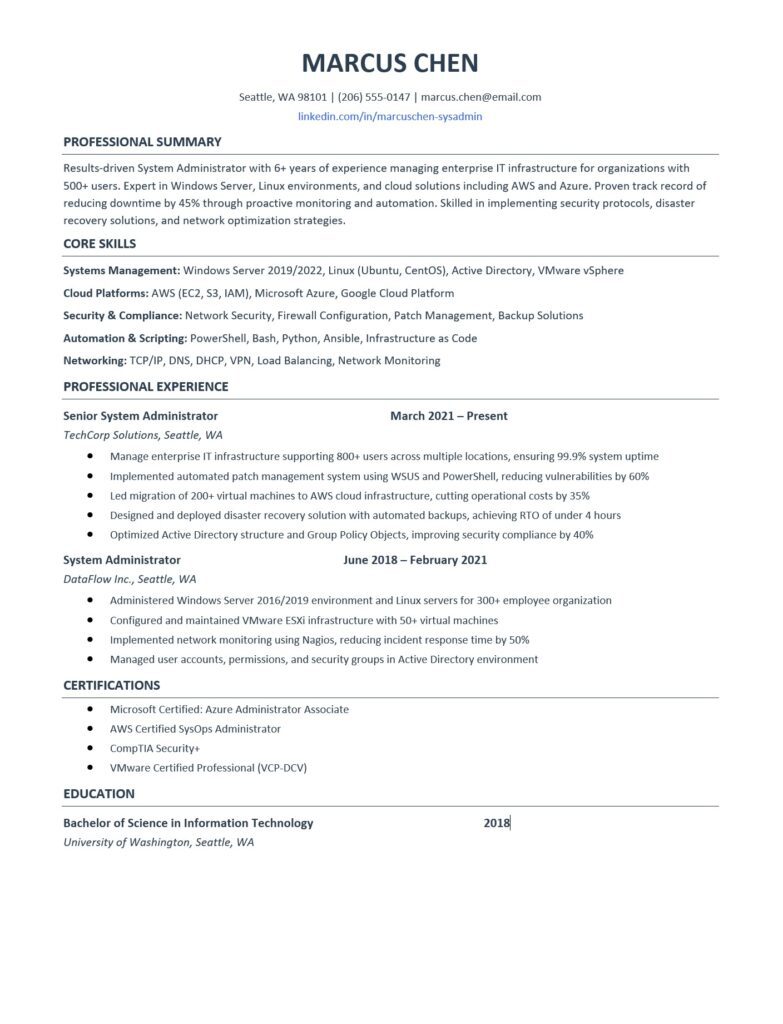
Here’s a professional system admin resume example. This example gives you an idea of what type of content fits in a good ATS friendly resume.
Example Resume:
Here’s a professional system admin resume template you can download and customize. This template is designed to be both visually appealing and ATS-friendly, with clean formatting that highlights your strengths.
Blank Customizable Template
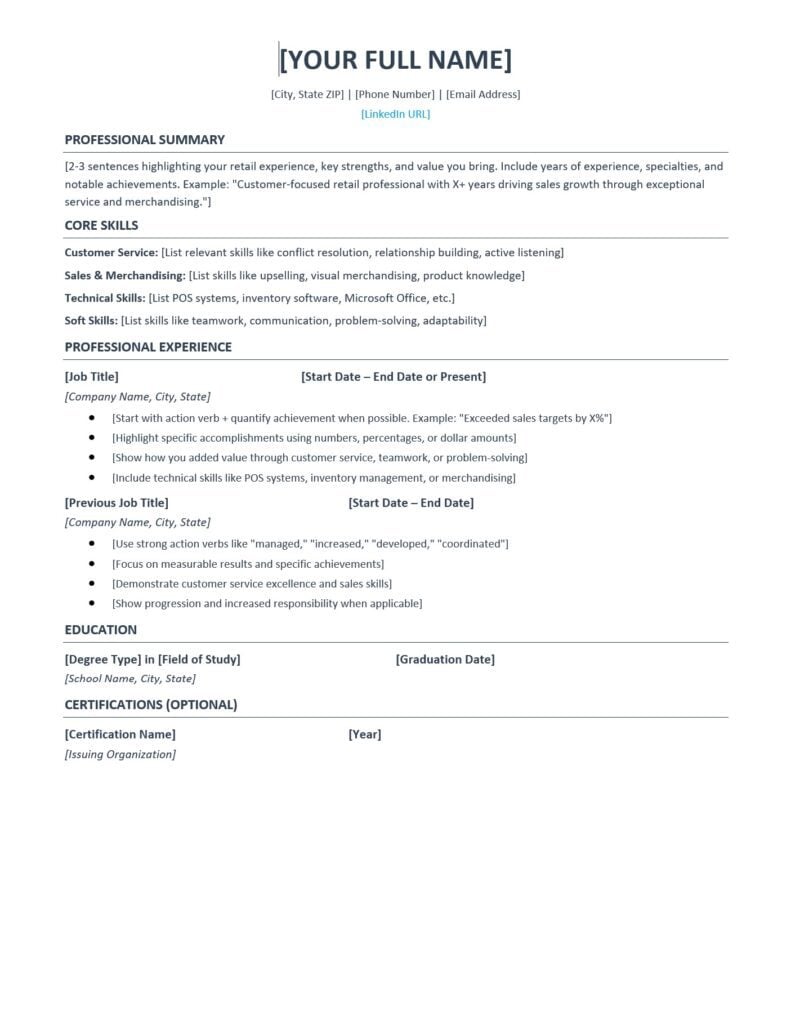
Download Your Free Template:
- Download DOCX Template (fully editable in Microsoft Word)
Interview Guys Tip: The DOCX template is fully editable, allowing you to adjust fonts, colors, and spacing to match your personal brand while maintaining professional formatting. Just replace the placeholder text with your own information.
Essential Components of Your System Administrator Resume
Let’s break down each section that belongs on your system administrator resume and why it matters.
Professional Summary
Your professional summary is your elevator pitch in written form. This 3-4 sentence paragraph at the top of your resume needs to communicate your experience level, technical specializations, and quantified achievements.
Strong summaries always include years of experience, specific technologies you’ve mastered, and at least one metric showing your impact. For example: “Results-driven System Administrator with 6+ years managing enterprise IT infrastructure for 500+ user organizations, reducing downtime by 45% through proactive monitoring and automation.”
Core Skills Section
Organize your technical skills into clear categories that make it easy for both ATS systems and hiring managers to quickly assess your qualifications. The five essential categories are systems management, cloud platforms, security and compliance, automation and scripting, and networking.
Within each category, list specific technologies, tools, and platforms you’ve worked with. This strategic organization helps your resume pass ATS filters while giving hiring managers immediate insight into your technical breadth.
Professional Experience
This is where you prove everything you claimed in your summary. Each position should include your job title, company name, location, and dates of employment, followed by 4-6 achievement-focused bullet points.
The secret to powerful experience bullets is the formula: action verb + what you did + measurable result. Never write “responsible for backups.” Instead, write “designed and deployed disaster recovery solution with automated backups, achieving RTO of under 4 hours.”
Focus on these types of achievements: Infrastructure you managed (scale and complexity), automation you implemented (time or cost saved), security improvements (reduced vulnerabilities or incidents), performance optimizations (uptime improvements, cost reductions), and migration projects (scope and business impact).
If you need help preparing for the conversations that come after submitting your resume, check out our system administrator interview questions guide to ace the interview once you land it.
Certifications
Certifications are absolutely critical for system administrators. They validate your technical expertise and often serve as mandatory requirements for specific positions.
List your most relevant certifications first, prioritizing those mentioned in the job description. Popular certifications include Microsoft Certified Azure Administrator, AWS Certified SysOps Administrator, CompTIA Security+, VMware Certified Professional, and Red Hat Certified System Administrator.
According to industry salary data, professionals with cloud or security certifications earn 15-20% more than those without these credentials.
Education
Your education section should include your degree name, institution, location, and graduation year. For system administrators, relevant degrees include Bachelor of Science in Information Technology, Computer Science, Network Administration, or Cybersecurity.
If you’re early in your career (less than 3 years of experience), place education near the top of your resume. For experienced professionals, this section belongs at the bottom since your hands-on experience carries more weight.
How to Write Each Section Effectively
Let’s dive deeper into the specific strategies that make each section of your resume stand out.
Crafting a Compelling Professional Summary
Your summary needs to establish credibility immediately. Start by stating your years of experience and your specific focus area within system administration.
Next, highlight your technical expertise by mentioning 2-3 key platforms or technologies you specialize in. This could be “expert in Windows Server and Linux environments” or “specialized in AWS cloud infrastructure and automation.”
Finally, include at least one quantified achievement that demonstrates business impact. Numbers like “reduced downtime by 45%” or “cut operational costs by 35%” immediately signal value to hiring managers.
Selecting the Right Technical Skills
The skills you list must align with the job description while accurately representing your expertise. Never claim skills you don’t have, as you’ll likely be tested on them during technical interviews.
Analyze the job posting carefully and identify which skills appear multiple times or are listed as requirements. These are your priority keywords that must appear somewhere in your resume.
Organize skills from most to least proficient within each category. If you’re an expert in AWS but have only basic Google Cloud knowledge, list AWS prominently and consider leaving GCP off entirely if space is tight.
Interview Guys Tip: Create a master resume with every skill and technology you’ve ever worked with, then customize by selecting the most relevant 15-20 skills for each application. This ensures you’re not accidentally leaving off keywords that could help you pass ATS screening.
Writing Achievement-Focused Experience Bullets
Generic responsibility statements kill resumes. “Maintained servers” tells hiring managers nothing about your capabilities or impact.
Transform weak bullets into powerful achievements using this three-part formula: What technical challenge or opportunity did you address? What specific actions did you take to solve it? What measurable results did you achieve?
For example: “Orchestrated migration of 200+ virtual machines to AWS cloud infrastructure, implementing automated scaling and monitoring, which cut operational costs by 35% while improving system performance by 40%.”
Strong action verbs for system administrators include: implemented, automated, optimized, migrated, configured, deployed, architected, streamlined, secured, and orchestrated.
Common Mistakes to Avoid
Even experienced system administrators make critical errors that sink their job applications. Let’s address the most damaging mistakes.
Listing Outdated Technologies
Technology evolves rapidly in IT. Dedicating precious resume space to legacy systems you haven’t touched in years signals that you’re behind the curve.
Focus on current, in-demand technologies. If you must mention older systems, do so only if they’re specifically requested in the job description or if you’re migrating away from them to demonstrate modernization skills.
Neglecting Soft Skills
System administrators need more than technical prowess. You interact with non-technical users, collaborate with other IT professionals, and often need to explain complex issues in simple terms.
Weave soft skills into your experience bullets naturally. Instead of listing “excellent communication skills,” demonstrate it: “Served as primary liaison between IT and business units, translating technical requirements into actionable implementation plans for 5 major infrastructure projects.”
Ignoring ATS Optimization
With 83% of companies using AI resume screening by 2025, your resume must be ATS-friendly or it won’t reach human eyes.
Use standard section headings like “Professional Experience” rather than creative alternatives like “Where I’ve Made an Impact.” Stick to common fonts like Calibri or Arial, avoid graphics or tables that confuse ATS software, and save your resume as a .docx file unless the application specifically requests PDF.
Using Generic Templates from Resume Builders
Cookie-cutter templates from generic resume builders fail to account for the specific needs of technical roles. They often prioritize visual design over ATS compatibility and don’t understand how to structure technical skills sections effectively.
Our specialized system administrator template addresses these industry-specific requirements while maintaining clean, professional formatting that works with any ATS system.
ATS Optimization and Keywords
Understanding how ATS systems evaluate your resume is crucial for getting past the initial screening.
How ATS Systems Work
When you submit your application, ATS software parses your resume to extract information and match it against the job requirements. The system assigns you a score based on how well your qualifications align with what they’re seeking.
Resumes with higher scores get forwarded to hiring managers. Those that don’t meet minimum thresholds get automatically rejected, often without any human ever seeing them.
Strategic Keyword Placement
Keywords should appear naturally throughout your resume, not stuffed awkwardly into a single skills section. The ATS looks for keywords in context to verify you actually have the experience you claim.
Include relevant keywords in your professional summary, experience bullets, and skills section. For example, if the job requires “Active Directory management,” you might write: “Optimized Active Directory structure and Group Policy Objects, improving security compliance by 40%.”
System-Specific Keywords to Include
Based on common job postings, here are high-value keywords for system administrator resumes: Windows Server, Linux (Ubuntu, CentOS, Red Hat), Active Directory, VMware vSphere, AWS/Azure/Google Cloud, PowerShell scripting, Bash automation, network security, patch management, backup and disaster recovery, virtualization, TCP/IP networking, DNS/DHCP configuration, monitoring tools (Nagios, Zabbix, Prometheus), and security compliance.
Match these to your actual experience and the specific job requirements you’re applying for.
Frequently Asked Questions
How long should a system administrator resume be?
Keep your resume to one page if you have less than 10 years of experience. This length forces you to be selective and highlight only your most impressive achievements. Senior system administrators with extensive experience can extend to two pages, but every line must add value.
Should I include every technology I’ve ever worked with?
No. Focus on current, relevant technologies that match the job description and represent your strongest skills. Including outdated or barely-used technologies dilutes your expertise and wastes valuable space that could showcase your core competencies.
What’s more important: certifications or hands-on experience?
Both matter, but they serve different purposes. Certifications validate your knowledge and often satisfy mandatory requirements, but hands-on experience with quantifiable results proves you can deliver business value. The strongest resumes showcase both, with experience taking precedence once you’re past entry-level roles.
How do I explain career gaps on my system administrator resume?
Address gaps honestly but briefly. If you were continuing education, pursuing certifications, or working on personal projects, mention these productive activities. Focus the bulk of your resume on your technical accomplishments and what you can offer the employer. For more guidance, explore our career gap strategies article.
Do I need a different resume for junior vs. senior system administrator roles?
Absolutely. Junior roles emphasize foundational skills, eagerness to learn, and any relevant projects or internships. Senior roles demand evidence of leadership, complex project management, strategic planning, and mentoring experience. Tailor your summary, bullet points, and highlighted achievements to match the level you’re pursuing.
Conclusion
Your system administrator resume is your most powerful tool for landing interviews in a competitive IT job market. By focusing on quantifiable achievements, strategic keyword placement, and ATS-friendly formatting, you set yourself apart from the hundreds of generic applications flooding hiring managers’ inboxes.
Download our free system administrator resume template to get started with a proven format that works. The example resume shows you exactly what hiring managers want to see, while the blank template makes it easy to customize for your unique experience.
Remember that your resume is just the beginning. Once you secure interviews, prepare thoroughly to discuss your technical expertise and problem-solving approach. And when you’re ready to explore other resume templates for different roles, browse our free resume template library for more career resources.
Your next system administrator role is waiting. Start building your winning resume today.
Before you send that resume: most System Administrator resumes get filtered out by ATS before a human ever sees them. Upload yours and find out your score. It takes 60 seconds and it’s free.
Advice like this is the general version. Longbow scores your actual resume against the actual job you want and shows you what's missing, before the filters decide for you. Here's why we built it.

ABOUT THE INTERVIEW GUYS (JEFF GILLIS & MIKE SIMPSON)
Mike Simpson: Co-founder of The Interview Guys and Longbow. He has been the voice behind our interview advice since 2013 — his work has reached over 100 million job seekers around the world. The strategic mind behind Longbow, our new career platform.
Jeff Gillis: Co-founder of The Interview Guys and Longbow. He built the systems that put our work in front of those readers, and he leads the engineering on Longbow, the cutting edge career platform built for today’s job seeker.