
How to Give Yourself a Real Mock Interview (No Partner, No Career Center, No Feeling Ridiculous)

Every interview guide ever written, including a decade’s worth of ours, ends with the same advice: practice out loud.
And almost nobody does it.
Not because people are lazy. Because the available options are all quietly terrible. Practicing into a mirror feels absurd. Asking your spouse to play hiring manager gets you either giggles or marital feedback you didn’t ask for. Career centers book out, cost money, or came with your degree and stayed there. And your friends, bless them, will tell you everything sounded great, which is exactly as useful as it sounds.
So most people do the honest human thing: they read their notes a few more times, feel roughly ready, and walk in. Then the interviewer says “so, tell me about yourself,” and the answer they knew perfectly in their head comes out of their mouth wearing pajamas.
This article is about closing that gap by yourself. A real mock interview, run solo, that actually simulates the thing you’re preparing for. We’ll go up the ladder from free-and-simple to the full protocol, and we’ll be clear about where each rung stops working. At the top of the ladder we’ll show you the tool we built for this, because after twelve years of watching people skip out-loud practice, we finally built the thing that makes it not weird. Fair warning, as always: it’s ours.
Why reading your notes is not rehearsal
Here’s the uncomfortable neuroscience-adjacent truth that every performer, athlete and trial lawyer already knows: recognizing information and producing it are different skills, stored differently, and only one of them gets tested in an interview.
When you re-read your prepared answers, your brain nods along: yes, I know this. That feeling is real, and it’s also a trap. Recognition is easy. Retrieval under pressure, out loud, in complete sentences, while managing your face and your hands and the clock, is a different act entirely. The first time you perform that act should not be the time it counts.
You’ve felt this. Everyone who has blanked on “tell me about yourself,” a question they’ve been answering their entire adult life, has felt it. The content was in there. The performance wasn’t. Interviews are oral exams, and nobody passes an oral exam by silently re-reading the textbook.
The fix is not more reading. It’s rehearsal, which means out loud, which means we need to talk about what “out loud” actually needs to include.
Practicing Interviews Out Loud works best when tailored to your company and role:
The five things a real interview throws at you
If solo practice is going to work, it has to reproduce what makes interviews hard. Strip an interview down and there are five ingredients:
1. Production. You must generate answers with your mouth, in real time, in full sentences. No editing, no starting over.
2. Unpredictability. You don’t control the order, the phrasing, or which of your carefully prepped topics gets skipped entirely.
3. Follow-ups. Real interviewers don’t accept your answer and move politely on. They poke it. The second question about your story is usually harder than the first.
4. An audience. Being listened to changes your performance. Pressure narrows working memory, speeds your speech and shortens your breath, and you need exposure to that state before it counts.
5. Feedback. Practice without feedback just makes your current habits more permanent, including the bad ones.
Hold every practice method up against those five. That’s the whole evaluation framework, and it explains immediately why mumbling your answers in the shower, pleasant as it is, doesn’t move the needle much.
The ladder: solo methods from free to full simulation
Rung 1: Talk to the wall (production only)
Stand up, pick a question, answer it out loud to nobody. It feels ridiculous for ninety seconds and then it doesn’t. This is the minimum viable rehearsal, and it beats another hour of reading by a mile, because it forces production.
What it gives you: ingredient one. What it can’t: everything else. You’ll ramble without noticing, because nothing stops you.
Rung 2: The voice memo (production + feedback)
Same exercise, but record it on your phone, then listen back. This is the single highest-value free upgrade, because hearing yourself is feedback nobody can spin for you. Listen for four things: filler density (the ums and likes), answer length (aim for 90 to 120 seconds on behavioral answers; if you’re past two minutes, you’re monologuing), whether your answer had a spine or wandered, and whether you’d hire the person you’re hearing.
Yes, you will hate the sound of your own voice. Everyone does; it’s a known quirk of hearing yourself through the air instead of through your skull. Push through it, because the interviewer hears that voice either way, and you’re the only one who can hear it in advance.
Rung 3: Video (adds the body)
Prop the phone up and record video, especially if your interview is remote. Now you can audit eye contact, posture, and the facial expression you make while thinking, which is rarely the expression you imagine. Our 24-hour interview prep guide leans on this method for a reason: one recorded run-through the night before surfaces more fixable problems than three hours of silent review.
Rung 4: The shuffle (adds unpredictability)
Here’s where most solo practice quietly cheats: you pick the next question, which means you’re always secretly ready for it. Real interviews don’t grant you that.
The fix is old-fashioned and works. Write your predicted questions on cards, or number them and use a random number generator, and answer whichever one comes up, cold, no redraws. If you haven’t built your predicted-question list yet, that’s a separate skill, and we wrote a complete guide to predicting your interview questions from the job posting. Do that first; practicing the wrong questions well is its own special tragedy.
Rung 5: The skeptic drill (adds follow-ups)
This is the most neglected skill in interview prep, and the one that separates prepared candidates from bulletproof ones. After you answer a question, before moving on, ask yourself out loud: “What would a skeptic ask me next?” Then answer that.
Told a story about a successful project? The skeptic asks what you’d do differently, or what your specific contribution was versus the team’s. Claimed a strength? The skeptic asks for a second example, because one example is an anecdote. Explained why you’re leaving your job? The skeptic asks what you tried before deciding to leave.
Two rounds of the skeptic drill on your five most likely questions will do more for your confidence than any amount of first-answer polish, because follow-ups are where interviews are actually won and lost.
Rung 6: The dress rehearsal (adds the full sequence)
Once, before any interview that matters, run the whole thing: dressed like it’s real, at the desk or camera setup you’ll actually use, from “tell me about yourself” through your questions for them, timed, no stopping. Use your shuffled deck, apply the skeptic drill on at least two answers, and record it.
Then score yourself against a simple rubric, one point each: Was every answer under two minutes? Did every behavioral answer contain a specific, named situation? Did you quantify at least one result? Did you avoid trashing any previous employer? Did you finish with real questions for them (we keep a guide to those too)? Four out of five is interview-ready. Below that, you’ve found this week’s homework, which is the entire point.
If your interview is remote, practice for the camera, not the room
One more layer, because odds are decent your next interview happens in a rectangle on someone’s screen. Remote interviews change the performance in specific ways, and practicing for an in-person room when you’re facing a webcam is rehearsing the wrong play.
Three adjustments to build into your recorded practice. First, eye contact now means the lens, not the face. Looking at the interviewer’s video feels natural and reads on their side as looking down and away. Practice delivering the first sentence of each answer straight into the camera; you don’t need to hold it for the whole answer, but openings and key claims land differently when they arrive with eye contact. Put a sticky note arrow next to the lens if you need the reminder; everyone needs the reminder.
Second, energy transmits at about 80 percent through a webcam, so what feels like normal enthusiasm on your side arrives slightly flat. Your recorded practice will show you this. The fix feels mildly ridiculous and works: sit forward, gesture within frame, and let your voice do a bit more than feels natural. On camera, “slightly too much” reads as “engaged.”
Third, decide your notes policy in practice, not live. One of the genuine advantages of remote interviews is that a single index card of bullet spines can sit just below your camera. Practice with it exactly where it will be, so glancing at it takes half a second and doesn’t derail your sentence. If your dress rehearsal shows you reading instead of glancing, the card is too detailed; cut it down to single words. For the full remote playbook, camera setup included, we keep a complete guide to virtual interviews.
Which answers deserve the practice time
Not every question deserves equal rehearsal, and treating them equally is how people end up polished on trivia and shaky on the questions that decide the interview. Budget your out-loud time in this order.
First: your opener. “Tell me about yourself” is nearly guaranteed, it sets the temperature for everything after, and it’s the answer most people have never once said aloud despite it being the most predictable ninety seconds of their professional lives. Practice it until the spine is automatic. We have a full guide to introducing yourself if yours needs rebuilding rather than rehearsing.
Second: your two or three money stories. These are the accomplishment stories that map to the job’s biggest repeated requirements, the ones your question prediction flagged as guaranteed territory. Each money story does double or triple duty across different questions, so polish here pays out everywhere. Run the skeptic drill on these especially, because these are the stories interviewers dig into.
Third: your danger zone. Every candidate has one: the gap in the resume, the short stint, the layoff, the career change, the missing skill the posting asks for. You know yours. It’s the question you’re hoping doesn’t come up, which is precisely why it needs the most out-loud practice, because hope is not a delivery strategy, and this is the one answer where a calm, rehearsed, non-defensive ninety seconds changes the entire interview. Practice it until it bores you. Boredom is what composure feels like from the inside.
Last: everything else. The long tail of possible questions gets one pass each through the shuffle, not deep polish. If your fundamentals are strong, adjacent questions borrow their strength.
Where the ladder tops out
Do everything above and you’ll be better prepared than the vast majority of candidates. We’d happily end the article here if it were the whole truth. It isn’t quite, and you’ve probably already spotted why.
You can’t surprise yourself. You wrote the deck; some part of you is always half-ready. You can’t follow yourself up. The skeptic drill helps, but your inner skeptic only knows what you know, and it goes easy on you in exactly the places a stranger wouldn’t. And you can’t grade yourself objectively. Humans are reliably bad at self-assessment; we forgive our own rambling because we know what we meant.
For decades, the only fix for those three gaps was another human, which brings back every problem from the top of this article: scheduling, cost, awkwardness, and feedback quality that depends entirely on who you could rope in.
That’s the gap we built our way out of.
The mock interview that talks back
Longbow is our career platform; if you’re new here, the full story is on the blog. Among the things it does is run real voice mock interviews, and “real” is doing actual work in that sentence: an interviewer asks you questions out loud, tailored to the specific job you’re prepping and your actual resume, listens to your answers, follows up, and scores you afterward with a debrief you can act on.
Check it against the five ingredients. Production: you answer by speaking, full sentences, no do-overs unless you ask. Unpredictability and follow-ups: covered, and adjustable, which is why there are two modes. Warm-Up walks your prepped questions in order at your pace, you say when each answer is done, and it’s the right place to start because it’s rung two through five in one sitting. Hot Seat is the dress rehearsal with teeth: no script, questions remixed, probes into your resume, and when you stop talking, it moves on, exactly like the real thing. The audience effect: you’d be surprised how real the pressure feels the first time it asks a follow-up you didn’t plan for. And feedback: every session ends with a scored debrief, answer by answer, from a system that has no interest in sparing your feelings and no fatigue on your fifth attempt.
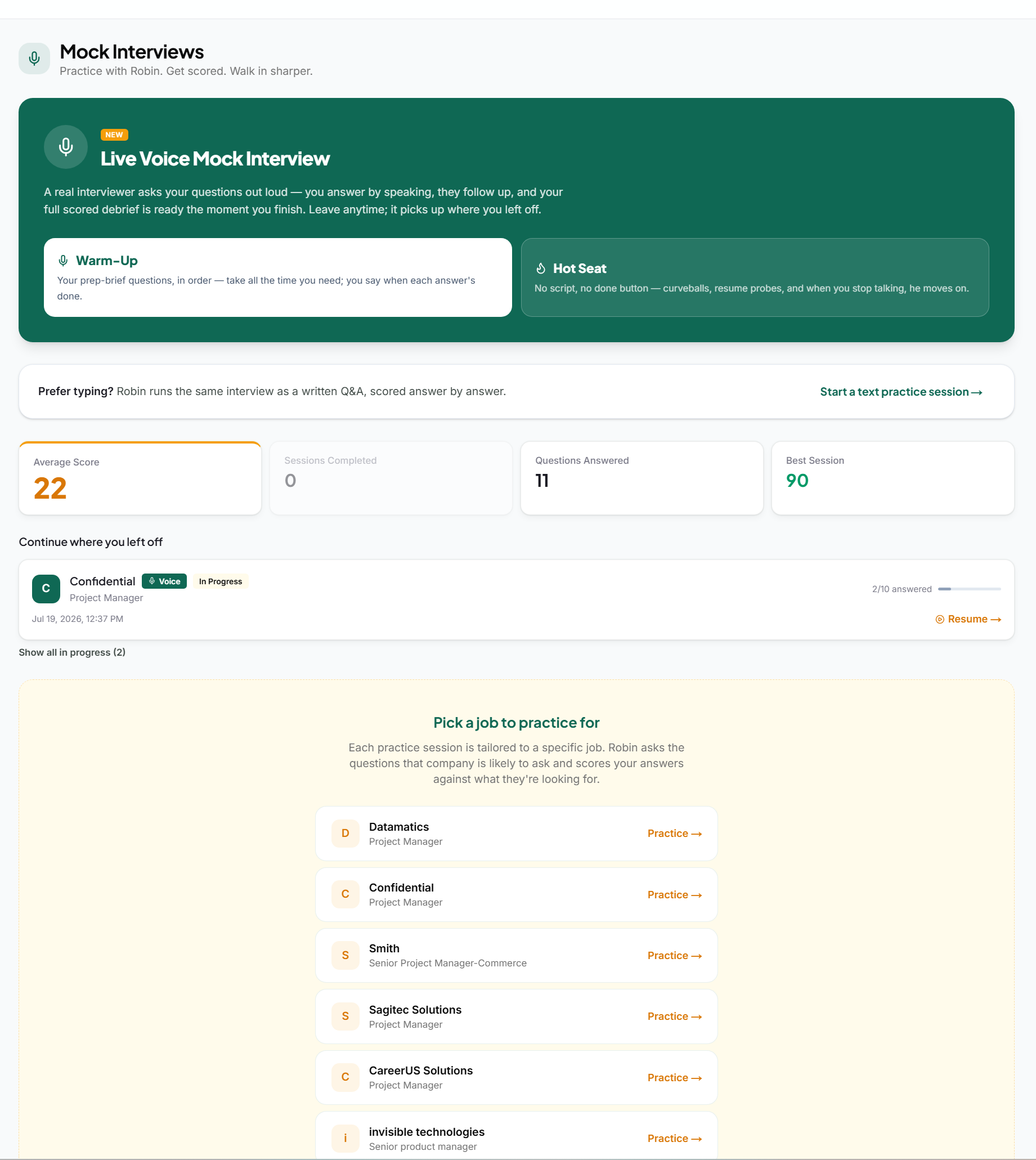
The honest caveats, because we always give you those: voice mock interviews are part of Longbow Pro, and like every tool in Longbow, the quality tracks what you give it. Practice for a specific job with your real resume uploaded and the questions and follow-ups get specific; practice against a vague posting and you’ll get a vaguer interviewer. And no simulator, ours included, replaces the dress rehearsal habit; it upgrades it.
When to practice what: a simple schedule
A week out from an interview, the sequence that works looks like this. First, predict your questions from the posting; twenty minutes. Days five and four, work rungs two and five: voice memos plus the skeptic drill on your top questions, fixing content problems while there’s time to fix them. Days three and two, add unpredictability: shuffled deck or Warm-Up sessions, one full run each day. The day before, one dress rehearsal or Hot Seat, scored, and then stop; the goal is one clean, complete run, not a midnight cram.
The morning of, exactly one answer out loud, your “tell me about yourself,” once, to warm up the machinery. Then close the notes. Rehearsal got you here; more cramming now just borrows anxiety from the afternoon.
Questions people ask about practicing alone
How many times should I practice each answer?
Two or three full out-loud repetitions per answer, then stop and vary the phrasing on the last one. The goal is knowing your story’s spine cold while keeping the sentences alive. If you drill the exact wording ten times you’ll sound like you’re reciting, which interviewers clock instantly; we wrote a whole guide on practicing without sounding rehearsed because the canned-answer problem is real.
Should I memorize my answers?
Memorize bullets, never scripts. For each story: the situation in one line, the two or three beats of what you did, the result with a number attached. Under pressure you’ll reliably retrieve five bullets; you will not reliably retrieve two hundred memorized words, and the attempt is what produces that glassy mid-answer stall everyone recognizes.
How long should my answers be?
Ninety seconds to two minutes for behavioral stories, under a minute for factual and motivational questions. When you review recordings, treat two minutes as a hard ceiling, and remember that a good short answer invites a follow-up, which is a conversation, which is what a good interview actually is.
Is practicing with a chatbot in text good enough?
Text practice genuinely helps with content: it can pressure-test your stories and sharpen your bullets. But it exercises none of the performance layer, and the performance layer is where interviews are lost. Typing a great answer and saying one are as different as writing a speech and giving it. Use text tools for what they’re good at, then move your mouth.
What if I only have one hour before the interview?
Skip the ladder and do this: fifteen minutes predicting the five most likely questions, thirty minutes answering each out loud once with one skeptic follow-up apiece, ten minutes on your questions for them, five minutes of silence. That single hour out loud beats three hours of silent review, and our 24-hour prep guide has the extended version of this emergency protocol.
The candidate who has already done this
Here’s the quiet advantage waiting at the end of all this. Most of the people you’re competing with prepared by reading. They know their material the way you know a song you’ve only ever listened to.
You’ll walk in having sung it. Out loud, under pressure, with follow-ups, more than once. Nothing that happens in the room will be the first time it’s happened, and interviewers can feel that from the first two minutes, because calm is very hard to fake and very easy to earn.
Practice out loud. We’ve been saying it for twelve years. Now the only remaining excuse is gone: paste the job posting into Longbow, predict the questions, and let the interviewer who never gets tired, never judges, and never books out ask you the hard ones before it counts.
Walking into an interview? Don’t wing it.
Longbow gives you the exact questions this company tends to ask for your role, coached answers in your own voice, and unlimited mock practice with Robin until you sound ready. The interview prep we spent a year building — so you walk in knowing what’s coming.
Prep with Robin free →Free to start · No credit card · Built by The Interview Guys
Their questions.
Your best answers.
Don’t go into your interview without knowing the Practicing Interviews Out Loud questions your specific company uses:
This article is the general version. Longbow is the tool we built to do this for the specific job you're interviewing for: it reads the posting, predicts the questions, and coaches your answers from your real background. Here's the full story of why we built it.

ABOUT THE INTERVIEW GUYS (JEFF GILLIS & MIKE SIMPSON)
Mike Simpson: Co-founder of The Interview Guys and Longbow. He has been the voice behind our interview advice since 2013 — his work has reached over 100 million job seekers around the world. The strategic mind behind Longbow, our new career platform.
Jeff Gillis: Co-founder of The Interview Guys and Longbow. He built the systems that put our work in front of those readers, and he leads the engineering on Longbow, the cutting edge career platform built for today’s job seeker.