
The State of the Entry-Level Job Collapse 2026: Why a College Degree Just Stopped Being an Insurance Policy

Maya did everything the script told her to. Good grades, the right major, two internships, a diploma that was supposed to function like an insurance policy against exactly this kind of moment. Eighteen months after walking the stage, she’s answering support tickets in a job that never once asked to see the degree she’s still paying for, one of the millions of grads who followed the map and arrived at a cliff.
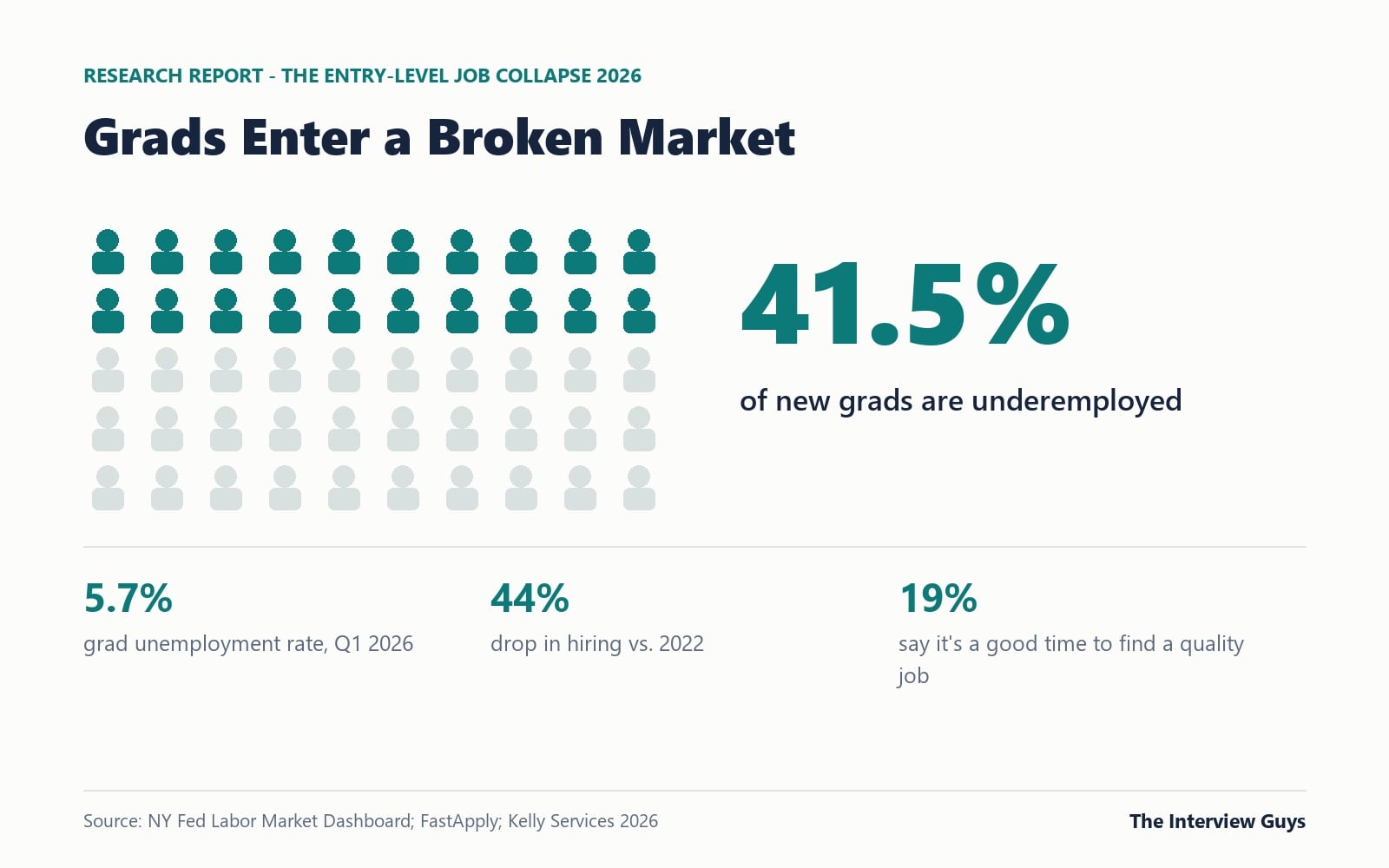
The numbers behind Maya’s story are brutal and new. Recent college graduates now face a 5.7% unemployment rate, above the national average, and 41.5% are underemployed, working jobs that don’t require the credential they were told would protect them. It is the worst entry-level market in over a decade, and by September 2025 grad unemployment had climbed to 9.7%, the same rate as peers who never went to college at all.
This report traces how the safety policy lapsed, and why AI in job interviews turned into the defining force of the collapse: it’s screening resumes before humans see them, running the interviews, being weaponized by candidates to cheat back, and quietly eliminating the first rung of the career ladder entirely. Here’s what the data actually shows, and what to do about it.
☑️ Key Takeaways
- The degree premium has effectively vanished. Recent grads hit a 9.7% unemployment rate in September 2025, identical to peers holding only a high school diploma, while the ‘safety premium’ shrank to just -2.8 points versus a historical -4.1.
- The first rung is being sawed off. 21% of companies have already frozen entry-level hiring because of AI, and 47% expect to eliminate entry-level roles entirely by 2027.
- AI now sits on both sides of the table. 72% of HR pros use AI in hiring and 63% of job seekers have already sat through an AI-run interview in the last six months, while 66% of Americans say they’d avoid an AI-hiring employer.
- The fraud arms race is out of control. 38.5% of candidates were flagged for AI cheating across 19,368 live interviews, deepfake attempts jumped 1,300%, and humans catch fakes only 55.54% of the time.
- The tools may not even work. 88% of HR leaders report no significant business value from AI recruiting tools, yet 93% of recruiters plan to increase AI use in 2026.
The Safety Policy That Lapsed
For decades, a college degree worked like insurance. You paid the premium in tuition and time, and in return you got a cushion against unemployment. That policy just lapsed.
Recent college graduates (ages 22-27) hit a 5.7% unemployment rate in Q1 2026, higher than the 4.3% national average, according to the Federal Reserve Bank of New York. Read that again. The people who did everything right are now unemployed at a higher rate than the general workforce.
It got starker earlier. By September 2025, grad unemployment reached 9.7%, the exact same rate as 20-to-24-year-olds who hold nothing but a high school diploma (New York Fed data via FastApply). The four-year degree bought those grads no advantage at all.
Goldman Sachs put a number on how much the cushion has thinned. The unemployment ‘safety premium’ for college grads has collapsed to just -2.8 percentage points, far below the historical -4.1 point gap you’d see in strong labor markets (Fortune). The protection is still technically there. It’s just wearing thin.
Here’s the stat that should stop you cold. For six straight months in 2025, workers with occupational associate’s degrees in skilled trades posted better employment outcomes than four-year degree holders. That’s the first time college grads have lost their employment edge since federal tracking began in the 1990s (FastApply, citing federal data).
So if you’re staring at a diploma wondering why it isn’t opening doors, you’re not imagining things. The insurance policy your parents swore by didn’t get canceled. It quietly stopped paying out.
The people who did everything right are now unemployed at a higher rate than the general workforce.
By the Numbers: A Market in Freefall
Unemployment is only half the story. The other half is underemployment, and it’s uglier.
In Q1 2026, 41.5% of recent college grads were underemployed, working jobs that don’t require their degree, per the New York Fed’s dedicated dashboard. That means nearly 4 in 10 grads are pouring coffee, driving deliveries, or doing work their degree was supposed to make unnecessary.
And it peaked worse than that. In Q4 2025, underemployment climbed to 42.5%, the worst reading since tracking began (New York Fed via CollegeRecruiter). This isn’t a blip. It’s a ceiling that keeps rising.
The class of 2023 offers a preview of how sticky this gets. A year after graduation, 52% of them were still underemployed (FastApply / New York Fed data). The first job you can’t get shapes the second job you can’t get.
Hiring volume tells the same grim tale. Employer hiring of college grads is running 44% below 2022 levels, according to FastApply. Nearly half the demand that existed four years ago has evaporated.
And grads know it. Only 19% say it’s a good time to find a quality job, down from over 70% in 2022 (Kelly Services). Confidence didn’t dip. It fell off a cliff. If you want to see where the roles that are still hiring actually live, we broke it down in our look at the top industries hiring entry-level talent.
- 41.5% underemployed in Q1 2026, with a record 42.5% peak in Q4 2025 (New York Fed).
- 52% of the class of 2023 were still underemployed a full year after graduation.
- 44% below 2022 is where grad hiring now sits (FastApply).
- 19% of grads call it a good time to find a quality job, down from 70%+ in 2022 (Kelly Services).
The first job you can’t get shapes the second job you can’t get.
The Vanishing First Rung
The entry-level job isn’t just harder to land. In a lot of companies, it’s being deleted.
Grad hiring dropped 16% in 2025 versus 2024, and big tech got hit hardest. Its hiring of recent graduates is now down 50% compared to pre-pandemic levels, with AI cited as a primary driver (SignalFire). The rungs that used to lift new grads into tech careers are getting sawed off.
The supply-and-demand math is brutal. Entry-level postings fell 15-16% year-over-year between August 2024 and August 2025, while applications per posting rose 26-30% (Handshake data). Fewer doors, more people slamming into them.
Some firms aren’t cutting quietly. 21% of companies have already frozen entry-level hiring specifically because of AI, and 47% expect to eliminate entry-level roles entirely by 2027, per a Resume.org survey reported by CollegeRecruiter. Nearly half of employers are planning for a world with no bottom rung.
But don’t blame AI for all of it. A May 2026 LSE study found that remote work is actually a better predictor than AI of the decline in entry-level hiring (IBISWorld). When nobody’s in the office, the cost of supervising and training a junior hire goes up, and the on-the-job learning that justified the role goes down. We dug into why the panic misses the nuance in what the jobpocalypse gets wrong about AI and entry-level work.
Zoom out and the whole market is tight. Total US job openings dropped to 6.5 million at the end of 2025, the lowest level since September 2020 (BLS via Bloomberg). Fewer openings, fewer entry doors, and a whole class of grads standing in line for both.
Nearly half of employers are planning for a world with no bottom rung.
The Algorithm at the Front Door
Say you do find an opening. Here’s the part nobody warns you about: the first thing reading your resume probably isn’t a person.
AI adoption among HR professionals jumped from 43% in 2024 to 72% in 2025, per HireVue’s report of more than 4,000 respondents (SQ Magazine). And 93% of recruiters plan to increase their AI use in 2026. The trend line only points one direction.
Resume review is where it hits first. About 82% of companies that use AI in hiring point it straight at resumes (ResumeBuilder). That’s the de facto front door for most large employers now, and an algorithm is holding the handle.
At the top of the market, automated screening is basically universal. 75% of large US enterprises, including 99% of Fortune 500 companies, automate their applicant screening (Harvard Business School). If you’re applying to a household-name company, assume a machine ranks you before a recruiter ever hears your name.
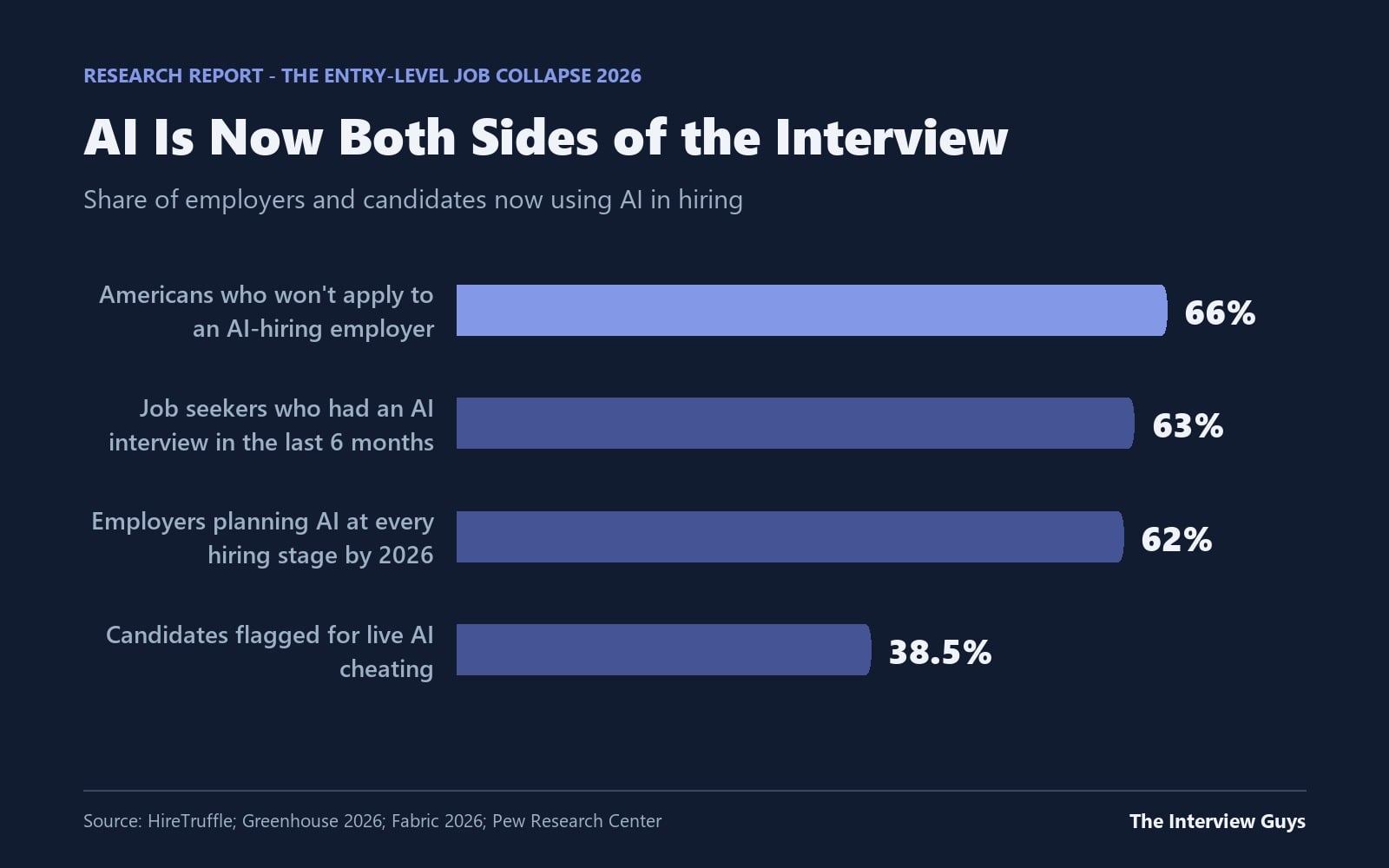
And it’s not stopping at the resume. 62% of employers expect to use AI across most or all hiring stages by 2026 (HireTruffle), from screening to scheduling to the interview itself. The human touchpoints are getting squeezed out at every step.
Adoption clusters at the big players, too. It runs from 33% at companies under 100 employees to 60% at enterprises over 5,000 (SHRM State of AI in HR 2026). So the largest, most visible employers, the ones you most want on your resume, are exactly the ones where a human may never see your application first. That changes how you should write it, which is why we rebuilt our advice on how to write a college resume around beating the machine, not charming it.
If you’re applying to a household-name company, assume a machine ranks you before a recruiter ever hears your name.
When the Robot Runs the Interview
For decades, the interview was the one human moment in a mechanical process. A person looked you in the eye, asked a question, and made a call. That moment is disappearing fast.
Nearly two-thirds of US job seekers, 63%, say they’ve already sat through an AI-run interview in the past six months, according to a Greenhouse survey of 2,950 candidates. Not a phone screen with a recruiter. An algorithm asking the questions.
This isn’t a fringe experiment anymore. Video interviews now show up in 86% of hiring processes globally, and 56% of companies use AI-powered video tools that analyze your facial expressions, your tone, and the words you choose. The machine isn’t just recording you. It’s scoring you.
The category growing fastest is the most unsettling one. Roughly 23% of employers now use AI to conduct interviews outright, up from close to zero just three years ago (ResumeBuilder data via SQ Magazine). That’s the part of hiring people assumed would stay human the longest, and it’s going first.
Here’s the problem for employers who love this stuff: candidates hate it. 66% of Americans say they wouldn’t even apply to a company that uses AI to help make hiring decisions, per Pew Research Center. Only 26% trust AI to evaluate them fairly, even as more than half suspect it’s already screening their applications.
The damage runs deepest with the people entering the market right now. Among Gen Z entry-level candidates, 62% have lost trust in the hiring process entirely (Gartner survey of 2,918 candidates). Think about what that means. The first real interaction a young worker has with the professional world is a camera judging their face, and they’ve already decided the game is rigged.
If you’re on the job hunt, treat the AI interview as a format you have to learn, not a wall you can’t climb. Rehearse out loud, keep your answers structured, and don’t let the empty screen throw your energy off. Our breakdown of why behavioral questions just got harder gets into how to keep your answers sharp when a machine is the one listening.
The one human moment in hiring is being automated away, and the people it hurts most trust the process least.
The Arms Race Nobody Wins
Candidates didn’t just roll over when AI took over the interview. They fought back with the same weapon. And that’s where things got messy for everyone.
Today, 78% of job seekers use AI somewhere in their search, and 22% admit they use it live, in real time, while an actual interview is happening (Resume Genius 2026). Not to prep the night before. During the conversation, feeding themselves answers off a hidden screen.
The scale of it is staggering. Across 19,368 live interviews analyzed by Fabric, 38.5% of all candidates were flagged for AI-cheating behavior. And it’s accelerating, not leveling off. That flag rate tripled from 9% to 45% in just three months of late 2025.
A whole industry sprang up to make this easy. Tools like Cluely and Interview Coder, which overlay invisible AI assistance on your screen while you’re screen-sharing an interview, have racked up more than a million combined users. The pitch is blunt: let the machine answer, and the interviewer never knows.
It’s not just live interviews, either. Proctored assessment fraud jumped from 16% to 35%, meaning cheating more than doubled even in tests that were actively being watched. When candidates believe the whole system is automated and impersonal, gaming it stops feeling like cheating and starts feeling like fair play.
Here’s the ugly truth about this arms race: nobody comes out ahead. Every faked answer makes employers trust real candidates less. Every AI screener makes candidates trust the process less. The honest applicant, the one actually qualified for the job, gets caught in the crossfire and treated like a suspect. That’s the real cost, and it lands on the people who play it straight.
- 78% now use AI in the job search, and 22% admit to using it live during real interviews (Resume Genius 2026).
- 38.5% of candidates got flagged for cheating across 19,368 live interviews, with the rate tripling from 9% to 45% in three months (Fabric).
- A million-plus users have downloaded overlay tools like Cluely and Interview Coder that feed answers during screen-shared interviews.
- Proctored fraud doubled, jumping from 16% to 35% even in monitored assessments.
Every faked answer makes employers trust real candidates less, and the honest applicant pays the bill.
Identity Itself Is Now Forgeable
Cheating on an interview is one thing. Not being a real person is another. And that line just got crossed.
Deepfake fraud attempts in hiring jumped 1,300% year over year, according to our own State of Hiring Fraud 2026. We’re not talking about a candidate reading off notes. We’re talking about a synthetic face on the video call, a fabricated human applying for a real paycheck.
Hiring managers are already living it. 31% say they’ve interviewed someone they believed was synthetic. That’s roughly one in three people whose job is to spot talent, telling you they’ve probably talked to a fake human and couldn’t be sure.
The reason they can’t be sure is brutal math. Humans detect deepfakes with only 55.54% accuracy, barely better than flipping a coin. And 62% of hiring professionals admit candidates are now better at faking than recruiters are at catching. The defense is losing on the merits.
This has real money behind it. US deepfake fraud losses tripled to $1.1 billion, and the incentive to fake your way into a remote role, collect a salary, and maybe access company systems keeps climbing. The FBI has issued formal warnings about exactly this kind of employment fraud.
And it gets worse from here. Gartner projects that by 2028, one in four candidate profiles worldwide will be entirely fabricated. Read that again. A quarter of the people applying alongside you may not exist at all. For a legitimate job seeker, that means the burden of proving you’re real is about to become part of every hiring process you touch.
- Deepfake hiring fraud up 1,300% year over year, with 31% of managers reporting they’ve interviewed someone they believed was synthetic.
- 55.54% detection accuracy is all humans manage against deepfakes, barely better than a coin flip.
- $1.1 billion in US losses, a tripling of deepfake fraud damage as fake candidates chase real salaries.
- 1 in 4 profiles fabricated by 2028, per Gartner, a threat the FBI has warned about directly.
By 2028, a quarter of the people applying alongside you may not exist at all.
Employers Strike Back: The In-Person Revival
When you can’t trust the video call, you go back to the one thing AI can’t fake yet: a body in a room. That’s exactly what employers are doing.
In-person interview requests jumped 500%, climbing from 5% of roles in 2024 to 30% in 2025, as companies scramble to counter AI fraud (The Interview Guys / Fabric 2026). The remote-first hiring era spent years bragging about speed and convenience. Now it’s quietly reversing.
It’s the final round where this shows up most. 72% of recruiting leaders now use in-person final interviews specifically to fight AI fraud. The screen gets you in the door. The handshake decides if you’re real.
The big names moved first. Google, McKinsey, and Cisco all reintroduced mandatory in-person interviews by mid-2025, in direct response to the surge in AI interview fraud (Sherlock.sh / Wall Street Journal). When companies that built their reputations on cutting-edge tech go back to conference rooms, you know the fraud problem got serious.
But here’s the gap. Only 31% of companies have deployed any AI or deepfake detection software, and 48% of HR professionals have had zero fraud-detection training. Most employers are fighting a high-tech problem with almost no high-tech defense. So they fall back on the low-tech one that actually works.
There’s a real irony worth sitting with. The most advanced hiring technology in history created a fraud crisis it can’t reliably detect, and the fix turned out to be a handshake. For you, the honest candidate, that’s genuinely good news. If you can show up, look someone in the eye, and be exactly who your resume says you are, you’ve got an edge no overlay tool can copy. Master the human room and you win the round: our guide to the state of the hiring process walks through what employers are actually testing for now.
- In-person requests up 500%, from 5% of roles in 2024 to 30% in 2025.
- 72% of recruiting leaders now run in-person final rounds specifically to fight AI fraud.
- Google, McKinsey, and Cisco reintroduced mandatory in-person interviews by mid-2025.
- Only 31% have detection software, and 48% of HR staff have had no fraud-detection training at all.
The most advanced hiring tech in history created a fraud crisis it can’t detect, and the fix turned out to be a handshake.
Does Any of This Actually Work?
Here’s the part nobody in the boardroom wants to say out loud. The tools eating the entry-level pipeline don’t actually work very well.
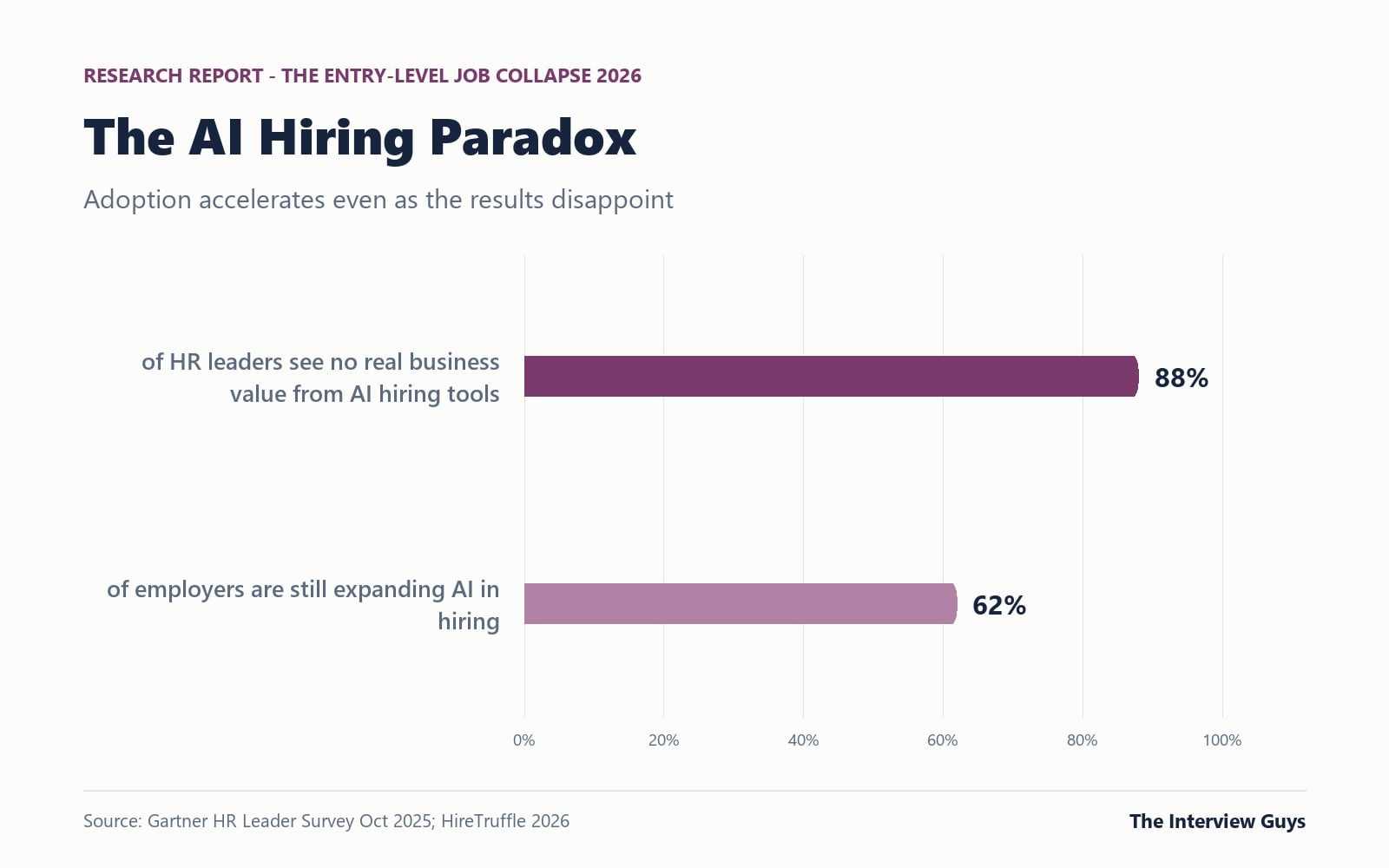
In an October 2025 Gartner survey of 114 HR leaders, 88% said their teams have seen no significant business value from AI recruiting tools. Not a little value. None worth writing home about. That number should stop you cold, because it means companies are gutting their junior hiring for software that hasn’t proven it delivers.
It gets worse when you look at the damage. SHRM found that 19% of organizations using AI in hiring said their tools overlooked or screened out qualified applicants. That’s one in five employers admitting the algorithm rejected people it should have advanced.
And this isn’t a new bug. Amazon famously scrapped an internal resume screener after it learned to penalize applications that mentioned women’s colleges. The machine absorbed the bias in its training data and ran with it. That story is years old, and the industry still hasn’t solved the underlying problem.
So logic says employers would pump the brakes. They’re doing the opposite. As the 2026 recruitment data shows, 62% of employers expect to use AI across most or all hiring stages by 2026, and 95% of hiring managers anticipate increasing their AI investment to optimize recruitment further.
Read that sequence again. The people closest to these tools report no value and real harm, and the response is to spend more. That’s not a strategy. That’s a bandwagon with the brakes cut. If you want the fuller breakdown of how this reshaped the funnel, we walked through it in our look at the state of the hiring process.
The people closest to these tools report no value and real harm, and the response is to spend more.
Where the Jobs Actually Are
Now the good news, and it’s real. The entry-level market didn’t disappear. It moved.
While overall postings shrank, healthcare bucked the trend hard. Entry-level healthcare postings rose 13 percentage points against the broader market decline, according to FastApply’s 2026 analysis. When everyone else is cutting, one sector is still opening doors.
Skilled trades are the other quiet winner. The Bureau of Labor Statistics projects trades employment growing 5.3% from 2024 to 2034, nearly double the 3.1% overall job market rate. That’s the same shift we flagged in our coverage of skills-based hiring: employers want proof you can do the work, not just proof you sat through the lectures.
Zoom out and the pattern sharpens. Government, healthcare, and leisure and hospitality accounted for almost 75% of all jobs added in late 2024 and 2025. If you’re a new grad, that tells you exactly where to aim your energy.
There’s also a sneaky signal in how employers are testing the waters. Internship postings on ZipRecruiter are up 32% year over year in white-collar fields, even as full-time entry-level listings shrink. Employers want auditions, not commitments. They’ll try you out before they’ll hire you outright.
So the story isn’t a vanishing job market. It’s a bifurcated one. Opportunity migrated toward care work, public sector roles, trades, and try-before-you-buy internships. For a running list of where the doors are still open, our breakdown of the top industries hiring entry-level talent and our roundup of entry-level IT and cybersecurity jobs are the maps you want.
The entry-level market didn’t disappear. It moved.
What This Means For You
Enough diagnosis. Let’s talk about what you actually do with all this.
First, use AI as a tool, not a crutch. Job seekers who used AI in their search landed twice as many offers while sending only 40% more applications, according to ZipRecruiter data. That’s a leverage story, not a volume story. Smart, targeted, AI-assisted applications beat blasting your resume into the void.
Second, stop worshipping the public job boards. Metaintro found that new grads who target smaller employers, build proof-of-work portfolios, and tap hidden job networks land roles up to 40% faster than those relying on public postings. The reason is simple. Fewer applicants per opening, more human eyes, less algorithmic gatekeeping.
Third, aim where the hiring is happening. Healthcare, skilled trades, cybersecurity, public sector, and the care economy are the fields still actively bringing on new graduates in 2026. If you’re building skills, build them toward those rooms. A stack of entry-level IT certifications or a trade credential can move you faster than another year of generalist coursework.
- Build proof, not just claims. A portfolio of real work beats a polished resume that an algorithm might toss. Show the thing you made, the problem you solved, the result you drove.
- Get in the room. In-person interview requests jumped 500%, from 5% of roles in 2024 to 30% in 2025, as employers fight AI fraud. Being someone who shows up and performs live is now a genuine advantage.
- Target smaller and specific. Smaller employers screen with fewer layers of AI. Your application is more likely to reach a person who can actually say yes.
In-person and portfolio proof now beat a polished-but-suspect digital application every time.
The Reckoning Ahead
The law is starting to catch up, slowly, unevenly, but it’s moving.
Colorado’s SB 24-205 took effect February 1, 2026, requiring bias audits for AI used in employment decisions. It’s one of the first real attempts to force accountability onto the black box. Employers now have to prove their tools aren’t quietly discriminating.
Across the Atlantic, the EU AI Act classifies hiring AI as high-risk, with fines reaching €15 million or 3% of global annual turnover. The full enforcement deadline got pushed to December 2027 after the Digital Omnibus cleared Council approval, so the teeth are real but the clock got extended. California also banned AI-based facial-expression assessments in hiring in October 2025, killing one of the creepier corners of the industry.
The courtroom is where this could get decided fastest. In Mobley v. Workday, a US federal court authorized the case as a collective action, signaling the start of AI hiring litigation at scale. If courts establish that a screening vendor can carry liability for discriminatory outcomes, the whole cost-benefit math on these tools changes overnight.
Meanwhile, the technology isn’t waiting. Stanford HAI’s 2026 AI Index documents agentic AI job postings growing 10,854% year over year through early 2026. That’s the next wave: not tools that assist a recruiter, but agents that execute hiring tasks on their own.
So here’s where it all lands. Regulation is arriving right as the technology mutates into something more autonomous. You’re entering a market being fought over in courtrooms, legislatures, and code all at once. The winners won’t be the ones who wait for it to settle. They’ll be the ones who build real, provable skills and get in front of real humans. We dug into why the panic narrative misses this in our piece on what the jobpocalypse gets wrong.
Regulation is arriving right as the technology mutates into something more autonomous.
The degree didn’t fail because it stopped teaching anything. It failed as an insurance policy, a signal employers no longer treat as a guarantee of a job, because the entry-level rung it used to unlock is being automated, frozen, or eliminated before a human ever reads your name. AI is now the gatekeeper, the interviewer, the cheating tool, and the thing everyone claims doesn’t quite work yet keeps buying anyway. That contradiction is the whole story of 2026.
The move isn’t to opt out of the machine, it’s to stop pretending the old map still works. Use AI in your search the way employers use it against you, build proof of what you can actually do, chase the industries still hiring humans, and force your way into rooms where a real person can vouch for you. The market is broken, not sealed. The grads who win in 2026 are the ones who read the new rules first and refuse to apply like it’s still 2021.
Resources & References
- NY Fed: Labor Market for Recent College Graduates (live dashboard, Q1 2026)
- EPI: Class of 2026, Young College Graduates Face a Weaker Labor Market
- EPI: Class of 2026, Depressed Hires Rate Is a Major Cause of Labor Market Weakness
- Bloomberg: Job Market Gets Tougher for College Grads as Competition and AI Rise (2026)
- IBISWorld: More Degrees, Tougher Odds, Why the Job Market in 2026 Leaves New Grads Behind
- Fortune: The College Degree ‘Safety Premium’ Is Almost Gone (Goldman Sachs analysis)
- BestColleges: Lumina Foundation-Gallup 2026 Employer Survey on Degree Requirements
- Harvard Business School / Burning Glass Institute: The Degree Reset, Gap Between Policy and Practice
- SQ Magazine: AI Recruitment Statistics 2026, Hiring Trends & Data
- Pin AI: AI Adoption in Recruiting, The Complete 2026 Industry Report
- Employer Branding News: AI in Hiring Statistics 2026, Adoption, Bias & Trust
- The Interview Guys: The State of Hiring Fraud 2026, When 38.5% of Candidates Are Cheating
- Kira AI: AI Detection in Interviews 2026, Cheating Statistics and Employer Responses
- Indeed Hiring Lab: Where Do College Degrees Still Matter in a Skills-First Job Market?
- RecruitAISuite: 47 AI Recruiting Statistics for 2026 (SHRM & LinkedIn Data)
- Sherlock.sh: Rise of AI Interview Fraud in 2026, Deepfakes, Proxy Hiring & How to Protect Your Company
- FastApply.co: Entry-Level Jobs Are Disappearing, What New Grads Must Do in 2026
- CollegeRecruiter: The Entry-Level Job Market Is Broken (May 2026)
- DemandSage: AI Recruitment Statistics 2026, Global Data & Trends
- The Interview Guys: State of AI in Job Interviews 2026, 96% of Hiring Pros All-In
- CXOToday: The Deepfake Candidate, How AI Is Breaking the Hiring Process
- InCruiter: AI in Recruitment 2026, Trends, Stats & What’s Actually Working
- HireTruffle: 100 AI Recruiting Statistics for 2026
- Aiseptor: AI Cheating Statistics 2026, 35%, 88% of Exams at Risk
- Second Talent: Top 100+ AI in Recruitment Statistics for 2026
After twelve years of writing advice like this, we built the tool that does it with you. It's called Longbow, and here's the whole story.

ABOUT THE INTERVIEW GUYS (JEFF GILLIS & MIKE SIMPSON)
Mike Simpson: Co-founder of The Interview Guys and Longbow. He has been the voice behind our interview advice since 2013 — his work has reached over 100 million job seekers around the world. The strategic mind behind Longbow, our new career platform.
Jeff Gillis: Co-founder of The Interview Guys and Longbow. He built the systems that put our work in front of those readers, and he leads the engineering on Longbow, the cutting edge career platform built for today’s job seeker.