
The State of Hiring Fraud 2026: When 38.5% of Candidates Are Cheating the Interview

A startup founder opens his inbox to fill one remote engineering role. He scrolls through the résumés and feels his stomach drop: by his own estimate, roughly 95% of them appear to come from North Korean operatives posing as Americans. This is not a spy thriller. This is Tuesday in the 2026 job market.
Somewhere between the rise of ChatGPT and the normalization of remote work, the job interview quietly stopped being a reliable test of who a person is or what they can do. Consider the number at the center of this report: 38.5% of all candidates were flagged for AI-cheating behavior across 19,368 live interviews tracked between July 2025 and January 2026, a rate that tripled in just three months. Nearly four in ten people you interview may not be showing you their real abilities, their real answers, or in a growing number of cases, their real face.
This report maps the full battlefield: who’s cheating and why, how deepfakes turned identity itself into a forgeable credential, why employers are losing the detection arms race, and what the smartest companies are already doing to claw integrity back. The numbers are alarming. The story underneath them is even more so.
☑️ Key Takeaways
- Cheating has gone structural. 38.5% of all candidates were flagged for AI-cheating behavior across 19,368 live interviews, a rate that tripled from 9% to 45% in just three months of late 2025 (Fabric, 2026).
- Detection has collapsed. 62% of hiring professionals admit candidates are now better at faking with AI than recruiters are at catching it, and humans spot deepfakes with only 55.54% accuracy, barely better than a coin flip.
- Deepfakes went mainstream. Deepfake fraud attempts in hiring jumped 1,300% year-over-year, and 31% of hiring managers have already interviewed a candidate they believed was synthetic.
- Both sides are armed. 87% of companies now use AI in hiring (99% of the Fortune 500), while 70% of job seekers use generative AI too, yet 88% of HR leaders say they’ve seen no real business value from it.
- Trust is the casualty. 66% of U.S. adults would avoid applying to companies that use AI in hiring decisions, and only 26% of candidates trust AI to evaluate them fairly.
By the Numbers: A Market Built on Shaky Ground
AI isn’t creeping into hiring anymore. It’s the front door, the hallway, and most of the rooms.
Right now 87% of all companies use AI somewhere in their hiring process, and 99% of Fortune 500 firms do too, according to AI recruitment data compiled for 2026. If you’re applying for a job, you’re almost certainly being read by a machine before a human ever sees your name.
The speed of the buildout is the real story. Adoption among HR pros jumped from 58% to 72% in a single year, per HireVue’s survey of more than 4,000 HR leaders. And 93% of recruiters say they plan to expand their AI use in 2026.
The scale underneath that is staggering. Nearly 20 million assessments and video interviews ran through HireVue’s platform in the first quarter of 2024 alone. The global AI-in-HR market sat at $6.25 billion in 2026 and is growing at a 24.8% clip per year, according to Grand View Research.
Here’s the paradox you need to sit with. Companies built this enormous machine to handle volume they could never process by hand, but they built the verification and trust systems way too slowly. The infrastructure raced ahead. The safeguards didn’t.
That gap is exactly where fraud lives. We’ve covered how bad hiring fraud has gotten, and the data only points one direction. When the gate is automated and the guardrails aren’t, both sides start gaming the system. The rest of this report is about what happens next.
Companies built a machine to handle volume they could never process by hand, then forgot to build the locks.
Cheating at Scale: The 38.5% Problem
If you want a single number that captures the state of hiring in 2026, here it is. 38.5% of all candidates were flagged for cheating behavior across 19,368 live interviews, according to Fabric’s analysis of AI-powered interviews run between July 2025 and January 2026.
And it didn’t build slowly. The cheating rate tripled in three months, climbing from 9% in July 2025 to 45% by September, then staying elevated through January. Something broke open in late 2025, and it hasn’t closed back up.
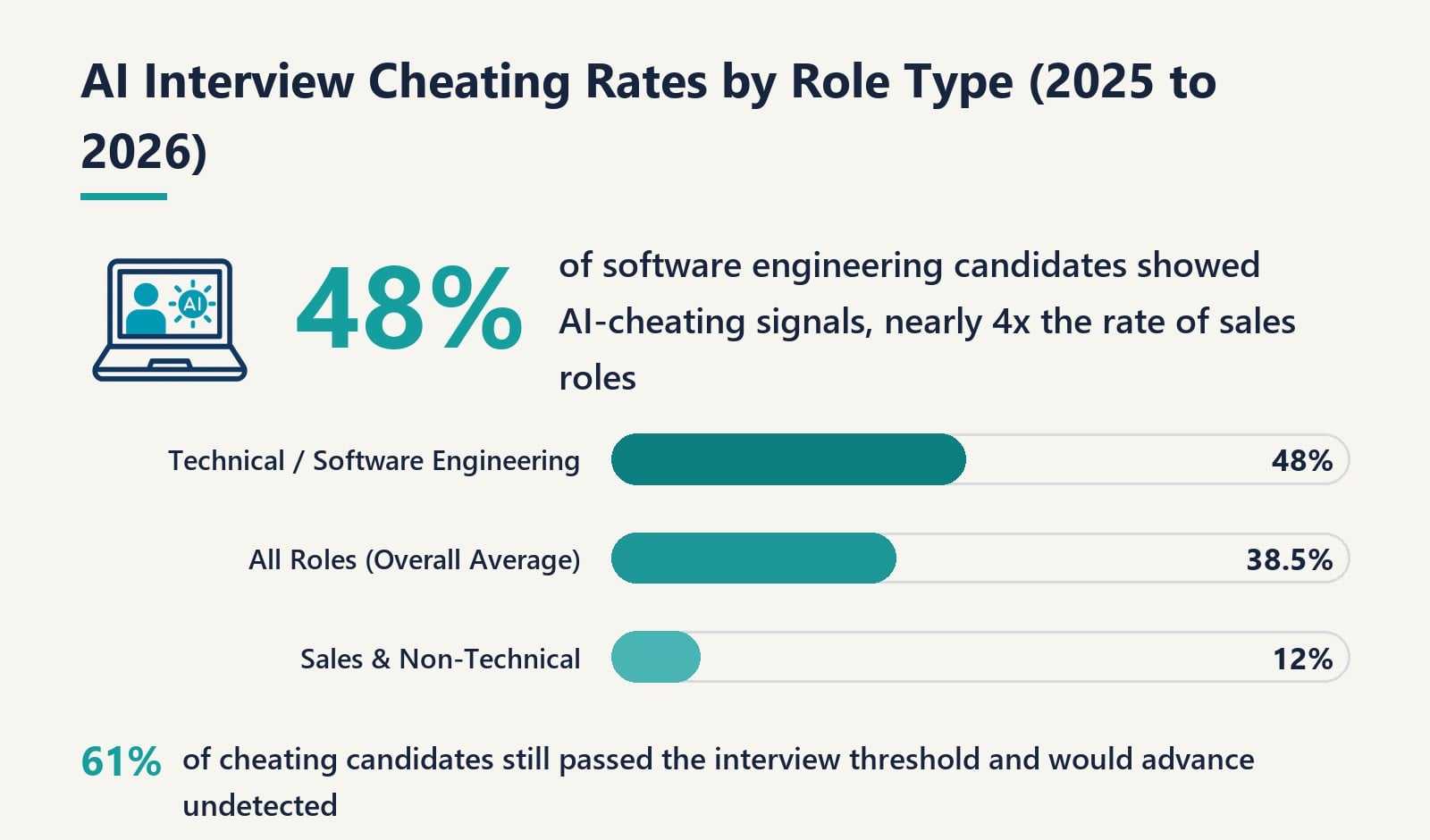
Technical roles took the worst of it. In software engineering interviews the cheating rate hit 48%, versus just 12% in sales. The pattern makes sense once you think about it: coding questions have clean, checkable answers, which is exactly what an AI assistant is built to spit out in real time.
Now here’s the part that should worry every hiring team. 61% of the candidates who cheated still scored above the passing threshold and would have advanced to the next round with no detection at all. The score didn’t catch them. The score rewarded them.
Read that again, because it reframes the whole problem. The interview score isn’t a measure of the candidate anymore. It’s a measure of whoever had the better AI assistant running in the background.
And this isn’t a few desperate people. About 30% of repeat interviewers cheat in every single interview as a fixed strategy, and a Codepanion survey found 83% of candidates say they’d use AI assistance live if they thought they could get away with it. The willingness is nearly universal. The only thing holding most people back is the fear of getting caught, and that fear is fading fast. We’ve broken down exactly how job seekers are gaming these systems, and the methods keep getting cleaner.
- The score is broken: 61% of cheaters scored above the passing bar and would have advanced undetected (Fabric, 2026).
- Technical roles are ground zero: 48% cheating in software engineering versus 12% in sales.
- The intent is nearly universal: 83% of candidates would use live AI assistance if they believed they wouldn’t be caught.
The interview score isn’t a measure of the candidate anymore. It’s a measure of whoever had the better AI running in the background.
Seeing Is No Longer Believing: The Deepfake Surge
Answer fraud is one thing. Identity fraud is another, and it’s the scarier of the two.
We’re not just talking about candidates feeding answers through a hidden chatbot. We’re talking about the face on your screen not being a real person, or not being the person who shows up on day one.
The numbers move fast and ugly. Deepfake fraud attempts in hiring jumped 1,300% year over year between 2023 and 2024, according to Pindrop’s 2025 Voice Intelligence Report. Sumsub clocked a separate 1,100% surge in North America alone in early 2025.
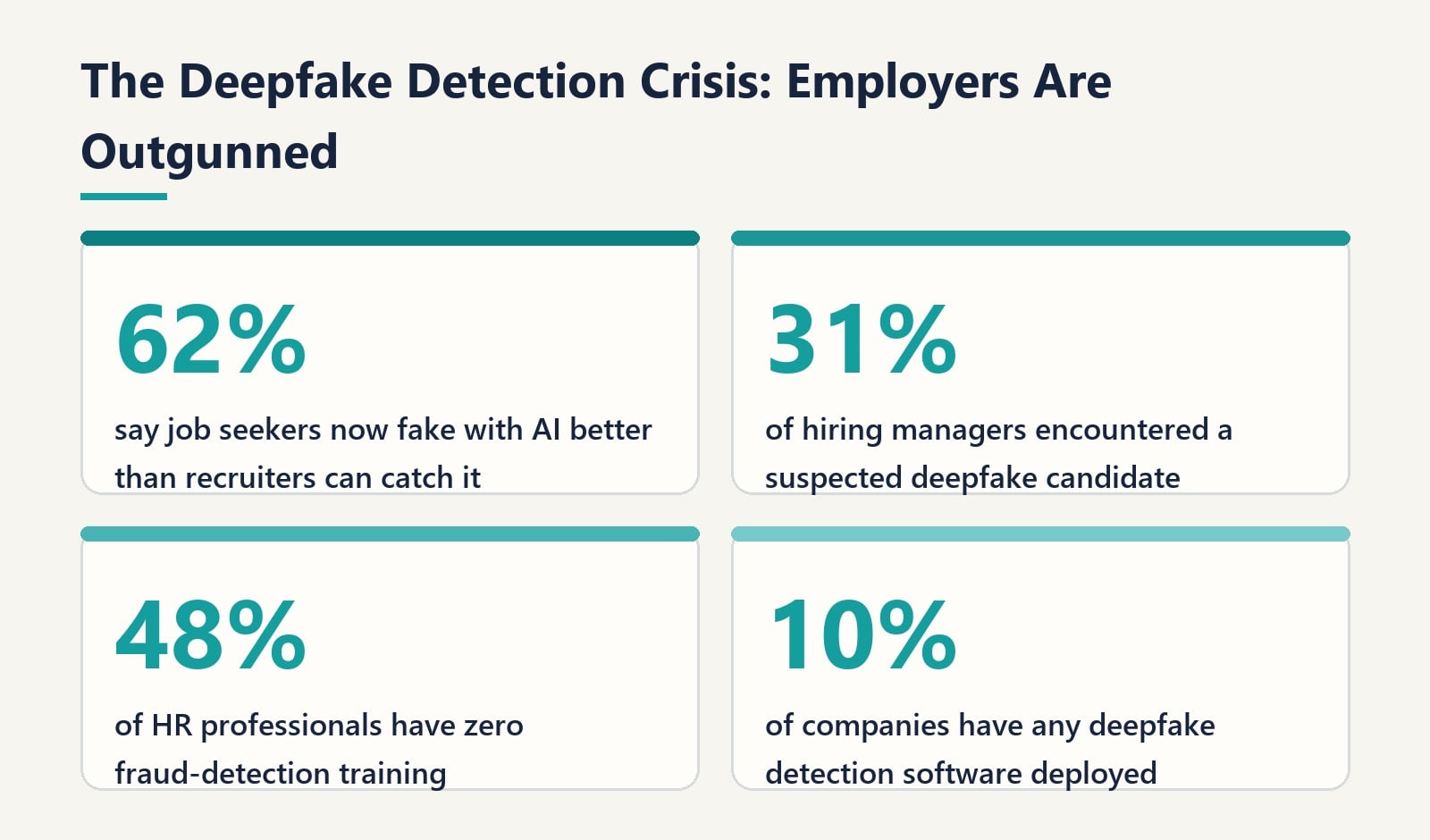
And it’s already in the room with hiring managers. A Greenhouse survey of 4,136 people found 31% have personally interviewed someone they suspected or confirmed was using deepfake technology. A full 91% have encountered or suspected AI-generated answers during online meetings.
Here’s the brutal kicker. Humans detect deepfakes with only 55.54% accuracy, per a 2025 meta-analysis of 56 studies. That’s barely better than flipping a coin. The instinct you trust, that gut sense that something’s off, is basically worthless against good synthetic media.
Stack that against the forecast and the stakes get clear. Gartner predicts that by 2028, one in four candidate profiles worldwide will be fake or a synthetic persona. When the face on the call can be manufactured and your eyes can’t tell, every remote interview becomes a question you can’t fully answer. That’s why companies are rethinking the whole format, something we explore in how firms are fighting back with in-person rounds.
Humans spot deepfakes at 55.54% accuracy. Your gut, the thing you trust most in an interview, is basically a coin flip.
The Arms Race Nobody Wins: Why Employers Are Outgunned
Talk to recruiters and you’ll hear confidence. Look at the tooling and you’ll see something else entirely.
The honesty is right there in the data. 62% of hiring professionals admit job seekers are now better at faking with AI than recruiters are at detecting it, according to research on the rise of AI interview fraud. That’s not a worry. That’s a concession.
Meanwhile the defenses are thin. Only 31% of companies have deployed any AI or deepfake detection software, and 10% use no detection tools whatsoever, per a Software Finder survey of 874 HR professionals. Nearly half of HR pros, 48%, have received zero training on AI-driven hiring fraud.
So the playbook for most teams is a human squinting at a webcam and trusting their judgment. We already know how that goes against synthetic media. And the consequence is concrete: 41% of organizations have unknowingly hired a fraudulent candidate, according to GetReal Security.
The tools on the candidate side make the mismatch worse. Products like Cluely and Interview Coder use GPU-level invisible overlays that sit on top of your screen and bypass standard screen-sharing detection. Your interviewer sees a clean shared screen. The candidate sees the answers. These tools have over a million combined users.
That’s the real shape of this arms race. One side has scalable, invisible, cheap technology and a million-strong user base. The other side has confidence and a manual review process. When 72% of recruiters are already finding AI-fabricated resumes and credentials in their pipelines, the gap stops being theoretical. The honest read is simple: capability is losing to confidence, and the people getting hurt are the honest candidates competing against ghosts.
- Detection barely exists: only 31% of companies run any AI or deepfake detection software, and 10% run none at all.
- The training gap is wide open: 48% of HR professionals have had zero training on AI-driven hiring fraud.
- The damage is already done: 41% of organizations have unknowingly hired a fraudulent candidate (GetReal Security).
One side has invisible, scalable tech and a million users. The other has confidence and a webcam. Guess who’s winning.
The Insider Threat: When the Fake Candidate Is a Foreign Operative
Most hiring fraud is some kid trying to bluff a coding test. This is not that.
Some of the people on the other side of your video call aren’t bad-fit candidates. They’re foreign operatives, and the money they earn doesn’t go toward rent. According to Pindrop’s research, 1 in 4 North Korean IT job applicants uses deepfake technology to hide who they really are.
In December 2024, the Justice Department indicted 14 North Korean nationals for running a fraudulent IT worker scheme. Over six years they funneled at least $88 million from U.S. businesses straight into a weapons program. These weren’t sketchy startups getting scammed. These were companies that thought they’d made solid remote hires.
Here’s how bad the saturation has gotten. One startup founder told CNBC that roughly 95% of the résumés they received for a single engineering role appeared to come from North Korean engineers posing as Americans. Not a handful. Nearly all of them.
Gartner now tells its clients to assume that for remote IT roles, at least half of the applications they receive will be false. Read that again. The default assumption for a remote tech req is that most applicants aren’t real.
And the broader scam economy is exploding right alongside it. The FTC logged job scam losses jumping from $90 million in 2020 to $501 million in 2024, and that figure predates the 2025 surge in AI-powered interview fraud. If you’re hiring remote, this stopped being an HR hygiene problem. It’s a security problem, and the people who treat it like one will be the ones still standing.
The default assumption for a remote tech role is now that most applicants aren’t real.
Preparation or Deception? The Blurry Line Candidates Walk
Before you start treating every applicant like a con artist, slow down. Most candidate AI use isn’t fraud at all.
About 70% of job seekers now use generative AI to research companies, draft cover letters, and prep their interview talking points, per Indeed’s 2025 data. That’s not cheating. That’s smart. And it pays off: job seekers who used AI in their search received twice as many offers while submitting only 40% more applications.
So where’s the line? It’s the difference between using AI to sharpen what you’d say and using AI to say it for you while you sit there pretending to think.
And plenty of people have crossed it. Around 20% of U.S. workers admit they secretly used AI during a live interview in 2025, and more than half now say it’s basically the norm. Technical assessment cheating doubled in a single year, climbing from 16% to 35% of attempts according to CodeSignal data, while Karat estimates 80% of candidates use large language models during code tests even when they’re explicitly banned.
Then there’s the deep end. In a Gartner survey of 3,000 job seekers, 6% admitted to full identity fraud: either impersonating someone else or having someone else impersonate them. Small percentage, massive consequence.
Here’s the mechanism worth understanding. The cheating concentrates exactly where the stakes are highest. Fabric found technical roles hit a 48% cheating rate versus just 12% in sales. When a job is high-demand and high-paying and the test feels like a hoop to jump through, more people rationalize the shortcut. We’ve watched this play out in how job seekers are gaming AI hiring systems, and the gray zone only gets murkier as the tools get better.
- Legitimate prep: researching the company, drafting and editing your materials, practicing answers out loud. This is the new baseline, and 70% of candidates already do it.
- The murky middle: running an AI overlay during a take-home test or leaning on it for live coding. CodeSignal saw this double to 35% in a year.
- Outright fraud: feeding live answers through a hidden tool or having someone else be you. That 6% identity-fraud figure is where careers and companies blow up.
The line isn’t AI versus no AI. It’s sharpening what you’d say versus letting AI say it while you pretend to think.
The Broken Trust Meter: How Candidates Really Feel
Strip away the fraud stats for a second and look at the people who aren’t cheating. They’re losing faith too.
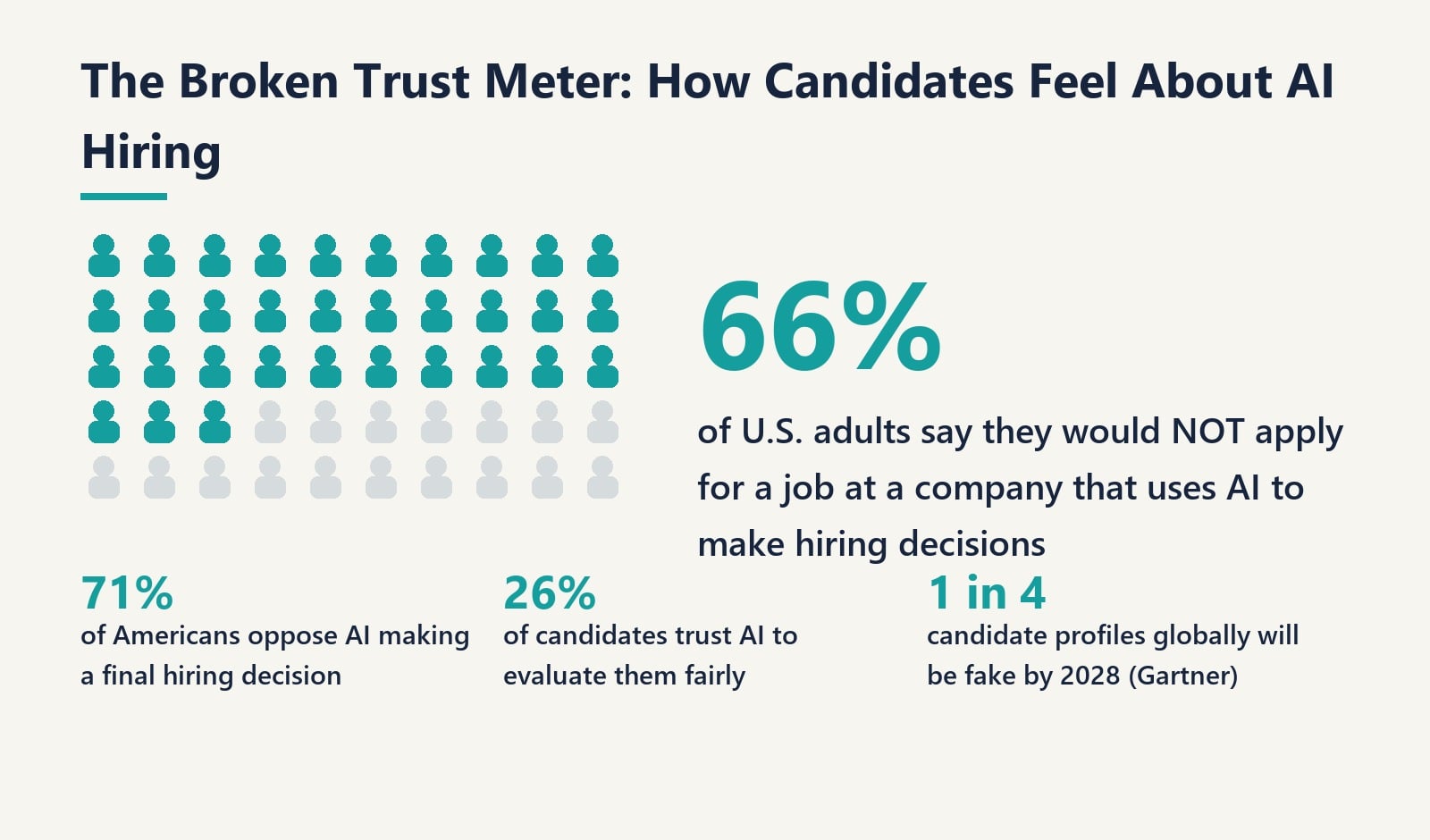
According to Pew Research, 66% of U.S. adults say they would avoid applying for a job at a company that uses AI to make hiring decisions. And 71% flat-out oppose letting AI make the final call. That’s not a fringe opinion. That’s the majority telling you they don’t want a machine deciding their future.
The trust numbers are brutal. Only 26% of candidates trust AI to evaluate them fairly, even though 52% believe AI is already screening their applications, per a Gartner survey of 2,918 candidates. So most people think they’re being judged by a system they don’t trust, and they’re applying anyway because they have no choice.
The youngest workers are the most burned. Gartner found 62% of Gen Z entry-level candidates have lost trust in the hiring process entirely. When the people just entering the workforce already believe the game is rigged, you’ve got a pipeline problem that compounds for years.
Here’s the connection most employers miss. Fraud and opacity feed each other. When companies hide the fact that AI is screening, honest candidates feel cheated, and the ones already inclined to cut corners feel justified. The whole system slides toward distrust.
There’s a clear ask buried in the data: 79% of candidates want transparency when AI is used in their hiring process, according to HireVue. People aren’t demanding you ditch the tools. They’re asking you to be honest about using them. The companies that stay quiet are the ones bleeding good applicants, a dynamic we dig into more in why so many recruiters worry AI is making hiring too robotic.
Most people think they’re being judged by a system they don’t trust, and they apply anyway because they have no choice.
Does Any of This Actually Work? The Value Gap
After all the fraud and the fear, the fair question is whether AI hiring even delivers. The answer is genuinely split.
Start with the optimistic case, because it’s real. Among organizations using AI in HR, 87% reported efficiency improvements and 75% reported better work quality, per SHRM’s State of AI in HR 2026. Companies using AI recruitment tools report 31% faster hiring times and a 50% improvement in quality-of-hire metrics. Those aren’t trivial gains.
The fairness data is even more surprising. Warden AI research found properly built AI systems scored 0.94 on fairness metrics versus 0.67 for human-led hiring, delivering up to 39% fairer treatment for women and 45% fairer for racial minority candidates. Done right, the machine can be less biased than the manager.
Now the counterweight. A Gartner survey of 114 HR leaders found 88% say their teams haven’t seen significant business value from AI tools yet. Adoption is everywhere. Payoff is not.
And the fairness story has a dark mirror. A ResumeBuilder survey found 47% of companies identify age bias in their own AI hiring tools, 44% cite socioeconomic bias, 30% gender bias, and 26% racial or ethnic bias. The same technology that can reduce bias when built carefully can bake it in when built carelessly. The phrase doing all the work is ‘properly implemented.’
So here’s the honest verdict. Adoption is racing way ahead of realized ROI. Companies bought the tools, automated the funnel, and are still waiting to see the value while a third of them admit those tools carry bias. If you’re a job seeker, that means the system judging you is powerful, fast, and not yet proven, and that’s exactly why showing up as a real, verifiable, prepared human still wins. We break down what that looks like in the state of skills-based hiring.
The same technology that can cut bias when built carefully bakes it in when built carelessly. The phrase doing all the work is ‘properly implemented.’
The 2026 Reckoning: Regulators Finally Catch Up
For years, AI hiring tools operated in a legal gray zone. That era is ending fast, and the penalties have real teeth now.
The EU AI Act classifies recruitment AI as high-risk, and full enforcement kicks in August 2, 2026. Get it wrong and you face fines up to EUR 15 million or 3% of your global annual turnover, whichever hurts more.
It already reshaped the industry once. The Act banned emotion recognition in hiring back in February 2025, which forced platforms like HireVue to tear out and redesign the facial analysis features they once sold as a selling point.
The U.S. picture is messier, and that’s exactly the problem. Colorado’s SB 24-205 took effect February 1, 2026, requiring bias audits for AI used in employment decisions. Meanwhile the EEOC quietly pulled its AI hiring guidance off its website in January 2025, leaving a federal vacuum just as state enforcement ramps up.
So you’ve got a patchwork: tough rules in some states, nothing in others, and a moving target everywhere. That combination is a compliance nightmare for any company hiring across state lines.
Here’s the part that should worry every HR leader. SHRM’s 2026 survey of 1,908 HR professionals found that 57% of HR pros in states with AI hiring regulations have no idea those laws exist, per SHRM’s State of AI in HR 2026. You can’t comply with a law you don’t know is on the books, and ignorance won’t save you from the fine.
More than half of HR pros in regulated states don’t know the laws already governing their tools, and ignorance won’t save them from the fine.
What This Means For You
Let’s get practical, because the data only matters if it changes what you do on Monday morning.
If you’re hiring for remote roles, change your baseline assumption. Gartner expects that for remote IT positions, employers should brace for at least half of applications to be false, and Software Finder’s survey of 874 HR professionals found 72% of recruiters have already hit AI-fabricated resumes, portfolios, or credentials. Treat verification as a core step, not an afterthought.
The catch is that almost nobody is ready for it. Only 31% of companies have deployed any AI or deepfake detection software, 48% of HR pros have had zero fraud training, and 41% of organizations have already hired a fraudulent candidate without knowing it. The fix isn’t exotic: budget for detection (40% of companies plan to invest within a year), train your team, and bring final rounds back in person where it counts.
That last move is already happening at scale. In-person interview requests jumped 500%, from 5% of roles in 2024 to 30% in 2025, and 72% of recruiting leaders now use in-person rounds specifically to fight AI fraud, as we covered in our breakdown of the in-person comeback.
Now for candidates, because the rules cut both ways. Using AI to research companies, sharpen your resume, and prep your talking points is smart, not cheating. ZipRecruiter found job seekers who used AI in their search landed twice as many offers while sending only 40% more applications.
But know where the line sits. Feeding answers through a hidden overlay during a live interview is increasingly getting caught, and identity fraud (someone else sitting in your seat, a synthetic persona) is a crime, not a hack. And demand transparency while you’re at it: 79% of candidates want to know when AI is judging them, per HireVue’s research. If a company won’t tell you, that’s information too. For more on how the system actually works, see our guide to gaming AI hiring systems.
- Employers: verify identity before you trust a screen. Assume up to half of remote-role applicants may be false, fund detection tools, and move final rounds in person.
- Candidates: prep with AI, never fake with it. AI prep doubles your offers, but live cheating gets caught and identity fraud is criminal.
- Everybody: push for transparency. 79% of candidates want disclosure when AI evaluates them, and a company’s answer tells you who they are.
AI prep is smart and doubles your offers. A hidden overlay in a live interview is a different game, and it’s one you’re increasingly going to lose.
The 2028 Horizon: What Comes Next
Look two years out and the trajectory gets stark. Gartner predicts that by 2028, one in four candidate profiles worldwide will be fake or a synthetic persona.
Sit with that number. A quarter of the faces and resumes flowing into your pipeline could be fiction, which turns hiring integrity from an HR concern into an existential one for any remote-first company.
The tooling is racing ahead too. Stanford HAI’s 2026 AI Index logged agentic AI job postings growing 10,854% year over year, a sign that autonomous AI recruiters are coming whether the systems are ready or not. Gartner thinks many won’t be: it projects that more than 40% of agentic AI hiring projects will be canceled by 2027 over unclear value, runaway costs, and weak risk controls.
The smarter bet is verification plus skills. Gartner expects 75% of hiring processes to include certifications or tests for workplace AI proficiency by 2027, which lines up with the broader move toward skills-based hiring that proves what someone can actually do.
And the biggest names are already voting with their calendars. Google, McKinsey, Deloitte, and Cisco have all reintroduced mandatory in-person interview rounds as a direct answer to AI fraud, a trend that went from niche to industry-wide in barely a year.
The recruiters themselves see the wave coming: 88% predict AI hiring fraud will reshape the entire hiring process within five years, per Software Finder. So the choice ahead is simple, even if the work isn’t. Verify identity and keep human judgment in the loop, or watch hiring integrity quietly dissolve. The companies that pick the first path will still trust who they hire in 2028. The rest are gambling on a coin flip, and the deepfakes are getting better at it than they are.
A quarter of all candidate profiles could be fake by 2028. That turns hiring integrity from an HR headache into a survival question.
The uncomfortable truth of 2026 is that hiring has become a contest between two armies of bots, with humans caught in the crossfire. Employers deploy AI to filter thousands of applicants; candidates deploy AI to beat the filters; and detection software races to catch deepfakes that humans identify barely better than a coin toss. Nobody is winning this arms race, and the casualty is trust itself, the one thing a hiring process cannot function without.
But the report also points to a way out, and it’s almost nostalgic: the companies clawing back integrity are the ones reintroducing human judgment, in-person final rounds, identity verification, and radical transparency about how they use AI. The lesson for 2026 isn’t to abandon AI or to fear every candidate. It’s that the organizations who treat verification as core infrastructure, not an afterthought, will be the ones still able to trust the person who shows up on day one. Start building that now, because by 2028, one in four faces on the call may not be real.
Resources & References
- Fabric: State of AI Interview Cheating in 2026, Analysis of 19,368 Live Interviews
- SHRM State of AI in HR 2026 Report (March 31, 2026)
- HireVue Global Hiring Trends Report 2025
- Pew Research Center: Public Views of AI in Hiring
- StudyFinds: AI Job Fraud Hits 72% of Recruiters, Software Finder Survey of 874 HR Professionals
- iShift Tech Talent: How to Spot Deepfakes in Job Interviews, Greenhouse 2025 Survey Data
- Pindrop 2025 Voice Intelligence & Security Report (deepfake fraud +1,300%)
- Pin.com: AI Adoption in Recruiting, Complete 2026 Industry Report (Gartner, SHRM, Stanford HAI sources)
- Warden AI / Findem: State of AI Bias in Talent Acquisition 2025
- Sherlock AI: Rise of AI Interview Fraud in 2026, Deepfakes, Proxy Hiring & Employer Response
- CNBC: How Deepfake AI Job Applicants Are Stealing Remote Work (July 2025)
- People Management: Deepfakes and AI-Enabled Impersonation Among Top Recruitment Threats (Greenhouse 2025 AI in Hiring Report)
- SHRM: Recruitment Is Broken, How AI Automation Is Eroding Hiring Trust (Nov 2025)
- Azumo: 77 AI Recruitment Statistics for 2026, Market Size, Adoption & Accuracy Data
- European Commission: EU AI Act, High-Risk AI Systems in Employment (Full Enforcement August 2026)
- Secrets of Privacy: Fake Job Interviews Are Stealing Your Face, Sumsub Deepfake Fraud Data Q1 2025
- HireVue 2025 Global Guide to AI in Hiring, 4,000+ HR leader and employee survey
- Bright Defense: 150+ Deepfake Statistics (2026 edition), fraud surge data and incident tracking
- The Interview Guys: 72% of Companies Are Fighting AI Fraud With In-Person Interviews
- Pindrop: Targeted by Deepfake Candidates?, Gartner 1-in-4 projection and Pindrop’s own hiring experiment
- InCruiter: AI in Recruitment 2026, Trends, Stats & What’s Actually Working
- Computerworld: To Counter AI Cheating, Companies Bring Back In-Person Interviews, ZipRecruiter and Gartner analyst data
- Fortune: Job Applicants Are Using Deepfake AI to Trick Recruiters, Pindrop developer role experiment (12.5% fake applicants)
- Connecting People: 38% of Tech Candidates Are Using AI to Cheat, Fabric data deep-dive with detection analysis
- Built In: Is Using AI in a Job Interview Cheating?, Blind 2025 study, Cluely/InterviewCoder landscape
- Stanford HAI 2026 AI Index Report, Public Opinion chapter (agentic AI job postings +10,854% YoY)
- DemandSage: AI Recruitment Statistics 2026, Global data, market sizing, and recruiter sentiment
After twelve years of writing advice like this, we built the tool that does it with you. It's called Longbow, and here's the whole story.

ABOUT THE INTERVIEW GUYS (JEFF GILLIS & MIKE SIMPSON)
Mike Simpson: Co-founder of The Interview Guys and Longbow. He has been the voice behind our interview advice since 2013 — his work has reached over 100 million job seekers around the world. The strategic mind behind Longbow, our new career platform.
Jeff Gillis: Co-founder of The Interview Guys and Longbow. He built the systems that put our work in front of those readers, and he leads the engineering on Longbow, the cutting edge career platform built for today’s job seeker.