
Warehouse Manager Resume Template: Examples & Writing Guide [2025]
Landing a warehouse manager role in 2025 means competing against dozens of other candidates who claim they can “manage operations” and “lead teams.” The difference between getting an interview and getting ghosted? A resume that proves your impact with hard numbers.
Your resume isn’t just a list of past jobs. It’s your ticket to standing out in a field where warehouse employment has surged 47% over the past decade and companies are desperate for managers who can actually deliver results. With the warehouse automation market expected to reach $63.36 billion by 2030, employers want leaders who understand both traditional operations and emerging technology.
If you’re struggling to translate your day-to-day warehouse experience into a compelling resume, you’re not alone. Most warehouse professionals focus on duties instead of achievements, leaving hiring managers wondering if you can actually move the needle. By the end of this article, you’ll have a downloadable resume template and the exact framework to showcase your value in a way that gets past Applicant Tracking Systems and impresses hiring managers.
☑️ Key Takeaways
- Quantify everything with specific metrics like cost reductions, productivity improvements, and accuracy rates to prove your impact
- ATS optimization is critical for warehouse manager roles since most applications go through automated screening systems before reaching human reviewers
- Leadership and safety accomplishments separate strong candidates from average ones, especially when backed by team size and incident-free periods
- WMS proficiency matters more than ever as companies prioritize candidates experienced with SAP, Oracle NetSuite, and Manhattan Associates platforms
What Makes a Warehouse Manager Resume Different?
Warehouse manager resumes require a unique approach compared to other professional roles. You’re not just managing people or processes. You’re orchestrating complex logistics operations where a single mistake can cost thousands of dollars and put employee safety at risk.
The metrics matter more than anywhere else. While a marketing manager might highlight “increased engagement,” warehouse managers need to prove impact with concrete numbers like inventory accuracy rates, order fulfillment speed, cost per unit, and safety incident rates. These quantifiable achievements separate candidates who understand operational excellence from those who just showed up.
Your resume needs to demonstrate proficiency with Warehouse Management Systems. In 2025, 83% of companies use AI-powered resume screening, and these systems specifically scan for WMS platforms like SAP, Oracle NetSuite, Manhattan Associates, and RF scanning technology. If you’re experienced with these systems, they need prominent placement on your resume.
Interview Guys Tip: Don’t just list WMS platforms you’ve used. Describe what you accomplished with them, like “Implemented SAP WMS to reduce order processing time by 35%” or “Leveraged Oracle NetSuite for real-time inventory tracking, improving accuracy to 99.8%.”
Leadership scope matters enormously in warehouse management. Hiring managers want to know exactly how many people you supervised, how large your facility was, and what volume you handled. Be specific: “Managed 185,000 sq. ft. distribution center with 53 employees processing 15,000+ orders monthly” tells a much more compelling story than “Managed warehouse operations.”
Warehouse Manager Resume Example
Here’s a professional warehouse manager resume example. This example gives you an idea of what type of content fits in a good ATS friendly resume.
Example Resume:
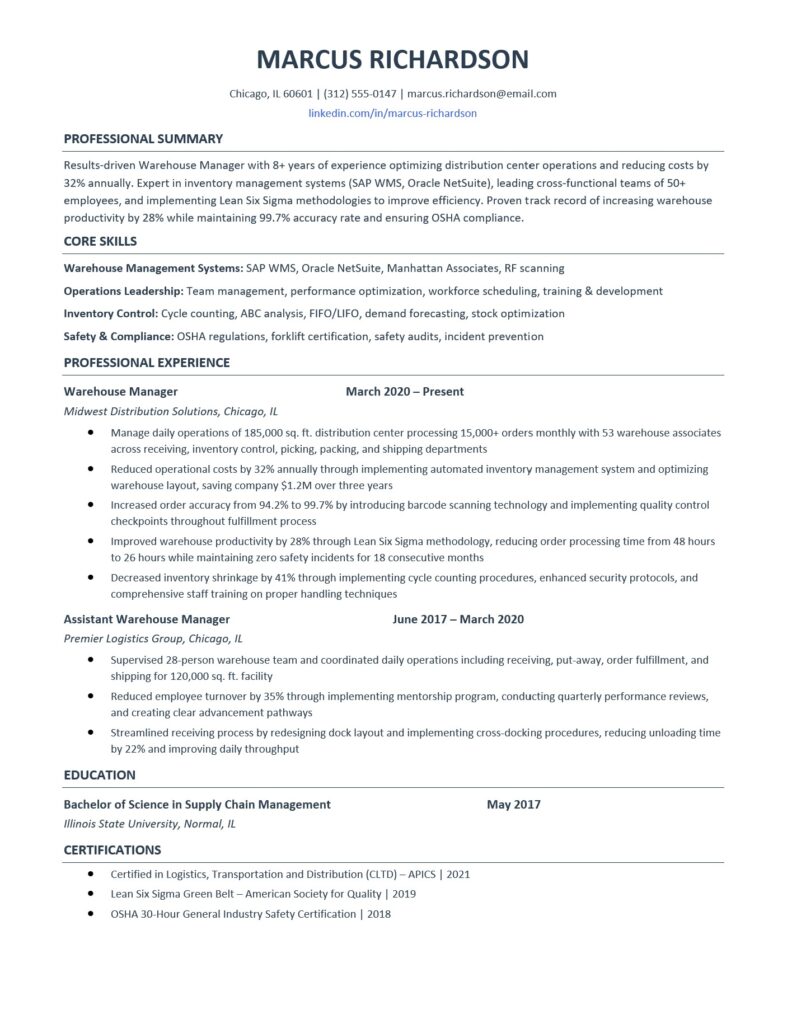
Here’s a professional warehouse manager resume template you can download and customize. This template is designed to be both visually appealing and ATS-friendly, with clean formatting that highlights your strengths.
Blank Customizable Template
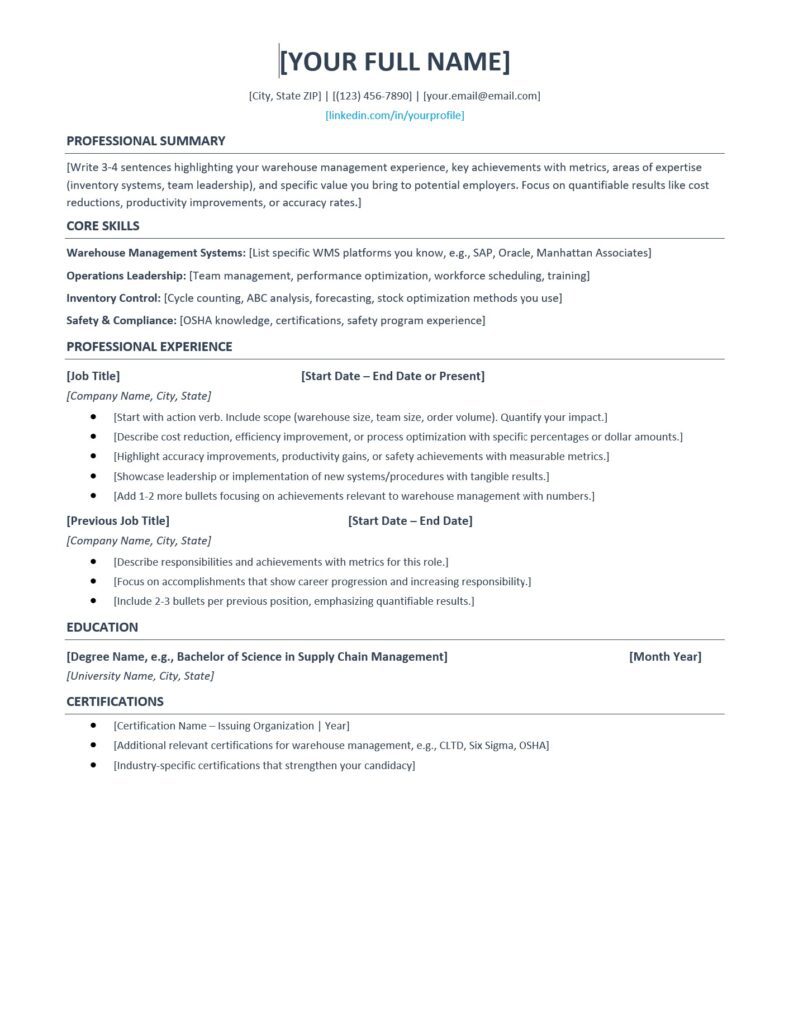
Download Your Free Template:
- Download DOCX Template (fully editable in Microsoft Word)
Interview Guys Tip: The DOCX template is fully editable, allowing you to adjust fonts, colors, and spacing to match your personal brand while maintaining professional formatting. Just replace the placeholder text with your own information.
Here’s what most people don’t realize: employers now expect multiple technical competencies, not just one specialization. The days of being “just a marketer” or “just an analyst” are over. You need AI skills, project management, data literacy, and more. Building that skill stack one $49 course at a time is expensive and slow. That’s why unlimited access makes sense:
Your Resume Needs Multiple Certificates. Here’s How to Get Them All…
We recommend Coursera Plus because it gives you unlimited access to 7,000+ courses and certificates from Google, IBM, Meta, and top universities. Build AI, data, marketing, and management skills for one annual fee. Free trial to start, and you can complete multiple certificates while others finish one.
Essential Components of a Winning Warehouse Manager Resume
Your warehouse manager resume should follow a specific structure that highlights your qualifications in order of importance. Based on current industry best practices, here’s the optimal section order:
Professional Summary (3-4 sentences) comes first and serves as your elevator pitch. This isn’t the place for generic statements like “results-driven professional seeking opportunities.” Instead, pack it with your years of experience, biggest achievements with metrics, technical expertise, and the specific value you bring. Think: “Results-driven Warehouse Manager with 8+ years optimizing distribution operations and reducing costs by 32% annually through Lean Six Sigma implementation.”
Core Skills section should be organized by category rather than a random list. Group your skills into logical buckets: Warehouse Management Systems, Operations Leadership, Inventory Control, and Safety & Compliance. This makes it scannable for both humans and ATS software.
For warehouse managers looking to ace their interviews after landing that call, check out our comprehensive guide on warehouse manager interview questions to prepare for the behavioral and technical questions you’ll face.
Professional Experience forms the heart of your resume and deserves the most space. List positions in reverse chronological order, with your most recent role first. Each position needs five key elements: job title, company name and location, employment dates, and 4-6 achievement-focused bullet points that start with strong action verbs and include specific metrics.
Education and Certifications round out your credentials. While a bachelor’s degree in supply chain management, logistics, or business administration strengthens your candidacy, relevant certifications like CLTD (Certified in Logistics, Transportation and Distribution), Lean Six Sigma, or OSHA 30-Hour can compensate for limited formal education.
How to Write Each Resume Section
Crafting Your Professional Summary
Your professional summary needs to accomplish three goals in 3-4 sentences: establish your level of experience, highlight your biggest measurable accomplishment, and showcase technical expertise that aligns with the job posting.
Start with your years of experience and primary role: “Warehouse Manager with 10+ years optimizing distribution center operations.” Then immediately follow with your most impressive achievement: “Reduced operational costs by $1.8M annually while improving order accuracy from 92% to 99.6%.” Finally, demonstrate technical proficiency: “Expert in SAP WMS, Oracle NetSuite, and implementing Lean Six Sigma methodologies across 200,000+ sq. ft. facilities.”
Avoid vague language like “dedicated professional” or “excellent communication skills.” Every word should convey concrete value. If you can’t back up a claim with a specific example, cut it.
Building Your Core Skills Section
The skills section serves dual purposes: it helps ATS systems identify you as a qualified candidate, and it gives hiring managers a quick snapshot of your capabilities. Organize skills into four categories that matter most for warehouse management.
Warehouse Management Systems: List specific platforms you’ve used (SAP WMS, Oracle NetSuite, Manhattan Associates, JDA, Infor, RF scanning). Don’t list every system you’ve touched once. Focus on platforms where you have substantial experience and can speak intelligently during interviews.
Operations Leadership: Include team management, workforce scheduling, performance optimization, training and development, and cross-functional collaboration. These soft skills prove you can lead people, not just manage processes.
Inventory Control: Highlight methodologies like cycle counting, ABC analysis, FIFO/LIFO, demand forecasting, stock optimization, and inventory turnover management. These technical competencies show you understand the financial implications of inventory management.
Safety & Compliance: Emphasize OSHA regulations, forklift certification, safety program development, incident prevention, and any specific industry compliance requirements (FDA for food and beverage, GMP for pharmaceuticals). With 5.5 workplace injuries per 100 full-time employees in the warehousing sector, safety expertise sets you apart.
Writing Achievement-Focused Experience Bullets
This is where most warehouse manager resumes fail. Instead of listing responsibilities (“Managed warehouse staff” or “Oversaw inventory”), focus relentlessly on achievements with quantifiable results.
Use this formula: Action Verb + Specific Task + Measurable Result. For example: “Implemented automated inventory management system, reducing stockouts by 43% and saving company $850K annually in rush shipping costs.”
Interview Guys Tip: If you’re struggling to remember specific metrics, review old performance reviews, quarterly reports, or emails where you shared wins with leadership. Even rough estimates like “approximately 30% improvement” are better than no numbers at all.
Every bullet point should answer the question: “So what?” If you trained new employees, explain the outcome. “Trained new employees” becomes “Developed comprehensive training program that reduced new hire ramp-up time from 6 weeks to 3 weeks and decreased first-month error rates by 38%.”
Strong action verbs for warehouse manager resumes include: streamlined, optimized, reduced, increased, implemented, coordinated, spearheaded, restructured, eliminated, and negotiated. These words convey leadership and results.
For more guidance on showcasing your achievements effectively, read our article on resume achievement formulas that help translate daily work into impressive accomplishments.
Education and Certifications That Matter
While formal education matters less than proven results in warehouse management, it still deserves strategic placement on your resume. List your degree, institution, and graduation year. If you graduated more than 15 years ago or have extensive experience, you can omit the year.
Relevant degrees include Supply Chain Management, Logistics, Operations Management, Business Administration, or Industrial Engineering. If you lack a degree, don’t panic. Focus extra attention on your certifications and make sure your experience section is packed with impressive metrics.
Key certifications for warehouse managers include:
Certified in Logistics, Transportation and Distribution (CLTD) from APICS demonstrates comprehensive supply chain knowledge and is increasingly expected for senior warehouse management roles. The certification covers logistics, inventory management, and strategic warehousing concepts.
Lean Six Sigma certifications (Green Belt or Black Belt) prove you can implement process improvements and eliminate waste. With companies constantly pressured to do more with less, Six Sigma methodology gives you a framework to drive measurable efficiency gains.
OSHA 30-Hour General Industry Safety Certification shows you take workplace safety seriously and understand federal regulations. Some companies won’t even consider candidates without this credential, especially in industries with strict safety requirements.
Common Mistakes That Kill Warehouse Manager Resumes
Generic job descriptions instead of specific achievements. Writing “Responsible for managing daily warehouse operations” tells hiring managers nothing about your capabilities. Instead, describe what you accomplished: “Managed 50-person warehouse team processing 20,000 orders weekly with 99.5% accuracy rate while reducing labor costs by 18%.”
Missing key metrics and quantification. Numbers prove impact. Every major accomplishment on your resume should include percentages, dollar amounts, timeframes, or volumes. If you reduced costs, by how much? If you improved efficiency, what was the before and after?
Irrelevant skills that waste space. You don’t need to list Microsoft Word or “attention to detail.” Hiring managers assume basic computer literacy and soft skills. Use that precious space for WMS platforms, certifications, and industry-specific competencies that differentiate you.
Poor formatting that fails ATS screening. Fancy graphics, tables, columns, headers, footers, and unusual fonts confuse Applicant Tracking Systems. Stick to clean, simple formatting with standard section headings. Use standard fonts like Calibri, Arial, or Times New Roman in 10-12 point size.
Too long or too short. Warehouse manager resumes should be exactly one page if you have less than 10 years of experience, or two pages maximum for senior roles. Don’t try to cram everything onto one page with 8-point font. Prioritize your most relevant and impressive achievements.
ATS Optimization and Keywords for Warehouse Manager Resumes
Applicant Tracking Systems act as gatekeepers, scanning your resume for specific keywords before a human ever sees it. Understanding how these systems work can dramatically improve your interview callback rate.
Start by mining the job description for keywords. The posting tells you exactly what the company values. If they mention “SAP WMS” three times, that platform needs prominent placement on your resume. If they emphasize “cost reduction,” include specific examples of how you’ve cut costs with dollar amounts.
Include both acronyms and full names for key terms. Write “Warehouse Management System (WMS)” and “Certified in Logistics, Transportation and Distribution (CLTD)” to ensure ATS picks up both versions. This simple technique can make the difference between appearing in search results or getting filtered out.
Technical skills matter most for ATS optimization. Systems specifically scan for WMS platforms (SAP, Oracle, Manhattan Associates, JDA, Infor), inventory methodologies (FIFO, LIFO, ABC analysis, cycle counting), compliance knowledge (OSHA, FDA, GMP), and process improvement frameworks (Lean, Six Sigma, Kaizen).
Interview Guys Tip: Don’t keyword stuff by listing every term from the job posting. ATS systems are sophisticated enough to recognize when candidates artificially inflate keyword usage. Focus on naturally incorporating relevant terms throughout your experience bullets where you genuinely have that expertise.
For a deeper dive into optimizing your entire job application package, explore our guide on resume, cover letter, and LinkedIn profile synchronization to ensure consistent messaging across all platforms.
Interview Guys Tip: Before you submit another application, run your resume through an ATS scanner. Most job seekers skip this step and wonder why they never hear back. Check out the free ATS checker we use and recommend →
Frequently Asked Questions
How long should a warehouse manager resume be?
One page if you have less than 10 years of experience, maximum two pages for senior warehouse management roles. Prioritize recent, relevant experience over older positions. If you need to trim length, reduce older jobs to just title, company, dates, and 1-2 key bullet points rather than including every detail.
What’s the best resume format for warehouse managers?
Reverse chronological format works best for warehouse management because it highlights your career progression and most recent accomplishments first. Hiring managers want to see your current capabilities, and most ATS systems are optimized for chronological resumes. Avoid functional or skills-based formats that obscure your work history.
Should I include references on my warehouse manager resume?
No. References belong on a separate document that you provide when requested during later interview stages. The phrase “References available upon request” is outdated and wastes valuable space. Use that room for additional achievements or certifications instead.
How do I show warehouse management skills without management experience?
Focus on leadership moments within other roles: training new employees, leading projects, implementing process improvements, or serving as a shift lead. Quantify these experiences with metrics. “Led 5-person team to reorganize storage layout, improving pick time by 22%” proves management capability even without a formal management title.
What if I don’t have experience with specific WMS platforms mentioned in job postings?
Highlight your ability to learn new systems quickly by describing how you’ve mastered previous platforms. Include phrases like “Quickly adapted to [System Name] within first month, achieving full proficiency in 6 weeks.” Also emphasize transferable technical skills, since core WMS concepts remain consistent across platforms.
Conclusion
Creating a warehouse manager resume that actually lands interviews requires more than listing past jobs and hoping for the best. You need to prove your impact with concrete metrics, optimize for ATS screening without sacrificing readability, and position yourself as a leader who understands both traditional operations and emerging technology.
The warehouse management field continues evolving rapidly, with automation, AI-driven systems, and increasing complexity. Your resume needs to reflect that you’re not just keeping up but driving innovation and delivering measurable results. Focus relentlessly on quantifying achievements, showcasing relevant technical expertise, and demonstrating leadership at scale.
Use the downloadable templates above as your foundation, then customize every section to align with specific job requirements. Mine job descriptions for keywords, incorporate them naturally throughout your experience bullets, and let your unique story of operational excellence shine through.
Ready to explore more professional resume templates? Browse our free resume template library for additional options across different industries and experience levels.
Here’s what most people don’t realize: employers now expect multiple technical competencies, not just one specialization. The days of being “just a marketer” or “just an analyst” are over. You need AI skills, project management, data literacy, and more. Building that skill stack one $49 course at a time is expensive and slow. That’s why unlimited access makes sense:
Your Resume Needs Multiple Certificates. Here’s How to Get Them All…
We recommend Coursera Plus because it gives you unlimited access to 7,000+ courses and certificates from Google, IBM, Meta, and top universities. Build AI, data, marketing, and management skills for one annual fee. Free trial to start, and you can complete multiple certificates while others finish one.

BY THE INTERVIEW GUYS (JEFF GILLIS & MIKE SIMPSON)
Mike Simpson: The authoritative voice on job interviews and careers, providing practical advice to job seekers around the world for over 12 years.
Jeff Gillis: The technical expert behind The Interview Guys, developing innovative tools and conducting deep research on hiring trends and the job market as a whole.