
Free Physician Assistant Resume Template 2026: ATS Ready Examples & Writing Guide
Why Your Physician Assistant Resume Matters More Than Ever
The physician assistant profession is booming. According to the U.S. Bureau of Labor Statistics, PA employment is projected to grow 20% from 2024 to 2034, adding approximately 12,000 new openings each year. With a median annual wage of $133,260, competition for these positions is fierce.
But here’s the challenge: hiring managers and healthcare recruiters often receive hundreds of applications for a single PA position. Your resume has seconds to make an impression before it gets passed over. That’s why having a professionally formatted, ATS-optimized resume is no longer optional.
By the end of this article, you’ll know exactly how to structure your physician assistant resume, which sections matter most, and how to showcase your clinical skills in a way that gets you interviews. Plus, you’ll get access to our free downloadable templates designed specifically for PAs in 2026.
Whether you’re a new grad fresh from clinical rotations or an experienced PA looking to switch specialties, the strategies here will help you stand out. Ready to build a resume that actually gets results? Let’s dive in.
☑️ Key Takeaways
- Your certifications and licenses belong near the top of your resume since NCCPA status and state licensure are non-negotiable requirements for PA positions
- Quantify patient outcomes and clinical volume to demonstrate your real-world impact and stand out from other candidates
- Tailor your resume for each specialty by highlighting relevant clinical rotations, procedures, and patient populations that match the job
- Over 98% of Fortune 500 companies use ATS software to screen resumes, making proper formatting and keyword optimization essential
What Makes a Physician Assistant Resume Different?
A physician assistant resume isn’t like other healthcare resumes. Hiring managers have specific expectations based on the unique nature of PA practice, and your resume needs to reflect that.
First, credentials come first. Unlike many other professions, your NCCPA certification and state licensure aren’t just nice to have. They’re absolute requirements. Many healthcare organizations won’t even consider your application without current PA-C status, which is why smart candidates place this information prominently.
Second, clinical experience trumps everything. While other fields might prioritize education or soft skills, PA hiring managers want to see where you’ve practiced, what patient populations you’ve served, and which procedures you can perform. Your work history tells them whether you can hit the ground running in their specific setting.
Third, specialization matters. A PA applying for an orthopedic surgery position needs a very different resume than one applying for family medicine. You’ll want to customize your experience descriptions and skills sections based on each role you pursue. This is why many successful PAs maintain two or three versions of their resume tailored to different specialties.
Understanding these distinctions will help you list skills on your resume in a way that resonates with healthcare recruiters and demonstrates your readiness for the role.
PA Resume Example
Here’s a professional physician assistant resume example. This example gives you an idea of what type of content fits in a good ATS friendly resume.
Example Resume:
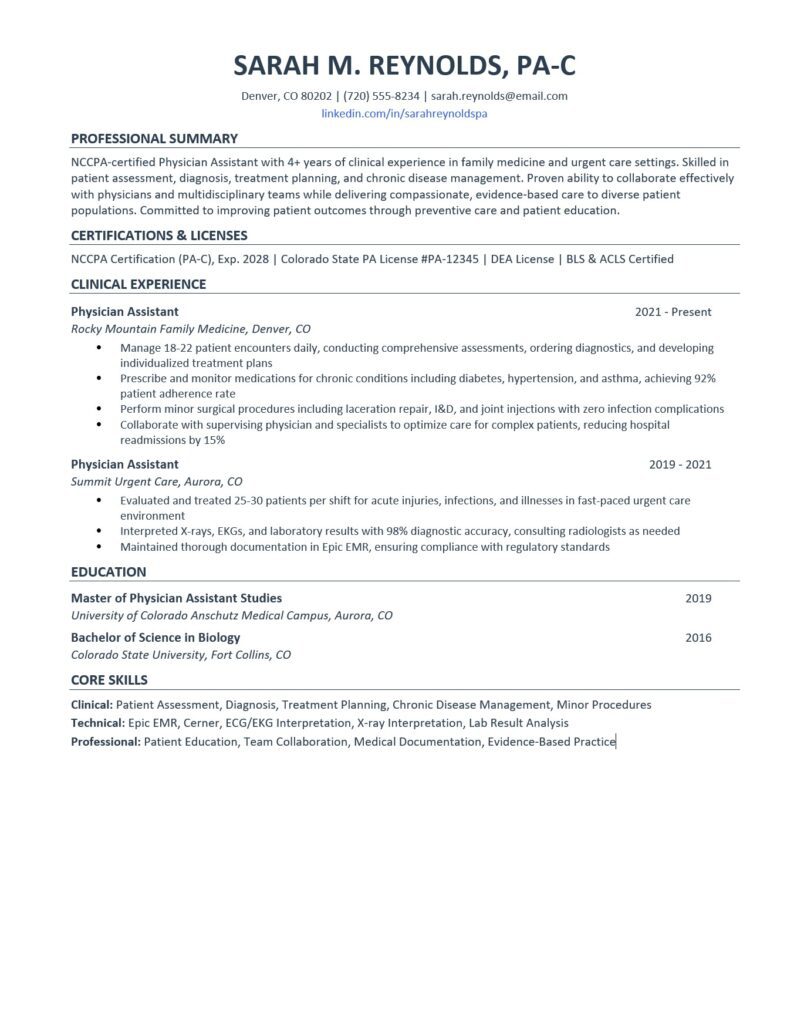
Here’s a professional physician assistant resume template you can download and customize. This template is designed to be both visually appealing and ATS-friendly, with clean formatting that highlights your strengths.
Blank Customizable Template
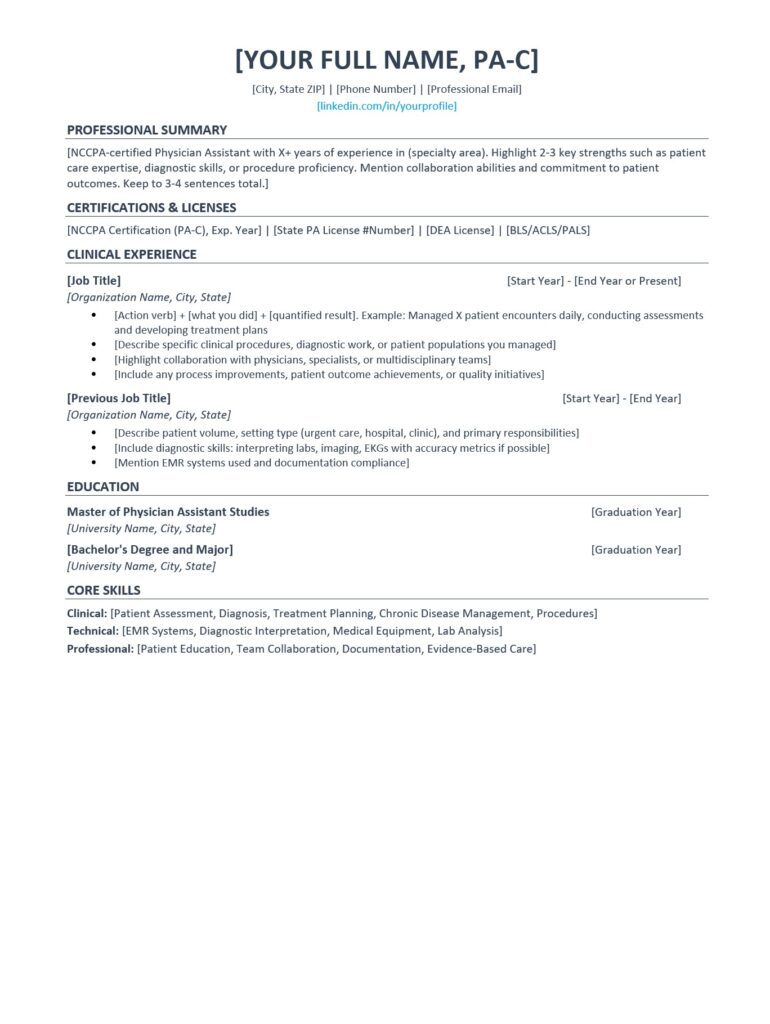
Download Your Free Template:
- Download DOCX Template (fully editable in Microsoft Word)
Interview Guys Tip: The DOCX template is fully editable, allowing you to adjust fonts, colors, and spacing to match your personal brand while maintaining professional formatting. Just replace the placeholder text with your own information.
Here’s what most people don’t realize: employers now expect multiple technical competencies, not just one specialization. The days of being “just a marketer” or “just an analyst” are over. You need AI skills, project management, data literacy, and more. Building that skill stack one $49 course at a time is expensive and slow. That’s why unlimited access makes sense:
Your Resume Needs Multiple Certificates. Here’s How to Get Them All…
We recommend Coursera Plus because it gives you unlimited access to 7,000+ courses and certificates from Google, IBM, Meta, and top universities. Build AI, data, marketing, and management skills for one annual fee. Free trial to start, and you can complete multiple certificates while others finish one.
Essential Components of a Winning PA Resume
Your physician assistant resume should follow a clear structure that guides recruiters through your qualifications efficiently. Here’s the optimal section order for most PA candidates:
1. Header and Contact Information Include your name with PA-C credentials, city and state (full address isn’t necessary), phone number, professional email, and LinkedIn profile. Keep this clean and easy to scan.
2. Professional Summary Write 3-4 sentences highlighting your certification status, years of experience, specialty focus, and key strengths. This is prime real estate for keywords that ATS systems scan for.
3. Certifications and Licenses List your NCCPA certification with expiration date, state PA license number, DEA license, and any additional certifications like BLS, ACLS, or PALS. This section should appear early since it’s the first thing many recruiters verify.
4. Clinical Experience Detail your work history in reverse chronological order. Include position titles, organization names, locations, and employment dates. Under each role, use bullet points to describe your responsibilities and accomplishments with quantified results whenever possible.
5. Education List your Master of Physician Assistant Studies first, followed by your bachelor’s degree. New graduates can also include clinical rotation details here.
6. Core Skills Organize your skills into categories like Clinical, Technical, and Professional. Include specific EMR systems, procedures, and competencies that match the job description.
Interview Guys Tip: Don’t waste valuable resume space listing basic skills that every PA should have. Employers expect you can take a patient history and perform physical exams. Instead, highlight specialized procedures, certifications, or unique competencies that set you apart from other candidates.
How to Write Each Section Effectively
Crafting Your Professional Summary
Your summary is often the only part of your resume that gets read thoroughly. Make every word count by leading with your strongest qualifications.
Strong example: “NCCPA-certified Physician Assistant with 5+ years of emergency medicine experience managing acute trauma, cardiac events, and critical care patients. Skilled in rapid assessment, bedside procedures, and collaborative care with ER physicians. Consistently maintained patient satisfaction scores above 92% while managing 25+ encounters per shift.”
Notice how this summary includes specific credentials, years of experience, specialty focus, quantified achievements, and key competencies. It tells the recruiter exactly what to expect from this candidate.
Avoid vague statements like “passionate about patient care” or “dedicated healthcare professional.” These phrases are meaningless without concrete evidence to back them up. For more guidance on this section, check out our resume summary examples for inspiration.
Showcasing Your Clinical Experience
This section is where you prove your value as a PA. Each bullet point should follow the formula: Action Verb + What You Did + Quantified Result.
Weak bullet: “Responsible for seeing patients in the clinic.”
Strong bullet: “Managed 20-25 daily patient encounters across primary care and urgent visits, diagnosing and treating conditions ranging from acute infections to chronic disease management.”
Focus on elements that demonstrate your capabilities: patient volume, diagnostic accuracy, procedure proficiency, collaboration with supervising physicians, and any quality improvement outcomes. If you reduced hospital readmissions, improved patient adherence rates, or streamlined workflows, include those accomplishments with numbers.
Highlighting Certifications Properly
Your certifications section should be straightforward but complete. Include:
- NCCPA Certification (PA-C) with expiration date
- State PA License with license number
- DEA License (especially important for prescriptive authority)
- BLS, ACLS, PALS or other emergency certifications
- Specialty certifications if applicable (CAQ credentials, etc.)
For new graduates awaiting certification, list these as “pending” rather than omitting them entirely. Many employers understand the timeline and will still consider your application.
Interview Guys Tip: If you have multiple state licenses or are willing to obtain licensure in other states, mention this. Healthcare systems often operate across state lines, and multi-state licensure can be a significant advantage.
Common Resume Mistakes Physician Assistants Make
Even qualified PAs sabotage their job search with avoidable resume errors. Here are the most damaging mistakes to avoid:
- Including irrelevant work history. If you worked retail or food service before entering healthcare, you don’t need to list those positions unless they’re directly relevant. A hiring manager wants to see your clinical background, not your college jobs.
- Failing to tailor for each position. Sending the same generic resume to every opening is a recipe for rejection. When applying for a cardiology position, emphasize your cardiology rotation experience and relevant procedures. For primary care, highlight your chronic disease management skills.
- Overloading with basic skills. Every PA can perform physical exams and take vital signs. Listing these basic competencies wastes space and makes your resume look like you’re padding it. Focus on specialized skills that differentiate you.
- Ignoring ATS requirements. According to recent data, nearly 99% of Fortune 500 companies use ATS platforms to screen resumes. If your formatting is incompatible or you’re missing key keywords, your resume may never reach human eyes. Use standard fonts, avoid graphics, and mirror language from the job description.
- Burying important information. Your NCCPA certification and clinical experience should be immediately visible. If recruiters have to hunt for your credentials, they’ll move on to the next candidate.
For a comprehensive overview of resume errors that hurt your chances, our guide on top resume mistakes covers additional pitfalls to avoid.
ATS Optimization and Keywords for PA Resumes
Applicant tracking systems are the gatekeepers of modern healthcare hiring. Research shows that 65% of healthcare recruiters use ATS specifically for candidate sourcing, making optimization non-negotiable.
How to optimize your PA resume for ATS:
Start by analyzing the job description carefully. Pull out specific keywords related to clinical skills, procedures, certifications, EMR systems, and patient populations. Then incorporate these terms naturally throughout your resume.
Common keywords for physician assistant roles include:
- Certifications: NCCPA, PA-C, BLS, ACLS, PALS, DEA
- Clinical Skills: Patient assessment, diagnosis, treatment planning, chronic disease management, prescriptive authority
- Procedures: Suturing, I&D, joint injections, splinting, wound care
- EMR Systems: Epic, Cerner, Athena, eClinicalWorks, Allscripts
- Specialties: Family medicine, emergency medicine, orthopedics, dermatology, urgent care
Use standard formatting with clear section headers. Avoid tables, text boxes, headers/footers, and fancy graphics that confuse ATS parsing algorithms. Stick to common fonts like Calibri, Arial, or Times New Roman.
Interview Guys Tip: Don’t try to game the system by stuffing invisible keywords into your resume. Modern ATS platforms are sophisticated enough to detect this, and it can get your application flagged or rejected outright.
For deeper guidance on making your resume ATS-compatible, explore our ATS-friendly resume template resource.
Interview Guys Tip: Before you submit another application, run your resume through an ATS scanner. Most job seekers skip this step and wonder why they never hear back. Check out the free ATS checker we use and recommend →
Frequently Asked Questions
How long should a physician assistant resume be?
Keep your PA resume to one page unless you have 10+ years of experience with highly relevant positions. Healthcare recruiters prefer concise documents that highlight your most important qualifications quickly. If you’re struggling to fit everything, cut less relevant positions rather than shrinking font sizes or cramming margins.
Should new PA graduates include clinical rotations?
Yes, absolutely. Clinical rotations are critical for new graduates who lack post-certification work experience. List your rotations with the specialty, facility, and key skills or patient populations you encountered. If applying for a specific specialty, expand on any rotation that matches that field.
What if I’m changing PA specialties?
Focus on transferable skills and any relevant experience, even from rotations. Highlight procedures, patient populations, and competencies that apply to the new specialty. Your professional summary should acknowledge your transition while emphasizing how your background adds value.
Should I include references on my PA resume?
No. References belong in a separate document provided when requested. Use that space for more impactful content about your qualifications. Have 3-5 professional references ready, including at least one supervising physician who can speak to your clinical abilities.
How do I address employment gaps?
Be honest but brief. If you took time off for additional training, family obligations, or health reasons, a simple explanation in your cover letter or during interviews is sufficient. Focus your resume on what you accomplished during your active employment periods.
Ready to Land Your Next PA Position?
Your physician assistant resume is the first impression you make on potential employers. With the healthcare industry projected to add thousands of PA positions over the next decade, the opportunity is real. But so is the competition.
Use the templates and strategies in this guide to create a resume that highlights your clinical expertise, passes ATS screening, and convinces hiring managers you’re worth interviewing. Remember to tailor your content for each application, quantify your accomplishments, and keep your certifications front and center.
Once your resume starts generating interviews, make sure you’re ready for what comes next. Our guide to physician assistant interview questions will help you prepare answers that land the job.
Download your free physician assistant resume template above, and browse our complete free resume template library for additional options across healthcare and beyond. Your next PA position is closer than you think.
Here’s what most people don’t realize: employers now expect multiple technical competencies, not just one specialization. The days of being “just a marketer” or “just an analyst” are over. You need AI skills, project management, data literacy, and more. Building that skill stack one $49 course at a time is expensive and slow. That’s why unlimited access makes sense:
Your Resume Needs Multiple Certificates. Here’s How to Get Them All…
We recommend Coursera Plus because it gives you unlimited access to 7,000+ courses and certificates from Google, IBM, Meta, and top universities. Build AI, data, marketing, and management skills for one annual fee. Free trial to start, and you can complete multiple certificates while others finish one.

BY THE INTERVIEW GUYS (JEFF GILLIS & MIKE SIMPSON)
Mike Simpson: The authoritative voice on job interviews and careers, providing practical advice to job seekers around the world for over 12 years.
Jeff Gillis: The technical expert behind The Interview Guys, developing innovative tools and conducting deep research on hiring trends and the job market as a whole.