
Physical Therapist Resume Template: ATS Examples & Writing Guide [2025]
You just spent years earning your Doctor of Physical Therapy degree, completed countless clinical hours, and passed your licensing exam. Now you’re staring at a blank document wondering how to translate all that hard work into a resume that actually gets you interviews.
Here’s the reality: hiring managers spend about six seconds scanning each resume before deciding whether to read further or move on to the next candidate. In those precious few moments, they’re looking for specific qualifications, relevant experience, and evidence that you can deliver results for their patients.
The good news? You’re in exactly the right place. By the end of this article, you’ll have everything you need to create a physical therapist resume that showcases your clinical expertise, highlights your patient outcomes, and positions you as the solution to their staffing needs. Plus, you’ll get access to our free downloadable resume templates designed specifically for physical therapists.
Whether you’re a new graduate seeking your first PT position or an experienced therapist looking to advance your career, this guide will walk you through every section of an effective physical therapist resume.
☑️ Key Takeaways
- Physical therapy jobs are growing 14% through 2033, much faster than average, creating excellent opportunities for qualified candidates who present themselves effectively
- Metrics matter more than duties on your PT resume. Showcase patient outcomes, satisfaction scores, and recovery time improvements to prove your clinical impact
- Licensure and certifications deserve their own prominent section since they’re non-negotiable requirements that hiring managers scan for immediately
- ATS-friendly formatting with the right keywords can be the difference between landing an interview and getting filtered out before a human ever sees your resume
What Makes a Physical Therapist Resume Different?
Your physical therapy resume isn’t like resumes for other professions. Healthcare employers have specific expectations, and your resume needs to address them head-on.
First, licensure and certifications must be front and center. Unlike other fields where credentials might be buried in an education section, your PT license number and specialty certifications are often deal-breakers. Hiring managers need to see them immediately to verify you’re legally qualified to practice.
Second, patient outcomes and metrics carry more weight than job descriptions. Anyone can say they “provided physical therapy services to patients.” What hiring managers really want to know is: Did your patients improve? How quickly? What was your success rate? These quantifiable results tell the real story of your clinical effectiveness.
Third, your resume needs to speak both languages: human and ATS. Over 98% of healthcare organizations use Applicant Tracking Systems to screen resumes before they reach human eyes. Your resume must include the right keywords and proper formatting to pass these digital gatekeepers while still engaging the hiring managers who ultimately make the hiring decision.
Interview Guys Tip: Place your PT license number and expiration date directly under your contact information or in a dedicated Licensure section near the top of your resume. Many hiring managers scan for this information first, and making it easy to find immediately positions you as a serious candidate.
Physical Therapist Resume Example
Here’s a professional physical therapist resume example. This example gives you an idea of what type of content fits in a good ATS friendly resume.
Example Resume:
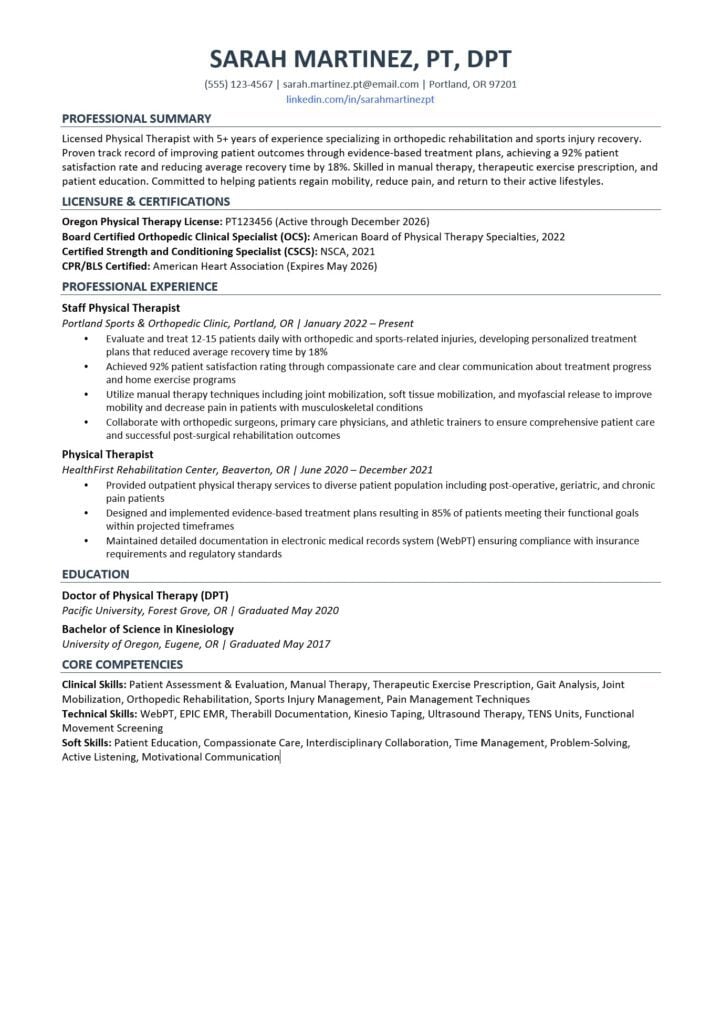
Here’s a professional physical therapist resume template you can download and customize. This template is designed to be both visually appealing and ATS-friendly, with clean formatting that highlights your strengths.
Blank Customizable Template
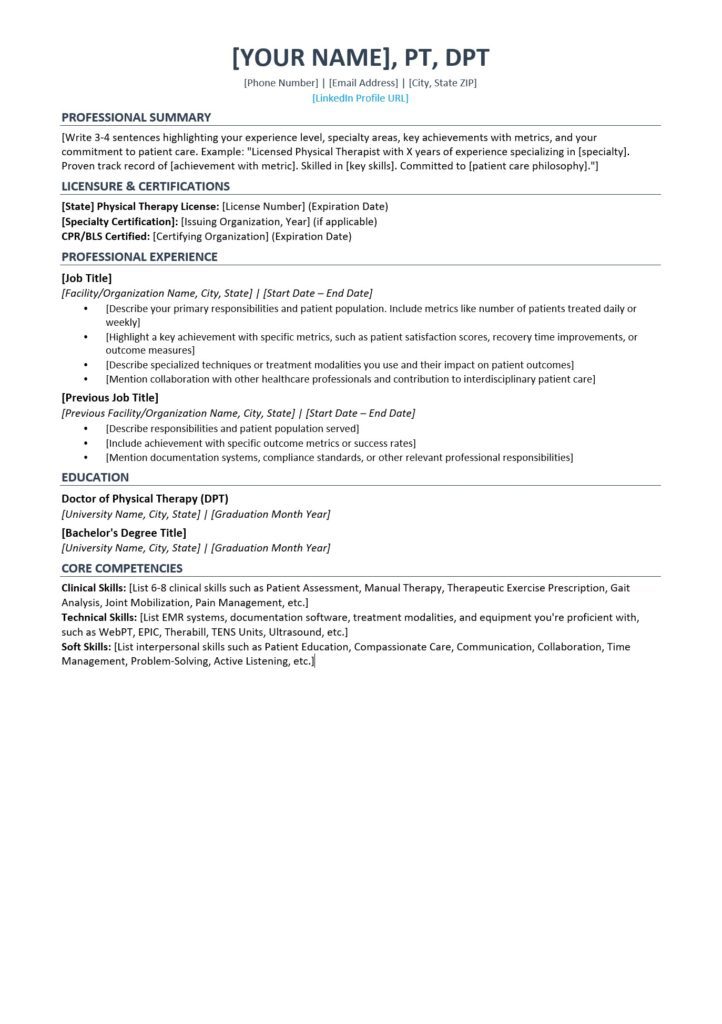
Download Your Free Template:
- Download DOCX Template (fully editable in Microsoft Word)
Interview Guys Tip: The DOCX template is fully editable, allowing you to adjust fonts, colors, and spacing to match your personal brand while maintaining professional formatting. Just replace the placeholder text with your own information.
Here’s what most people don’t realize: employers now expect multiple technical competencies, not just one specialization. The days of being “just a marketer” or “just an analyst” are over. You need AI skills, project management, data literacy, and more. Building that skill stack one $49 course at a time is expensive and slow. That’s why unlimited access makes sense:
Your Resume Needs Multiple Certificates. Here’s How to Get Them All…
We recommend Coursera Plus because it gives you unlimited access to 7,000+ courses and certificates from Google, IBM, Meta, and top universities. Build AI, data, marketing, and management skills for one annual fee. Free trial to start, and you can complete multiple certificates while others finish one.
Essential Components of a Physical Therapist Resume
Every strong PT resume needs these core sections in the right order. The sequence matters because it guides hiring managers through your qualifications in a logical flow.
Contact Information & Professional Title
Start with your full name in a larger, bold font, followed by your credentials (PT, DPT). Include your phone number, professional email address, city and state, and LinkedIn profile URL. Skip your full street address since it’s unnecessary and takes up valuable space.
Professional Summary
This 3-4 sentence section sits just below your contact information and serves as your elevator pitch. It should highlight your years of experience, specialty areas, key achievements with metrics, and your approach to patient care. Think of it as the preview that makes hiring managers want to read your entire resume.
Licensure & Certifications
Create a dedicated section for your PT license, specialty certifications like Board Certification in Orthopedic Physical Therapy (OCS), and CPR/BLS certification. Include license numbers and expiration dates to make verification easy for hiring managers.
Professional Experience
This is your resume’s powerhouse section. List your positions in reverse chronological order, including job title, facility name, location, and dates of employment. Under each position, use 3-5 bullet points that emphasize achievements and outcomes rather than just listing duties.
Education
Physical therapists must have their Doctor of Physical Therapy degree, often preceded by a bachelor’s in biology, kinesiology, or a related field. List your DPT first, followed by your undergraduate degree. Include the institution name, location, and graduation date.
Core Competencies
End with a skills section organized into categories: clinical skills, technical skills, and soft skills. This section serves double duty by incorporating keywords for ATS systems while showcasing your well-rounded capabilities to human readers.
How to Write a Compelling Professional Summary
Your professional summary is prime real estate at the top of your resume. Use it wisely.
Start by stating your experience level and specialty. Are you a “Licensed Physical Therapist with 5+ years specializing in orthopedic rehabilitation”? Or perhaps a “Compassionate new graduate PT with extensive clinical rotations in pediatric and geriatric care”?
Next, include a specific achievement that demonstrates your impact. This should always include a metric. For example: “Achieved 92% patient satisfaction rating” or “Reduced average recovery time by 18% through evidence-based treatment protocols.”
Then mention your key skills or areas of expertise. What treatment modalities do you excel at? Manual therapy? Sports rehabilitation? Neurology?
Finally, close with a statement about your professional philosophy or what drives you. This human element helps you connect with hiring managers on a deeper level.
Here’s what this looks like in action: “Licensed Physical Therapist with 5+ years of experience specializing in orthopedic rehabilitation and sports injury recovery. Proven track record of improving patient outcomes through evidence-based treatment plans, achieving a 92% patient satisfaction rate and reducing average recovery time by 18%. Skilled in manual therapy, therapeutic exercise prescription, and patient education. Committed to helping patients regain mobility, reduce pain, and return to their active lifestyles.”
Interview Guys Tip: Tailor your professional summary for each job application by incorporating keywords from the job description. If the posting emphasizes “geriatric care” or “outpatient rehabilitation,” work those specific terms into your summary to show you’re a perfect match.
Showcasing Your Professional Experience with Impact
This is where most PT resumes fail. They list duties instead of demonstrating impact.
- The mistake: “Responsible for treating patients with various orthopedic conditions.”
- The fix: “Evaluated and treated 12-15 patients daily with orthopedic and sports-related injuries, developing personalized treatment plans that reduced average recovery time by 18%.”
See the difference? The second version includes specific numbers (12-15 patients), identifies the patient population (orthopedic and sports injuries), describes what you did (developed personalized treatment plans), and most importantly, shows the result (reduced recovery time by 18%).
Every bullet point in your experience section should follow the action-result formula. Start with a strong action verb, describe what you did, and whenever possible, quantify the outcome.
Strong action verbs for PT resumes include: evaluated, developed, implemented, collaborated, designed, achieved, reduced, improved, educated, coordinated, and administered.
Here are examples of metrics you can incorporate:
- Number of patients treated daily or weekly
- Patient satisfaction scores or ratings
- Percentage of patients meeting functional goals within projected timeframes
- Reduction in recovery time or number of sessions needed
- Improvements in pain scores or mobility measurements
- Success rates for specific treatment protocols
- Home exercise program compliance rates
Don’t have perfect data for all your achievements? That’s okay. Use estimates based on your experience. “Treated approximately 200+ patients annually” is more compelling than no metric at all.
Remember to mention specific treatment modalities and specialized techniques you use. Hiring managers want to know you’re proficient in manual therapy techniques like joint mobilization, soft tissue mobilization, myofascial release, and gait training.
Highlighting Your Licensure & Certifications
Your PT license is your ticket to practice, and specialty certifications set you apart from other candidates. These credentials deserve prominent placement on your resume.
Create a dedicated “Licensure & Certifications” section positioned right after your professional summary or immediately after your experience section. This placement ensures hiring managers see your qualifications early in their review.
For your PT license, include:
- State where you’re licensed
- License number
- Expiration date or “Active through [date]”
For specialty certifications, include:
- Full certification name (spell it out, don’t just use acronyms)
- Issuing organization
- Year obtained
- Expiration date if applicable
Popular specialty certifications for physical therapists include Board Certification in Orthopedic Physical Therapy (OCS), Board Certification in Sports Physical Therapy (SCS), Board Certification in Neurologic Physical Therapy (NCS), and Certified Strength and Conditioning Specialist (CSCS).
Don’t forget your CPR/BLS certification. While it might seem basic, it’s a requirement for PT practice, and hiring managers specifically look for it.
If you have multiple state licenses, list them all. Many healthcare systems operate across state lines, and multi-state licensure makes you a more attractive candidate. According to recent workforce data, there are over 600,000 practicing physical therapists in the United States, so anything that differentiates you strengthens your candidacy.
Creating an ATS-Friendly Skills Section
Your skills section serves two critical purposes: it helps you pass ATS screening and shows hiring managers your capabilities at a glance.
Organize your skills into three categories for maximum impact:
- Clinical Skills include patient assessment and evaluation, manual therapy techniques, therapeutic exercise prescription, gait analysis and training, joint mobilization, orthopedic rehabilitation, sports injury management, neurological rehabilitation, pediatric or geriatric therapy (if applicable), and pain management techniques.
- Technical Skills cover the systems and equipment you use. List specific EMR platforms like WebPT, EPIC, Therabill, or Prompt. Mention treatment modalities like ultrasound therapy, TENS units, iontophoresis, kinesio taping, or functional movement screening. If you have experience with telehealth platforms, include those as well since 78% of healthcare facilities want PTs with hybrid care experience.
- Soft Skills demonstrate your ability to work effectively with patients and healthcare teams. Include patient education, compassionate care, interdisciplinary collaboration, time management, problem-solving, active listening, motivational communication, and cultural competence.
The key to an effective skills section is matching your listed skills to the job description. Read the posting carefully and incorporate the exact terminology they use. If they mention “evidence-based practice,” use that exact phrase. If they want “experience with post-operative rehabilitation,” include those specific words.
This strategy helps you pass ATS screening while also showing hiring managers that you speak their language and understand their needs. For more tips on presenting your abilities effectively, check out our guide on how to list skills on a resume.
Interview Guys Tip: Before you submit another application, run your resume through an ATS scanner. Most job seekers skip this step and wonder why they never hear back. Check out the free ATS checker we use and recommend →
Common Mistakes to Avoid
Even experienced PTs make resume mistakes that cost them interviews. Here are the biggest pitfalls and how to sidestep them.
- Listing duties instead of achievements. Your resume should show what you accomplished, not just what your job description said you were “responsible for.” Every bullet point should demonstrate value you brought to your patients, your facility, or your team.
- Using generic descriptions that could apply to any PT. Specificity sells. Don’t say you “worked with various patient populations.” Instead, specify: “Treated diverse patient population including post-operative orthopedic cases, chronic pain patients, and athletes recovering from sports injuries.”
- Failing to quantify your impact. Numbers provide context and proof. Without metrics, hiring managers have no way to gauge your effectiveness compared to other candidates.
- Including outdated or irrelevant information. Your high school job as a lifeguard doesn’t belong on your professional PT resume (unless you’re a new graduate with limited experience). Focus on relevant clinical experience and healthcare positions.
- Using inconsistent formatting. Inconsistent fonts, spacing, bullet points, or date formats look unprofessional and suggest a lack of attention to detail. This quality matters in healthcare where precision is critical.
- Forgetting to customize for each application. A generic, one-size-fits-all resume rarely performs as well as one tailored to the specific position. Take 10 minutes to adjust your professional summary and skills section to match each job posting.
- Submitting a cluttered or hard-to-read resume. White space is your friend. Use it to create visual breaks between sections. Stick to one or two professional fonts like Calibri or Arial. Keep your resume to one page if you have less than 10 years of experience, or a maximum of two pages for extensive careers.
Optimizing Your Resume for Applicant Tracking Systems
Understanding how ATS works is essential for physical therapists in 2025. These systems scan your resume for keywords, qualifications, and formatting before a human ever sees it.
- Use standard section headings that ATS recognizes. Stick with conventional labels like “Professional Experience,” “Education,” “Licensure & Certifications,” and “Skills.” Creative headings like “My Journey” or “Where I’ve Made an Impact” confuse ATS systems.
- Incorporate keywords naturally throughout your resume. Pull these directly from the job description. If the posting mentions “post-operative rehabilitation,” “manual therapy techniques,” or “interdisciplinary collaboration,” work those exact phrases into your resume where truthfully applicable.
- Save your resume as a .docx or PDF file. These formats preserve your formatting while remaining ATS-readable. Avoid uncommon file types that might cause parsing errors.
- Use a clean, simple format without tables, text boxes, or graphics. While creative designs look nice to human eyes, they confuse ATS systems and can cause important information to be misread or completely missed.
- Spell out acronyms on first use, then use the acronym thereafter. For example: “Doctor of Physical Therapy (DPT)” or “Electronic Medical Records (EMR).” This ensures the ATS recognizes both the full term and the abbreviated version.
- Include relevant certifications with their full names. Don’t just write “OCS.” Write “Board Certified Orthopedic Clinical Specialist (OCS).” The ATS is programmed to scan for both versions.
For more strategies on beating ATS systems, explore our article on ATS resume optimization.
Frequently Asked Questions About Physical Therapist Resumes
How long should my physical therapist resume be?
One page for new graduates and PTs with less than 10 years of experience. Two pages maximum for seasoned therapists with extensive experience, specialized certifications, and significant accomplishments. Hiring managers appreciate conciseness, so include only your most relevant and impressive information.
Should I include my clinical rotations on my PT resume?
Yes, if you’re a new graduate. Clinical rotations demonstrate your hands-on experience with different patient populations and treatment settings. However, once you have several years of professional experience, you can remove clinical rotations to make room for your paid positions.
Do I need to include my GPA?
Only if you’re a recent graduate and your GPA is 3.5 or higher. After you’ve been in the workforce for a couple of years, your GPA becomes less relevant than your actual clinical performance and patient outcomes.
What if I’m changing specialties within physical therapy?
Emphasize your transferable skills and any relevant experience you have in the new specialty area. If you’re moving from orthopedics to pediatrics, highlight any pediatric patients you’ve treated, relevant continuing education courses, or volunteer experience with children.
Should I list every job I’ve ever had?
No. Focus on positions relevant to physical therapy and healthcare. If you worked retail or food service during college, those positions generally don’t add value to your PT resume unless you’re a new graduate with very limited healthcare experience.
Taking the Next Step in Your PT Career
You now have all the tools you need to create a resume that showcases your clinical expertise, highlights your patient outcomes, and gets you noticed by hiring managers in this competitive field.
Remember, the physical therapy job market is growing rapidly. The Bureau of Labor Statistics projects 14% employment growth for physical therapists between 2023 and 2033, creating approximately 13,600 new jobs annually. This growth means opportunity, but it also means competition. Your resume needs to demonstrate why you’re the best candidate for the position.
Download our free physical therapist resume templates to get started today. We’ve designed both an example resume showing you what a strong PT resume looks like, and a blank template you can customize with your own information.
Once you’ve crafted your resume and landed that interview, make sure you’re prepared to impress. Check out our guide on physical therapist interview questions and answers to ace your interview and land the job.
Looking for more resume templates for different healthcare roles? Browse our complete free resume templates library to find the perfect format for your career goals.
Your next great PT opportunity is waiting. Now go get it.
Here’s what most people don’t realize: employers now expect multiple technical competencies, not just one specialization. The days of being “just a marketer” or “just an analyst” are over. You need AI skills, project management, data literacy, and more. Building that skill stack one $49 course at a time is expensive and slow. That’s why unlimited access makes sense:
Your Resume Needs Multiple Certificates. Here’s How to Get Them All…
We recommend Coursera Plus because it gives you unlimited access to 7,000+ courses and certificates from Google, IBM, Meta, and top universities. Build AI, data, marketing, and management skills for one annual fee. Free trial to start, and you can complete multiple certificates while others finish one.

BY THE INTERVIEW GUYS (JEFF GILLIS & MIKE SIMPSON)
Mike Simpson: The authoritative voice on job interviews and careers, providing practical advice to job seekers around the world for over 12 years.
Jeff Gillis: The technical expert behind The Interview Guys, developing innovative tools and conducting deep research on hiring trends and the job market as a whole.