
Free Pharmacist Resume Template 2025: ATS Friendly Examples & Writing Guide
Landing a pharmacist position in today’s competitive healthcare landscape requires more than just stellar credentials. You need a resume that showcases your clinical expertise, patient care philosophy, and technical proficiency in a format that both ATS systems and hiring managers can quickly digest.
The challenge? Most pharmacist resumes make critical formatting mistakes that get them filtered out before a human even sees them. They bury important licensure information, fail to quantify achievements, or use generic language that doesn’t reflect the specialized nature of pharmaceutical care.
That’s exactly why we created this comprehensive guide and free downloadable resume template. By the end of this article, you’ll have everything you need to build a pharmacist resume that highlights your unique value proposition, passes ATS screening, and positions you as the ideal candidate for your target role.
Early in your job search, you’ll also want to check out our guide on preparing for interviews to complement your strong application materials.
☑️ Key Takeaways
- Pharmacist resumes must prioritize licenses and certifications prominently, as state licensure and NAPLEX credentials are non-negotiable requirements for every position
- Quantifying your impact with metrics like prescription volume, accuracy rates, and patient outcomes makes your accomplishments tangible and memorable to hiring managers
- ATS optimization requires strategic keyword placement from job descriptions, including pharmacy software systems, clinical specializations, and technical competencies
- The right resume structure places clinical experience before retail when targeting hospital positions, but reverses the order for community pharmacy roles
What Makes a Pharmacist Resume Different from Other Healthcare Resumes
Pharmacist resumes require a unique approach compared to other healthcare positions. Your licensure status isn’t just important, it’s legally required for you to practice, making it essential to feature this information prominently rather than burying it at the bottom of your resume.
The pharmaceutical profession demands dual expertise. You need to demonstrate both your clinical knowledge and your operational capabilities. Hospital hiring managers want to see evidence of your medication therapy management skills and ability to collaborate with physicians. Retail pharmacy directors need proof you can manage high prescription volumes while maintaining exceptional accuracy and customer service.
According to the Bureau of Labor Statistics, the median annual wage for pharmacists reached $137,480 in 2024. With compensation at this level, employers expect resumes that reflect advanced professional capabilities and specialized training.
Interview Guys Tip: Unlike nursing or physician assistant resumes, pharmacist resumes should lead with your Doctor of Pharmacy degree and license number in most cases. This immediately establishes your credentials and saves recruiters valuable time verifying your eligibility.
Pharmacist Resume Example
Here’s a professional pharmacist resume example. This example gives you an idea of what type of content fits in a good ATS friendly resume.
Example Resume:
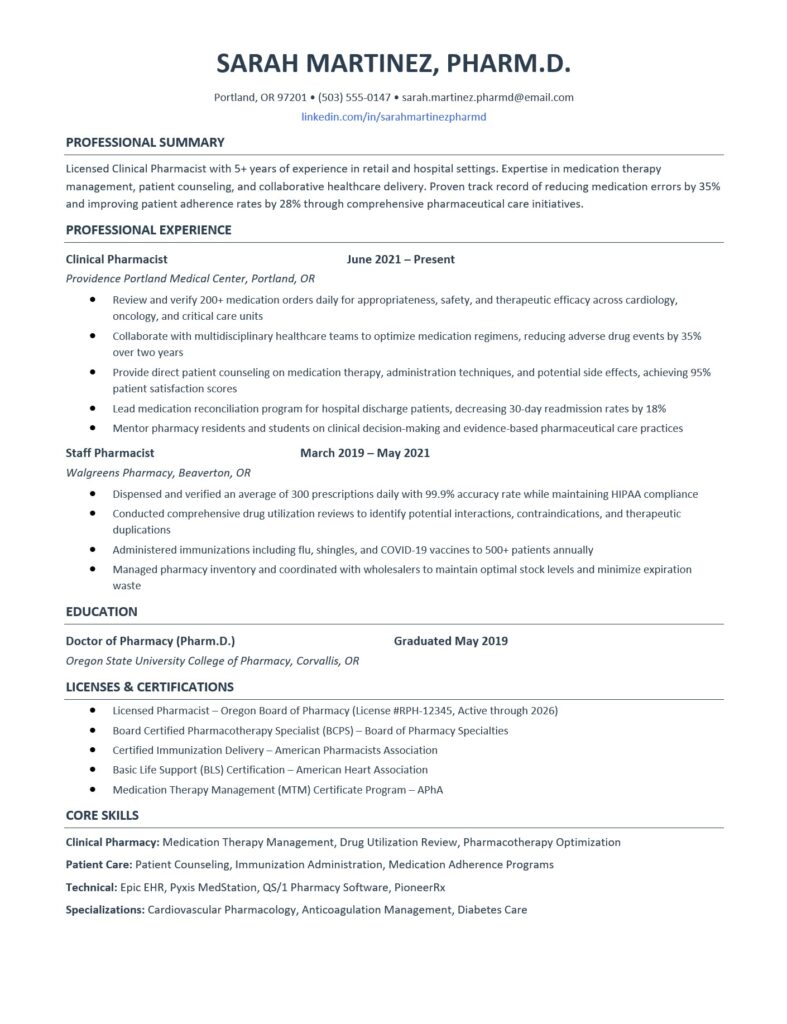
Here’s a professional pharmacist resume template you can download and customize. This template is designed to be both visually appealing and ATS-friendly, with clean formatting that highlights your strengths.
Blank Customizable Template

Download Your Free Template:
- Download DOCX Template (fully editable in Microsoft Word)
Interview Guys Tip: The DOCX template is fully editable, allowing you to adjust fonts, colors, and spacing to match your personal brand while maintaining professional formatting. Just replace the placeholder text with your own information.
Here’s what most people don’t realize: employers now expect multiple technical competencies, not just one specialization. The days of being “just a marketer” or “just an analyst” are over. You need AI skills, project management, data literacy, and more. Building that skill stack one $49 course at a time is expensive and slow. That’s why unlimited access makes sense:
Your Resume Needs Multiple Certificates. Here’s How to Get Them All…
We recommend Coursera Plus because it gives you unlimited access to 7,000+ courses and certificates from Google, IBM, Meta, and top universities. Build AI, data, marketing, and management skills for one annual fee. Free trial to start, and you can complete multiple certificates while others finish one.
Essential Components Every Pharmacist Resume Must Include
Professional Summary That Showcases Clinical Impact
Your professional summary is prime real estate. In 3-4 concise sentences, you need to communicate your experience level, clinical specializations, and most impressive achievements. Skip generic phrases like “hardworking” or “team player” and instead focus on quantifiable outcomes.
A strong pharmacist summary might read: “Board Certified Clinical Pharmacist with 7+ years optimizing medication therapies across critical care and cardiology units. Reduced adverse drug events by 42% through comprehensive clinical interventions and collaborative care protocols. Expertise in anticoagulation management, pharmacogenomics, and multidisciplinary healthcare delivery.”
Experience Section Built on Measurable Achievements
The experience section separates exceptional resumes from average ones. Instead of listing duties, demonstrate impact through specific metrics like prescriptions verified, error reduction percentages, patient satisfaction scores, or readmission rate improvements.
Strong pharmacist bullets include numbers wherever possible. Rather than writing “Dispensed medications and counseled patients,” transform it into “Dispensed and verified 250+ prescriptions daily with 99.8% accuracy rate while providing comprehensive medication counseling to 50+ patients weekly.”
For those transitioning between pharmacy settings, our guide on career change strategies offers valuable insights on reframing your transferable skills.
Licenses, Certifications, and Continuing Education
This section deserves its own dedicated heading on a pharmacist resume. State your license type, state of licensure, license number, and expiration date clearly. Many applicant tracking systems specifically scan for this information, and human reviewers need to verify it immediately.
Beyond your basic pharmacy license, specialty certifications significantly strengthen your candidacy. The Board Certified Pharmacotherapy Specialist (BCPS) credential, Certified Diabetes Care and Education Specialist (CDCES), and immunization certifications from the American Pharmacists Association are highly valued across practice settings.
Continuing education demonstrates your commitment to staying current in a rapidly evolving field. If you’ve completed specialized training in areas like oncology pharmacy, ambulatory care, or medication therapy management, include these certifications prominently.
How to Write Each Section for Maximum Impact
Crafting Your Contact Information and Header
Keep your header clean and professional. Include your name with your Pharm.D. credential, phone number, professional email address, city and state, and LinkedIn profile URL. Skip your full street address as it’s outdated and takes up valuable space.
Your email should be simple and professional. Use some variation of your name rather than quirky usernames. If you’re licensed in multiple states, you can note this in your professional summary rather than cluttering your header.
Building Your Professional Experience Chronology
List your positions in reverse chronological order, starting with your current or most recent role. For each position, include your job title, employer name, location, and employment dates. Format dates consistently using either “Month Year” or “MM/YYYY” format throughout.
Within each role, focus your bullets on achievements rather than responsibilities. Use strong action verbs like “optimized,” “implemented,” “reduced,” “collaborated,” “managed,” and “led.” Begin with your most impressive accomplishment for each position to hook the reader’s attention immediately.
Interview Guys Tip: If you’re applying for clinical pharmacy roles, emphasize your experience with medication therapy management, clinical interventions, and collaborative practice. For retail positions, highlight prescription volume management, patient counseling, immunization administration, and inventory control.
Showcasing Your Education and Academic Credentials
Your Doctor of Pharmacy degree should appear prominently, typically after your professional experience section unless you’re a new graduate. Include your degree title, university name, location, and graduation date. Recent graduates can include honors, relevant coursework, or research projects, but experienced pharmacists should focus on professional accomplishments instead.
If you completed pharmacy residencies or fellowships, create a separate section highlighting these experiences. Pharmacy residencies demonstrate specialized training and dedication to clinical practice, making them particularly valuable for hospital-based positions.
Selecting and Presenting Core Skills
Your skills section should balance technical competencies with soft skills essential to pharmaceutical care. Include both general pharmacy capabilities and specialized knowledge areas relevant to your target positions.
Clinical skills might encompass medication therapy management, drug utilization review, pharmacotherapy optimization, and therapeutic drug monitoring. Patient care abilities include counseling, immunization administration, and medication adherence programs. Technical proficiencies cover pharmacy management systems like Epic, Pyxis, QS/1, or PioneerRx.
For more insights on effectively showcasing your capabilities, explore our detailed guide on how to list skills on a resume.
Common Resume Mistakes Pharmacists Must Avoid
Failing to Tailor Your Resume to the Specific Position
One of the biggest mistakes pharmacists make is sending the same generic resume to every position. Hospital pharmacist roles require different emphasis than retail positions, and specialty pharmacy demands unique qualifications. Read each job description carefully and mirror the language used in your application materials.
If a posting emphasizes “collaborative practice agreements” and “antimicrobial stewardship,” these exact phrases should appear in your resume where applicable. When positions prioritize “patient counseling” and “prescription accuracy,” make these elements prominent in your experience bullets.
Neglecting to Quantify Your Contributions
Pharmacists work with numbers all day, yet many forget to include them on their resumes. Metrics provide concrete evidence of your capabilities and make your achievements memorable. Instead of vague statements, use specific data points.
Transform “Managed pharmacy operations” into “Managed pharmacy operations including inventory control for 5,000+ SKUs, reducing expired medication waste by $15,000 annually.” Change “Provided immunizations to patients” to “Administered 800+ immunizations including COVID-19, flu, and shingles vaccines with 98% patient satisfaction rating.”
Using Outdated or Overcomplicated Formatting
ATS systems struggle with tables, text boxes, graphics, headers, footers, and unconventional fonts. Stick with clean, simple formatting using standard fonts like Calibri, Arial, or Times New Roman. Use conventional section headings that ATS can easily identify: Professional Experience, Education, Licenses & Certifications, Skills.
Avoid creative section names like “Where I’ve Made an Impact” or “My Journey.” While these might seem engaging, they confuse applicant tracking systems and make your resume harder to scan quickly.
Omitting Software and Technology Proficiencies
Modern pharmacy practice relies heavily on technology, yet many pharmacists fail to highlight their software expertise. List the specific pharmacy management systems, electronic health records platforms, and clinical decision support tools you’ve used.
Mention experience with systems like Epic EHR, Pyxis MedStation, QS/1, PioneerRx, Pharmacy OneSource, or Omnicell. If you’ve worked with specialized software for compounding calculations, immunization registries, or medication therapy management documentation, include these as well.
ATS Optimization and Keywords That Get Results
Understanding How Pharmacy ATS Systems Work
Applicant tracking systems scan your resume for keywords that match the job description. For pharmacist positions, these typically include license types, pharmacy software names, clinical specializations, and specific technical competencies. The more relevant keywords your resume contains, the higher it scores in the ATS ranking.
Modern ATS technology has become more sophisticated, using contextual analysis rather than simple keyword matching. This means you should use keywords naturally within your experience bullets rather than stuffing them awkwardly into a skills section.
Strategic Keyword Placement Throughout Your Resume
The most effective approach is reading the job posting carefully and identifying 10-15 essential keywords, then incorporating them authentically throughout your resume. Place the most critical keywords in multiple sections including your professional summary, experience bullets, and skills section.
For example, if a position emphasizes “medication therapy management,” use this exact phrase in your professional summary, include it in at least one experience bullet with specific outcomes, and list it in your skills section. This repetition without redundancy reinforces your qualifications.
Balancing ATS Requirements with Human Readability
While optimizing for ATS is crucial, remember that humans ultimately make hiring decisions. Your resume needs to satisfy both algorithmic scanning and human readers. Use clear, compelling language that demonstrates your value proposition while incorporating necessary keywords naturally.
For guidance on creating application materials that resonate with human reviewers, check out our article on how to write a cover letter that complements your optimized resume.
Interview Guys Tip: Before you submit another application, run your resume through an ATS scanner. Most job seekers skip this step and wonder why they never hear back. Check out the free ATS checker we use and recommend →
Frequently Asked Questions
Should I include my pharmacy license number on my resume?
Yes, absolutely. Including your license number saves hiring managers time and immediately verifies your credentials. Format it clearly: “Licensed Pharmacist – Oregon Board of Pharmacy (License #RPH-12345, Active through 2026).” This information is public record and demonstrates transparency.
How far back should my work history go on a pharmacist resume?
Generally, include the last 10-15 years of relevant experience. If you have decades of experience, focus on the most recent and most relevant positions. Earlier career roles can be summarized briefly or omitted entirely unless they demonstrate unique skills or specializations relevant to your target position.
Is it better to use a functional or chronological resume format for pharmacists?
Chronological format is strongly preferred for pharmacist resumes. Healthcare hiring managers want to see a clear progression of your experience, and ATS systems handle chronological formats most effectively. Functional formats often raise red flags about employment gaps or lack of progression.
Should I include GPA on my pharmacist resume?
Only if you’re a recent graduate with a GPA of 3.5 or higher. Once you have 2-3 years of professional experience, remove your GPA and let your work achievements speak for themselves. Experienced pharmacists should focus resume space on clinical accomplishments rather than academic performance.
How do I address employment gaps on my pharmacist resume?
Be honest and strategic. If you took time off for family care, professional development, or health reasons, you can briefly note this in your cover letter. On your resume, consider using years only rather than months for dates if gaps are minimal. Focus on skills maintained or developed during breaks, such as continuing education courses or volunteer work.
Take the Next Step in Your Pharmacist Career
Creating a standout pharmacist resume doesn’t have to be overwhelming. With the templates and strategies in this guide, you have everything needed to build application materials that showcase your clinical expertise, patient care philosophy, and professional achievements effectively.
Remember these key principles as you craft your resume: prioritize your licensure and certifications prominently, quantify your achievements with specific metrics, optimize for ATS with strategic keyword placement, and tailor your content to each position’s unique requirements.
Download our free pharmacist resume templates to get started immediately with professionally formatted documents that follow industry best practices. Then customize them with your unique experiences, skills, and accomplishments to create a compelling narrative of your pharmaceutical career.
For additional resume templates across various healthcare specializations, browse our free resume template library with dozens of professionally designed options.
Once your resume is ready, prepare for the interview stage by reviewing common pharmacist interview questions and answers to ensure you’re ready to showcase your expertise in person.
Your next great pharmacist opportunity is waiting. Make sure your resume opens the door.
Here’s what most people don’t realize: employers now expect multiple technical competencies, not just one specialization. The days of being “just a marketer” or “just an analyst” are over. You need AI skills, project management, data literacy, and more. Building that skill stack one $49 course at a time is expensive and slow. That’s why unlimited access makes sense:
Your Resume Needs Multiple Certificates. Here’s How to Get Them All…
We recommend Coursera Plus because it gives you unlimited access to 7,000+ courses and certificates from Google, IBM, Meta, and top universities. Build AI, data, marketing, and management skills for one annual fee. Free trial to start, and you can complete multiple certificates while others finish one.

BY THE INTERVIEW GUYS (JEFF GILLIS & MIKE SIMPSON)
Mike Simpson: The authoritative voice on job interviews and careers, providing practical advice to job seekers around the world for over 12 years.
Jeff Gillis: The technical expert behind The Interview Guys, developing innovative tools and conducting deep research on hiring trends and the job market as a whole.