
Free Line Cook Resume Template: ATS Examples & Writing Guide 2026
Why Your Line Cook Resume Matters More Than Ever
The restaurant industry is booming. According to the Bureau of Labor Statistics, cook employment is projected to grow 5% from 2024 to 2034, with approximately 432,200 job openings each year. That means fierce competition for the best kitchen positions.
Here’s the challenge: most line cook resumes look exactly the same. Generic descriptions of “food preparation” and “working in fast-paced environments” won’t cut it when a restaurant manager has 50 applications on their desk. You need a resume that showcases your specific skills, your station expertise, and your measurable contributions to past kitchens.
The good news? We’ve created a free line cook resume template designed specifically for culinary professionals. Whether you’re a seasoned grill cook looking to move into fine dining or a prep cook ready to step up to the line, this template will help you present your experience in the most compelling way possible.
By the end of this article, you’ll know exactly how to structure your line cook resume, what skills hiring managers actually look for, and how to avoid the common mistakes that get applications tossed in the reject pile. Let’s get cooking.
☑️ Key Takeaways
- Over 432,000 cook positions open each year according to the Bureau of Labor Statistics, making a standout resume essential for getting noticed
- Lead with your strongest cooking stations like grill, sauté, or fry in your summary to immediately show hiring managers your value
- Include quantifiable achievements such as reduced ticket times or decreased food waste to prove your impact in the kitchen
- ServSafe and food safety certifications belong in a dedicated section since 59% of restaurant operators struggle to fill cook positions
What Makes a Line Cook Resume Different?
Line cook resumes require a unique approach compared to other professions. Restaurant managers aren’t looking for corporate jargon or vague descriptions. They want proof that you can handle the heat, literally and figuratively.
Station expertise matters. Unlike many jobs where your title tells the story, line cooks are defined by which stations they can manage. A grill cook who can also handle sauté is more valuable than someone limited to a single station. Your resume needs to make your range crystal clear.
Speed and volume speak volumes. The restaurant industry runs on efficiency. If you’ve prepared 150 covers during a Saturday dinner rush, that number belongs on your resume. Hiring managers understand kitchen metrics, so give them concrete data they can visualize.
Certifications carry weight. Food safety isn’t optional in professional kitchens. The National Restaurant Association reports that restaurants added nearly 68,000 jobs in the third quarter alone, but finding qualified candidates remains difficult. A ServSafe certification or food handler’s permit immediately separates you from untrained applicants.
When you understand how to list certifications on a resume properly, you signal professionalism before the interview even begins.
Line Cook Resume Example
Here’s a professional line cook resume example. This example gives you an idea of what type of content fits in a good ATS friendly resume.
Example Resume:

Here’s a professional line cook resume template you can download and customize. This template is designed to be both visually appealing and ATS-friendly, with clean formatting that highlights your strengths.
Blank Customizable Template
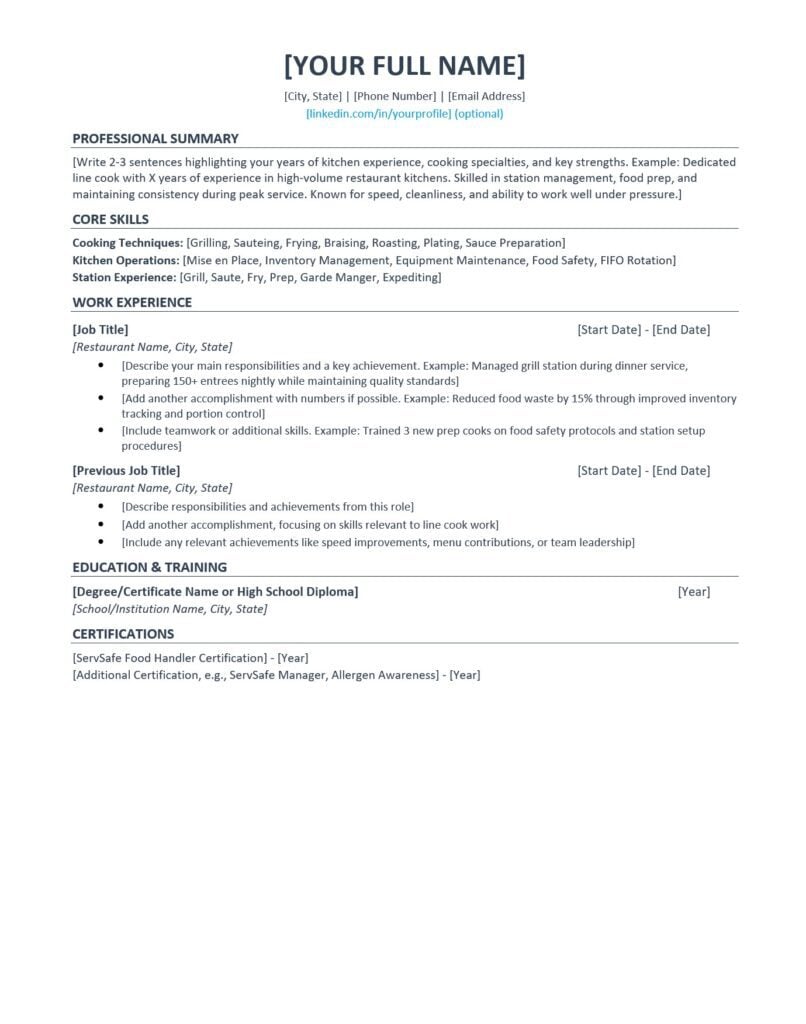
Download Your Free Template:
- Download DOCX Template (fully editable in Microsoft Word)
Interview Guys Tip: The DOCX template is fully editable, allowing you to adjust fonts, colors, and spacing to match your personal brand while maintaining professional formatting. Just replace the placeholder text with your own information.
Here’s what most people don’t realize: employers now expect multiple technical competencies, not just one specialization. The days of being “just a marketer” or “just an analyst” are over. You need AI skills, project management, data literacy, and more. Building that skill stack one $49 course at a time is expensive and slow. That’s why unlimited access makes sense:
Your Resume Needs Multiple Certificates. Here’s How to Get Them All…
We recommend Coursera Plus because it gives you unlimited access to 7,000+ courses and certificates from Google, IBM, Meta, and top universities. Build AI, data, marketing, and management skills for one annual fee. Free trial to start, and you can complete multiple certificates while others finish one.
Essential Components of a Winning Line Cook Resume
Your line cook resume should include these key sections in the following order:
Contact Information
Keep it simple but complete. Include your name, city and state (full address isn’t necessary), phone number, email, and LinkedIn profile if you have one. Use a professional email address that includes your name.
Professional Summary
This is your elevator pitch. In two to three sentences, highlight your years of experience, your strongest stations, a notable achievement, and relevant certifications. Think of it as answering the question “Why should I hire you?” before they even ask.
Core Skills
Organize your culinary and operational skills into easy-to-scan categories. Hiring managers often skim resumes in under 30 seconds, so make your capabilities immediately visible. Strong resume action verbs will help your skills pop off the page.
Professional Experience
List your most recent positions first, including the restaurant name, location, your title, and dates of employment. Under each role, include three to four bullet points describing your responsibilities and achievements. Focus on actions and results rather than job duties everyone already knows.
Education
Include any culinary degrees, certificates, or relevant training programs. If you’re newer to the industry, this section can come before experience. If you have years of kitchen work behind you, keep it brief and positioned after your work history.
Certifications
Create a dedicated section for your food safety credentials. ServSafe, food handler permits, and any specialized training belong here. This section is especially important for line cooks since health regulations require proper certification.
How to Write Each Section Like a Pro
Crafting Your Professional Summary
Your summary should hook the reader immediately. Avoid generic phrases like “hard worker” or “team player” without context. Instead, lead with specifics.
- Weak example: “Experienced line cook looking for a position where I can use my skills.”
- Strong example: “High-energy Line Cook with 4+ years of experience in high-volume restaurant kitchens. Skilled in grill, sauté, and fry station operations with expertise in food preparation and knife skills. Reduced ticket times by 15% through improved station organization. ServSafe certified.”
Notice the difference? The strong example quantifies experience, names specific stations, includes a measurable achievement, and mentions certification. That’s a summary that gets interviews.
Interview Guys Tip: Mirror the language from the job posting in your summary. If the restaurant mentions “high-volume” or “scratch kitchen” in their listing, include those exact phrases in your resume. This helps you pass both human review and ATS screening.
Listing Your Skills Effectively
Group your skills into logical categories rather than creating one long list. For line cooks, consider organizing them like this:
Culinary Techniques: Grill | Sauté | Frying | Sauce Preparation | Knife Skills | Food Plating
Kitchen Operations: Food Safety | Inventory Management | Recipe Execution | Time Management | Station Setup
This format makes your capabilities easy to scan and demonstrates both your cooking abilities and your understanding of kitchen operations. For more guidance on presenting your abilities effectively, check out our guide on how to list skills on a resume.
Making Your Experience Section Shine
Each bullet point in your experience section should follow this formula: Action Verb + Task + Result
Instead of writing “Responsible for cooking food,” try “Prepared 100+ entrees nightly across grill and sauté stations while maintaining quality standards and ticket times under 12 minutes.”
The Escoffier Global Culinary Industry Report notes that 59% of restaurant operators report difficulty hiring for chef and cook positions. Your experience section is where you prove you’re the solution to their staffing challenges.
Interview Guys Tip: Include at least one achievement in each job that shows initiative beyond basic job duties. Did you train new staff? Develop a prep system that reduced waste? Suggest a menu item that became a customer favorite? These details make you memorable.
The Education and Certification Balance
For line cooks, formal culinary education is valuable but not always required. The Bureau of Labor Statistics confirms that most cook positions require no formal education beyond a high school diploma, with skills learned through on-the-job training.
However, if you’ve completed culinary school or a certificate program, definitely include it. Format it like this:
Associate Degree in Culinary Arts Kendall College Culinary Arts, Chicago, IL | May 2021
If you’re working on a resume with no experience, your education section can highlight relevant coursework and any kitchen experience from training programs.
Common Mistakes That Kill Line Cook Resumes
Even experienced cooks make these errors that can cost them interviews:
- Forgetting to quantify achievements. “Cooked food during busy shifts” tells hiring managers nothing. “Managed grill station during 200-cover Saturday rushes with 97% positive plate return rate” demonstrates competence.
- Using the same resume for every application. Different restaurants value different things. Fine dining establishments want precision and presentation skills. High-volume casual spots need speed and consistency. Tailor your resume accordingly.
- Burying your best qualifications. Your most impressive credentials should appear in the first half of your resume. If you’ve worked at a notable restaurant or have specialized training, don’t hide it in a bottom section.
- Neglecting food safety credentials. Some hiring managers will immediately reject applications missing ServSafe or equivalent certification. Even if the job posting doesn’t list it as required, include your food safety training prominently.
- Including irrelevant work history. Your retail job from five years ago doesn’t belong on a line cook resume unless you can directly tie it to kitchen-relevant skills like inventory management or working under pressure.
ATS Optimization and Keywords for Kitchen Jobs
Most restaurants now use applicant tracking systems to filter resumes before human eyes ever see them. Understanding what ATS looks for in resumes can mean the difference between landing an interview and getting automatically rejected.
Use standard section headings. Stick with “Professional Experience” rather than creative alternatives like “Kitchen Journey” or “Culinary Adventures.” ATS software looks for conventional formatting.
Include keywords from the job posting. If the listing mentions “scratch cooking,” “banquet experience,” or “Italian cuisine,” work those exact phrases into your resume naturally. Don’t keyword stuff, but do ensure alignment with what they’re seeking.
Avoid graphics and tables. Fancy formatting often confuses ATS software. Use a clean, text-based layout with clear sections. Our downloadable template is designed to be both visually appealing and ATS-friendly.
List full names and acronyms. Write “ServSafe Food Handler Certification” rather than just “ServSafe” to ensure the system catches your credentials regardless of how it’s searching.
Preparing for What Comes Next
Once your resume lands you an interview, you’ll need to prove your skills in conversation. Restaurant interviews often include practical questions about how you’d handle kitchen scenarios.
Be ready to discuss your experience with specific stations, how you’ve handled difficult rushes, and examples of working effectively with kitchen teams. Our comprehensive guide to line cook interview questions and answers will help you prepare for the questions hiring managers actually ask.
Interview Guys Tip: When preparing interview stories about your kitchen experience, use the SOAR Method (Situation, Obstacle, Action, Result). This structure helps you deliver clear, compelling answers that demonstrate your problem-solving abilities in real kitchen situations.
Frequently Asked Questions
How long should a line cook resume be?
One page is ideal for most line cooks. Even with 10+ years of experience, you can highlight your most relevant positions and achievements on a single page. Hiring managers prefer concise resumes that quickly demonstrate your qualifications.
Should I include every restaurant I’ve worked at?
Focus on your last three to five relevant positions, or approximately the past 10 years of experience. Older positions can be summarized in a brief “Additional Experience” line if they add value. If you’ve worked at particularly prestigious establishments, include them even if they’re further back in your history.
What if I’m switching from prep cook to line cook?
Highlight any cross-training you’ve received, times you’ve covered line stations, and transferable skills like knife work, recipe execution, and time management. Your summary should acknowledge your prep background while emphasizing your readiness to step up.
Do I need to include references on my resume?
No. Remove “References available upon request” from your resume. It takes up valuable space, and hiring managers assume you’ll provide references when asked. Have a separate reference list ready to provide during the interview process.
How do I address employment gaps?
If you have gaps in your kitchen experience, be prepared to explain them briefly and positively in your cover letter or interview. Focus your resume on the experience you do have rather than drawing attention to gaps.
Putting It All Together
Creating a standout line cook resume requires more than listing your previous restaurants. You need to showcase your station expertise, quantify your contributions, and format everything in a way that passes both ATS systems and the quick scan of a busy hiring manager.
Download our free line cook resume template to get started with a professionally designed, ATS-friendly format that highlights what restaurants actually want to see. The example resume shows you exactly how to present your experience, while the blank template gives you the structure to fill in your own qualifications.
The restaurant industry continues to grow, with employment projected to add over 100,000 jobs in 2025 alone. With the right resume, you can position yourself for the best kitchen opportunities available.
For more resume templates across different industries and experience levels, explore our complete free resume template library and find the perfect starting point for your next career move.
Here’s what most people don’t realize: employers now expect multiple technical competencies, not just one specialization. The days of being “just a marketer” or “just an analyst” are over. You need AI skills, project management, data literacy, and more. Building that skill stack one $49 course at a time is expensive and slow. That’s why unlimited access makes sense:
Your Resume Needs Multiple Certificates. Here’s How to Get Them All…
We recommend Coursera Plus because it gives you unlimited access to 7,000+ courses and certificates from Google, IBM, Meta, and top universities. Build AI, data, marketing, and management skills for one annual fee. Free trial to start, and you can complete multiple certificates while others finish one.

BY THE INTERVIEW GUYS (JEFF GILLIS & MIKE SIMPSON)
Mike Simpson: The authoritative voice on job interviews and careers, providing practical advice to job seekers around the world for over 12 years.
Jeff Gillis: The technical expert behind The Interview Guys, developing innovative tools and conducting deep research on hiring trends and the job market as a whole.