
How to Predict Your Interview Questions From the Job Posting Alone (a Hiring Manager’s Script, Decoded)

Here’s a secret that changes how interview prep feels once you truly believe it: interviews are not unpredictable. They only feel that way from your side of the table.
From the other side, an interview is a tired, busy person trying to de-risk a decision. Your interviewer probably has a real job on top of hiring. They didn’t spend the weekend crafting exotic questions to trip you up. They skimmed the job posting, thought about what’s been painful on the team, and built their questions from those two things, sometimes in the fifteen minutes before you joined the call.
Which means the script for your interview is, to a surprising degree, sitting in public. It’s the job posting. You’ve read it five times already. You just haven’t read it the way an interviewer does.
We’ve spent over a decade teaching people how to answer interview questions. This article is about the skill that comes one step earlier and gets far less attention: figuring out which questions are coming, for this specific job, before anyone asks them. By the end you’ll be able to take any posting and pull eight to ten likely questions out of it, with reasons. And if you’d rather have that done for you, we’ll show you the tool we built that does exactly this. Fair warning: it’s ours.
Why the posting predicts the interview
A job posting isn’t marketing copy, or at least not only that. It’s the closest thing to the hiring manager’s actual wish list that you’ll ever see, because in most companies the posting was either written by the hiring manager or built from their bullet points.
Every line in it exists because of something. A requirement usually maps to a real gap on the team or a scar from a past hire who lacked it. A repeated theme maps to the thing keeping the manager up at night. Even the fluffy paragraph about the company’s values maps to a culture-fit question someone will be assigned to ask.
Interviewers then do the natural thing: they test the list. Not because they’re lazy, but because the posting is the agreed definition of the role, and their job in the interview is to find evidence you match it. When a panel splits up topics, they literally divide the posting’s sections among themselves.
So the prediction method is really a translation exercise: read each element of the posting and ask, “what question would a busy person write to test this?” Let’s build that skill piece by piece.
First, know the four kinds of questions
Nearly every interview question falls into one of four buckets, and each bucket gets triggered by different features of the posting. Knowing the buckets tells you not just what’s coming, but what shape your answer needs.
Behavioral questions (“Tell me about a time you…”) test whether you’ve actually done the thing before. They’re triggered by experience requirements and anything involving other humans: stakeholders, conflict, deadlines, leadership. These deserve most of your prep time, and they’re the reason we’ve written so much about behavioral interviews over the years.
Situational questions (“What would you do if…”) test judgment when you might lack the exact experience. They’re triggered by responsibilities that are new territory for most candidates, and they show up heavily when the role involves ambiguity or building something from scratch.
Technical questions test whether the skills on your resume are real. Every named tool, method or certification in the posting is a candidate. The more prominent its position in the requirements, the more likely you’ll be asked to walk through how you’ve used it.
Culture-fit questions test whether you’ll thrive in their particular environment. They’re triggered by the “about us” paragraph, the values list, and words like “fast-paced,” “collaborative” or “self-directed,” each of which is a question wearing a costume.
Keep these four buckets in mind. Now, the reading method.
The method: seven reads of one posting
Each of these takes a minute or two. Together they’ll usually surface more questions than the interview has time for, which is exactly the position you want to be in.
Read 1: Hunt for repetition
Print the posting or paste it somewhere you can mark it up, and highlight every skill or theme that appears more than once. Repetition is the loudest signal a posting can send. Nobody mentions stakeholder management in the summary, the responsibilities and the requirements by accident; that’s the pain point, and pain points get questions.
The rule of thumb: anything mentioned twice will probably come up. Anything mentioned three times is guaranteed question territory, and you should prepare two different stories for it, because it may come up twice from different interviewers.
Read 2: Translate every requirement into its question form
This is the core move. Go bullet by bullet through the requirements and responsibilities, and convert each one into the question a busy interviewer would write from it. The translation is nearly mechanical:
- “5+ years managing cross-functional projects” becomes “Tell me about a complex project you managed across teams.”
- “Experience presenting to senior leadership” becomes “Tell me about a time you had to influence executives” or “Walk me through how you’d present bad news upward.”
- “Comfortable with ambiguity” becomes “Describe a time you had to make progress without clear direction.”
- “Proficiency in SQL” becomes “Walk me through how you’ve used SQL in a real analysis,” possibly with a follow-up that tests whether you actually can.
- “Manage vendor relationships” becomes “Tell me about a difficult vendor situation and how you handled it.”
Notice the pattern: experience requirements become “tell me about a time.” Skills become “walk me through how.” Traits become “describe a situation where.” Run every bullet through that machine and you’ll have a dozen candidate questions in ten minutes.
Read 3: Listen to the verbs
Postings choose their verbs more carefully than people realize, and the verbs tell you the level and flavor of questioning.
“Own” and “drive” mean they want evidence of initiative without being asked, so expect questions about times you led without authority or rescued something drifting. “Support” and “assist” mean the role serves someone else’s agenda; expect questions about collaboration, flexibility and handling direction you disagree with. “Build” and “establish” mean nothing exists yet; expect situational questions about how you’d start from zero. “Optimize” and “scale” mean something exists and creaks; expect questions about diagnosing and improving what you inherit.
Read 4: Mine the company paragraph
The “about us” section and the values list feel like filler. They’re not; they’re the culture interview, pre-published. A company that calls itself “customer-obsessed” will ask you about a time you went out of your way for a customer. One that emphasizes “moving fast” will probe how you handle shifting priorities and imperfect information. A mission-driven organization will ask why you want to work there in particular, and will care about the answer more than most companies do.
Five extra minutes on the company’s actual site, especially any engineering blog, founder interview or annual report, sharpens this further. You’re not memorizing trivia; you’re learning which of their self-descriptions they take seriously.
Read 5: Adjust for level
The same posting content generates different questions at different levels, so calibrate.
For early-career roles, expect fundamentals and coachability: questions test whether you can do the tasks and whether you learn fast, and interviewers reach more for situational questions because they know your experience is thin. Mid-level roles get the heaviest dose of behavioral questions, because now you’re supposed to have the stories. Senior roles shift again: fewer “can you do the task” questions, far more about conflict, trade-offs, failure, developing others and influencing across the org. If you’re interviewing senior, prepare for “tell me about a time you were wrong” and “tell me about a decision that was unpopular” even if nothing in the posting mentions them, because at that level those questions are about the posting’s unstated requirement: judgment.
Read 6: Adjust for company type
Company context bends the question mix in predictable ways. A consulting or services firm will probe client-facing composure: expect questions about difficult clients, managing expectations and communicating across the full delivery lifecycle. A startup will probe ambiguity tolerance and range: expect “tell me about wearing multiple hats” and “how do you prioritize when everything is urgent.” A large enterprise will probe process and stakeholder navigation: expect questions about working within constraints, compliance and getting things done across silos. Government and education roles often add structured, rubric-scored behavioral questions, so precise, complete stories matter even more there.
Read 7: Add the questions that come regardless
Finally, layer in the evergreen set that appears in nearly every interview no matter what the posting says: tell me about yourself, why this company, why are you leaving, what’s your weakness, and where do you see yourself. These aren’t posting-driven, but they’re not optional either, and we’ve covered every one of them in depth in our most-asked questions guide. And prepare your own questions to ask them, because “I don’t have any questions” is itself an answer, and a bad one. We have a full guide to that too.
Let’s run one posting through the machine
Here’s the method applied to a composite posting, the kind we see every week. Role: Project Manager at a services company that delivers technology implementations for clients. The posting mentions client communication in three separate places, asks for “experience managing scope across multiple stakeholders,” lists Jira and “full project lifecycle from requirements through go-live,” describes itself as “delivery-oriented” and “fast-paced,” and asks for someone who can “own outcomes.”
Reading it the way you just learned:
- Client communication, mentioned three times: guaranteed territory. Expect “tell me about a difficult client conversation” AND a second angle, maybe “how do you keep clients informed when a project slips.” Prepare two stories.
- “Managing scope across multiple stakeholders”: expect “tell me about a time scope was threatening to run away, and what you did.”
- “Full lifecycle… through go-live”: expect the big one, “walk me through a project you ran end to end.” This is probably question one after the introductions.
- Jira, named: expect “how have you used Jira to actually run a project,” and be ready to be specific, because tool name-droppers get caught here.
- “Delivery-oriented” plus “fast-paced”: culture questions about handling deadline pressure and competing priorities.
- “Own outcomes”: expect a question about a time something failed and what you did about it, because ownership language is always secretly about failure.
- Level (this reads mid-to-senior): add a conflict question and a “how do you push back on unreasonable timelines” question.
- Evergreens on top: tell me about yourself, why us, why leaving.
That’s eleven predicted questions with reasoning, from one read-through, in about fifteen minutes. If you walked into that interview having prepped those eleven, you would not be surprised by much. That’s the whole point: you can’t script the interview, but you can make sure almost nothing in it is new to you.
The automatic version, and what it adds
Everything above is doable by hand, and we’d teach it even if we had nothing to sell. But we do have something to sell, and the honest pitch is that it does this exact process with three advantages you can’t easily replicate manually: it researches the company for you, it knows your resume, and it doesn’t get tired on the fourth job posting of the evening.
Longbow is the career platform we built. Paste a job posting and it predicts the ten questions you’re most likely to face, each labeled by type, each with the reason it’s coming. That reasoning line matters more than it looks: it’s the same “this company is delivery-oriented, so they want to see X” logic you just learned, applied automatically with actual research behind it.
Then it goes one step past prediction, which is the step that changes your interview: it coaches the answers. For each question you get an answer framework built from your real background, the key phrases worth working in, a list of what to avoid on this specific question, and a complete practice-ready answer.
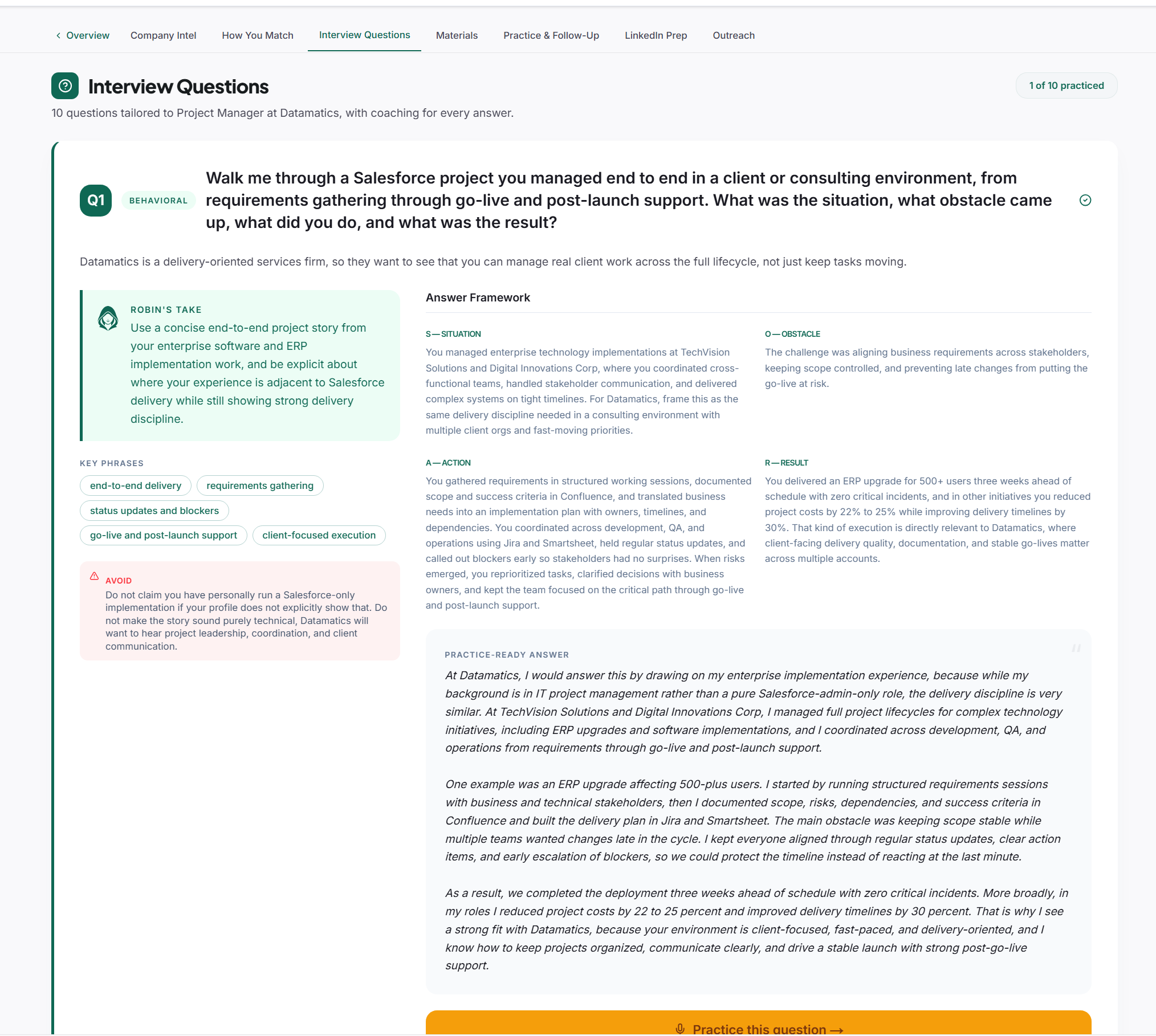
Look at the top of that screenshot: “Datamatics is a delivery-oriented services firm, so they want to see that you can manage real client work across the full lifecycle.” That’s Read 6 from this article, done for you. And notice the “Avoid” box warning the candidate not to claim Salesforce-only experience their profile doesn’t show. That’s the honesty piece: coaching that works with your real background instead of inventing a shinier one, because invented experience dies on the first follow-up question.
Prediction plus coached answers is free for your first three answers on every job you paste, with no card, so you can test the prediction quality against your own judgment. The full method behind it, including how the questions are generated and what the coaching will and won’t do, is documented on our how it works page, and the story of why we built it is here.
Prediction is half the job. Rehearsal is the other half.
One warning before you take your eleven predicted questions and go highlight your resume in celebration: knowing the question is not the same as being able to answer it out loud.
Everyone who has ever blanked on “tell me about yourself,” a question they have literally answered their whole life, knows this. Under pressure, the gap between “I know roughly what I’d say” and “I have said this before, with my mouth” is enormous. So whatever you predict, rehearse it aloud at least once. Alone in your car counts. A voice memo counts. A mock interview in Longbow counts double, because it asks your predicted questions out loud, listens, pushes back and scores you.
However you do it, close the loop. Prediction gets you the exam paper early. You still have to sit the practice exam.
Questions about predicting questions
How many questions should I actually prepare for?
Aim for ten to twelve: seven or eight derived from the posting plus the evergreen set. That’s enough to cover a typical hour with margin. More than fifteen and you’re diluting rehearsal time; the goal is depth on the likely, not coverage of the possible.
Will interviewers ask exactly what I predicted?
Rarely word for word, and it doesn’t matter. You’re predicting themes, and stories transfer across phrasings. If you prepped “tell me about a difficult client” and they ask “describe a time you had to deliver bad news to a stakeholder,” you are covered; it’s the same story with a different door. The prep fails only when the theme itself surprises you, and the whole method exists to prevent that.
What if the posting is vague?
A thin, generic posting predicts less, but it also tells you something: either the company didn’t scope the role carefully, or the posting isn’t entirely real. Check its age and repost history before investing heavily; we wrote a full guide to spotting ghost jobs for exactly this situation. If the job checks out but the posting is still vague, predict from the role title’s norms and the company’s type, and double down on the evergreen questions.
Can I predict the technical round this way?
You can predict the topics reliably: every tool and method named in the posting is fair game, weighted by how prominently it appears. What you can’t predict from the posting is the format, whether that’s a live exercise, a take-home or a whiteboard conversation. Ask the recruiter directly; format is a question they’ll almost always answer.
Does this work for panel interviews?
Especially well, because panels divide the posting among interviewers. Expect the hiring manager to take the role-fit and ownership questions, peers to take collaboration, and their manager to take judgment and trajectory. Same predictions, just distributed, and repetition across interviewers is normal rather than a bad sign.
The posting was the script all along
The next time a posting makes your stomach drop with excitement, resist the urge to fire off the application and start worrying about the interview as one giant unknowable. It isn’t one. It’s a document you can read seven ways, a set of questions you can see coming, and a rehearsal you can do before it counts.
That’s true whether you do it by hand with a highlighter or paste the posting into Longbow and get the questions, the reasons and the coached answers in one pass. Either way, walk in as the candidate who saw the exam paper early, because that candidate was always going to be you or someone else.
Walking into an interview? Don’t wing it.
Longbow gives you the exact questions this company tends to ask for your role, coached answers in your own voice, and unlimited mock practice with Robin until you sound ready. The interview prep we spent a year building — so you walk in knowing what’s coming.
Prep with Robin free →Free to start · No credit card · Built by The Interview Guys
Their questions.
Your best answers.
This article is the general version. Longbow is the tool we built to do this for the specific job you're interviewing for: it reads the posting, predicts the questions, and coaches your answers from your real background. Here's the full story of why we built it.

ABOUT THE INTERVIEW GUYS (JEFF GILLIS & MIKE SIMPSON)
Mike Simpson: Co-founder of The Interview Guys and Longbow. He has been the voice behind our interview advice since 2013 — his work has reached over 100 million job seekers around the world. The strategic mind behind Longbow, our new career platform.
Jeff Gillis: Co-founder of The Interview Guys and Longbow. He built the systems that put our work in front of those readers, and he leads the engineering on Longbow, the cutting edge career platform built for today’s job seeker.