
Free Retail Resume Template: Examples & Writing Guide [2025]
Landing a retail job in 2025 requires more than just showing up with experience. With retail employers expanding their teams and competition heating up, your resume needs to work harder than ever to get you noticed.
Here’s the challenge: most retail resumes never make it past the initial screening. Why? Because applicant tracking systems filter out candidates before a human ever sees their application. If your resume isn’t optimized for these systems, you’re basically invisible to hiring managers.
But here’s the good news. You don’t need to be a resume expert to create one that works. With the right template and strategy, you can showcase your retail experience in a way that both ATS systems and hiring managers love.
By the end of this article, you’ll have access to free, professionally designed retail resume templates plus a complete understanding of what makes retail resumes effective. You’ll learn exactly how to highlight your customer service skills, sales achievements, and technical abilities in a format that gets results. Plus, you’ll discover the specific keywords and phrases retail employers are searching for right now.
☑️ Key Takeaways
- Retail hiring is competitive with 61% of employers expanding teams in 2025, making a standout resume essential for success
- ATS systems screen 99.7% of retail applications, so proper formatting and keyword optimization are critical to getting noticed
- Quantified achievements boost interview chances by showing concrete impact through metrics like sales increases and customer satisfaction
- Our free downloadable templates provide both completed examples and blank formats to simplify your resume creation process
What Makes a Retail Resume Different?
Retail resumes have unique requirements that set them apart from other industries. Understanding these differences is crucial to creating an application that resonates with retail hiring managers.
Customer-centric focus matters most. While every resume should highlight relevant skills, retail resumes must emphasize customer service excellence above everything else. Retail managers want to see how you’ve created positive shopping experiences, resolved conflicts, and built customer relationships.
Metrics speak louder than duties. Generic statements like “responsible for sales” won’t cut it. Retail employers want concrete numbers showing your impact. Did you exceed sales targets? By how much? How many customers did you serve daily? These specifics demonstrate your value in measurable terms.
Technical proficiency is increasingly important. Today’s retail environments rely heavily on technology. From point-of-sale systems to inventory management software, showing you can navigate these tools efficiently gives you a competitive edge. Many retail positions now require familiarity with platforms like Square, Shopify, or specialized retail management systems.
Interview Guys Tip: Research shows that candidates who quantify their achievements are significantly more likely to receive interview callbacks. Instead of saying you “improved customer satisfaction,” specify that you “maintained a 98% customer satisfaction rating while serving 75+ customers daily.”
Retail Resume Example
Here’s a professional retail resume example. This example gives you an idea of what type of content fits in a good ATS friendly resume.
Example Resume:

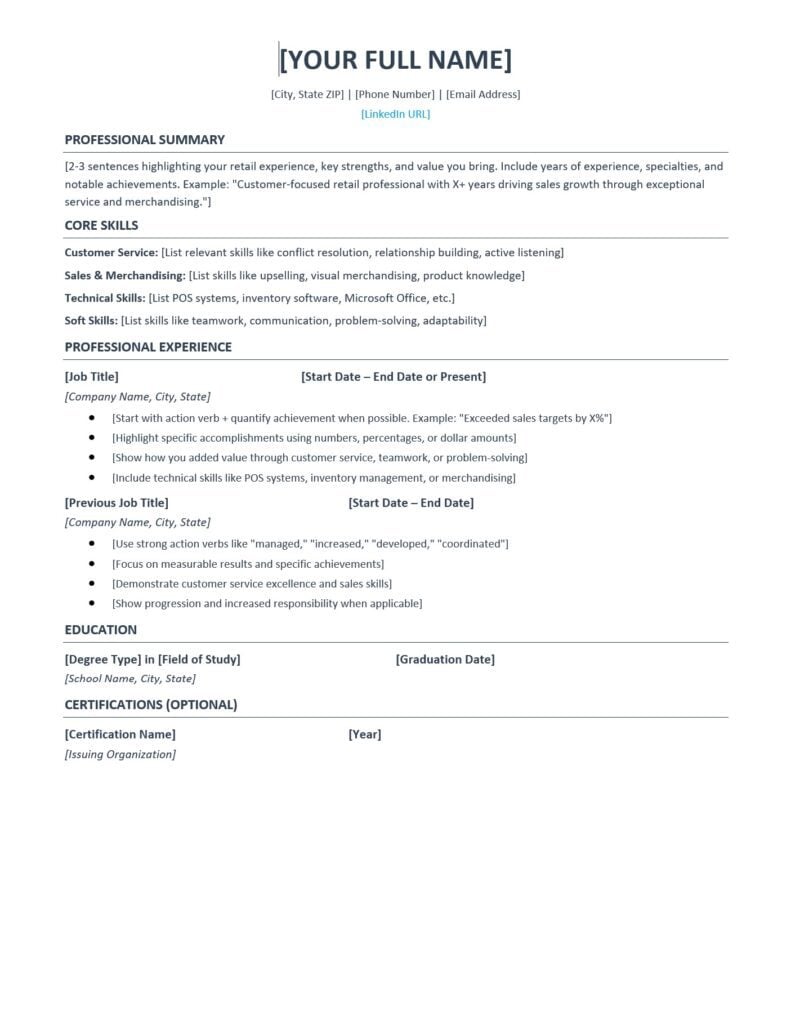
Here’s a professional retail resume template you can download and customize. This template is designed to be both visually appealing and ATS-friendly, with clean formatting that highlights your strengths.
Blank Customizable Template
Download Your Free Template:
- Download DOCX Template (fully editable in Microsoft Word)
Interview Guys Tip: The DOCX template is fully editable, allowing you to adjust fonts, colors, and spacing to match your personal brand while maintaining professional formatting. Just replace the placeholder text with your own information.
Here’s what most people don’t realize: employers now expect multiple technical competencies, not just one specialization. The days of being “just a marketer” or “just an analyst” are over. You need AI skills, project management, data literacy, and more. Building that skill stack one $49 course at a time is expensive and slow. That’s why unlimited access makes sense:
Your Resume Needs Multiple Certificates. Here’s How to Get Them All…
We recommend Coursera Plus because it gives you unlimited access to 7,000+ courses and certificates from Google, IBM, Meta, and top universities. Build AI, data, marketing, and management skills for one annual fee. Free trial to start, and you can complete multiple certificates while others finish one.
Essential Components of Your Retail Resume
Every effective retail resume includes specific sections that hiring managers expect to see. Let’s break down what belongs in each one.
Professional Summary
Your professional summary sits at the top of your resume and serves as your elevator pitch. In 2-3 sentences, you need to capture who you are professionally, what you’ve achieved, and what value you bring to the role.
For retail positions, this section should highlight your years of experience, customer service strengths, and any notable accomplishments like consistently exceeding sales goals. Keep it specific and results-oriented rather than using generic phrases.
Core Skills Section
The core skills section is your opportunity to showcase both hard and soft skills relevant to retail. This section is crucial for ATS optimization because it allows you to naturally incorporate keywords from the job description.
Organize your skills into logical categories like customer service, sales and merchandising, technical proficiency, and soft skills. This makes it easy for hiring managers to quickly assess your qualifications while ensuring the ATS picks up relevant keywords.
Professional Experience
Your work history should be listed in reverse chronological order, starting with your most recent position. Each entry needs your job title, company name, location, and dates of employment.
The bullet points under each position are where you really sell yourself. Focus on achievements rather than responsibilities. Use strong action verbs and include specific metrics whenever possible. Show how you solved problems, improved processes, or contributed to team success.
Interview Guys Tip: When describing your retail experience, use the SOAR method (Situation, Obstacle, Action, Result) to structure your bullet points. This framework helps you tell compelling stories about your achievements while naturally incorporating the details hiring managers want to see.
Education and Certifications
List your educational background, including degree type, field of study, school name, and graduation date. For most retail positions, a high school diploma or associate degree is sufficient, though some management roles may prefer a bachelor’s degree.
If you have relevant certifications like retail management training, customer service excellence programs, or product-specific credentials, include them in a separate certifications section. These additional qualifications can set you apart from other candidates.
How to Write Each Section Effectively
Creating a compelling retail resume requires attention to detail in every section. Here’s how to approach each component strategically.
Crafting Your Professional Summary
Start with your current role or professional identity, then immediately follow with your years of experience. Next, highlight your most impressive achievement or area of expertise. Finally, mention one or two key skills that align with the job you’re targeting.
Avoid vague statements or overused buzzwords. Instead of saying you’re a “results-driven team player,” show it through specific accomplishments. Your summary should make the hiring manager want to keep reading to learn more about you.
Showcasing Your Skills
When selecting which skills to include, carefully review the job description and identify which qualifications appear most frequently. These are your priority keywords that need to appear in your resume.
Balance hard skills (like POS systems, inventory management, and visual merchandising) with soft skills (like communication, problem-solving, and adaptability). Retail employers value both technical competence and interpersonal abilities, so your resume should reflect this balance.
For technical skills, be specific about which systems and software you’ve used. Don’t just say “POS experience.” Instead, specify “Square POS, Shopify, and Lightspeed Retail” to show exactly what you can handle.
Detailing Your Work Experience
Each bullet point should start with a strong action verb and focus on what you accomplished, not just what you did. Weak bullet points state responsibilities: “Handled cash register transactions.” Strong bullet points showcase achievements: “Processed 75+ daily transactions with 100% accuracy using Square POS system.”
Whenever possible, quantify your impact with numbers, percentages, or dollar amounts. Did you increase sales? Train new employees? Reduce inventory discrepancies? These metrics prove your value and make your resume more memorable.
If you’re entry-level or changing careers into retail, draw on transferable skills from other experiences. Customer service, teamwork, and problem-solving abilities translate across industries. Show how your background prepares you for retail success.
Common Mistakes to Avoid
Even experienced retail professionals make critical resume errors that cost them interviews. Here’s what to watch out for.
- Using the same resume for every application is the biggest mistake. With 99.7% of recruiters using ATS keyword filters, a generic resume rarely makes it through. Take the time to customize your resume for each position by incorporating specific keywords from the job description.
- Focusing on duties instead of achievements weakens your resume. Listing job responsibilities tells employers what you were supposed to do, not what you actually accomplished. Transform every bullet point into an achievement statement that demonstrates your impact.
- Poor formatting confuses ATS systems. Graphics, tables, unusual fonts, and complex layouts might look appealing but can scramble your information during the parsing process. Stick with clean, simple formatting using standard fonts like Calibri or Arial.
- Leaving gaps in employment unexplained raises red flags. If you have employment gaps, briefly address them in your cover letter or be prepared to discuss them in interviews. Consider including relevant activities during those periods, like volunteer work or skill development.
- Typos and grammatical errors signal carelessness. Retail positions require attention to detail, so errors on your resume suggest you might make similar mistakes on the job. Proofread carefully and ask someone else to review your resume before submitting it.
ATS Optimization and Keywords
Understanding how applicant tracking systems work is essential for getting your resume noticed. Here’s what you need to know about beating the bots.
ATS systems parse your resume into categories like work experience, skills, and education. They then scan for specific keywords that match the job requirements. Resumes with higher keyword match rates get prioritized for human review.
Interview Guys Tip: Before you submit another application, run your resume through an ATS scanner. Most job seekers skip this step and wonder why they never hear back. Check out the free ATS checker we use and recommend →
The key to ATS optimization is using the exact language from the job description. If the posting mentions “visual merchandising,” use that exact phrase rather than synonyms like “product displays” or “store layout.” ATS systems typically don’t recognize variations or alternative wording.
Include both the full term and acronym for important skills. For example, write “Point of Sale (POS)” to ensure the ATS picks up both versions. This simple technique increases your keyword match rate without stuffing your resume unnaturally.
Place your most important keywords in multiple sections throughout your resume. They should appear in your professional summary, core skills section, and woven naturally into your work experience bullet points. This repetition reinforces your qualifications to both ATS algorithms and human readers.
Interview Guys Tip: According to recent data, the average time-to-hire in retail has increased significantly, with many employers using ATS systems to efficiently manage high application volumes. A well-optimized resume ensures you make it through this crucial first filter.
For file format, save your resume as a .docx file unless the job posting specifically requests PDF. While PDFs preserve formatting, not all ATS systems can parse them correctly. Word documents are universally compatible and safer for automated screening.
Frequently Asked Questions
How long should my retail resume be?
For most retail positions, keep your resume to one page. Hiring managers in retail review hundreds of applications and appreciate concise, scannable documents. Only extend to two pages if you have extensive relevant experience (10+ years) that justifies the additional space. Focus on your most recent and relevant positions, and be selective about what you include.
Should I include a photo on my retail resume?
No, avoid including photos on your resume. In the United States, photos can introduce bias into the hiring process and many companies discourage them. Additionally, photos can cause problems with ATS parsing. Let your qualifications speak for themselves without visual elements that don’t add professional value.
What if I don’t have retail experience?
Focus on transferable skills from other customer-facing roles. Experience in food service, hospitality, volunteering, or even school projects can demonstrate relevant abilities like communication, teamwork, and problem-solving. Emphasize any experience handling money, working with the public, or managing inventory in any context. Entry-level retail positions expect to train new hires, so showing enthusiasm and relevant soft skills can be enough.
How do I show I’m tech-savvy for retail positions?
List specific systems and software you’ve used, even if they’re not retail-specific. Experience with any POS system, inventory management software, or customer relationship management tools demonstrates technical competence. Mention your comfort level with learning new technologies and provide examples of how you’ve quickly adapted to new systems in past roles.
Should I include my GPA on my retail resume?
Only include your GPA if you’re a recent graduate with limited work experience and your GPA is 3.5 or higher. For most retail positions, work experience and skills matter more than academic performance. Once you have a few years of professional experience, remove your GPA entirely and let your work achievements speak for themselves.
Conclusion
Creating an effective retail resume doesn’t have to be complicated. With the right template and strategy, you can showcase your experience in a way that gets noticed by both ATS systems and hiring managers.
Remember the key elements: quantify your achievements with specific metrics, optimize for ATS by using exact keywords from job descriptions, and focus on customer service excellence and sales results. These fundamentals will set your resume apart in a competitive retail job market.
Use our free downloadable templates as your starting point, then customize them for each position you apply for. Take the time to research each company and tailor your resume to show how your experience aligns with their specific needs.
Ready to get started? Download your free retail resume template today and take the first step toward landing your ideal retail position. Your next opportunity is waiting, and now you have the tools to make sure your resume gets you there.
For more help with your job search, check out our guides on ATS resume optimization, writing compelling cover letters, mastering retail interview questions, and negotiating your salary.
Here’s what most people don’t realize: employers now expect multiple technical competencies, not just one specialization. The days of being “just a marketer” or “just an analyst” are over. You need AI skills, project management, data literacy, and more. Building that skill stack one $49 course at a time is expensive and slow. That’s why unlimited access makes sense:
Your Resume Needs Multiple Certificates. Here’s How to Get Them All…
We recommend Coursera Plus because it gives you unlimited access to 7,000+ courses and certificates from Google, IBM, Meta, and top universities. Build AI, data, marketing, and management skills for one annual fee. Free trial to start, and you can complete multiple certificates while others finish one.

BY THE INTERVIEW GUYS (JEFF GILLIS & MIKE SIMPSON)
Mike Simpson: The authoritative voice on job interviews and careers, providing practical advice to job seekers around the world for over 12 years.
Jeff Gillis: The technical expert behind The Interview Guys, developing innovative tools and conducting deep research on hiring trends and the job market as a whole.