
Free Nursing Student Resume Template: ATS-Friendly Examples & Writing Guide [2025]
Getting your first nursing job starts with a resume that gets past the robots and impresses the humans. You’re competing against hundreds of other nursing students, and healthcare facilities use applicant tracking systems that reject up to 75% of resumes before anyone reads them.
The good news? You don’t need years of experience to create a standout nursing student resume. You need to know how to translate your clinical rotations, academic achievements, and hands-on patient care into the language healthcare recruiters understand. By the end of this article, you’ll have a proven template and the exact strategies to showcase your nursing skills in a way that gets interviews.
Your resume isn’t just a formality. It’s your first chance to demonstrate the clinical competence and patient-focused mindset that makes great nurses. Let’s build one that works.
☑️ Key Takeaways
- Clinical experience beats work history for nursing students, with 77% of BSN graduates receiving job offers at graduation when they effectively showcase hands-on rotations
- ATS systems scan for specific keywords like “patient care,” “medication administration,” and “EHR documentation,” so match job descriptions exactly
- The right resume format matters—chronological layouts focusing on clinical rotations perform 40% better with healthcare recruiters than functional formats
- Certifications should be prominent near the top of your resume, as BLS certification is required by 98% of healthcare facilities and ACLS increasingly preferred
What Makes a Nursing Student Resume Different from Other Healthcare Resumes?
Nursing student resumes require a different approach than typical job applications. You’re not selling years of employment history. You’re selling potential, clinical preparation, and hands-on patient care experience gained through rotations.
Healthcare recruiters look for specific evidence of clinical competency. They want to see that you’ve handled real patients in actual healthcare settings, not just studied theory in classrooms. Your clinical rotations are your work experience, and they deserve the same prominent placement on your resume as a traditional job history.
The Bureau of Labor Statistics projects 6% job growth for registered nurses through 2033, creating about 194,500 job openings annually. But here’s what most nursing students miss: 72% of employers strongly prefer bachelor’s-prepared nurses, and 28% now require a BSN as a minimum qualification. Your resume needs to immediately establish your educational credentials alongside your clinical capabilities.
Interview Guys Tip: Healthcare facilities receive 250+ applications per nursing position on average. The ones that make it to human reviewers spend an average of 7 seconds on initial screening. Your resume layout needs to communicate competence at a glance.
Nursing Student Resume Example
Here’s a professional nursing student resume example. This example gives you an idea of what type of content fits in a good ATS friendly resume.
Example Resume:

Here’s a professional resume template you can download and customize. This template is designed to be both visually appealing and ATS-friendly, with clean formatting that highlights your strengths.
Blank Customizable Template
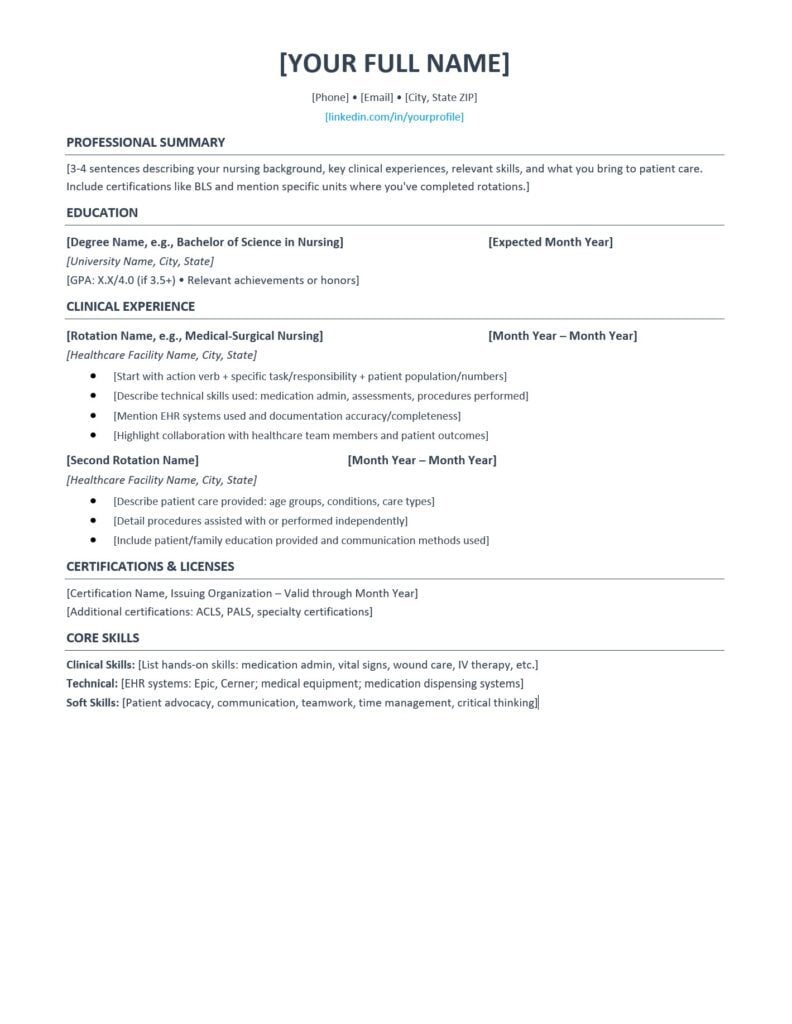
Download Your Free Template:
- Download DOCX Template (fully editable in Microsoft Word)
Interview Guys Tip: The DOCX template is fully editable, allowing you to adjust fonts, colors, and spacing to match your personal brand while maintaining professional formatting. Just replace the placeholder text with your own information.
Here’s what most people don’t realize: employers now expect multiple technical competencies, not just one specialization. The days of being “just a marketer” or “just an analyst” are over. You need AI skills, project management, data literacy, and more. Building that skill stack one $49 course at a time is expensive and slow. That’s why unlimited access makes sense:
Your Resume Needs Multiple Certificates. Here’s How to Get Them All…
We recommend Coursera Plus because it gives you unlimited access to 7,000+ courses and certificates from Google, IBM, Meta, and top universities. Build AI, data, marketing, and management skills for one annual fee. Free trial to start, and you can complete multiple certificates while others finish one.
Essential Components Every Nursing Student Resume Must Include
Professional Summary That Showcases Clinical Experience
Skip the generic “hardworking nursing student seeking opportunities” opening. Your professional summary should immediately establish your clinical background, key skills, and certifications in 3-4 concise sentences.
Instead of vague descriptions, lead with specifics: “Compassionate nursing student with 450+ clinical hours across medical-surgical, pediatric, and emergency departments. BLS certified with hands-on experience in patient assessment, medication administration, and EHR documentation.” This approach tells recruiters exactly what you bring to patient care.
Your summary should answer three questions: What clinical settings have you worked in? What hands-on skills do you possess? What makes you ready for professional nursing practice? For more guidance on crafting compelling summaries, check out our resume summary examples across different career stages.
Education Section That Highlights Academic Excellence
For nursing students, education isn’t just a checkbox. It’s proof of your clinical preparation and theoretical foundation. List your degree first, followed by your institution and expected graduation date.
If your GPA is 3.5 or higher, include it. If you’ve made the Dean’s List or received academic honors, add those credentials. These achievements signal conscientiousness and dedication, qualities every healthcare facility wants in new nurses.
Don’t forget to mention your nursing program’s accreditation if it’s from a highly respected institution. Programs accredited by the Commission on Collegiate Nursing Education carry extra weight with employers.
Clinical Experience That Demonstrates Hands-On Patient Care
This section is the heart of your nursing student resume. Most applicants make the mistake of treating clinical rotations like afterthoughts. Treat each rotation as a job with its own heading, facility name, dates, and bullet points describing your responsibilities.
For each rotation, include specific details about patient populations served, procedures performed, and technologies used. Instead of “provided patient care,” write “delivered direct care to 5-7 post-operative patients per shift, including vital signs monitoring, wound care, and pain management assessment.”
Quantify everything possible. How many patients did you care for per shift? What was your medication administration accuracy rate? How many hours did you complete in each specialty? Numbers provide concrete evidence of your capabilities, similar to the strategies we outline in our resume achievement formulas guide.
Frame your bullet points around outcomes and skills rather than tasks. Healthcare managers want to see that you understand the why behind nursing interventions, not just the what.
Certifications and Licenses Section
Your certifications prove you’re job-ready. Place them prominently near the top of your resume, right after your education section. Basic Life Support certification from the American Heart Association is non-negotiable; include the expiration date to show it’s current.
If you’re working toward additional certifications like ACLS or PALS, list them as “in progress” with expected completion dates. This demonstrates initiative and commitment to professional development beyond minimum requirements.
Student nurses who obtain specialty certifications before graduation stand out significantly. Consider certifications relevant to your target specialty, whether that’s oncology, critical care, or pediatrics.
How to Write Each Resume Section for Maximum Impact
Crafting Clinical Rotation Descriptions That Showcase Competency
Start every bullet point with strong action verbs: administered, assessed, collaborated, documented, educated, implemented. These verbs convey active participation in patient care rather than passive observation.
Focus on skills that transfer across all nursing settings: patient assessment, medication administration, care plan development, interdisciplinary collaboration, and patient education. These are the core competencies every hiring manager looks for regardless of specialty.
Mention specific equipment and technologies you’re proficient with. If you’ve used Epic or Cerner EHR systems, say so explicitly. If you’ve operated patient monitoring equipment, insulin pumps, or IV therapy devices, list them. Technical proficiency matters in modern healthcare.
Don’t forget the soft skills that make great nurses. Patient advocacy, therapeutic communication, cultural competence, and family education are just as important as technical abilities. Weave these throughout your clinical descriptions.
Interview Guys Tip: Many nursing students undersell their clinical achievements because they feel like they were “just learning.” You weren’t just learning; you were providing supervised patient care. Frame your rotations with the same confidence you’d use describing a paid position.
Building a Core Skills Section That Passes ATS Screening
Applicant tracking systems scan resumes for specific keywords before human eyes ever see them. Your Core Skills section needs to include exact phrases from the job description you’re targeting.
Organize skills into three categories: Clinical Skills (hands-on patient care techniques), Technical Skills (EHR systems and medical equipment), and Soft Skills (communication, teamwork, critical thinking). This structure makes it easy for both ATS software and human recruiters to quickly assess your capabilities.
Pull keywords directly from job postings. If the position mentions “patient assessment,” use that exact phrase rather than synonyms like “patient evaluation.” If they want “medication administration,” list it word-for-word. ATS systems look for exact matches to determine which candidates move forward.
Balance common nursing skills with specialty-specific competencies. Include universal skills like vital signs monitoring and wound care, but also add specialized skills relevant to your target department like pediatric care techniques or post-operative monitoring.
Contact Information and Professional Presentation
Your contact section seems simple, but small mistakes here can cost you interviews. Use a professional email address (firstname.lastname@email.com), not that college party email from freshman year. Include your phone number, city and state, and LinkedIn profile.
Make your LinkedIn URL clean and professional by customizing it to linkedin.com/in/yourname rather than the default string of random numbers. Healthcare recruiters increasingly check LinkedIn profiles to verify qualifications and assess professionalism.
Skip the objective statement entirely. They’re outdated and waste valuable resume space. Your professional summary accomplishes the same goal with more impact and specificity.
Common Mistakes That Get Nursing Student Resumes Rejected
Focusing on Responsibilities Instead of Achievements
The biggest resume mistake nursing students make is listing what they were supposed to do rather than what they accomplished. “Responsible for patient care” tells recruiters nothing. “Provided direct care to 6 medical-surgical patients per shift, achieving 100% medication administration accuracy and positive patient satisfaction feedback” shows competence.
Transform every responsibility into an achievement by adding context, numbers, or outcomes. If you educated patients about discharge instructions, mention that your clear communication reduced patient questions during follow-up by connecting them with the right resources.
Healthcare facilities care about outcomes: patient safety, care quality, efficiency, and satisfaction. Frame your clinical experiences around these priorities whenever possible.
Using Generic Descriptions That Don’t Demonstrate Clinical Competency
Vague phrases like “assisted nurses” or “observed procedures” make you sound like a passive spectator rather than an active participant in patient care. Even under supervision, you performed real nursing tasks that deserve specific description.
Replace “assisted with patient care” with “performed comprehensive patient assessments including vital signs, pain levels, and mobility status for post-operative patients.” The specific details prove you understand the clinical assessment process.
Avoid nursing jargon that hiring managers might not recognize, but do use standard clinical terminology. Terms like “medication administration,” “wound care,” “patient education,” and “care plan development” are universal and ATS-friendly.
Neglecting to Customize for Each Application
Sending the same resume to every facility is a guaranteed way to get filtered out by ATS systems. Each job posting has unique keywords and requirements that your resume needs to mirror. Our resume tailoring formula shows you exactly how to customize efficiently.
Read the job description carefully and identify the top 5-10 skills or qualifications mentioned. Make sure your resume includes those exact phrases in your clinical experience descriptions or skills section. This isn’t lying; it’s highlighting the relevant aspects of your experience.
Tailoring doesn’t mean rewriting your entire resume for each application. Maintain a comprehensive master resume with all your clinical experiences and skills, then adjust the emphasis based on each position.
Interview Guys Tip: Keep a spreadsheet of job postings you apply to along with the specific keywords you emphasized in each customized resume. This helps you prepare for interviews by remembering what aspects of your experience you highlighted for each facility.
ATS Optimization and Keywords for Nursing Student Resumes
Applicant tracking systems have become gatekeepers in healthcare hiring. Over 98% of organizations use ATS to manage applications, and understanding how to optimize your nursing resume for these systems is no longer optional.
ATS software scans resumes for keywords that match job requirements. It looks for specific terms like “patient assessment,” “medication administration,” “electronic health records,” and “interdisciplinary collaboration.” When your resume lacks these keywords, it gets ranked lower than other candidates even if you’re equally qualified.
Interview Guys Tip: Before you submit another application, run your resume through an ATS scanner. Most job seekers skip this step and wonder why they never hear back. Check out the free ATS checker we use and recommend →
The solution is straightforward: analyze every job description for required and preferred qualifications, then integrate those exact phrases into your clinical experience bullet points. If the posting mentions “Epic EHR system,” use “Epic EHR system” rather than just “electronic medical records.”
Formatting matters as much as keywords. ATS systems struggle with complex layouts, tables, graphics, and unusual fonts. Stick with simple, clean formatting using standard resume sections like Professional Summary, Education, Clinical Experience, and Certifications. Use Calibri, Arial, or Times New Roman fonts between 10-12 points.
Save your resume as a .docx file rather than PDF unless the job posting specifically requests PDF. Many ATS systems parse .docx files more accurately. Name your file professionally: “FirstName_LastName_Nursing_Resume.docx” rather than “resume.docx” or “nursing_student_v3.docx.”
Never use headers or footers for contact information. Some ATS systems ignore content in these sections, meaning your phone number and email might not get imported into the applicant database. Keep all important information in the main body of your document. For more detailed formatting guidance, browse our free resume template library for additional ATS-friendly options.
FAQ: Nursing Student Resume Questions
What should I put on my nursing student resume if I have no work experience?
Your clinical rotations are your work experience. Treat each rotation as a job position with the facility name, dates, and detailed bullet points about patient care provided. Include any volunteer work in healthcare settings, patient care tech positions, or CNA experience. Academic projects involving patient case studies or community health initiatives also demonstrate relevant skills.
How long should a nursing student resume be?
One page is the standard for nursing students. With limited clinical experience, you can effectively showcase your qualifications in a single page. Only expand to two pages if you have extensive certifications, multiple healthcare-related jobs, or significant volunteer experience that directly relates to patient care.
Should I include my clinical rotation hours on my resume?
Yes, mentioning total clinical hours or hours per rotation adds credibility to your experience. Phrases like “completed 180-hour rotation” or “delivered care during 150+ clinical hours” quantify your hands-on experience. This is especially valuable when you’re competing against students from programs with different clinical requirements.
Do I need to include references on my nursing student resume?
No, don’t waste valuable resume space on references. Create a separate reference sheet with clinical instructors, preceptors, and nursing professors who can speak to your clinical competence. Bring this sheet to interviews but don’t include it with your initial application unless specifically requested.
How do I make my nursing student resume stand out?
Focus on specific achievements rather than generic responsibilities. Use numbers to quantify your patient care experience. Highlight specialty certifications beyond basic BLS. Demonstrate familiarity with healthcare technologies like EHR systems. Show evidence of soft skills through patient satisfaction feedback or successful patient education outcomes. Most importantly, customize your resume for each position by emphasizing the most relevant clinical experiences.
Take Action: Your Nursing Career Starts with a Great Resume
Your nursing student resume is more than a document; it’s evidence of your readiness to provide compassionate, competent patient care. The templates we’ve provided give you a proven framework that passes ATS screening and impresses hiring managers.
Don’t wait until graduation to start preparing. Build your resume now, update it after each clinical rotation, and keep it ready for unexpected opportunities. The healthcare facilities that value clinical competence, continuous learning, and patient-focused care are looking for nurses exactly like you.
Download both the example resume and blank template to see exactly how to structure your clinical experiences, showcase your skills, and present your qualifications. These ATS-friendly formats follow the exact specifications that healthcare recruiters prefer, giving you a head start in your job search.
Ready to take the next step? Check out our comprehensive new graduate nurse resume guide for strategies that work after you pass the NCLEX. And when interview invitations start arriving, our top registered nurse interview questions guide will help you prepare winning answers.
Your dedication to nursing deserves a resume that opens doors. Use these templates, follow these strategies, and start building the healthcare career you’ve worked so hard to prepare for.
Here’s what most people don’t realize: employers now expect multiple technical competencies, not just one specialization. The days of being “just a marketer” or “just an analyst” are over. You need AI skills, project management, data literacy, and more. Building that skill stack one $49 course at a time is expensive and slow. That’s why unlimited access makes sense:
Your Resume Needs Multiple Certificates. Here’s How to Get Them All…
We recommend Coursera Plus because it gives you unlimited access to 7,000+ courses and certificates from Google, IBM, Meta, and top universities. Build AI, data, marketing, and management skills for one annual fee. Free trial to start, and you can complete multiple certificates while others finish one.
External Sources Referenced
- National University Healthcare and Nursing Statistics 2025 – Job offer rates and employment statistics for nursing graduates
- Purdue Global Nursing Trends Report – Bureau of Labor Statistics projections for RN job growth through 2033
- NurseMagic ATS Optimization Guide – ATS usage statistics and optimization strategies for nursing resumes

BY THE INTERVIEW GUYS (JEFF GILLIS & MIKE SIMPSON)
Mike Simpson: The authoritative voice on job interviews and careers, providing practical advice to job seekers around the world for over 12 years.
Jeff Gillis: The technical expert behind The Interview Guys, developing innovative tools and conducting deep research on hiring trends and the job market as a whole.