
Free Data Analyst Resume Template: Examples & Writing Guide [2025]
You’re staring at a blank page, wondering how to translate your SQL queries and Python scripts into a resume that actually gets you interviews. You know you’re great at transforming messy datasets into insights that drive business decisions, but explaining that on paper feels impossible.
Here’s the reality. Most data analyst resumes end up in the rejection pile not because candidates lack skills, but because their resumes fail to communicate their value effectively. With companies receiving hundreds of applications for each data analyst position and over 97% of Fortune 500 companies using applicant tracking systems, your resume needs to work twice as hard: first to get past automated screening, then to impress human recruiters.
That’s exactly why we created this comprehensive guide and free templates. We’ve combined our expertise in career development with research on what actually works in today’s job market to help you build a data analyst resume that stands out. You’ll learn how to showcase your technical skills, quantify your impact, and format everything in a way that both ATS and hiring managers love.
By the end of this article, you’ll have access to two professional resume templates (one filled example and one blank template you can customize), plus a complete understanding of what makes a data analyst resume effective. Let’s turn your data skills into a document that opens doors. For more comprehensive guidance on the job search process, check out our complete guide to job search tips and hacks.
☑️ Key Takeaways
- 98% of Fortune 500 companies use ATS systems to screen data analyst resumes, making keyword optimization essential for getting past initial screening
- Quantified achievements increase interview rates by up to 40% compared to resumes that only list job duties without measurable results
- Data analyst resumes need both technical and soft skills to demonstrate your ability to transform complex data into actionable business insights
- Our free templates include an example resume and blank template that follow proven formatting guidelines while staying ATS-compliant
What Makes a Data Analyst Resume Different?
Data analyst resumes require a unique approach because you’re selling two things simultaneously: technical expertise and business impact. Unlike some roles where soft skills take center stage, data analyst positions demand proof that you can work with specific tools and technologies.
The most effective data analyst resumes strike a balance. You need to demonstrate proficiency in SQL, Python, Tableau, and other technical tools while showing that you understand how data drives business decisions. This means every bullet point should ideally connect a technical skill to a business outcome.
Python has become the most widely used language in data analytics , with SQL remaining essential for database management. Your resume needs to reflect current industry standards. If you’re listing skills that were relevant five years ago but aren’t commonly used today, you’re hurting your chances.
Interview Guys Tip: Don’t just list tools you’ve used. Show how you applied them to solve real business problems. Instead of “Proficient in Python,” write “Built predictive models using Python that improved customer retention forecasting by 32%.”
Data Analyst Resume Example
Here’s a professional data analyst resume example. This example gives you an idea of what type of content fits in a good ATS friendly resume.
Example Resume:

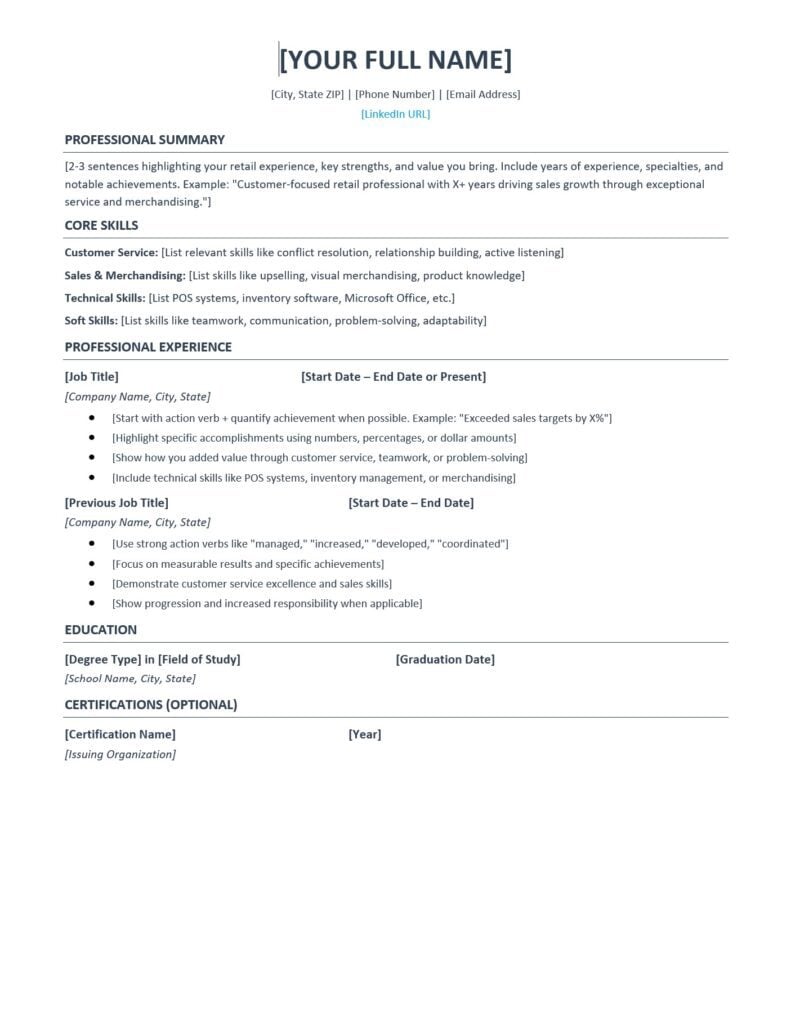
Here’s a professional data analyst resume template you can download and customize. This template is designed to be both visually appealing and ATS-friendly, with clean formatting that highlights your strengths.
Customizable Data Analyst Resume Template
Download Your Free Template:
- Download DOCX Template (fully editable in Microsoft Word)
Interview Guys Tip: The DOCX template is fully editable, allowing you to adjust fonts, colors, and spacing to match your personal brand while maintaining professional formatting. Just replace the placeholder text with your own information.
Here’s what most people don’t realize: employers now expect multiple technical competencies, not just one specialization. The days of being “just a marketer” or “just an analyst” are over. You need AI skills, project management, data literacy, and more. Building that skill stack one $49 course at a time is expensive and slow. That’s why unlimited access makes sense:
Your Resume Needs Multiple Certificates. Here’s How to Get Them All…
We recommend Coursera Plus because it gives you unlimited access to 7,000+ courses and certificates from Google, IBM, Meta, and top universities. Build AI, data, marketing, and management skills for one annual fee. Free trial to start, and you can complete multiple certificates while others finish one.
Essential Components of a Data Analyst Resume
Your data analyst resume should include these core sections, arranged in order of importance to hiring managers.
Professional Summary
This 3-4 sentence paragraph sits at the top of your resume and serves as your elevator pitch. It should immediately communicate your years of experience, key technical skills, and most impressive quantifiable achievement.
Think of your professional summary as the hook that determines whether recruiters keep reading. With recruiters spending an average of 7 seconds on initial resume screening, this section needs to capture attention fast.
A weak summary says: “Data analyst seeking opportunities to utilize my skills.” A strong summary quantifies your impact: “Results-driven Data Analyst with 4+ years of experience transforming complex datasets into actionable business insights. Expertise in SQL, Python, and Tableau with a proven track record of increasing operational efficiency by 25% through data-driven decision making.”
Core Skills Section
This section serves double duty. It helps ATS systems identify you as a match for the role, and it gives human recruiters a quick snapshot of your technical capabilities.
Organize your skills into categories: Programming Languages, Data Visualization Tools, Database Management, and Analytics & Tools. This makes it easy for recruiters to scan and find what they’re looking for.
Don’t fall into the trap of listing every tool you’ve ever touched. Focus on skills that are both genuine strengths and relevant to the positions you’re targeting. For guidance on identifying your strongest skills, explore our article on the best skills to put on a resume.
Professional Experience
This is where you prove you can deliver results. Each job entry should include your title, company name, location, and dates of employment. But the real value lies in your bullet points.
Structure each bullet point to show what you did, how you did it, and what the result was. Start with strong action verbs like “Developed,” “Analyzed,” “Built,” or “Led.” Include the technical tools you used. Then quantify the impact with specific numbers.
Using quantified achievements on your resume makes it more compelling and effectively communicates the impact you can have on a potential employer’s organization. Instead of “Created reports for management,” write “Developed automated reporting dashboards using Tableau that reduced manual reporting time by 40%, saving 15 hours per week.”
How to Write Each Section
Crafting Your Professional Summary
Start by identifying your key selling points. How many years of experience do you have? What are your strongest technical skills? What’s your most impressive quantifiable achievement?
Write your summary in third person or implied first person (without using “I”). Keep it between 50-75 words. Every word should add value. If a sentence doesn’t tell the reader something important about what you bring to the table, cut it.
Test your summary by asking: Would this make a recruiter want to keep reading? Does it differentiate me from other candidates? Does it speak directly to what employers need?
Building Your Skills Section
Review 5-10 job descriptions for roles you want. Make a list of every technical skill mentioned. Now compare that list to your actual skills. The overlap represents your core skills section.
Organize skills by category rather than dumping them in a single list. This makes your resume more scannable and helps ATS systems parse your information correctly. Each category should have 3-6 items, which is enough to demonstrate expertise without overwhelming the reader.
Be honest about your skill levels. If you’ve only dabbled in a tool, don’t list it. Recruiters often test candidates on the skills they claim, and getting caught exaggerating hurts your credibility.
Interview Guys Tip: Update your skills section for each application. If a job description emphasizes Tableau and you list it fourth in your visualization tools, move it to the front. Small adjustments like this help ATS systems identify you as a stronger match.
Writing Compelling Experience Bullets
Every bullet point should follow the CAR format: Challenge, Action, Result. What problem needed solving? What did you do about it? What was the outcome?
Quantify everything possible. Using numbers gives hiring managers a better sense of your value and demonstrates your expertise in the data analyst role. Percentages, dollar amounts, time saved, and volume of data processed all work well.
Use industry-specific keywords naturally. If the job description mentions “predictive modeling,” “ETL processes,” or “data visualization,” and you’ve done that work, use those exact phrases. This helps both ATS systems and human readers recognize your relevant experience.
Start with your most impressive achievements. Don’t bury your best work in the fourth bullet point where recruiters might never see it. Lead with impact. For more tips on presenting your work effectively, read about how to write your resume’s work experience section.
Education and Certifications
List your degree, institution, and graduation date. A bachelor’s degree in data analytics or a related field such as statistics, mathematics, computer science, or information technology is typically preferred for data analyst positions.
If you graduated more than 5-10 years ago, you can omit your graduation date to avoid age discrimination. If your GPA is above 3.5, you can include it, but it’s optional for experienced professionals.
Certifications demonstrate ongoing learning and commitment to your field. Popular certifications include Google Data Analytics Professional Certificate, Tableau Desktop Specialist, and Microsoft Certified: Data Analyst Associate. Only list current, relevant certifications.
Common Mistakes to Avoid
Stop making these errors that tank your chances before recruiters even finish reading.
Mistake 1: Generic Job Descriptions
Writing “Analyzed data to support business decisions” tells recruiters nothing. Every data analyst does that. The question is how well you do it and what results you achieved.
Always include specific technologies, methodologies, and outcomes. “Performed statistical analysis on datasets with over 1M records using Python and SQL, identifying trends that led to 22% improvement in targeted campaign conversion rates” paints a much clearer picture.
Mistake 2: Missing Keywords
75% of qualified candidates are rejected by ATS systems because the system can’t read the resume correctly or because critical keywords are missing. Each job description contains clues about what keywords matter most.
If a job posting mentions “Python” three times, “SQL” twice, and “data visualization” four times, those terms should definitely appear in your resume. But use them naturally in context, not stuffed into a keyword dump section.
Mistake 3: Poor Formatting
Tables, graphics, headers, footers, and unusual fonts confuse ATS systems. Stick with standard fonts like Calibri, Arial, or Times New Roman. Use conventional section headers. Save your creativity for the content, not the design.
Your resume should be clean, professional, and scannable. Plenty of white space helps readability. Bullet points should use consistent formatting throughout. For a complete list of resume formatting guidelines, check out our resume formatting guide.
Mistake 4: Ignoring Soft Skills
Data analysts don’t work in isolation. You need to show you can communicate complex findings to non-technical stakeholders, collaborate with cross-functional teams, and translate business questions into analytical approaches.
Weave soft skills into your experience bullets. “Presented technical data insights to C-suite executives through clear visualizations, influencing strategic decisions that increased revenue by $1.2M” demonstrates both technical and communication skills.
Mistake 5: Length Issues
For most data analysts, one page is sufficient until you hit 10+ years of experience. If you’re stretching content across two pages when you only have 3-4 years of experience, you’re probably including too much detail about early roles or irrelevant information.
Cut ruthlessly. Every line should serve a purpose. Older or less relevant positions can be summarized in 1-2 bullets instead of 4-5. Focus your detail on recent, relevant, impressive achievements.
ATS Optimization and Keywords
Understanding how ATS systems work is essential for getting your resume in front of human eyes.
How ATS Systems Screen Resumes
Recruiters use ATS to search for resumes using specific keywords. The resumes that contain those keywords are the ones they actually see. This means your resume is being evaluated on two levels: first by software, then by people.
ATS systems scan your resume and extract information into a database. They look for section headers, job titles, companies, dates, education, and skills. If your formatting is too complex, the system can’t parse the information correctly and your resume essentially becomes unreadable.
Many systems also rank candidates based on keyword matches. A resume with 8 out of 10 required skills might rank higher than one with only 5 out of 10, even if the second candidate is actually more qualified.
Identifying the Right Keywords
Job descriptions are your keyword goldmap. Read 5-10 postings for similar roles. Make a list of repeated terms, required skills, and preferred qualifications. These are your target keywords.
Pay special attention to the “Required Skills” or “Qualifications” sections. These terms absolutely must appear in your resume if you have those skills. Don’t lie or exaggerate, but do use the exact terminology employers use.
Technical skills like SQL, Python, Tableau, Excel, and specific methodologies like A/B testing or predictive modeling should appear multiple times throughout your resume, naturally integrated into context.
Strategic Keyword Placement
Keywords should appear in multiple sections of your resume. Include them in your professional summary, skills section, and woven into your experience bullets.
Use both acronyms and full terms. Write “SQL (Structured Query Language)” once, then use “SQL” throughout the rest of your resume. This helps you match searches whether recruiters search for the acronym or the full term.
Don’t create a separate “keywords” section at the bottom of your resume. This looks manipulative and adds no value for human readers. Instead, naturally incorporate terms throughout your document where they make sense.
Interview Guys Tip: Before you submit another application, run your resume through an ATS scanner. Most job seekers skip this step and wonder why they never hear back. Check out the free ATS checker we use and recommend →
FAQ: Data Analyst Resume Questions
How long should a data analyst resume be?
For most data analysts with less than 10 years of experience, one page is ideal. The one-page resume is a classic, but for seasoned professionals, stretching to two pages is acceptable. The key is relevance and conciseness. Every line should add value and relate directly to the data analyst role you’re pursuing.
Should I include a cover letter with my data analyst resume?
Yes, whenever possible. A well-crafted cover letter lets you explain how your specific experience matches the role’s requirements and shows enthusiasm for the position. It’s your chance to tell the story behind your resume numbers. Learn more in our guide to writing effective cover letters.
What if I don’t have formal data analyst experience?
Focus on transferable skills and relevant projects. If you’ve analyzed data in another role, conducted research, worked with databases, or completed data analysis coursework or bootcamps, those count. Highlight academic projects, freelance work, or volunteer data analysis that demonstrates your capabilities.
Do I need to list every tool I’ve ever used?
No. Focus on tools you’re genuinely proficient in and that are relevant to your target roles. It’s better to list 8-10 tools you know well than 20 tools you’ve barely touched. Recruiters often verify skills during interviews, so honesty is essential.
How often should I update my resume?
Update your resume every time you complete a significant project, learn a new skill, or achieve a measurable result. Then when you’re ready to apply for jobs, you have current content to work with. For each application, tailor your resume to match the specific job description.
Conclusion
Landing your ideal data analyst role starts with a resume that showcases both your technical expertise and business impact. By using our free templates and following the strategies in this guide, you’re equipped to create a document that gets past ATS screening and impresses hiring managers.
Remember that your resume is a living document. As you gain new skills, complete projects, and achieve results, update it immediately. The best time to capture details about your work is right after you complete it, not months later when you’re scrambling to apply for jobs.
Download our free data analyst resume templates below and start building your interview-winning resume today. For additional support with your job search, explore our resources on preparing for data analyst interviews and negotiating your salary offer.
Your data skills are valuable. Now you have the tools to communicate that value effectively. Go create a resume that opens doors.
Here’s what most people don’t realize: employers now expect multiple technical competencies, not just one specialization. The days of being “just a marketer” or “just an analyst” are over. You need AI skills, project management, data literacy, and more. Building that skill stack one $49 course at a time is expensive and slow. That’s why unlimited access makes sense:
Your Resume Needs Multiple Certificates. Here’s How to Get Them All…
We recommend Coursera Plus because it gives you unlimited access to 7,000+ courses and certificates from Google, IBM, Meta, and top universities. Build AI, data, marketing, and management skills for one annual fee. Free trial to start, and you can complete multiple certificates while others finish one.

BY THE INTERVIEW GUYS (JEFF GILLIS & MIKE SIMPSON)
Mike Simpson: The authoritative voice on job interviews and careers, providing practical advice to job seekers around the world for over 12 years.
Jeff Gillis: The technical expert behind The Interview Guys, developing innovative tools and conducting deep research on hiring trends and the job market as a whole.