
Free Beginner Resume Template For 2025: + Examples & Writing Guide
Starting your career can feel overwhelming, especially when you’re staring at a blank document wondering how to create a professional resume with limited work experience. You’re not alone. Every successful professional started exactly where you are right now.
The good news? You don’t need years of experience to create a compelling resume that gets noticed by hiring managers. What you need is the right structure, smart formatting, and a strategy to showcase your potential.
By the end of this article, you’ll have a clear understanding of how to build an effective beginner resume that highlights your strengths, demonstrates your value, and opens doors to exciting opportunities. Plus, you’ll get access to free downloadable templates you can customize immediately.
Let’s dive in and turn that blank page into your ticket to landing interviews.
☑️ Key Takeaways
- A clean, one-page format with clear section headings makes your beginner resume easy to scan and ATS-friendly
- Lead with education and relevant coursework when you lack extensive work experience to showcase your qualifications
- Use action verbs and quantify achievements in bullet points to demonstrate impact, even from internships or part-time jobs
- Tailor your skills section to match job descriptions and include both technical abilities and transferable soft skills
What Makes a Beginner Resume Different?
A beginner resume requires a different approach than a traditional resume. When you’re early in your career, your resume format needs to emphasize potential over proven track record.
The biggest difference? You’ll lead with education rather than experience. This strategic shift puts your strongest qualifications front and center. Recent graduates typically have impressive academic achievements, relevant coursework, and hands-on projects that demonstrate capabilities even without extensive work history.
Your beginner resume should also focus heavily on transferable skills. These are abilities that apply across different roles and industries. Communication, teamwork, problem-solving, and adaptability matter just as much as technical skills when you’re starting out.
Interview Guys Tip: Don’t underestimate experiences like volunteer work, student organizations, or class projects. These count as legitimate experience and often demonstrate valuable skills that employers seek.
Beginner Resume Example
Here’s a beginner resume example. This example gives you an idea of what type of content fits in a good ATS friendly resume.
Example Resume:

Here’s a beginner resume template you can download and customize. This template is designed to be both visually appealing and ATS-friendly, with clean formatting that highlights your strengths.
Blank Customizable Template
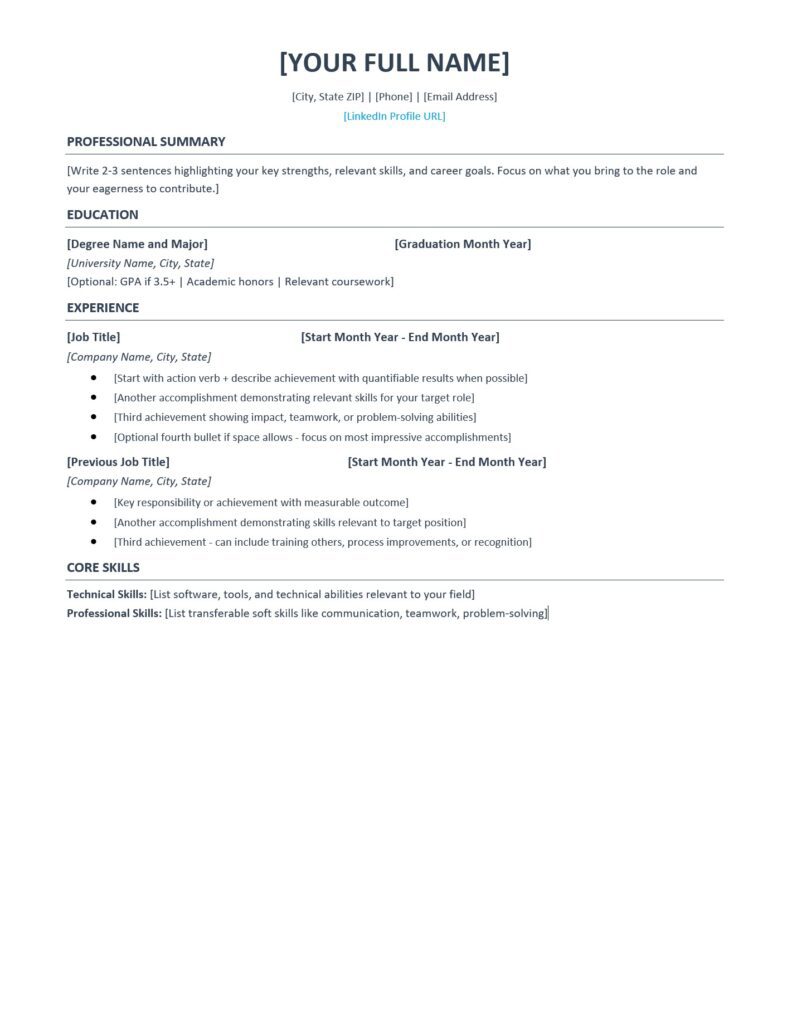
Download Your Free Template:
- Download DOCX Template (fully editable in Microsoft Word)
Interview Guys Tip: The DOCX template is fully editable, allowing you to adjust fonts, colors, and spacing to match your personal brand while maintaining professional formatting. Just replace the placeholder text with your own information.
Here’s what most people don’t realize: employers now expect multiple technical competencies, not just one specialization. The days of being “just a marketer” or “just an analyst” are over. You need AI skills, project management, data literacy, and more. Building that skill stack one $49 course at a time is expensive and slow. That’s why unlimited access makes sense:
Your Resume Needs Multiple Certificates. Here’s How to Get Them All…
We recommend Coursera Plus because it gives you unlimited access to 7,000+ courses and certificates from Google, IBM, Meta, and top universities. Build AI, data, marketing, and management skills for one annual fee. Free trial to start, and you can complete multiple certificates while others finish one.
Essential Components of a Winning Beginner Resume
Every effective beginner resume includes specific sections arranged in a strategic order. Here’s what you need and why each section matters.
Contact Information
Start with the basics at the top of your resume. Include your full name, city and state (no need for full address), phone number, email address, and LinkedIn profile URL. Make sure your email address sounds professional. If you’re still using that quirky handle from high school, create a new account with your name.
Professional Summary
This 2-3 sentence section sits right below your contact information. Think of it as your elevator pitch on paper. Highlight your key strengths, most relevant skills, and career goals. Focus on what you bring to the role rather than what you want from it.
For beginners, this section should emphasize your enthusiasm, relevant coursework or projects, and any internship or part-time experience. Keep it concise but impactful.
Education Section
Place your education prominently near the top of your beginner resume. List your degree, major, school name, and graduation date. If you graduated with honors or maintained a GPA above 3.5, include it. Add relevant coursework that directly relates to your target position.
Academic achievements like Dean’s List recognition, scholarships, or awards belong here too. These accomplishments demonstrate excellence and dedication to potential employers.
Experience Section
This is where many beginners struggle. You might think you don’t have enough to include here, but you’re probably selling yourself short. Include internships, part-time jobs, volunteer work, and significant class projects.
According to research from ResumeBuilder, entry-level candidates who quantify their achievements in bullet points are 40% more likely to get interview callbacks. Even in retail or food service roles, you can demonstrate valuable skills through specific examples.
Core Skills Section
Create two categories: Technical Skills and Professional Skills. Technical skills include software, tools, and industry-specific knowledge. Professional skills cover transferable abilities like communication, teamwork, and time management.
Make sure to tailor this section to each job application by including keywords from the job description. Applicant tracking systems scan for these specific terms, so alignment is crucial.
How to Write Each Section for Maximum Impact
Crafting Your Professional Summary
Your professional summary needs to hook the reader immediately. Start by identifying your strongest qualification for the role. Are you a recent graduate with a relevant degree? An intern with hands-on experience? Someone transitioning careers with transferable skills?
Lead with that qualification, then mention 2-3 key skills or achievements. End with a statement about your career goals that aligns with the position you’re seeking. Keep it to 3-4 lines maximum.
Avoid generic phrases like “hard-working” or “team player” without evidence. Instead, write something specific: “Recent Business Administration graduate with social media marketing internship experience and proven ability to increase engagement by 25%.”
Maximizing Your Education Section
When you lack extensive work experience, your education section becomes a powerful tool. Go beyond just listing your degree. Include relevant coursework that directly relates to your target position. If you’re applying for a marketing role, mention classes in digital marketing, consumer behavior, or market research.
Academic projects can demonstrate real-world skills. Did you complete a capstone project? Lead a group presentation? Conduct original research? These experiences show initiative and capability.
Interview Guys Tip: If you’re still in school, list your expected graduation date. If you graduated more than two years ago, you can skip including graduation dates to avoid potential age bias.
Writing Compelling Experience Bullet Points
Each bullet point under your experience should follow a simple formula: action verb + what you did + quantifiable result when possible. This structure creates clear, impactful statements that demonstrate value.
Start with strong action verbs like “developed,” “managed,” “created,” “analyzed,” or “coordinated.” Avoid weak verbs like “responsible for” or “helped with.” These phrases dilute your contributions.
Whenever possible, include numbers. Did you serve 50+ customers daily? Train 3 new employees? Increase social media engagement by 25%? Numbers provide concrete evidence of your impact and make your accomplishments more memorable.
According to data from Novoresume, resumes with quantified achievements receive 43% more interview requests than those with generic descriptions.
Building a Skills Section That Gets Noticed
Your skills section needs strategic planning. Don’t just list every skill you possess. Focus on the most relevant abilities for each specific job application.
Divide your skills into categories: Technical Skills and Professional Skills. Technical skills are hard skills specific to your field: software proficiency, programming languages, data analysis tools, or industry certifications.
Professional skills are the soft skills that make you effective in any role: communication, teamwork, problem-solving, adaptability, time management. These transferable abilities matter immensely, especially for entry-level positions where employers know they’ll need to train you.
Match your skills to the job description. If the posting mentions “Microsoft Excel” three times, make sure Excel appears prominently in your skills section. This alignment helps you pass applicant tracking systems and shows hiring managers you’re a strong fit.
Common Mistakes to Avoid
Many beginners make the same resume mistakes that cost them interviews. Let’s address the most common pitfalls so you can avoid them.
- Exceeding one page. Unless you have 10+ years of experience, your resume should fit on one page. Recruiters spend an average of seven seconds scanning each resume initially. Make those seconds count by keeping content concise and relevant.
- Including irrelevant information. Your high school achievements stop mattering once you’re in college or beyond. References to outdated skills or jobs from a decade ago add clutter without value.
- Using passive language. Phrases like “responsible for” or “duties included” sound weak. Replace them with strong action verbs that demonstrate agency and impact.
- Neglecting to proofread. Spelling and grammar errors signal carelessness. Have multiple people review your resume before sending it anywhere. Tools like Grammarly can help, but human eyes catch issues that software misses.
Interview Guys Tip: Never use the same resume for every application. Tailoring takes time, but it significantly increases your chances of getting interviews. Adjust your professional summary and skills section to match each specific job posting.
ATS Optimization and Keywords
Understanding how applicant tracking systems work is essential for beginners. These software programs scan resumes before human eyes ever see them. If your resume isn’t optimized for ATS, it might get rejected automatically regardless of your qualifications.
ATS software looks for specific keywords that match the job description. These systems also evaluate your resume’s formatting. Complex designs, unusual fonts, or graphics can confuse ATS and cause rejection.
Stick with simple, clean formatting. Use standard section headings like “Experience,” “Education,” and “Skills.” Avoid headers and footers where ATS might not read information. Save your resume as a .docx file rather than PDF when possible, unless the application specifically requests PDF format.
To optimize for keywords, carefully read each job description and identify the most important skills and qualifications mentioned. Incorporate these exact phrases into your resume where truthful and relevant. Don’t just stuff keywords randomly. They need to fit naturally within your experience and skills sections.
According to Jobscan research, 98% of Fortune 500 companies use applicant tracking systems. Your beginner resume must be ATS-friendly to have any chance of reaching human reviewers.
Interview Guys Tip: Before you submit another application, run your resume through an ATS scanner. Most job seekers skip this step and wonder why they never hear back. Check out the free ATS checker we use and recommend →
Formatting Best Practices
Clean, professional formatting makes your beginner resume easier to read and more likely to impress hiring managers. Follow these proven formatting guidelines.
Use a standard font like Arial, Calibri, or Times New Roman in 10-12 point size. Fancy or decorative fonts look unprofessional and can confuse ATS. Maintain consistent formatting throughout. If you bold one job title, bold them all.
Create clear visual hierarchy with section headings. Make headings slightly larger and bold to help readers quickly scan your resume. Use plenty of white space. Margins should be at least 0.5 inches on all sides.
Align dates consistently, typically to the right side of the page. This creates a clean look and makes it easy to see your chronology at a glance. Use bullet points rather than paragraphs for experience descriptions. Bullets make content scannable and digestible.
Keep your resume to one page. This constraint forces you to be strategic about what you include. Every line should serve a purpose and demonstrate your value. If something doesn’t contribute meaningfully, cut it.
Additional Sections to Consider
Beyond the core components, certain optional sections can strengthen your beginner resume depending on your background and the role you’re pursuing.
- Certifications and Licenses: If you’ve earned relevant certifications like Google Analytics, Microsoft Office Specialist, or CPR certification, create a dedicated section. These credentials demonstrate initiative and relevant knowledge.
- Volunteer Experience: Meaningful volunteer work can showcase leadership, community involvement, and skills development. Treat volunteer positions like paid work, using the same bullet point format to describe your contributions.
- Projects: Academic or personal projects demonstrate practical application of skills. This section works especially well for technical roles or creative positions where you can show what you’ve built or created.
- Languages: If you speak multiple languages, list them with proficiency levels. In our globalized workforce, language skills can be a significant differentiator, especially for customer-facing roles or international companies.
- Professional Associations: Membership in relevant professional organizations shows engagement with your field. Include any leadership positions you’ve held within these groups.
Frequently Asked Questions
Should I include my GPA on my beginner resume?
Include your GPA only if it’s 3.5 or higher. If your GPA is lower but your major GPA is strong, you can list that instead. Once you have substantial work experience, you can remove GPA entirely.
How do I explain employment gaps?
Brief gaps (a few months) don’t require explanation on your resume. For longer gaps, you can include relevant activities like freelance work, volunteering, professional development courses, or family responsibilities that demonstrate you remained productive.
Can I include part-time jobs on my resume?
Absolutely. Part-time positions, especially those where you developed transferable skills, absolutely belong on your beginner resume. The key is describing these roles in ways that highlight relevant abilities rather than focusing on basic duties.
What if I have no experience at all?
Focus on academic projects, volunteer work, student organizations, and coursework. You can also create a more skills-based resume that emphasizes your abilities rather than work history. Consider taking on volunteer projects or internships to gain experience quickly.
Should I include references on my resume?
No. Save valuable resume space for your qualifications. Create a separate references document to provide when requested. Most employers will ask for references during later interview stages, not with your initial application.
Take Action: Your Resume Success Starts Now
You now have the complete framework for building a powerful beginner resume that showcases your potential and opens doors to career opportunities. The difference between getting interviews and getting ignored often comes down to how effectively you present your qualifications.
Download our free beginner resume template and start building your resume today. Remember to customize it for each application, focusing on the skills and experiences most relevant to each specific role.
Your first job won’t be your last. This beginner resume is just the starting point of an exciting career journey. Make it count by putting in the effort to craft a document that truly represents your capabilities and potential. You’ve got this.
Here’s what most people don’t realize: employers now expect multiple technical competencies, not just one specialization. The days of being “just a marketer” or “just an analyst” are over. You need AI skills, project management, data literacy, and more. Building that skill stack one $49 course at a time is expensive and slow. That’s why unlimited access makes sense:
Your Resume Needs Multiple Certificates. Here’s How to Get Them All…
We recommend Coursera Plus because it gives you unlimited access to 7,000+ courses and certificates from Google, IBM, Meta, and top universities. Build AI, data, marketing, and management skills for one annual fee. Free trial to start, and you can complete multiple certificates while others finish one.

BY THE INTERVIEW GUYS (JEFF GILLIS & MIKE SIMPSON)
Mike Simpson: The authoritative voice on job interviews and careers, providing practical advice to job seekers around the world for over 12 years.
Jeff Gillis: The technical expert behind The Interview Guys, developing innovative tools and conducting deep research on hiring trends and the job market as a whole.