
Free Accountant Resume Template: Examples & Writing Guide [2025]
Landing an accounting job in 2025 means navigating both human recruiters and sophisticated applicant tracking systems. Your resume needs to check every box: ATS-friendly formatting, quantifiable achievements, relevant keywords, and a professional design that doesn’t sacrifice readability for style.
The good news? The accounting job market is incredibly strong right now. Accountants and auditors currently face an unemployment rate of just 1.3%, significantly lower than the national average. Companies are desperate for qualified accounting professionals, with approximately 124,200 openings projected each year through 2034 according to Bureau of Labor Statistics data.
But here’s the challenge: 93% of finance leaders report difficulties finding qualified professionals. That means you’re competing against fewer candidates, but you still need a resume that immediately proves your value.
By the end of this article, you’ll have everything you need to create a standout accountant resume. We’ve included two free downloadable templates (example and blank), plus a complete writing guide covering every section from your professional summary to your certifications. Let’s get started.
Before diving into accounting-specific strategies, check out how to make a resume to understand the fundamentals.
☑️ Key Takeaways
- Download our free ATS-optimized accountant resume templates in DOCX format with professional formatting that passes applicant tracking systems
- Unemployment for accountants sits at just 1.3% in 2025, with over 124,000 job openings projected annually, making this the perfect time to job hunt
- Quantify your achievements with specific metrics like cost savings, efficiency improvements, and transaction volumes to stand out from other candidates
- Master the Core Skills section by organizing your technical proficiencies, compliance knowledge, and software expertise in scannable categories
What Makes an Accountant Resume Different?
Your accountant resume isn’t like other professional resumes. It needs to demonstrate two critical qualities immediately: precision and trustworthiness.
Hiring managers in accounting roles expect to see specific technical competencies. They’re looking for proficiency in GAAP, experience with ERP systems, and a track record of managing financial processes with zero errors. Your resume must communicate that you’re detail-oriented without using vague phrases like “detail-oriented.”
The other unique aspect? Numbers are your best friend. Unlike creative roles where you might describe your approach or philosophy, accounting resumes should be packed with quantifiable achievements. Reduced processing time by 35%? Managed $2M in monthly transactions? Identified $15K in discrepancies? These metrics immediately establish your value.
Finally, accounting resumes need to navigate ATS filters more carefully than most. Research shows that over 70% of resumes don’t make it past applicant tracking systems, and accounting positions often have strict keyword requirements around specific software, certifications, and compliance standards.
Interview Guys Tip: Your accounting resume should be a one-page document unless you have 10+ years of experience or extensive certifications. Recruiters spend an average of seven seconds on initial resume reviews, so every line needs to justify its place on the page.
Retail Resume Example
Here’s a professional accoutant resume example. This example gives you an idea of what type of content fits in a good ATS friendly resume.
Example Resume:
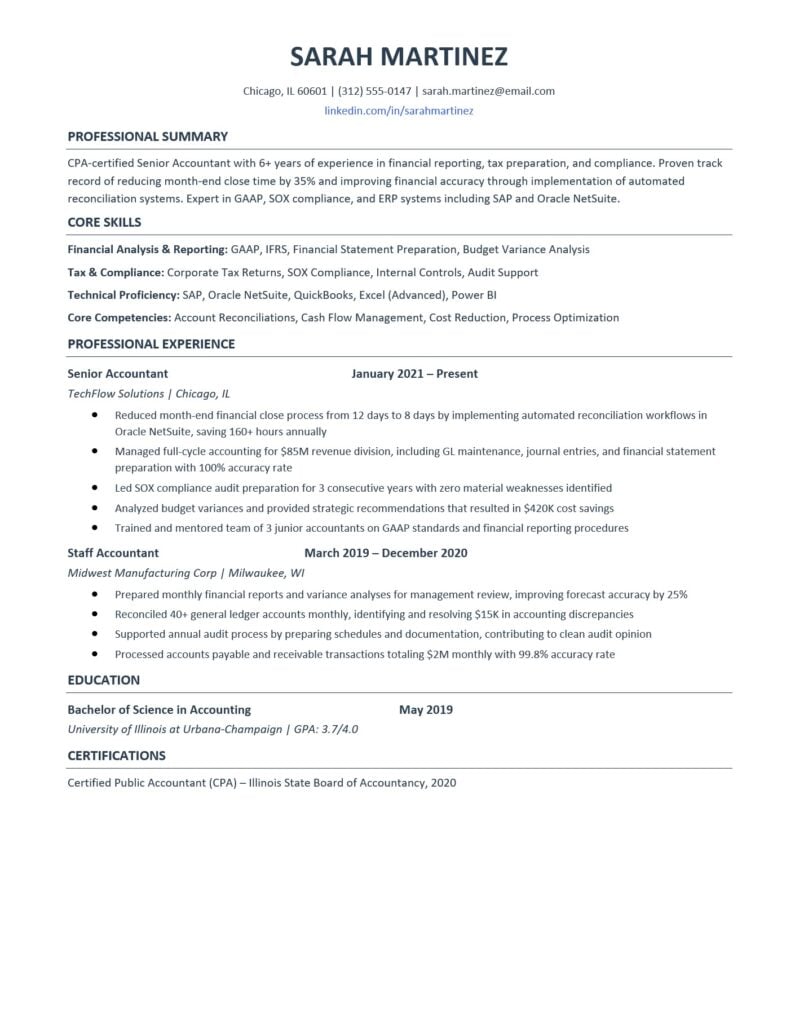
Here’s a professional accountant resume template you can download and customize. This template is designed to be both visually appealing and ATS-friendly, with clean formatting that highlights your strengths.
Customizable Accountant Resume Template
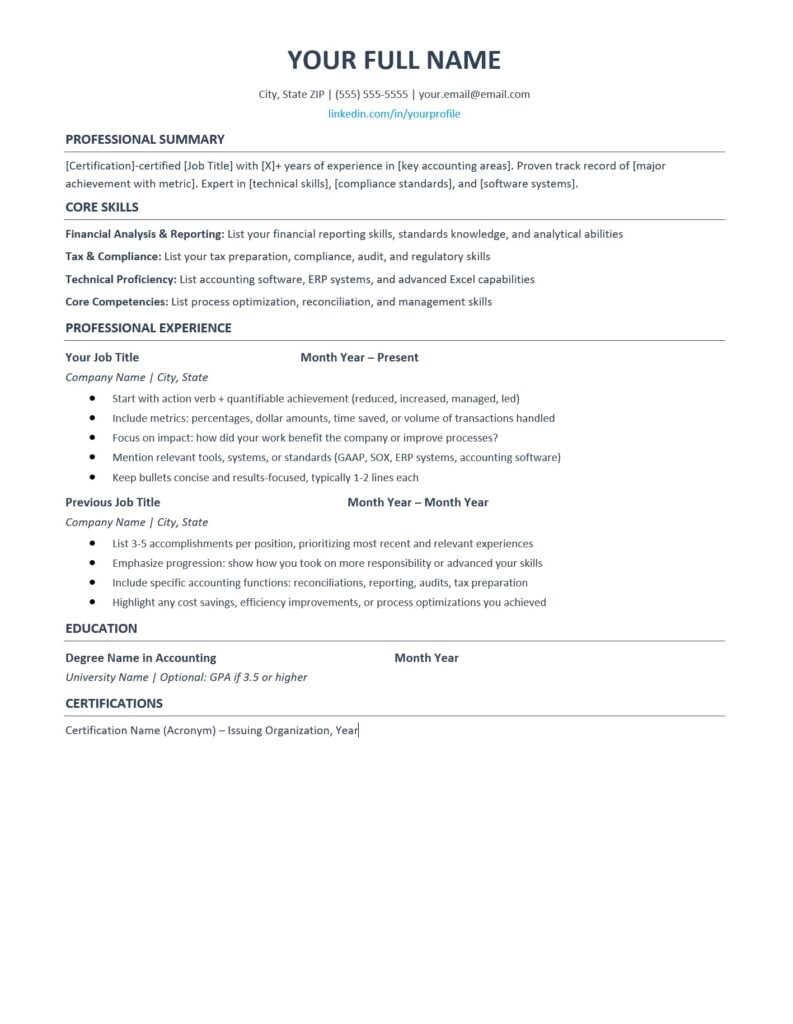
Download Your Free Template:
- Download DOCX Template (fully editable in Microsoft Word)
Interview Guys Tip: The DOCX template is fully editable, allowing you to adjust fonts, colors, and spacing to match your personal brand while maintaining professional formatting. Just replace the placeholder text with your own information.
Here’s what most people don’t realize: employers now expect multiple technical competencies, not just one specialization. The days of being “just a marketer” or “just an analyst” are over. You need AI skills, project management, data literacy, and more. Building that skill stack one $49 course at a time is expensive and slow. That’s why unlimited access makes sense:
Your Resume Needs Multiple Certificates. Here’s How to Get Them All…
We recommend Coursera Plus because it gives you unlimited access to 7,000+ courses and certificates from Google, IBM, Meta, and top universities. Build AI, data, marketing, and management skills for one annual fee. Free trial to start, and you can complete multiple certificates while others finish one.
Essential Components of an Accountant Resume
Every strong accountant resume includes these core sections:
Contact Information appears at the top with your name prominently displayed. Include your city and state (no full address needed), phone number, professional email, and LinkedIn profile URL. Skip the objective statement unless you’re a recent graduate or career changer.
Professional Summary gives you 3-4 sentences to make your case. Lead with your certification (CPA, CMA, etc.), years of experience, and specializations. Follow with your top achievement using a specific metric, then close with your technical expertise.
Core Skills should be organized into categories that align with common job requirements. Group related competencies together: financial reporting skills, compliance and audit expertise, technical proficiencies, and core competencies. This makes it easy for both ATS and human reviewers to find what they need.
Professional Experience forms the meat of your resume. List positions in reverse chronological order with 3-5 bullet points per role. Each bullet should start with a strong action verb and include quantifiable results.
Education and Certifications typically appear last. List your degree, institution, and graduation date. If your GPA was 3.5 or higher, include it. Certifications deserve their own section and should list the full name, acronym, issuing body, and year obtained.
How to Write Your Professional Summary
Your professional summary answers one question: Why should we interview you?
Start with your credentials and specialization. “CPA-certified Senior Accountant with 6+ years in financial reporting and tax preparation” immediately establishes credibility. This opening should match the job title you’re targeting.
Next, prove your value with your biggest achievement. Don’t write “responsible for month-end close.” Instead, write “Reduced month-end close time by 35% through implementation of automated reconciliation workflows.” This demonstrates impact, not just duties.
Close with your technical toolkit. List 2-3 relevant systems or competencies that align with the job description. If the posting mentions SAP and SOX compliance, those exact terms should appear in your summary.
Avoid generic phrases like “hard-working,” “team player,” or “excellent communication skills.” These tell the reader nothing about your specific accounting expertise. Let your achievements and technical skills speak for themselves.
Writing Effective Professional Experience Bullets
Your experience section needs to walk a fine line between comprehensive and concise. Each bullet point should follow this formula: action verb + specific task + quantifiable result.
Weak bullet: “Prepared monthly financial reports”
Strong bullet: “Prepared monthly financial reports and variance analyses for management review, improving forecast accuracy by 25%”
The difference? The strong version includes the methodology (variance analyses), the audience (management), and the measurable outcome (25% improvement). It transforms a basic responsibility into a meaningful achievement.
Interview Guys Tip: Use the “so what?” test on every bullet point. If you can’t answer why this achievement mattered to the business, rewrite it with more context or a stronger metric. Hiring managers want to see how your work translated into tangible value.
When describing your accounting experience, prioritize recent and relevant positions. If you’re applying for a senior role, your entry-level position from five years ago gets 2-3 bullets maximum. Your current or most recent position should have 4-5 detailed accomplishments.
Strong Action Verbs for Accountants
Choose action verbs that communicate precision and impact. Instead of generic verbs like “did” or “handled,” use accounting-specific terminology:
- For financial reporting: Prepared, compiled, analyzed, reconciled, consolidated, audited
- For process improvement: Streamlined, automated, optimized, reduced, eliminated, improved
- For leadership: Led, managed, trained, mentored, coordinated, directed
- For compliance: Ensured, maintained, implemented, verified, documented, established
The right verb sets the tone for your entire bullet point and signals your level of responsibility.
Crafting Your Core Skills Section
Your Core Skills section does heavy lifting for both ATS and human reviewers. This is where you pack in the keywords that will get your resume past software filters while making it easy for hiring managers to verify your qualifications at a glance.
Organize skills into four categories:
- Financial Analysis & Reporting: Include accounting standards (GAAP, IFRS), report types you’ve prepared, and analytical methods you use. Examples: Financial statement preparation, budget variance analysis, cash flow forecasting, cost accounting.
- Tax & Compliance: List tax expertise, regulatory knowledge, and audit experience. Examples: Corporate tax returns, SOX compliance, internal controls, quarterly/annual audit support, risk assessment.
- Technical Proficiency: Name specific software and systems. Don’t just write “accounting software.” List SAP, Oracle NetSuite, QuickBooks, Sage, or whatever you’ve actually used. Include Excel capabilities like pivot tables, VLOOKUP, or macros if you’re advanced.
- Core Competencies: Add the soft skills and processes that round out your profile. Examples: Account reconciliations, month-end close, AP/AR management, process optimization, team leadership.
This categorization serves multiple purposes. It helps ATS match your skills to job requirements. It allows recruiters to quickly scan for must-have qualifications. And it demonstrates that you understand how accounting skills are typically organized and evaluated.
ATS Optimization for Accounting Resumes
Let’s talk about the elephant in the room: applicant tracking systems. These software programs scan your resume before any human sees it, and they can be ruthless.
The accounting shortage means companies are flooded with applications. When Robert Half surveyed finance leaders in 2025, they found that it takes an average of seven weeks to fill permanent accounting roles. Part of that delay comes from sorting through high application volumes, which is why ATS usage is universal.
Here’s how to make your resume ATS-friendly:
- Use standard section headers. Stick with “Professional Experience,” “Education,” “Skills,” and “Certifications.” Don’t get creative with “My Journey” or “Where I’ve Made Impact.” ATS looks for conventional labels.
- Include both acronyms and full terms. Write “Certified Public Accountant (CPA)” instead of just “CPA.” Write “Generally Accepted Accounting Principles (GAAP)” on first use. This doubles your keyword matches.
- Match job description language. If the posting says “accounts payable,” don’t write “AP management.” If it says “financial reporting,” use those exact words. The ATS is looking for literal matches.
- Avoid tables, text boxes, and graphics. These formatting elements confuse ATS parsers. Stick with standard paragraphs and bullet points using simple formatting.
- Save as DOCX or PDF. Most systems handle both formats well, but if the job posting specifies one, follow those instructions exactly.
You can learn more about optimizing your resume in our guide on ATS resume formatting.
Interview Guys Tip: Before you submit another application, run your resume through an ATS scanner. Most job seekers skip this step and wonder why they never hear back. Check out the free ATS checker we use and recommend →
Common Mistakes to Avoid
Even experienced accountants make critical resume errors that cost them interviews. Here are the most common mistakes:
Listing duties instead of achievements. Your resume shouldn’t read like a job description. Every bullet point should highlight what you accomplished, not just what you were responsible for. “Managed accounts payable” tells me nothing. “Processed $2M in monthly AP transactions with 99.8% accuracy rate” shows competence and reliability.
Omitting quantifiable metrics. Numbers are the universal language of business, and accounting is literally all about numbers. If you can’t quantify an achievement, either dig deeper to find the metric or cut that bullet point entirely. How much did you save? How many accounts did you manage? By what percentage did you improve efficiency?
Using an outdated format. That two-column resume with your photo and skill bars? It’s killing your chances. ATS can’t parse columns reliably, photos are inappropriate for U.S. resumes, and visual skill ratings tell hiring managers nothing about your actual proficiency level.
Forgetting to tailor for each application. The days of blast-sending one generic resume are over. Every application should involve reviewing the job description, identifying 5-10 critical keywords, and ensuring those terms appear naturally throughout your resume. This takes 10 minutes per application but dramatically increases your interview rate.
Including irrelevant information. Unless you’re a recent graduate, your high school achievements don’t belong on your resume. Neither does your marital status, age, or hobbies (unless they’re directly relevant to the position). Every line should reinforce why you’re the right accountant for this specific job.
Skipping the proofread. A typo on an accountant’s resume is particularly damaging because attention to detail is a core requirement of the job. Use spell check, read your resume backward, and have someone else review it. Zero tolerance for errors.
Highlighting Your Education and Certifications
Your education section is straightforward but important. List your degree, major (or make it clear it’s an accounting degree), institution, and graduation date. New graduates can include their GPA if it’s 3.5 or higher and relevant coursework or academic honors.
If you have a master’s degree, include both your bachelor’s and master’s. If you started a degree but didn’t finish, you can list “X credits toward Bachelor of Science in Accounting” with the dates attended.
Certifications deserve special attention in accounting. Your CPA, CMA, CIA, or other credentials should have their own section, not be buried in education. Format them like this: Certified Public Accountant (CPA), Illinois State Board of Accountancy, 2020.
If you’re currently pursuing a certification, include it with “In Progress” and your expected completion date. Many employers value candidates who are actively working toward credentials, especially with the critical CPA shortage facing the industry.
The accounting field is seeing fewer new entrants, with CPA exam candidates down 27% over the past decade according to recent industry analysis. This makes your certifications even more valuable. If you have them, make them prominent. If you’re pursuing them, say so.
Creating Your Skills-Based Resume Sections
Some accountants benefit from leading with a skills-based approach, particularly career changers or those with employment gaps. However, most accounting positions still require the traditional chronological format.
If you’re considering a skills-based resume, you need a compelling reason. Are you transitioning from bookkeeping to accounting? Moving from public accounting to corporate finance? Have a gap due to parental leave or education?
Even in these cases, you’re better off using a hybrid approach that leads with your skills but still includes your chronological work history. Employers want to see your career progression, and a purely functional resume raises red flags.
The better strategy? Use your Professional Summary and Core Skills sections to frontload your most relevant qualifications, then follow with a straightforward chronological experience section. This gives you the best of both worlds: immediate relevance and transparency about your work history.
For more guidance on resume structure, explore our article on resume formatting best practices.
Interview Guys Tip: If you’re changing careers into accounting, emphasize transferable skills in your summary and skills sections. Financial analysis, data management, audit support, and compliance all translate across industries. Then use your experience bullets to highlight achievements that demonstrate these competencies, even if they came from non-accounting roles.
FAQ: Accountant Resume Questions
Should I include my CPA license number on my resume?
No. Your resume should state that you’re a Certified Public Accountant and include the issuing state and year, but save the license number for background check forms. It’s unnecessary detail that takes up valuable space.
How far back should my work history go?
Generally 10-15 years is sufficient. If you have earlier experience that’s highly relevant, you can include it, but focus your detailed bullet points on your most recent positions. Older roles can be listed with just title, company, and dates.
What if I don’t have accounting software experience?
Be honest about what you’ve used, but also emphasize your ability to learn new systems quickly. If you’ve mastered multiple accounting platforms, mention that as evidence of adaptability. Consider taking free trials or online courses to gain familiarity with industry-standard software like QuickBooks or Excel.
Do I need a cover letter with my accountant resume?
Not always, but it helps. When applying to competitive positions or making a career change, a tailored cover letter can provide context your resume can’t. Keep it to three paragraphs and focus on why you’re interested in this specific role. Check out our cover letter writing guide for detailed advice.
How do I explain employment gaps on my accounting resume?
Address gaps briefly and honestly. If you took time off for education, family, or health reasons, you can include a line in your experience section. For example: “Career Development (2023-2024): Completed CPA certification while managing family responsibilities.” Then move on. Don’t over-explain or apologize. Focus on what you accomplished during that time and how you’ve kept your skills current.
Your Next Steps
You now have everything you need to create a compelling accountant resume that gets past ATS filters and impresses hiring managers. The templates give you a professional foundation. The guidance in this article helps you fill each section with relevant, achievement-focused content.
Here’s your action plan: Download both templates. Review the example to understand what strong content looks like. Open the blank template and start with your contact information and professional summary. Work through each section methodically, tailoring every bullet point to demonstrate your value.
Before you submit any application, run your resume through an ATS checker to identify potential formatting or keyword issues. Proofread obsessively. Then customize your resume for each specific job posting by incorporating their exact language and requirements.
The accounting job market strongly favors candidates right now, with unemployment rates far below average and thousands of positions going unfilled. Your resume is your ticket to those opportunities. Make it count.
Here’s what most people don’t realize: employers now expect multiple technical competencies, not just one specialization. The days of being “just a marketer” or “just an analyst” are over. You need AI skills, project management, data literacy, and more. Building that skill stack one $49 course at a time is expensive and slow. That’s why unlimited access makes sense:
Your Resume Needs Multiple Certificates. Here’s How to Get Them All…
We recommend Coursera Plus because it gives you unlimited access to 7,000+ courses and certificates from Google, IBM, Meta, and top universities. Build AI, data, marketing, and management skills for one annual fee. Free trial to start, and you can complete multiple certificates while others finish one.

BY THE INTERVIEW GUYS (JEFF GILLIS & MIKE SIMPSON)
Mike Simpson: The authoritative voice on job interviews and careers, providing practical advice to job seekers around the world for over 12 years.
Jeff Gillis: The technical expert behind The Interview Guys, developing innovative tools and conducting deep research on hiring trends and the job market as a whole.