
Free Electrical Engineer Resume Template 2025: Download ATS-Friendly Examples & Writing Guide
Landing your dream electrical engineering role starts with a resume that gets past the robots and impresses the humans. Sounds simple, right? But here’s the reality: most electrical engineer resumes never make it past applicant tracking systems, which automatically filter out 75% of applications before a single hiring manager reads them.
You’ve spent years mastering circuit design, power systems, and control theory. You can optimize energy consumption and troubleshoot complex electrical systems with your eyes closed. Yet somehow, translating all that technical brilliance onto a resume feels like solving an equation with too many variables.
That’s exactly why we created this guide. By the end of this article, you’ll have access to professional, ATS-friendly resume templates specifically designed for electrical engineers, understand exactly which technical keywords to include, know how to quantify your engineering achievements, and learn the proven structure that gets interviews. Plus, you’ll avoid the common formatting mistakes that send qualified candidates straight to the rejection pile.
Let’s transform your experience into a resume that opens doors to interviews at your target companies.
☑️ Key Takeaways
- ATS-friendly formatting is critical as over 98% of engineering firms use automated screening software that rejects poorly formatted resumes before human review
- Quantifiable achievements dramatically outperform generic job duties, with electrical engineers who include specific metrics seeing 40% more interview callbacks
- Strategic keyword placement throughout your resume, not just in a skills section, increases your chances of passing ATS filters by matching exact terminology from job descriptions
- The optimal resume structure for electrical engineers prioritizes technical skills near the top, uses reverse chronological work history, and fits on one page for early-career professionals
What Makes an Electrical Engineer Resume Different?
Electrical engineering resumes require a unique balance that other professions don’t. You need to showcase hardcore technical skills while proving you can communicate complex concepts to non-engineers. Your resume must speak two languages: the technical language of engineering and the results-oriented language of business.
According to recent hiring data, about 9,800 new electrical engineering positions are projected over the next decade, with the ratio of job openings to qualified engineers remaining around 3:1. This means competition is real, but opportunities exist for engineers who position themselves effectively.
Here’s what separates electrical engineer resumes from other technical roles: you’re dealing with regulated industries where certifications matter enormously, your work directly impacts safety and compliance, and hiring managers need to see both your technical depth and your ability to manage projects and budgets.
Interview Guys Tip: Modern electrical engineering increasingly involves programming and software integration. If you have experience with Python, C++, MATLAB, or machine learning applications in signal processing or automation, highlight these skills prominently. They’re becoming differentiators in a crowded field.
Electrical Engineer Resume Example
Here’s a professional resume example. This example gives you an idea of what type of content fits in a good ATS friendly resume.
Example Resume:
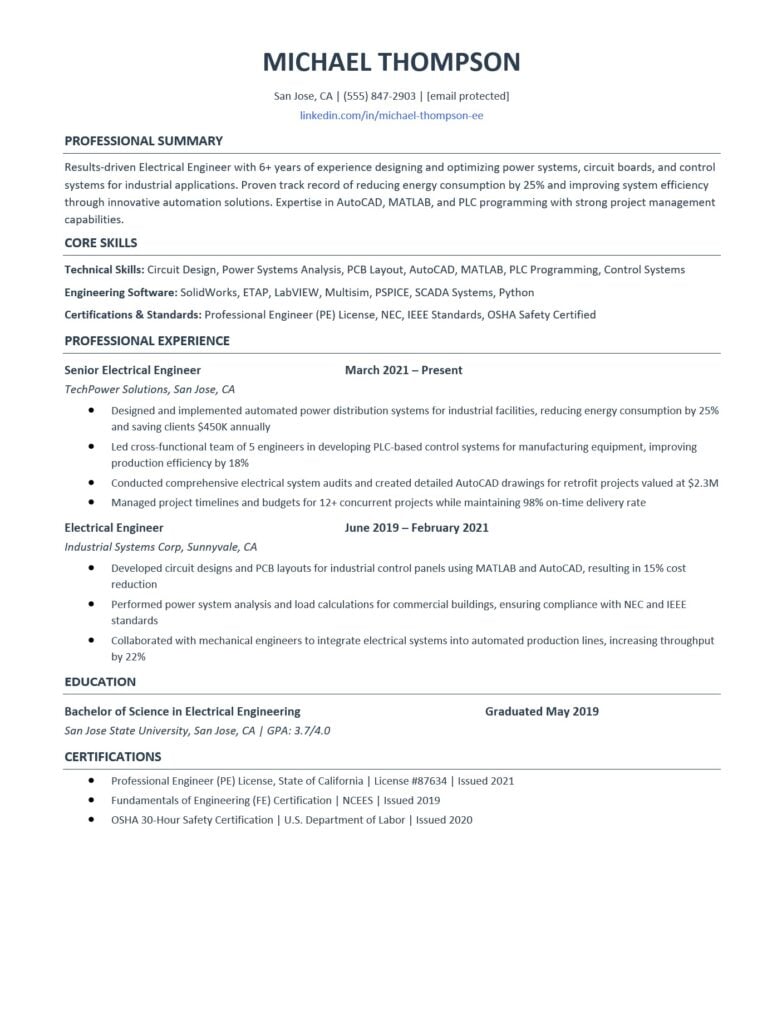
Here’s a professional electrical engineer resume template you can download and customize. This template is designed to be both visually appealing and ATS-friendly, with clean formatting that highlights your strengths.
Blank Customizable Template

Download Your Free Template:
- Download DOCX Template (fully editable in Microsoft Word)
Interview Guys Tip: The DOCX template is fully editable, allowing you to adjust fonts, colors, and spacing to match your personal brand while maintaining professional formatting. Just replace the placeholder text with your own information.
Here’s what most people don’t realize: employers now expect multiple technical competencies, not just one specialization. The days of being “just a marketer” or “just an analyst” are over. You need AI skills, project management, data literacy, and more. Building that skill stack one $49 course at a time is expensive and slow. That’s why unlimited access makes sense:
Your Resume Needs Multiple Certificates. Here’s How to Get Them All…
We recommend Coursera Plus because it gives you unlimited access to 7,000+ courses and certificates from Google, IBM, Meta, and top universities. Build AI, data, marketing, and management skills for one annual fee. Free trial to start, and you can complete multiple certificates while others finish one.
Essential Components Every Electrical Engineer Resume Needs
Your resume isn’t just a list of jobs you’ve held. It’s a strategic document designed to get past automated systems and convince hiring managers you’re the solution to their specific engineering challenges.
Contact Information comes first, but there’s a catch: never put this in headers or footers where ATS systems can’t read it. Include your full name, city and state (skip the full address for privacy), professional email, phone number, and LinkedIn profile URL. Make sure your email address looks professional and skip the outdated AOL or Hotmail accounts.
Professional Summary sits at the top and serves as your elevator pitch. This isn’t where you say “detail-oriented engineer seeking opportunities.” Instead, write 3-4 sentences highlighting your years of experience, key specializations like power systems or circuit design, major quantified achievements, and core technical competencies. Think of it as your engineering value proposition condensed into 60 seconds of reading time.
Core Skills section belongs near the top because that’s where ATS systems hunt for technical keywords. Organize your skills into categories: Technical Skills (circuit design, power systems analysis, PCB layout), Engineering Software (AutoCAD, MATLAB, PLC programming, SCADA systems), and Certifications & Standards (PE license, NEC, IEEE standards, OSHA safety certification). This organization makes it scannable for humans while ensuring ATS systems capture your technical breadth.
Professional Experience forms your resume’s backbone. Use reverse chronological order, starting with your current or most recent position. For each role, include your job title, company name and location, and employment dates. Then here’s where most engineers go wrong: they list responsibilities instead of achievements.
Interview Guys Tip: Every bullet point in your experience section should follow this formula: Action Verb + Technical Task + Quantifiable Result. Instead of “Responsible for designing electrical systems,” write “Engineered automated power distribution systems that reduced energy consumption by 25% and saved clients $450K annually.” See the difference?
How to Write Each Resume Section for Maximum Impact
Let’s break down exactly how to craft each section to maximize your chances of landing interviews.
Crafting Your Professional Summary
Your professional summary needs to accomplish three things in under 100 words: establish your engineering credentials, highlight your specialization, and preview your biggest wins.
Start with your years of experience and primary expertise: “Results-driven Electrical Engineer with 6+ years specializing in industrial power systems and automation.” Then add your most impressive quantified achievement: “Proven track record of reducing energy consumption by 25% through innovative control system designs.” Finish with your technical toolkit: “Expert in AutoCAD, MATLAB, PLC programming, and project management for multimillion-dollar engineering projects.”
Notice how this flows naturally while packing in keywords like “power systems,” “automation,” “energy consumption,” “control system,” and specific software? That’s intentional. You’re writing for humans while feeding the ATS what it’s hunting for.
Building Your Technical Skills Arsenal
The skills section requires strategic thinking. Don’t just list every software tool you’ve ever touched. Instead, focus on skills mentioned in your target job descriptions and organize them logically.
Review job postings for electrical engineers at companies you’re targeting. Notice which technical terms appear repeatedly? Those are your keywords. If every posting mentions “AutoCAD” and “PLC programming,” those terms better appear in your skills section using those exact phrases, not synonyms.
According to industry research on ATS optimization, matching job description terminology exactly increases your chances of passing automated filters. If the posting says “AutoCAD,” don’t substitute “computer-aided design software.” If they want “power distribution,” don’t write “electrical system management.”
Group your skills into three categories:
- Technical Skills: Your core engineering competencies like circuit design, power systems analysis, and control systems
- Engineering Software: Specific tools like AutoCAD, MATLAB, LabVIEW, ETAP, PSPICE, and Python
- Certifications & Standards: Your PE license, FE certification, OSHA safety training, and knowledge of NEC and IEEE standards
Writing Achievement-Focused Experience Bullets
This is where most electrical engineers sabotage their own resumes. They write about what they were “responsible for” instead of what they accomplished. Hiring managers don’t care about your job description. They care about the problems you solved and the value you delivered.
Here’s the transformation:
- Weak: “Responsible for designing electrical systems for commercial buildings.”
- Strong: “Designed power distribution systems for 8 commercial facilities totaling 2.4M square feet, implementing energy-efficient LED lighting and smart controls that reduced electricity costs by 32% ($180K annually).”
See how the strong version includes specific numbers, technical details, and business outcomes? That’s what gets interviews.
For every bullet point, ask yourself: “So what? What was the result? How did this help the company?” Then quantify it. Did you reduce costs? By what percentage or dollar amount? Did you improve efficiency? Speed up processes? Prevent downtime? Numbers make your achievements concrete and credible.
Interview Guys Tip: Include industry-standard software and methodologies in your bullet points naturally. Instead of “Completed project on time,” write “Delivered $2.3M power system upgrade on schedule using AutoCAD for design documentation and MS Project for timeline management, achieving 98% stakeholder satisfaction.”
Education and Certifications That Stand Out
For electrical engineers, education typically includes your degree and any relevant coursework or academic achievements. List your highest degree first: Bachelor of Science in Electrical Engineering (or Master’s if applicable), the university name, location, and graduation date.
If your GPA is 3.5 or higher, include it. If you made Dean’s List, graduated with honors, or completed a notable senior project or thesis, mention it. Once you have 3+ years of experience, education becomes less prominent and can move below your experience section.
Certifications deserve their own section because they’re huge differentiators in electrical engineering. Your Professional Engineer (PE) license is gold standard and should be listed with your license number and issuing state. The Fundamentals of Engineering (FE) certification matters for early-career engineers. OSHA safety certifications, six sigma training, and project management certifications (PMP) all add credibility.
When listing certifications, use this format: Certification Name | Issuing Organization | Date Obtained | License Number (if applicable).
Common Mistakes That Kill Electrical Engineer Resumes
Let’s talk about what not to do, because sometimes learning from mistakes is faster than learning best practices.
- Mistake #1: Creative formatting that breaks ATS parsers. Those beautiful two-column layouts, fancy graphics, and creative fonts might look stunning, but they confuse applicant tracking systems. Stick with simple, clean single-column layouts using standard fonts like Calibri, Arial, or Times New Roman.
- Mistake #2: Generic job duties instead of specific achievements. “Maintained electrical systems” tells hiring managers nothing. “Implemented predictive maintenance program for industrial electrical systems, reducing equipment failures by 40% and extending asset lifecycles by 3 years” tells them you deliver measurable value.
- Mistake #3: Missing critical keywords. If the job posting mentions “NEC compliance” and “IEEE standards” but your resume says “electrical code knowledge,” the ATS might not make the connection. Match their language exactly.
- Mistake #4: Burying your best stuff. If your most impressive achievement is at the bottom of your second page, hiring managers might never see it. Put your strongest accomplishments in the first few bullet points of your most recent position.
- Mistake #5: Ignoring soft skills entirely. Yes, technical skills matter most, but electrical engineers need to communicate with clients, lead project teams, and explain complex systems to non-technical stakeholders. Weave evidence of these abilities into your achievement bullets.
ATS Optimization and Keywords for Electrical Engineers
Understanding how applicant tracking systems work gives you a massive advantage. These aren’t evil robots trying to keep you unemployed. They’re filters helping overwhelmed hiring managers find qualified candidates efficiently.
ATS systems scan your resume for specific keywords, typically pulled directly from the job description. They look for technical skills, software proficiencies, certifications, and industry terminology. Then they rank candidates based on how well their resumes match the job requirements.
Here’s your optimization strategy: Create a master resume with all your experience, skills, and achievements. Then for each application, customize it to mirror the language in that specific job posting. This doesn’t mean lying about skills you don’t have. It means emphasizing the right skills and using the employer’s exact terminology.
For example, if Job A emphasizes “renewable energy systems” and “smart grid technologies,” make sure those phrases appear in your skills and experience. If Job B focuses on “industrial automation” and “PLC programming,” adjust your emphasis accordingly.
Key electrical engineering keywords to include (when accurate):
- Technical: Circuit design, power systems, PCB layout, control systems, power distribution, load calculations, electrical schematics
- Software: AutoCAD, MATLAB, LabVIEW, ETAP, Multisim, PSPICE, SolidWorks, Python, SCADA systems
- Standards & Codes: NEC, IEEE, NFPA, OSHA, IEC standards
- Specializations: Renewable energy, smart grid, automation, robotics, telecommunications, signal processing
Need more help with how to optimize your resume for ATS systems? We’ve got you covered with detailed strategies that work across all engineering disciplines.
Interview Guys Tip: Before you submit another application, run your resume through an ATS scanner. Most job seekers skip this step and wonder why they never hear back. Check out the free ATS checker we use and recommend →
Tailoring Your Resume for Different Electrical Engineering Specializations
Not all electrical engineering roles are created equal. A power systems engineer’s resume should emphasize different skills than a circuit design specialist or an automation engineer.
- For power systems engineers, highlight experience with transmission and distribution, load flow analysis, protective relaying, and renewable energy integration. Emphasize projects involving grid infrastructure, substations, or utility-scale installations.
- For control systems engineers, focus on PLC programming, SCADA systems, HMI design, and process automation. Showcase experience with industrial control systems, manufacturing automation, and instrumentation.
- For circuit design and PCB engineers, emphasize analog and digital circuit design, PCB layout experience with tools like Altium or Eagle, component selection, and testing methodologies. Include any experience with high-frequency design, signal integrity, or power electronics.
- For automation and robotics engineers, highlight programming skills (Python, C++, MATLAB), sensor integration, motion control, and machine vision systems. Showcase projects involving automated systems, conveyor controls, or robotic applications.
Customize your professional summary and skills section to reflect the specialization most relevant to your target role. Then reorder your experience bullets to put the most relevant achievements first.
Frequently Asked Questions
How long should an electrical engineer resume be?
For early-career engineers with less than 5 years of experience, keep it to one page. Mid-career engineers with 5-10 years can extend to two pages if needed. Senior engineers and those in management roles can use two full pages. Never go beyond two pages unless you’re in academia or applying for government positions requiring detailed work histories.
Should I include my undergraduate projects on my resume?
Only if you’re a recent graduate or the project directly relates to the job you’re applying for. For example, if you designed a solar panel optimization system for your senior project and you’re applying to renewable energy companies, absolutely include it. Otherwise, once you have professional experience, replace academic projects with real-world achievements.
Do I need a PE license to get hired as an electrical engineer?
It depends on your industry and career goals. Power systems, utilities, and consulting firms often require or strongly prefer PE licensure. Consumer electronics, manufacturing, and tech companies typically don’t require it. That said, having your PE license never hurts and often opens doors. At minimum, get your FE certification and work toward the PE.
How do I showcase soft skills on a technical resume?
Don’t create a separate “soft skills” section. Instead, weave evidence of communication, leadership, and collaboration into your achievement bullets. “Led cross-functional team of 8 engineers and technicians” shows leadership. “Presented technical findings to non-technical stakeholders” demonstrates communication. “Collaborated with mechanical engineers to integrate electrical systems” proves teamwork.
What’s the best way to describe career gaps on an electrical engineer resume?
Brief gaps under 6 months don’t need explanation. For longer gaps, you can include a line in your experience section like “Career Break (dates) – Professional development including [relevant courses, certifications, or freelance projects].” The key is having something to show for the time, whether it’s upskilling, consulting work, or relevant volunteer experience.
From Resume to Interview: Your Next Steps
You’ve got the template, you understand the structure, and you know how to optimize for both ATS systems and human hiring managers. Now it’s time to build your winning resume.
Start by downloading both versions of our electrical engineer resume templates above. Use the example template for inspiration and structure, then customize the blank template with your own information. Remember to quantify every achievement, match keywords from your target job descriptions, and keep formatting simple and ATS-friendly.
Once you’ve landed that interview, make sure you’re prepared for the types of questions electrical engineering hiring managers ask. Check out our comprehensive guide to electrical engineer interview questions and answers to nail every technical question and behavioral scenario.
Your electrical engineering expertise deserves a resume that showcases it effectively. With these templates and strategies, you’re equipped to create a document that gets past the robots and impresses the humans. Now go build something that opens doors to your next opportunity.
For even more resume templates across different industries and experience levels, browse our complete free resume template library. You’ll find formats optimized for every career stage and specialization.
Here’s what most people don’t realize: employers now expect multiple technical competencies, not just one specialization. The days of being “just a marketer” or “just an analyst” are over. You need AI skills, project management, data literacy, and more. Building that skill stack one $49 course at a time is expensive and slow. That’s why unlimited access makes sense:
Your Resume Needs Multiple Certificates. Here’s How to Get Them All…
We recommend Coursera Plus because it gives you unlimited access to 7,000+ courses and certificates from Google, IBM, Meta, and top universities. Build AI, data, marketing, and management skills for one annual fee. Free trial to start, and you can complete multiple certificates while others finish one.

BY THE INTERVIEW GUYS (JEFF GILLIS & MIKE SIMPSON)
Mike Simpson: The authoritative voice on job interviews and careers, providing practical advice to job seekers around the world for over 12 years.
Jeff Gillis: The technical expert behind The Interview Guys, developing innovative tools and conducting deep research on hiring trends and the job market as a whole.