
Free DevOps Engineer Resume Template 2025: ATS Examples & Writing Guide
Landing a DevOps engineer role requires more than just technical chops. You need a resume that speaks both human and machine language while proving you can bridge the gap between development and operations teams.
Here’s the challenge: DevOps is still a relatively young field, and hiring managers have wildly different expectations depending on their organization’s maturity level. Some want infrastructure wizards who can automate anything. Others need collaboration experts who can break down silos. The best DevOps resumes do both.
The average DevOps engineer salary sits at $141,136 per year, according to Glassdoor, with experienced professionals earning significantly more in tech hubs like San Francisco and Seattle. With such competitive compensation on the line, your resume needs to immediately demonstrate value. By the end of this article, you’ll have a proven template and the exact strategies to showcase your automation expertise, cloud platform proficiency, and measurable impact on system reliability in a way that gets interviews.
☑️ Key Takeaways
- DevOps engineers earn an average of $141,136 annually, with top earners making over $217,000, making a standout resume essential for capturing these lucrative opportunities.
- Quantifiable achievements are critical for DevOps resumes because they demonstrate your actual impact on deployment speed, system reliability, and cost reduction in measurable terms.
- The right resume structure matters for this role: lead with a technical summary, showcase cloud platforms and automation tools prominently, and emphasize cross-functional collaboration.
- ATS optimization is non-negotiable since most DevOps roles require passing through automated screening systems that scan for specific keywords like Kubernetes, Terraform, and CI/CD.
What Makes a DevOps Engineer Resume Different?
DevOps resumes require a delicate balance. You’re not purely a systems administrator, and you’re not strictly a software developer. You’re the person who makes the entire software delivery lifecycle faster, more reliable, and more efficient.
Traditional IT resumes focus heavily on technical certifications and specific technologies. Developer resumes emphasize coding languages and project outcomes. Your DevOps resume needs both, plus something extra: evidence that you can collaborate across teams and automate processes that save real time and money.
The hiring manager reviewing your resume wants answers to specific questions. Can you reduce deployment times? Will you improve system uptime? Do you understand both the development and operations perspectives? Your resume needs to answer these questions immediately, preferably with quantifiable metrics.
Interview Guys Tip: DevOps hiring managers often skim resumes looking for two things first: cloud platform expertise (AWS, Azure, or GCP) and container orchestration experience. Make sure these appear in your first few lines, not buried halfway down the page.
Devops Engineer Resume Example
Here’s a professional resume example. This example gives you an idea of what type of content fits in a good ATS friendly resume.
Example Resume:
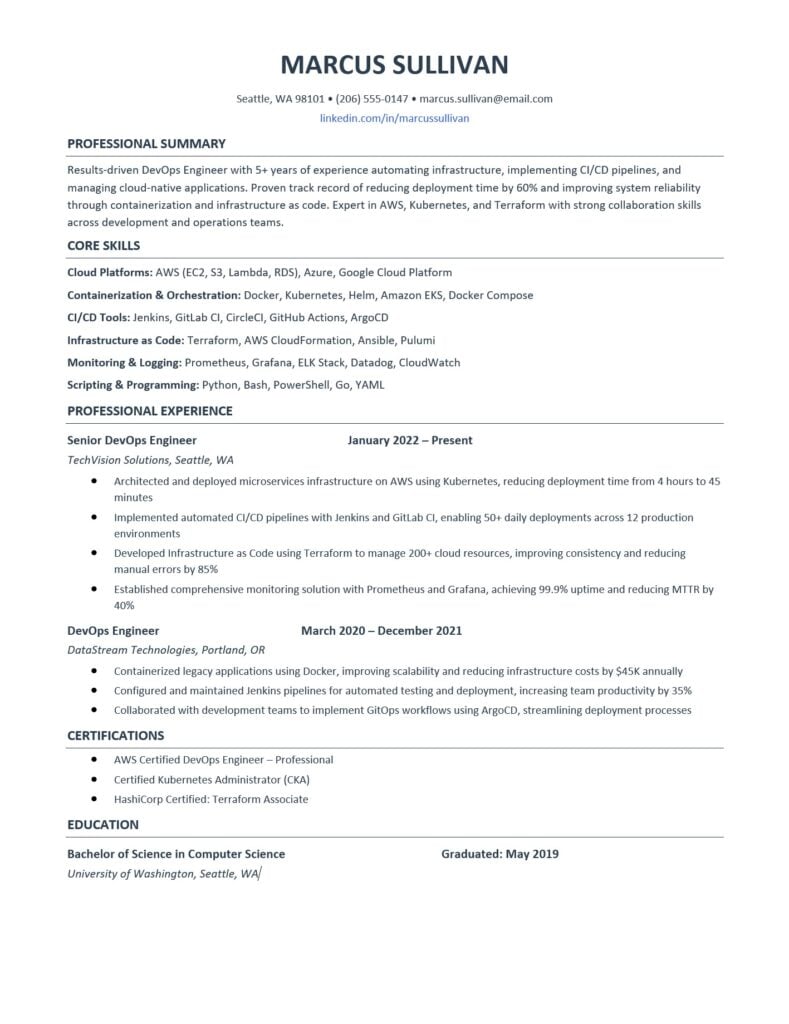
Here’s a professional devops engineer resume template you can download and customize. This template is designed to be both visually appealing and ATS-friendly, with clean formatting that highlights your strengths.
Blank Customizable Template
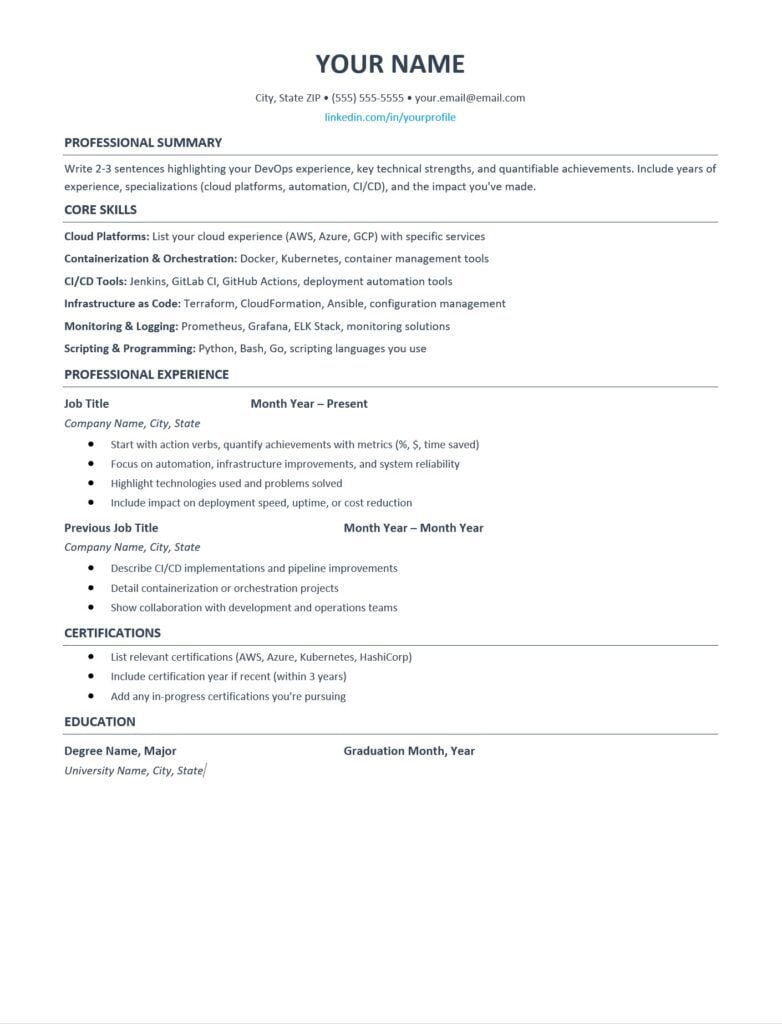
Download Your Free Template:
- Download DOCX Template (fully editable in Microsoft Word)
Interview Guys Tip: The DOCX template is fully editable, allowing you to adjust fonts, colors, and spacing to match your personal brand while maintaining professional formatting. Just replace the placeholder text with your own information.
Here’s what most people don’t realize: employers now expect multiple technical competencies, not just one specialization. The days of being “just a marketer” or “just an analyst” are over. You need AI skills, project management, data literacy, and more. Building that skill stack one $49 course at a time is expensive and slow. That’s why unlimited access makes sense:
Your Resume Needs Multiple Certificates. Here’s How to Get Them All…
We recommend Coursera Plus because it gives you unlimited access to 7,000+ courses and certificates from Google, IBM, Meta, and top universities. Build AI, data, marketing, and management skills for one annual fee. Free trial to start, and you can complete multiple certificates while others finish one.
Essential Components of a DevOps Engineer Resume
Your DevOps resume needs six core sections, each serving a specific purpose in telling your professional story.
Professional Summary
Start with a powerful 2-3 sentence summary that positions you as a results-driven automation expert. This isn’t the place for vague statements about being a “team player” or having “strong communication skills.” Instead, lead with your years of DevOps experience, your specialization (cloud-native applications, CI/CD automation, infrastructure as code), and one impressive quantifiable achievement.
For example: “Results-driven DevOps Engineer with 5+ years of experience automating infrastructure, implementing CI/CD pipelines, and managing cloud-native applications. Proven track record of reducing deployment time by 60% and improving system reliability through containerization and infrastructure as code.”
Core Skills Section
This section serves double duty. It helps human readers quickly assess your technical fit, and it feeds keywords to applicant tracking systems scanning your resume.
Organize your skills into logical categories: Cloud Platforms, Containerization & Orchestration, CI/CD Tools, Infrastructure as Code, Monitoring & Logging, and Scripting & Programming. Be specific rather than generic. Don’t just write “cloud experience.” Instead, list “AWS (EC2, S3, Lambda, RDS), Azure, Google Cloud Platform.”
According to Roadmap.sh’s DevOps career guide, the most in-demand technical skills for 2025 include Kubernetes, Terraform, Jenkins, and Python. Make sure your strongest skills in these areas are prominently displayed.
Professional Experience
This is where you prove your impact. Each position should include 3-4 bullet points that follow a simple formula: action verb + what you did + quantifiable result.
Strong DevOps bullets always include metrics. How much faster did deployments become? What percentage improvement in uptime? How much money did you save through automation? These numbers transform vague accomplishments into concrete proof of value.
Focus on achievements that demonstrate DevOps core competencies: automation, collaboration, continuous improvement, and system reliability. Your bullet points should paint a picture of someone who doesn’t just maintain systems but actively improves them.
Certifications
DevOps certifications carry significant weight because they demonstrate validated expertise in specific platforms and tools. The most valuable certifications for 2025 include AWS Certified DevOps Engineer (Professional), Certified Kubernetes Administrator (CKA), and HashiCorp Certified: Terraform Associate.
These certifications aren’t just resume decorations. PayScale data shows that DevOps engineers with AWS certifications earn approximately 15% more than those without cloud certifications. List your certifications prominently, ideally in their own section rather than buried in your education.
Education
For DevOps roles, your education typically matters less than your practical experience and certifications. Most positions prefer a bachelor’s degree in computer science, information technology, or a related field, but many organizations will accept equivalent experience.
Keep this section brief. List your degree, institution, and graduation year. If you’re a recent graduate without much experience, you can add relevant coursework or academic projects involving Linux administration, networking, or software development.
Additional Sections (Optional)
Consider adding sections for open-source contributions, personal projects, or technical blog posts if they’re relevant. DevOps culture values continuous learning and sharing knowledge with the community. If you maintain a popular GitHub repository, contribute to infrastructure tools, or write technical content, these activities demonstrate passion beyond your day job.
How to Write Each Resume Section
Crafting Your Professional Summary
Your summary needs to accomplish three things in 2-3 sentences: establish credibility, highlight specialization, and tease your biggest win.
Start with your experience level and role clarity: “DevOps Engineer with 5+ years of experience” or “Cloud-focused DevOps specialist.” Follow with your technical specialization: what specific areas of DevOps you excel in. End with your most impressive quantifiable achievement.
Avoid generic language that could apply to any IT professional. Phrases like “detail-oriented professional” or “effective communicator” waste valuable space. Instead, use DevOps-specific language: “automation expert,” “infrastructure architect,” or “CI/CD specialist.”
Building a Powerful Skills Section
Your skills section needs strategic organization. Group related technologies together rather than listing them randomly. This organization helps both humans and ATS software understand your capabilities.
Interview Guys Tip: Match your skills section to the job description you’re targeting. If the posting emphasizes AWS and Kubernetes, those should appear in your first skill category. Don’t lie about skills you don’t have, but do prioritize the ones most relevant to each application.
Research from Veritis identifies the top DevOps skills for 2025: Kubernetes, Docker, Terraform, monitoring tools (Prometheus/Grafana), and scripting languages (Python/Bash). Make sure these appear in your skills section if they’re part of your toolkit.
For each skill category, list specific tools rather than general concepts. Instead of “monitoring experience,” write “Prometheus, Grafana, ELK Stack, Datadog, CloudWatch.” This specificity helps your resume pass ATS screening and gives hiring managers confidence in your actual capabilities.
Writing Achievement-Focused Experience Bullets
Every bullet point in your experience section should prove value, not just describe duties. The difference between weak and strong bullets often comes down to one thing: specificity.
Weak bullet: “Responsible for managing CI/CD pipelines.” This tells what you did but not why it mattered or what you achieved.
Strong bullet: “Implemented automated CI/CD pipelines with Jenkins and GitLab CI, enabling 50+ daily deployments across 12 production environments.” This shows the action, the tools, and the quantifiable result.
Use strong action verbs that convey technical expertise: architected, automated, configured, deployed, implemented, optimized, orchestrated, streamlined. Avoid passive voice and weak verbs like “helped with” or “was responsible for.”
Focus your bullets on these high-value DevOps activities: reducing deployment times, improving system uptime, automating manual processes, implementing infrastructure as code, establishing monitoring and alerting, and reducing cloud costs through optimization.
Common Mistakes to Avoid
The “Technology Laundry List” Problem
Some DevOps engineers try to list every technology they’ve ever touched, creating a skills section that spans half the page. This approach backfires. Hiring managers want to see your strengths, not a comprehensive list of tools you’ve used once.
Focus on technologies you can confidently discuss in depth during an interview. If you experimented with a tool in a personal project but never used it professionally, it probably doesn’t belong on your resume for senior-level positions.
Neglecting the Business Impact
Many technical professionals make the mistake of describing what they did without explaining why it mattered. Your resume shouldn’t read like a job description. It should demonstrate business value.
Instead of “Maintained Kubernetes clusters,” write “Optimized Kubernetes cluster configurations, reducing monthly cloud costs by $38K while improving application performance by 25%.” The business impact makes the achievement meaningful.
Ignoring the Collaboration Aspect
DevOps is fundamentally about breaking down silos between development and operations teams. If your resume only showcases technical skills without any indication that you can work effectively across teams, you’re missing a crucial element.
Include bullets that demonstrate collaboration: “Partnered with development teams to implement GitOps workflows” or “Led cross-functional initiative to establish monitoring standards across engineering organization.”
Generic Professional Summary
Starting your resume with a vague summary like “Experienced IT professional seeking challenging DevOps role” wastes your most valuable real estate. This generic opener could apply to thousands of candidates and does nothing to differentiate you.
ATS Optimization and Keywords
Applicant tracking systems scan your resume for specific keywords that match the job description. For DevOps roles, this means including both tools and methodologies in your resume text.
Interview Guys Tip: Before you submit another application, run your resume through an ATS scanner. Most job seekers skip this step and wonder why they never hear back. Check out the free ATS checker we use and recommend →
Key DevOps keywords for 2025 include: CI/CD, continuous integration, continuous deployment, Docker, Kubernetes, containerization, infrastructure as code, Terraform, Ansible, Jenkins, GitLab CI, GitHub Actions, AWS, Azure, GCP, Python, Bash, monitoring, logging, automation, orchestration, microservices, cloud-native, and Agile.
Don’t just stuff these keywords randomly into your resume. Use them naturally within context: “Implemented CI/CD pipelines using Jenkins” or “Managed containerized applications with Docker and Kubernetes.”
The ATS also looks for variations of terms. Include both acronyms and full phrases when appropriate: “CI/CD” and “continuous integration/continuous deployment,” “IaC” and “infrastructure as code.”
Interview Guys Tip: Read the job description carefully and identify the technical requirements mentioned multiple times. These repeated terms are signals of what’s most important to the employer. Make sure your resume includes these exact phrases, assuming you have genuine experience with them. When you land your DevOps engineer interview, you’ll need to speak confidently about everything on your resume.
Tailoring Your Resume for Specific DevOps Roles
Not all DevOps positions are identical. Some organizations want cloud infrastructure specialists. Others need automation experts. Some seek site reliability engineers with a DevOps mindset.
Before submitting your resume, review the job description for emphasis areas. If the role heavily emphasizes AWS experience, make sure your AWS skills and achievements appear prominently. If they’re looking for someone to build out CI/CD from scratch, highlight your pipeline implementation experience.
This doesn’t mean creating a completely different resume for each application. It means strategically reordering information and adjusting emphasis to match what each employer values most. For more guidance on positioning yourself effectively, check out our comprehensive guide on how to write a resume that gets results.
Frequently Asked Questions
Should I include my GitHub profile on my DevOps resume?
Yes, if your GitHub contains relevant DevOps projects, automation scripts, or infrastructure as code examples. Many hiring managers will review your repositories to assess your coding style and technical approach. If your GitHub doesn’t have relevant content or hasn’t been updated recently, it’s better to leave it off.
How many years of experience should I include on my resume?
Include your last 10-15 years of relevant experience. For DevOps specifically, focus on the last 5-7 years since that’s when modern DevOps practices became standard. Older experience in traditional systems administration or software development can be summarized briefly if it provides relevant context. Learn more about structuring work history in our article on resume formatting best practices.
Do I need different resumes for DevOps Engineer vs Site Reliability Engineer roles?
These roles overlap significantly, but SRE positions typically emphasize reliability engineering, incident response, and service level objectives (SLOs) more than traditional DevOps roles. If you’re applying for SRE positions, adjust your resume to highlight these areas. The core structure remains the same.
Should I list all my certifications or just the most recent ones?
List current, relevant certifications. If you hold multiple certifications from the same vendor (like several AWS certifications), include them all as they demonstrate breadth of knowledge. However, outdated certifications from obsolete technologies can be removed unless they’re specifically relevant to the position.
How do I show DevOps experience if I’m transitioning from a different role?
Focus on transferable skills and any DevOps practices you’ve implemented in your current role. Automation projects, infrastructure improvements, or collaboration between teams all count. Consider adding a “Projects” section highlighting DevOps-related work, even if it wasn’t your primary job responsibility. For more guidance on career transitions, explore our guide on changing careers.
Taking Action: Your Next Steps
You now have the template and the strategy to create a DevOps resume that gets interviews. Don’t let this information sit unused. Download the templates, open them up, and start customizing them with your actual experience and achievements today.
Remember: the goal isn’t to have a perfect resume. The goal is to have a strong resume that accurately represents your value and gets you into conversations with hiring managers. Your resume is a marketing document designed to generate interviews, not tell your complete professional life story.
As you refine your resume, keep focusing on those quantifiable achievements. Numbers make your accomplishments concrete and memorable. The difference between “improved deployment processes” and “reduced deployment time from 4 hours to 45 minutes” could be the difference between getting an interview and getting overlooked.
When you’re ready to expand your job search toolkit, browse our complete free resume template library for additional resources. And once your resume is polished and you start landing interviews, check out our comprehensive job interview preparation guide to ensure you’re ready to convert those interviews into offers.
Your DevOps career awaits. Now go build something remarkable.
Here’s what most people don’t realize: employers now expect multiple technical competencies, not just one specialization. The days of being “just a marketer” or “just an analyst” are over. You need AI skills, project management, data literacy, and more. Building that skill stack one $49 course at a time is expensive and slow. That’s why unlimited access makes sense:
Your Resume Needs Multiple Certificates. Here’s How to Get Them All…
We recommend Coursera Plus because it gives you unlimited access to 7,000+ courses and certificates from Google, IBM, Meta, and top universities. Build AI, data, marketing, and management skills for one annual fee. Free trial to start, and you can complete multiple certificates while others finish one.

BY THE INTERVIEW GUYS (JEFF GILLIS & MIKE SIMPSON)
Mike Simpson: The authoritative voice on job interviews and careers, providing practical advice to job seekers around the world for over 12 years.
Jeff Gillis: The technical expert behind The Interview Guys, developing innovative tools and conducting deep research on hiring trends and the job market as a whole.