
Behavioral Interview Questions 101: Your Complete Guide to Mastering the Most Important Interview Format
You walk into your interview feeling confident. You’ve researched the company, prepared your elevator pitch, and reviewed common interview questions. Then the hiring manager leans forward and asks: “Tell me about a time when you had to deal with a difficult coworker.”
Your mind goes blank.
Behavioral interview questions are the single most common interview format used by employers today. Research shows that 85% of companies now rely on behavioral questions as a core component of their hiring process. Yet most candidates still struggle to answer them effectively.
Here’s the good news: behavioral questions are actually one of the easiest types of questions to prepare for because you already have all the answers. They’re just sitting in your professional history, waiting to be shaped into compelling stories.
By the end of this article, you’ll know exactly how to identify behavioral questions, structure powerful answers using the SOAR Method, and prepare the right stories that showcase your skills. You’ll also learn why the SOAR Method outperforms the traditional STAR approach, especially for mastering behavioral interviews in competitive job markets.
Let’s turn those tricky “tell me about a time” questions into your secret weapon.
☑️ Key Takeaways
- Behavioral questions assess past performance as a predictor of future success, requiring specific examples rather than hypothetical scenarios
- The SOAR Method (Situation, Obstacle, Action, Result) provides a powerful framework that emphasizes problem-solving over the more basic STAR approach
- Prepare 5-7 versatile stories in advance that can be adapted to answer multiple behavioral questions during your interview
- Practice delivering answers conversationally rather than memorizing scripts to maintain authenticity and adapt to unexpected question variations
What Are Behavioral Interview Questions? (And Why They Matter)
Behavioral interview questions ask you to share specific examples from your past work experiences. Unlike traditional questions that let you describe what you would do in a hypothetical situation, behavioral questions require you to explain what you actually did.
The fundamental premise behind behavioral interviewing is simple: past behavior predicts future performance. If you successfully resolved conflicts with coworkers in your previous role, you’ll likely handle similar situations well in your next position.
Employers love behavioral questions because they cut through rehearsed answers and reveal how candidates actually operate under pressure. You can’t fake your way through a behavioral question the way you might with “What’s your greatest weakness?” These questions demand real stories with specific details.
The shift toward behavioral interviewing reflects how the workplace has evolved. Technical skills matter, but employers increasingly recognize that soft skills like communication, adaptability, and problem-solving determine long-term success.
Think about it this way: anyone can claim they’re a team player on their resume. But when a hiring manager asks “Tell me about a time you had to work with a difficult team member,” your answer reveals the truth about your collaboration skills.
Understanding this format gives you a massive advantage. While other candidates stumble through vague generalities, you’ll deliver concrete examples that demonstrate exactly why you’re the right person for the job.
To help you prepare, we’ve created a resource with proven answers to the top questions interviewers are asking right now. Check out our interview answers cheat sheet:
Job Interview Questions & Answers Cheat Sheet
Word-for-word answers to the top 25 interview questions of 2026.
We put together a FREE CHEAT SHEET of answers specifically designed to work in 2026.
Get our free Job Interview Questions & Answers Cheat Sheet now:
How to Recognize a Behavioral Question (Before It Catches You Off Guard)
The first step to mastering behavioral questions is recognizing them when they appear. Most behavioral questions follow predictable patterns that make them easy to spot.
Look for these telltale openings:
- “Tell me about a time when…”
- “Give me an example of…”
- “Describe a situation where…”
- “Have you ever…”
- “What do you do when…”
These phrases signal that the interviewer wants a specific story from your past. They’re not asking you to theorize or explain what you might do. They want to hear about something that actually happened.
Some behavioral questions disguise themselves as closed-ended questions. For example, “Do you have experience handling customer complaints?” sounds like a yes-or-no question. But smart candidates recognize this as a behavioral question in disguise and respond with a specific example.
Here’s a helpful distinction: if a question can be answered with a story about a real experience you’ve had, it’s probably a behavioral question. Practice this skill by reviewing common interview questions and identifying which ones require storytelling versus theoretical answers.
The interviewer might also ask follow-up questions to dig deeper into your story. Questions like “What was your specific role?” or “How did you handle that?” indicate they want more detail about your behavioral example.
Learning to spot these questions in real-time helps you mentally prepare your response strategy. Instead of panicking when you hear “Tell me about a time,” you’ll recognize it as your opportunity to showcase a prepared story that highlights your skills.
The 5 Most Common Behavioral Questions (With Sample Answers)
Let’s tackle the five behavioral questions you’re most likely to face in any interview. For each question, you’ll see a natural, conversational answer that demonstrates the SOAR Method in action without sounding robotic or overly structured.
1. “Tell Me About a Time You Faced a Conflict with a Coworker”
This question appears in nearly every interview because workplace conflict is inevitable. Employers want to see that you can navigate disagreements professionally while maintaining positive relationships.
Sample Answer:
“Last year, I was managing a product launch with a colleague who had completely different ideas about our marketing approach. She wanted to focus all our budget on social media ads, while I believed we needed a mix that included email campaigns and influencer partnerships.
The real challenge was that we were both under pressure to deliver results, and our disagreement was holding up the entire project timeline. I realized that arguing wasn’t getting us anywhere, so I suggested we each present our strategies with supporting data to our team lead.
I spent an evening putting together a presentation showing how our target demographic actually engaged across multiple channels, not just social media. I also incorporated some of her strongest ideas into my proposal to show I valued her input. When we met with our team lead, she could see I’d done my research, and she actually agreed that the hybrid approach made sense.
We ended up combining our strategies, and the campaign performed 40% better than our previous launch. More importantly, my colleague and I developed mutual respect and still collaborate well today.”
Why this works: The answer shows emotional intelligence, data-driven decision-making, and the ability to compromise while still advocating for your position. Learn more about navigating this challenging question with our detailed guide on handling conflict with coworkers.
2. “Describe a Time You Failed at Something”
Failure questions terrify candidates because nobody wants to highlight their mistakes. But employers aren’t trying to catch you out. They want to see self-awareness, accountability, and your ability to learn from setbacks.
Sample Answer:
“During my first year as a sales associate, I was so excited about exceeding my targets that I oversold a client on features our product didn’t actually have. I genuinely thought those features were coming in the next update based on casual conversations I’d overheard.
When the client discovered the features weren’t available, they were understandably upset. The real problem wasn’t just the miscommunication but that I’d damaged trust with what could have been a long-term customer.
I immediately called the client to apologize and take full responsibility. I offered to refund their purchase and connect them with a competitor who had the features they needed. I also asked my manager to implement a better system for communicating product capabilities to the sales team.
The client actually decided to keep our product after all, appreciating my honesty and the discount I arranged. But the bigger win was that I created a weekly product update email for our sales team, which reduced similar miscommunications by about 80%. That system is still in use three years later.”
Why this works: You own the mistake completely, show initiative in fixing it, and demonstrate lasting positive change that benefited the entire team.
Interview Guys Tip: When discussing failure, keep the spotlight on what you learned rather than dwelling on the mistake itself. Employers care more about your growth than your stumbles.
3. “Give Me an Example of Going Above and Beyond”
This question lets you showcase your initiative, dedication, and problem-solving skills. Employers want to see that you’ll do more than the minimum required.
Sample Answer:
“I was working as a customer service representative when we started receiving complaints about shipping delays during the holiday season. Our standard response was to apologize and explain the situation, but customers were clearly frustrated and some were threatening to switch to competitors.
The issue was that we were reactive rather than proactive. I realized we could prevent a lot of anger if we contacted customers before they even knew there was a problem.
I came in an hour early for two weeks straight and created a database of all pending orders that might be delayed. I personally called or emailed each customer to let them know about potential delays, offered a discount code for their next purchase, and gave them the option to upgrade to faster shipping at no extra cost.
Our customer satisfaction scores actually increased during that chaotic holiday season, and we retained 95% of potentially at-risk customers. My manager was so impressed that she asked me to train the rest of the team on proactive customer communication, and I eventually got promoted to team lead.”
Why this works: The answer demonstrates initiative, strategic thinking, and measurable results. You can find more inspiration in our comprehensive guide about going above and beyond in your role.
4. “Tell Me About a Time You Had to Meet a Tight Deadline”
Deadline questions assess your time management, ability to work under pressure, and prioritization skills. Most roles involve deadlines, so employers want confidence that you can deliver.
Sample Answer:
“I was working on a quarterly report that typically took two weeks to complete when my manager suddenly asked for it in three days. Our biggest client had moved up their board meeting, and they needed our data immediately.
The tight timeline meant I couldn’t use my usual process of carefully verifying every data point before compiling the report. I needed to work smarter, not just harder.
I started by identifying which sections were most critical for the client’s board meeting and which were nice-to-have details. I reached out to colleagues who had relevant data already compiled and asked if I could adapt their work instead of starting from scratch. I also blocked off my calendar completely for those three days and set up automated responses so I could focus without interruptions.
I delivered the report with six hours to spare, and the client specifically mentioned how the data insights influenced a major strategic decision at their board meeting. The experience taught me that not every task needs perfection. Sometimes meeting the deadline with 90% of the detail is better than missing it while pursuing 100%.”
Why this works: Shows strategic thinking, collaboration, and the ability to make tough prioritization calls under pressure.
5. “Describe a Time You Led a Team or Project”
Leadership questions evaluate your ability to guide others, even if you’re not applying for a management position. Modern workplaces value collaborative leadership at all levels.
Sample Answer:
“I was asked to lead a volunteer committee organizing our company’s annual charity fundraiser. This was challenging because everyone on the committee was a peer, and I had no formal authority over anyone.
The main obstacle was getting people to follow through on commitments when they were already swamped with their regular work. Three weeks before the event, we were behind schedule on almost every deliverable.
Instead of just sending reminder emails that people would ignore, I scheduled individual 15-minute coffee chats with each committee member. I asked what obstacles they were facing and how I could help remove those barriers. For one person, it was finding a caterer. I took that task off their plate. For another, it was getting approval from their manager to spend time on the project. I spoke with their manager directly to explain the company’s support.
The event ended up being our most successful fundraiser ever, raising $50,000 compared to $35,000 the previous year. More importantly, several committee members told me they appreciated my supportive leadership style, and two of them volunteered to help again the next year.”
Why this works: Demonstrates servant leadership, problem-solving, and the ability to influence without formal authority. Explore more leadership strategies in our guide on answering leadership questions.
Interview Guys Tip: The best leadership stories show you empowering others rather than just telling them what to do. Highlight how you helped your team succeed, not just how you succeeded.
SOAR vs STAR: Which Method Works Better? (And When to Use Each)

You’ve probably heard about the STAR Method (Situation, Task, Action, Result) for answering behavioral questions. It’s taught in countless interview prep resources and recommended by career counselors everywhere. So why should you consider using SOAR instead?
The SOAR Method stands for Situation, Obstacle, Action, Result. The key difference between SOAR and STAR is how you frame the middle portion of your story. While STAR focuses on the task you were assigned, SOAR emphasizes the obstacle you had to overcome.
This might seem like a small change, but it transforms how your answer resonates with interviewers. SOAR creates a more compelling narrative by highlighting your problem-solving abilities.
Think about the last great movie or book you experienced. The story wasn’t engaging because the character had a task to complete. It was engaging because they faced obstacles that seemed impossible to overcome. SOAR applies this same storytelling principle to your interview answers.
Here’s a practical comparison using the same workplace scenario:
STAR Approach: “My task was to increase customer retention rates by 15% over the next quarter.”
SOAR Approach: “The obstacle was that our customer retention rates were dropping because our onboarding process was confusing, and customers were giving up before experiencing our product’s value.”
See the difference? The SOAR version immediately creates drama and shows why your actions mattered. It positions you as someone who solves real problems, not just someone who completes assigned tasks.
When to use STAR:
- Entry-level positions where you may have limited autonomy
- Straightforward questions about basic responsibilities
- Situations where there wasn’t a significant obstacle to overcome
- Roles that emphasize following established procedures
When to use SOAR:
- Mid-level to senior positions where problem-solving is crucial
- Competitive interviews where you need to stand out
- Questions specifically asking about challenges or difficulties
- Roles that require innovation and strategic thinking
The truth is that both methods work. But SOAR tends to create more memorable, compelling answers because it emphasizes the narrative tension that makes stories interesting.
Most candidates don’t realize they can use SOAR for any “tell me about a time” question. Even when the interviewer doesn’t specifically ask about obstacles or challenges, you can frame your answer to highlight them. This approach naturally showcases your critical thinking and resilience.
One important note: don’t artificially inflate obstacles to make your story more dramatic. The obstacle should be real and significant enough to require genuine problem-solving. Exaggerating challenges will make your answer feel inauthentic.
Want to master the SOAR Method specifically? Check out our complete guide to the SOAR Method, which breaks down each component with additional examples and practice exercises.
Interview Guys Tip: Practice telling the same story using both STAR and SOAR. Notice how SOAR naturally creates more engagement and positions you as a proactive problem-solver rather than just a task-completer.
How to Prepare Your Behavioral Interview Stories (Without Over-Rehearsing)
The secret to acing behavioral questions isn’t memorizing perfect answers. It’s preparing flexible stories that you can adapt on the spot. Here’s how to build your story bank strategically.
Start with the 5-7 Core Story Formula
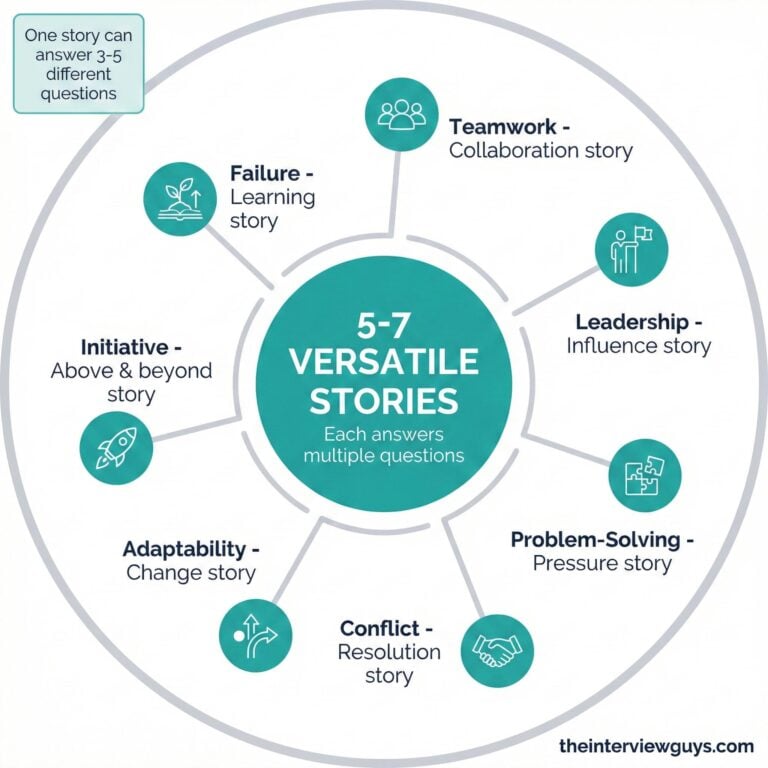
You don’t need dozens of stories memorized. Most successful candidates prepare 5-7 versatile stories that can be adapted to answer multiple questions.
Choose stories that highlight different competencies:
- Teamwork and collaboration
- Leadership or influence
- Problem-solving under pressure
- Conflict resolution
- Adaptability to change
- Going above expectations
- Learning from failure
Each story should come from your actual professional experience. This includes full-time jobs, internships, volunteer work, academic projects, or freelance gigs. The key is that the story is real and you played a significant role.
Many candidates make the mistake of only preparing stories about huge successes. Include at least one genuine failure story and one story about learning from feedback. These questions appear in nearly every interview, and authentic vulnerability creates trust with interviewers.
Map Your Stories to Common Questions
Once you have your core stories, identify which questions each story could answer. A single strong story about leading a challenging project might work for questions about leadership, problem-solving, working under pressure, and handling obstacles.
This mapping exercise serves two purposes. First, it helps you see gaps in your story bank. If you can’t think of a good conflict resolution story, you know you need to develop one. Second, it reduces interview anxiety because you’ll recognize that most questions can be answered with stories you’ve already prepared.
External resources like The Muse’s behavioral question guide and Indeed’s interview response techniques offer additional question lists you can use for mapping practice.
Practice Out Loud (But Don’t Memorize Scripts)
There’s a crucial difference between preparation and memorization. Memorized answers sound robotic and fall apart if the interviewer asks unexpected follow-up questions.
Instead, practice telling your stories conversationally. Use different words each time you practice. Focus on remembering the key plot points and outcomes rather than specific phrases.
Record yourself practicing and listen back. Are you rambling? Are you including unnecessary details? Are you spending too much time on the situation and not enough on your actions?
Most strong behavioral answers take 1.5-2 minutes to deliver. Any longer and you risk losing the interviewer’s attention. Any shorter and you’re probably not providing enough detail about your specific actions and results.
Quantify Your Results Whenever Possible
Numbers make your stories more credible and memorable. Instead of saying “I improved team efficiency,” say “I reduced processing time from 3 hours to 45 minutes.”
Even approximate numbers work better than vague claims. “I helped increase sales” is weak. “I contributed to a roughly 25% increase in quarterly sales” is much stronger.
If you can’t remember exact numbers, prepare ranges: “We reduced customer complaints by 30-40%.” This shows you paid attention to results without claiming precision you don’t have.
Create a Quick-Reference Cheat Sheet
The night before your interview, create a one-page cheat sheet listing your core stories with bullet points covering:
- Basic situation/context
- Key obstacle
- Your specific actions (3-4 main points)
- Measurable result
- What you learned
Review this sheet 30 minutes before your interview. Don’t bring it into the interview itself, but having recently reviewed these key points helps keep your stories fresh and accessible in your memory.
Consider using our behavioral interview matrix to organize your stories systematically and ensure you’re ready for any question category.
Common Mistakes to Avoid (That Sink Even Strong Candidates)
Even candidates with impressive experience sabotage themselves with these common behavioral interview mistakes. Avoid these pitfalls to ensure your answers land effectively.
Mistake 1: Giving Theoretical Answers to Behavioral Questions
When asked “Tell me about a time you handled a difficult customer,” some candidates respond with “I would listen carefully to their concerns and…” Stop right there. That’s not what the interviewer asked for.
Behavioral questions demand specific examples from your actual experience. If you catch yourself saying “I would” or “I usually” instead of “I did,” you’re giving the wrong type of answer.
If you genuinely don’t have experience with the specific situation the interviewer asks about, acknowledge this honestly, then offer the closest relevant example you do have: “I haven’t encountered that exact situation, but I had a similar experience when…”
Mistake 2: Taking Too Much or Too Little Credit
Group projects create a tricky balance. You want to show you’re a team player, but you also need to demonstrate your individual contributions.
Avoid the “we” trap where your entire answer focuses on what the team did collectively. Interviewers need to understand what you specifically contributed. Use “I” statements to describe your actions while acknowledging others’ contributions.
The opposite mistake is claiming sole credit for team achievements. This makes you seem like a poor collaborator. Be honest about working with others while clearly articulating your unique role.
Mistake 3: Rambling Without Structure
Nothing loses an interviewer faster than a meandering story with no clear beginning, middle, or end. Without a framework like SOAR, answers become a stream-of-consciousness narrative that’s hard to follow.
Practice discipline with your storytelling. Set the scene briefly, identify the key challenge, explain your specific actions, and share the result. If you find yourself talking for more than two minutes, you’re probably including unnecessary details.
Mistake 4: Choosing Irrelevant Examples
That time you organized your college dorm’s game night might show planning skills, but is it really your best example when interviewing for a senior project manager position? The complexity and stakes of your example should match the level of the role you’re pursuing.
Recent, relevant examples from professional settings carry more weight than distant stories from unrelated contexts. If you’re early in your career and lack extensive professional examples, that’s fine. Just choose the most professionally relevant scenarios you can from internships, volunteer work, or academic projects.
Mistake 5: Ending Without Impact
Some candidates tell a compelling story but forget to emphasize the result or lesson learned. Your answer needs a strong conclusion that ties back to the skills required for the role you’re pursuing.
After sharing your result, briefly connect it to the position: “This experience taught me the importance of proactive communication, which I know is crucial for the account manager role you’re hiring for.”
This connection shows self-awareness and helps the interviewer see how your past experiences prepare you for their specific needs. Resources like MIT’s STAR method guide emphasize the importance of this final connection.
Mistake 6: Speaking Negatively About Others
Even when discussing conflict or difficult coworkers, maintain a professional tone. Badmouthing previous employers or colleagues raises red flags about your judgment and professionalism.
You can acknowledge challenges without attacking anyone’s character. Instead of “My manager was incompetent and micromanaged everything,” try “My manager had a very hands-on style that didn’t match my preference for autonomy, so I learned to adapt by providing frequent updates proactively.”
The way you describe others reflects your maturity and emotional intelligence more than anything else.
Mastering the Follow-Up Questions (That Reveal Your Depth)
After you deliver your initial answer, skilled interviewers will probe deeper with follow-up questions. These follow-ups separate strong candidates from great ones because they reveal whether your story is authentic and whether you truly understand what you accomplished.
Common follow-up questions include:
- “What was your specific role in that situation?”
- “What would you do differently if you faced that situation again?”
- “How did other people react to your approach?”
- “What did you learn from that experience?”
Don’t panic when interviewers dig deeper. Follow-ups usually mean they’re interested in your story and want to understand it better. Answer follow-ups with the same specificity you used in your original answer.
If you can’t remember certain details, it’s better to say “I don’t recall the exact timeline” than to make something up. Authenticity matters more than having perfect recall of every detail from years ago.
Prepare for the common “What would you do differently?” follow-up by identifying one small improvement you could make to each of your prepared stories. This shows self-awareness and continuous learning. Even in successful stories, there’s usually something minor you’d tweak with hindsight.
The follow-up phase is also your opportunity to add details you might have missed in your initial answer. If the interviewer asks “How did your team react?” and you realize you didn’t emphasize your team’s positive response in your first answer, this is your chance to highlight that validation.
Putting It All Together: Your Pre-Interview Checklist

You now have everything you need to master behavioral interview questions. Here’s your final preparation checklist to ensure you’re ready:
One Week Before:
- Identify 5-7 core stories from your experience
- Write brief SOAR outlines for each story
- Map each story to 3-5 potential questions
- Identify any gaps in your story bank
Three Days Before:
- Practice telling your stories out loud conversationally
- Add specific numbers and metrics to your results
- Review the job description to understand which competencies matter most
- Research company-specific behavioral questions on LinkedIn
The Night Before:
- Create your one-page story cheat sheet
- Review your stories one final time
- Get good sleep (tired candidates ramble more)
The Day Of:
- Review your cheat sheet 30 minutes before
- Remember that authenticity beats perfection
- Plan to adapt your stories to each specific question
- Trust your preparation
Behavioral interview questions feel intimidating until you realize you’re just sharing true stories from your professional life. With the SOAR Method as your framework and 5-7 solid stories prepared, you’re ready to turn “Tell me about a time” from a source of anxiety into your opportunity to shine.
The key is starting your preparation now. Don’t wait until the night before your interview to think about these questions. Identify your stories, practice telling them naturally, and walk into your next interview knowing you can handle whatever behavioral questions come your way.
For additional preparation strategies, explore our comprehensive guides on preparing for job interviews and common interview mistakes to avoid.
The job you want is waiting for you. Your next interview is your chance to prove you’re the right person for it. Make your stories count.
To help you prepare, we’ve created a resource with proven answers to the top questions interviewers are asking right now. Check out our interview answers cheat sheet:
Job Interview Questions & Answers Cheat Sheet
Word-for-word answers to the top 25 interview questions of 2026.
We put together a FREE CHEAT SHEET of answers specifically designed to work in 2026.
Get our free Job Interview Questions & Answers Cheat Sheet now:

BY THE INTERVIEW GUYS (JEFF GILLIS & MIKE SIMPSON)
Mike Simpson: The authoritative voice on job interviews and careers, providing practical advice to job seekers around the world for over 12 years.
Jeff Gillis: The technical expert behind The Interview Guys, developing innovative tools and conducting deep research on hiring trends and the job market as a whole.