
Am I Qualified for This Job? The 7-Factor Test We Use to Score Any Candidate Against Any Posting (Weights Included)

There’s a specific moment every job seeker knows. The posting is open in one tab, your resume is open in another, and you’re toggling between them like a customs officer comparing a passport photo to a face. Some lines match beautifully. Some don’t match at all. And the question sitting on your chest is the oldest one in job searching: am I actually qualified for this, or am I about to waste an application?
Most people answer that question with vibes. And vibes fail in two opposite directions. Half of you overestimate: the job title matches your job title, so you fire off the application without noticing the posting is really asking for a different animal wearing the same name. The other half underestimate: you’re missing one listed requirement, so you close the tab on a job you’d have been shortlisted for, because you read a wish list as a set of laws.
Both mistakes come from the same root: nobody ever gave you a method. You’ve heard the folklore, like “apply if you meet 60 percent of the requirements,” but folklore isn’t a method; it doesn’t tell you which 60 percent matters. A missing nice-to-have is nothing. A missing must-have is everything. Treating them as interchangeable percentages is how good candidates skip winnable jobs and how everyone else carpet-bombs postings they never had a chance at.
So here’s something we don’t think any other career company has done. We built a scoring system that answers this question, it runs inside Longbow, our career platform, and rather than waving vaguely at “our proprietary algorithm,” we’re going to hand you the whole thing: all seven factors, their exact weights, and how to run the arithmetic yourself with nothing but a pen. Yes, this is our product’s actual method, published. We think a score you can’t inspect is a score you can’t trust, and that goes double for a score about you.
The seven factors, in order of weight
Score yourself from 1 to 5 on each factor, honestly, where 3 means “adequate,” 1 means “no evidence at all,” and 5 means “obviously, provably strong.” We’ll do the arithmetic at the end. The honesty part matters more than the arithmetic; you’ll see why when we get to the hard rules.
1. Skills match (20 percent)
The most obvious factor and still the most misjudged. Go through the posting’s named skills, tools and methods, and check each against your actual evidence: not “I could pick that up,” but “I have used this and can talk about it for two uncomfortable follow-up questions.”
The key distinction is core versus peripheral. Skills in the job title, the first three requirements, or mentioned repeatedly are core; miss one of those and no volume of peripheral matches compensates. Skills in the final bullet of a twelve-bullet list are decoration. If you read our guide on predicting interview questions from the posting, you already know how to spot which is which: repetition and placement are the posting telling you what it means.
Score a 5 if you have strong evidence for every core skill and most peripherals. Score a 1 or 2 if a core skill is genuinely absent from your history.
2. Experience alignment (20 percent)
Equal in weight to skills, and different from it. Skills are the tools; experience alignment is whether you’ve done this kind of work, at this kind of scale, with this kind of complexity. Five years of project management on three-person internal projects is real experience, and it is not the same experience as one year running cross-company implementations with angry external clients. The years number is the least informative part of an experience requirement; the shape of the work is what an interviewer will actually probe.
Read the responsibilities section, not the requirements, for this one. That’s where the actual Tuesday-afternoon reality of the job lives. Score yourself on how much of that reality you have already lived.
3. Seniority fit (15 percent)
Here’s the factor almost everyone scores wrong, because they assume it only cuts one way. Being over-leveled scores just as badly as being under-leveled, and hiring managers treat it that way. Under-leveled, they worry you’ll drown. Over-leveled, they worry you’ll be bored, expensive, gone in a year, or quietly competing with your boss. A director applying to a coordinator posting is not “obviously qualified”; they’re a seniority mismatch with a flight risk attached.
Score a 5 only when the role’s level is genuinely your level, or one clean step up from it with evidence you’re already operating there.
4. Career trajectory (15 percent)
Notice what this factor is: it’s not about whether they should want you. It’s about whether you should want this job. Does the role move you toward what you’re building, or sideways, or backward? A job can score perfectly on every other factor and still be wrong because it advances nothing you care about.
Most matching tools skip this entirely, because it’s a score about your interests rather than the employer’s. We weight it at 15 percent on purpose: a significant slice of “qualified” is “qualified for your own plans.” A panic application to a role that rewinds your career three years is a mismatch even if you’d get the offer, and you deserve a scoring system that says so.
5. Industry and domain relevance (10 percent)
This is the honesty factor, and the one where our system is deliberately stricter than your hopeful inner voice. The same job title in an unfamiliar domain is not the same job. A brilliant IT project manager applying to a healthcare-communications PM role has the title, the tools and the seniority, and still faces a real gap: they’ve never lived that domain’s constraints, vocabulary or failure modes, and the interviewer knows it even when the score doesn’t.
In Longbow’s implementation, this factor has teeth: a candidate with no demonstrated experience in the job’s domain cannot score above the mid-80s overall no matter how perfect everything else looks, because a system that hands out 95s on title-match alone is flattering you into wasted applications. Domain gaps are closable, but they’re closed in the interview by naming them honestly, not on the scoresheet by ignoring them.
6. Location and logistics (10 percent)
The unglamorous factor: location, remote policy, salary floor versus their range, and any hard practical constraint. It’s only 10 percent of the score but it behaves like a gate in real life; a perfect match who can’t accept the salary or the on-site policy is a 0 wearing a 90’s clothing. Score it honestly, including the parts you’re tempted to defer, because “I’ll deal with the relocation question later” is how people spend three interview rounds on a job they were never going to take.
7. Opportunity quality (10 percent)
The final factor asks about the job itself: is this posting worth anyone’s application? Compensation transparency, a coherent role scope (versus three jobs stapled together), a real hiring signal rather than a zombie listing. You already know how to check that last part; our guide to spotting ghost jobs is the full method, and our job posting red flags guide covers the employer-quality tells. A low score here doesn’t mean you’re unqualified; it means the posting may not deserve your evening, which is a different and equally useful answer.
Now run the arithmetic
Take your seven scores. Multiply each by its weight: skills and experience by 4, seniority and trajectory by 3, and domain, logistics and opportunity quality by 2. Add them up. You’ll land between 20 and 100.
Before you read your number, calibrate your expectations, because this is where every other scoring tool lies to you. A typical honest score for a job you like sits between 40 and 70. That’s not failure; that’s what real candidates look like against real postings. In our system, 85 and above is reserved for genuinely strong fits, and 90-plus means something specific: a recruiter for this job would be surprised NOT to interview you. Out of fifty candidates, one to three might clear 90. Many postings produce none.
If that sounds harsh, compare it to the alternative you’ve already lived: tools that score every posting 92-plus, because flattery keeps you clicking. You cannot budget a job search with scores like that. A spread of honest 50s, 60s and the occasional 84 tells you exactly where your evenings should go. A wall of 95s tells you nothing at all.
Here’s what our version looks like in practice, on a real posting, scored against a real background:
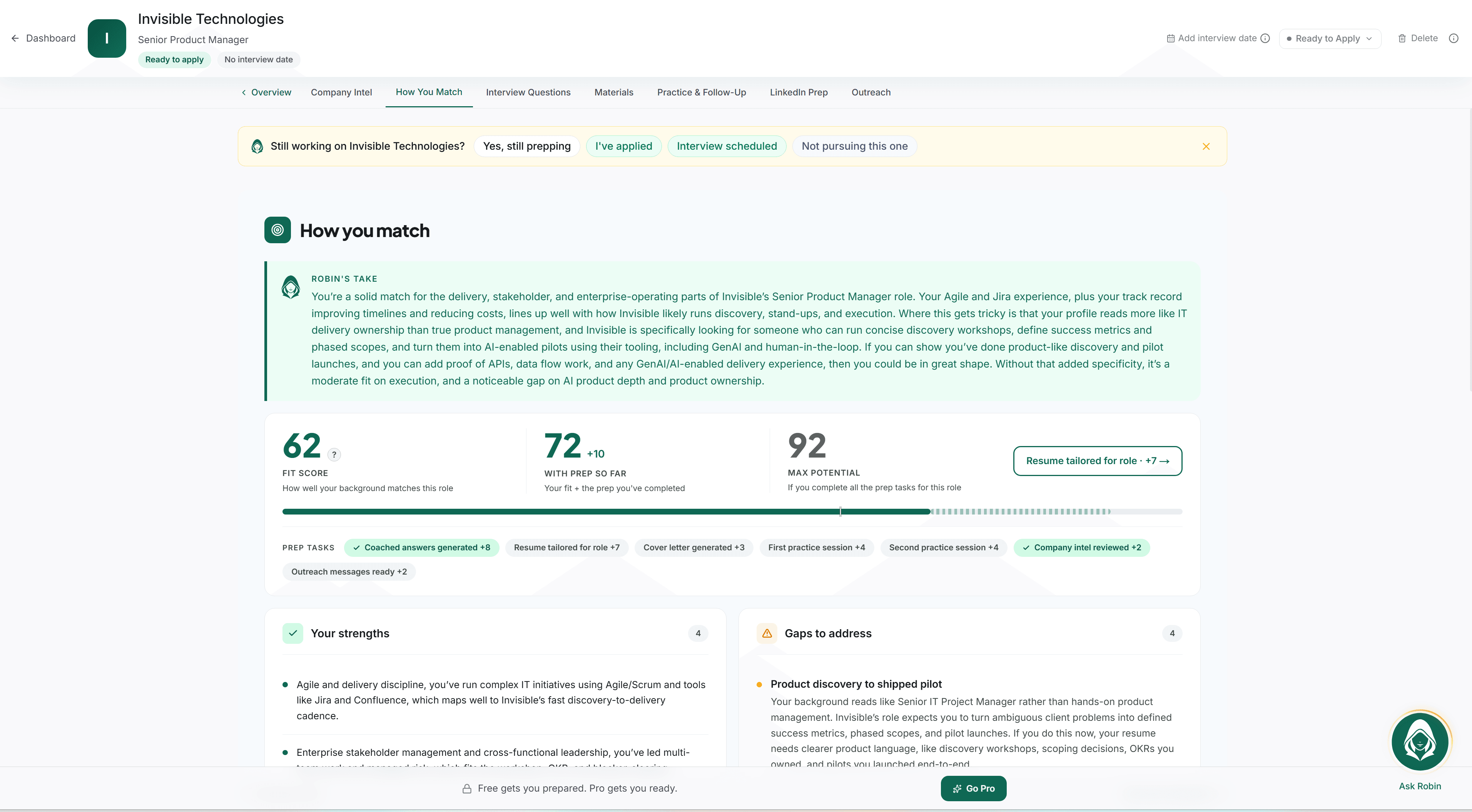
Let’s score one for real
Abstract factors are easy to nod along to, so here’s the method applied, start to finish. The candidate is a composite we see constantly: eight years as an operations manager at a logistics company, strong on process improvement and team leadership, comfortable with data but self-taught, wants to move into tech. The posting: Senior Operations Manager at a mid-size software company, hybrid, asking for operations leadership, cross-functional process design, “experience with SaaS metrics,” and familiarity with SQL “a plus.”
Skills match: process design and team leadership are provably strong; SaaS metrics is the wobble. She’s managed by metrics for years, but not those metrics. Core skills mostly present, one core skill adjacent rather than direct. Score: 3. Times the weight of 4: 12 points.
Experience alignment: the responsibilities read almost identically to her current Tuesday: cross-team coordination, vendor management, process ownership at similar headcount. The setting differs; the work barely does. Score: 4. Times 4: 16.
Seniority fit: senior manager to senior manager, no level jump in either direction. Score: 5. Times 3: 15.
Career trajectory: this is exactly the industry move she’s trying to make, at level, without a rewind. Score: 5. Times 3: 15.
Industry and domain: here’s the honest one. Zero software-industry history. The domain gap is real, and it’s precisely what the interviewer will probe. Score: 2. Times 2: 4.
Location and logistics: hybrid works, the salary band clears her floor. Score: 4. Times 2: 8.
Opportunity quality: posting is twelve days old, on the company’s own site, salary listed, coherent scope. Alive and real. Score: 5. Times 2: 10.
Total: 80. And look at what the breakdown just handed her, because it’s worth more than the number. She’s not a marginal candidate hoping to sneak through; she’s a strong candidate with exactly one thin spot, and she knows its name before any interviewer does. Her whole application strategy writes itself from that: the cover letter translates logistics metrics into SaaS vocabulary, her SQL gap becomes “currently working through it” by actually starting this week, and her interview prep centers on the one question she can now see coming: “you’ve never worked in software; why should that not worry us?” Rehearsed, that question is her best moment instead of her worst.
That’s what a scoring method is actually for. Not permission to apply. A map of where the fight will happen.
The part nobody tells you: your score is not fixed
Here’s where the “am I qualified” question gets genuinely reframed, and it’s our favorite thing about the whole system.
Most of your seven factors are history: your skills, your experience, your level. You can’t change them by Thursday. But the score that matters isn’t “how do I look on paper today.” It’s “how do I show up in the room.” And that number moves with preparation, predictably enough that we publish those numbers too.
In Longbow, completing coached answers for a job’s predicted questions adds 8 points to your score for that job. A resume tailored to the posting adds 7. A cover letter adds 3. Each practice interview session adds 4, reviewing the company research adds 2, and having your outreach ready adds 2. It sums to a ceiling of 30 points of earnable preparation, and nothing pushes past 100.
Those specific numbers are our judgment calls, and you’re welcome to argue with them. But the shape of the claim is the thing to take away even if you never touch our product: the gap between an unprepared 62 and a prepared 62 is enormous, and it’s the only part of your qualification you fully control this week. A 62 who has rehearsed the exact questions, tailored the resume, and can name their domain gap before the interviewer does will beat an unprepared 80 with startling regularity. We’ve spent twelve years watching it happen.
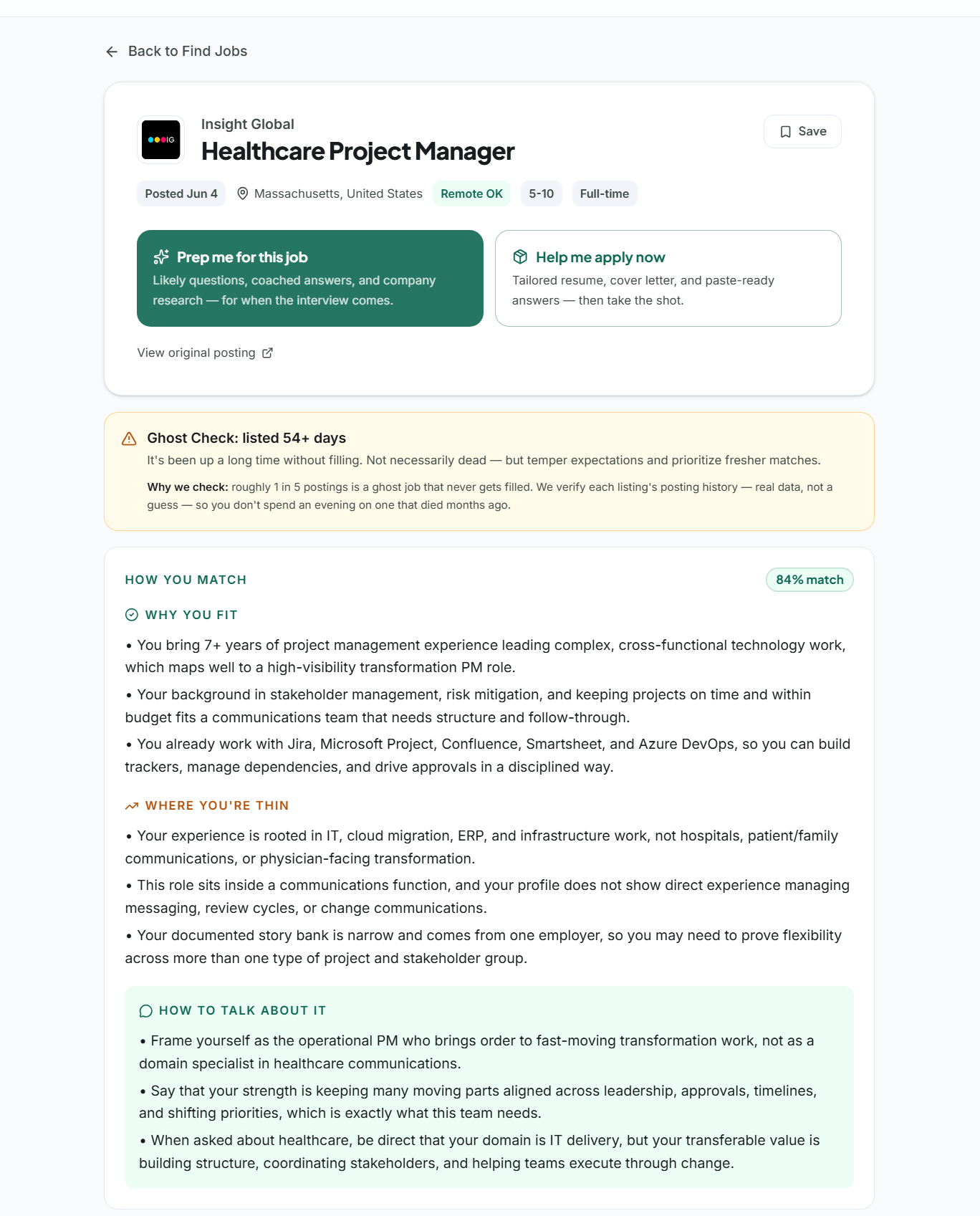
That middle column, “where you’re thin,” is the one to love, even though it stings. Your thin spots are findable by any competent interviewer. The only question is whether you map them first.
So what do you do with your number?
Above 80: apply, fast and properly. Genuinely strong fits are rare, speed matters on fresh postings, and this is where the full-effort application belongs.
55 to 80: apply, and let the low factors set your strategy. Thin on domain? Your cover letter and interview answers should name the adjacency and translate your experience into their world before they ask. Thin on a peripheral skill? Start closing it now so the interview version of you can say “I’m currently doing X about it,” which is a categorically better sentence than “no.”
40 to 55: apply selectively, with efficient applications rather than three-hour masterpieces, and only when trajectory or genuine interest justifies it. This band is where energy budgeting matters most, and where you should verify the posting is even real before investing.
Below 40: the folklore would say skip it. We’d say: notice which factors dragged it down. A 35 driven by logistics you can’t change is a skip. A 35 driven by skills and domain is not a “no”; it’s a “not yet,” and your skill-building plan just found its priorities.
And in every band: the score describes the posting as written, and postings are wish lists written by optimists. The requirements section describes the candidate they imagined on their best day, not the one they’ll hire. You’re not competing against the posting. You’re competing against whoever else actually applies.
Questions people ask about qualification
Is the “apply at 60 percent of requirements” rule real?
It’s directionally sane and mechanically useless. The spirit is right: requirement lists mix must-haves with nice-to-haves, and waiting for 100 percent means never applying. But percent-of-bullets treats every bullet as equal, and they never are. One missing core skill outweighs five missing peripherals. That’s exactly why a weighted method beats a percentage: it tells you which 40 percent you’re missing.
What if I’m overqualified?
Then your seniority factor is telling the truth: this is a mismatch, just a comfortable-feeling one. If you want the job anyway, for lifestyle, stability or a deliberate downshift, your entire application has to answer the interviewer’s real worry, which is “will you stay and will you be manageable.” Address it head-on or the interviewer will address it silently, in the rejection.
Do employers actually score candidates like this?
Not usually with published weights, but functionally yes: recruiters skim for exactly these dimensions, in roughly this priority order, in seconds. Structured interview processes formalize it further. The difference is that their version happens to you, invisibly. This one you get to run first.
Can I raise my score without new experience?
You can’t add years by Thursday, but you can change what your existing history demonstrates. Most people’s resumes underreport their evidence: the domain exposure buried in a bullet, the leadership shown but never named. Honest reframing, tailored materials and rehearsed answers routinely move the presented version of you by a band. That’s not gaming the system; that’s the preparation the score was designed to reward.
Why would you publish your own algorithm?
Because the score is about you, and scores about you shouldn’t be black boxes. Also, honestly, because we’re confident in it: the method survives inspection, and a scoring system that flatters its way to 95 wouldn’t. The full technical writeup lives on our how it works page, alongside everything else Longbow does and doesn’t do.
Stop asking the ceiling, start asking the floor
“Am I qualified?” quietly assumes the posting is the exam and you’re hoping to pass. Run the seven factors and the question changes shape: you’ll know your genuine strengths for this role, your real gaps, whether the job even deserves you, and precisely what preparation would move your number.
You can do all of it by hand with this article and twenty honest minutes. Or you can paste the posting into Longbow and get the same seven-factor score computed against your actual resume, with the breakdown, the thin spots, and the prep that closes them, free, no card. Either way, stop letting a wish list written by an optimist decide which jobs you’re allowed to want. Score it. Then decide like someone holding the numbers.
Stop applying into the void. Start landing interviews.
Longbow finds the jobs worth your time (including 576 job boards most people never see), tailors your resume to each posting so it actually gets past the filter, and shows you where you stand before you hit apply. The tool we built to get you interviews — not more rejections.
Try Longbow free →Free to start · No credit card · Built by The Interview Guys
Find the right jobs.
Get more interviews.
This is the general advice. Longbow applies it to your actual search: real match scores, ghost-job checks, and prep for the jobs worth your time. Here's the full story.

ABOUT THE INTERVIEW GUYS (JEFF GILLIS & MIKE SIMPSON)
Mike Simpson: Co-founder of The Interview Guys and Longbow. He has been the voice behind our interview advice since 2013 — his work has reached over 100 million job seekers around the world. The strategic mind behind Longbow, our new career platform.
Jeff Gillis: Co-founder of The Interview Guys and Longbow. He built the systems that put our work in front of those readers, and he leads the engineering on Longbow, the cutting edge career platform built for today’s job seeker.