
Free Property Manager Resume Template: ATS Proof Example & Writing Guide 2026

Why Your Property Manager Resume Needs a 2026 Refresh
The property management industry is booming. With projected growth of 5% through 2032, hiring managers are actively seeking qualified professionals who can demonstrate real results. But here’s the challenge: the average job posting receives over 250 applications, and most companies use Applicant Tracking Systems to filter candidates before a human ever sees their resume.
That means your property manager resume needs to do more than list your job duties. It must prove you can increase occupancy rates, reduce costs, and keep tenants happy. The good news? With the right template and strategy, you can position yourself as the obvious choice.
By the end of this article, you’ll have a free, downloadable property manager resume template plus expert guidance on showcasing your portfolio management experience, certifications, and software skills. Whether you’re a seasoned professional or transitioning into property management, these strategies will help you land more interviews.
☑️ Key Takeaways
- Property management resumes must showcase quantifiable achievements like occupancy rates, cost savings, and portfolio size to stand out in 2026.
- Industry-specific software proficiency in platforms like Yardi Voyager, AppFolio, and Buildium is essential for passing ATS screening.
- Certifications such as CPM, ARM, and state real estate licenses significantly boost your credibility with hiring managers.
- A skills-forward format works best for property managers because it immediately demonstrates your operational and financial management capabilities.
Before you send that resume: most Property Manager resumes get filtered out by ATS before a human ever sees them. Upload yours and find out your score. It takes 60 seconds and it’s free.
What Makes a Property Manager Resume Different?
Property management sits at the intersection of real estate, customer service, and financial management. Your resume needs to reflect this unique combination of skills. Unlike generic resumes, a strong property manager resume emphasizes three critical areas.
First, you need to demonstrate portfolio scope. Hiring managers want to know how many units you’ve managed, what types of properties you’ve overseen, and the total revenue under your control. These numbers immediately establish your level of experience.
Second, your resume must showcase measurable outcomes. Did you increase occupancy? Reduce turnover? Cut maintenance costs? Property management is a results-driven field, and your achievements should be quantified whenever possible.
Third, you need to highlight relevant certifications and licenses. According to industry data, over 72% of property manager job postings mention licenses or certifications. If you hold a CPM, ARM, or state real estate license, these credentials deserve prominent placement on your resume.
Interview Guys Tip: When describing your portfolio, always include both the number of units AND the annual revenue or budget. Saying you managed “280 units with $4.2M in annual revenue” is far more impressive than just “280 units.”
Property Manager Resume Example
Here’s a professional resume example. This example gives you an idea of what type of content fits in a good ATS friendly resume.
Example Resume:
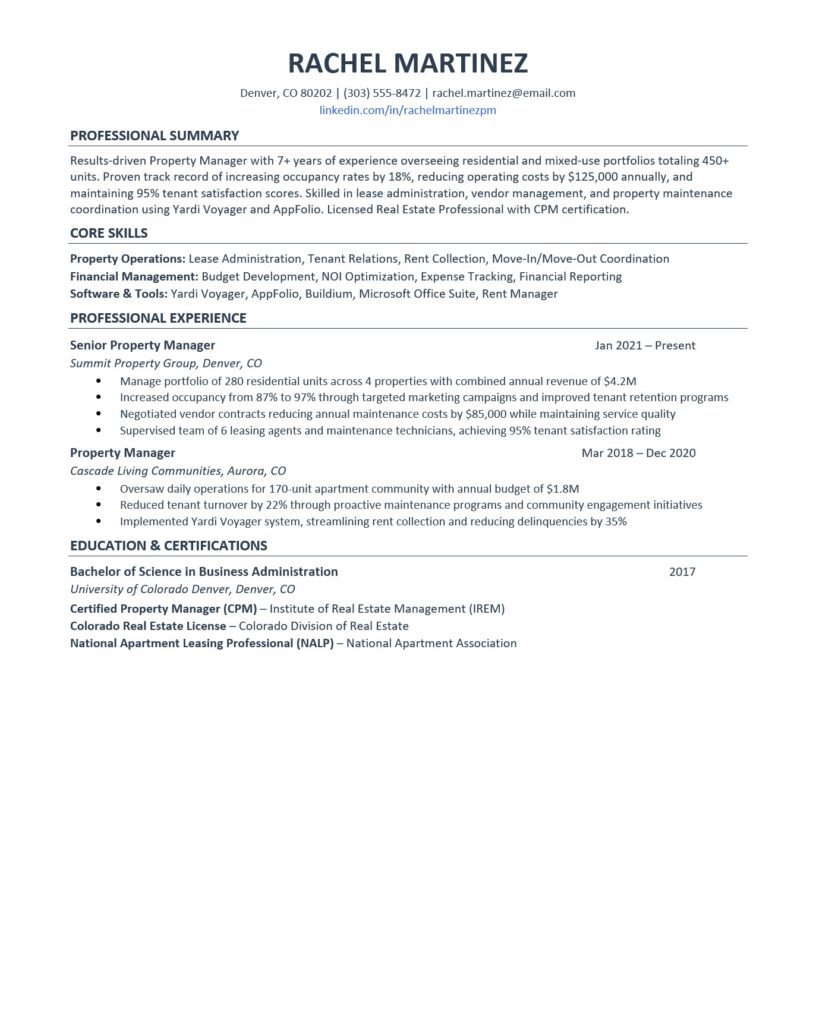
Here’s a professional property manager resume template you can download and customize. This template is designed to be both visually appealing and ATS-friendly, with clean formatting that highlights your strengths.
Blank Customizable Template
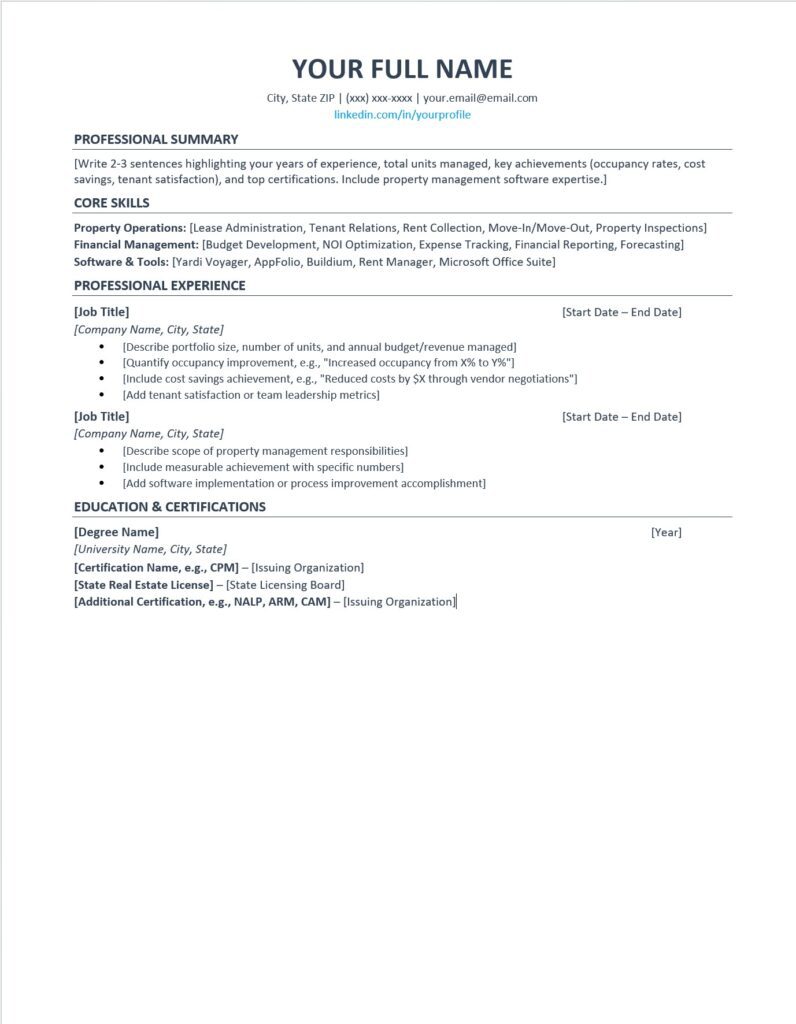
Download Your Free Template:
- Download DOCX Template (fully editable in Microsoft Word)
Interview Guys Tip: The DOCX template is fully editable, allowing you to adjust fonts, colors, and spacing to match your personal brand while maintaining professional formatting. Just replace the placeholder text with your own information.
Essential Components of a Property Manager Resume
Every effective property manager resume includes these key sections, organized to highlight your most relevant qualifications first.
Contact Information
Keep this section clean and professional. Include your city and state (full address not necessary), phone number, email, and LinkedIn profile URL. Property management is a relationship-driven industry, so make it easy for recruiters to reach you.
Professional Summary
This is your elevator pitch in 2-3 sentences. Lead with your years of experience, total units managed, and your most impressive achievement. Include your top certification and mention your proficiency with property management software that employers use.
A strong summary might read: “Results-driven Property Manager with 7+ years of experience overseeing residential portfolios totaling 450+ units. Proven track record of increasing occupancy rates by 18% and reducing operating costs by $125,000 annually. CPM certified with expertise in Yardi Voyager and AppFolio.”
Core Skills Section
This section serves double duty. It helps ATS systems identify your qualifications while giving hiring managers a quick snapshot of your capabilities. Organize your skills into categories like Property Operations, Financial Management, and Software Proficiency.
Include keywords directly from job postings you’re targeting. Terms like lease administration, tenant relations, rent collection, NOI optimization, budget development, and vendor management should appear naturally throughout this section.
Professional Experience
This is where you prove your value. For each position, include your job title, company name, location, and dates of employment. Then add 3-5 bullet points that describe your responsibilities AND achievements.
Start each bullet with a strong action verb. Words like “managed,” “increased,” “reduced,” “negotiated,” and “implemented” demonstrate initiative and results. Most importantly, include numbers whenever possible. Property management is a metrics-driven field, so quantify your impact on occupancy, costs, tenant satisfaction, and revenue.
Education and Certifications
List your highest degree first, followed by relevant certifications. For property managers, certifications often carry more weight than educational background. The Certified Property Manager (CPM) designation from the Institute of Real Estate Management is highly valued, along with state real estate licenses, National Apartment Leasing Professional (NALP), and Accredited Residential Manager (ARM) credentials.
How to Write Each Section Like a Pro
Crafting Your Professional Summary
Your summary should answer three questions: Who are you? What have you accomplished? What can you bring to the role?
Avoid vague statements like “hardworking professional seeking new opportunities.” Instead, lead with specifics. Mention your years of experience, the scope of properties you’ve managed, and your standout achievement. If you have a key certification, include it here.
Interview Guys Tip: Customize your summary for each application by incorporating 2-3 keywords from the job description. This simple adjustment can significantly improve your ATS match rate.
Writing Achievement-Focused Bullet Points
The difference between a good resume and a great one lies in how you describe your experience. Too many property managers simply list their job duties. That approach misses the point entirely.
Instead, use the achievement formula: Action + Result + Context. For example, don’t write “Responsible for maintaining occupancy.” Write “Increased occupancy from 87% to 97% through targeted marketing campaigns and improved tenant retention programs.”
Here are some achievements property managers should consider highlighting:
- Occupancy rate improvements
- Rent collection rates and reduction in delinquencies
- Operating cost reductions through vendor negotiations
- Tenant satisfaction scores
- Turnover rate decreases
- NOI (Net Operating Income) growth
- Successful property renovations or improvements
- Team leadership and staff development
When thinking about how to present your accomplishments in interviews, our guide on property manager interview questions and answers can help you prepare compelling stories using these same achievements.
Showcasing Software Proficiency
Property management technology has evolved rapidly. Employers expect candidates to be proficient in industry-standard platforms. The most commonly requested software includes Yardi Voyager, AppFolio, Buildium, Rent Manager, and MRI Software.
Don’t just list software names. When possible, describe how you’ve used these tools to achieve results. For example: “Implemented Yardi Voyager system, streamlining rent collection and reducing delinquencies by 35%.”
Also include general business software like Microsoft Excel (especially if you can use pivot tables and financial formulas), accounting software, and CRM systems.
Before you send that resume: most Property Manager resumes get filtered out by ATS before a human ever sees them. Upload yours and find out your score. It takes 60 seconds and it’s free.
Common Mistakes to Avoid
Even experienced property managers make resume mistakes that cost them interviews. Here are the most common errors and how to fix them.
- Being too vague about portfolio size. Always specify the number of units, property types, and budget or revenue figures. “Managed multiple properties” tells hiring managers nothing. “Oversaw 4 residential communities totaling 280 units with $4.2M annual revenue” paints a clear picture.
- Forgetting to include certifications prominently. Your CPM, ARM, or real estate license shouldn’t be buried at the bottom. These credentials set you apart and should be mentioned in your summary and your certifications section.
- Neglecting to quantify achievements. Property management is about results. If you improved something, reduced something, or increased something, put a number on it. Even estimates like “approximately 20%” are better than no numbers at all.
- Using generic job descriptions. Copying job duties from a generic property manager description makes your resume blend into the pile. Customize your bullet points to reflect YOUR specific achievements and the requirements of the job you’re applying for.
- Ignoring ATS optimization. With 98% of Fortune 500 companies using ATS software, your resume must be formatted correctly and include relevant keywords. Our guide to how to list skills on a resume offers additional strategies for keyword optimization.
ATS Optimization and Keywords for Property Managers
Applicant Tracking Systems scan your resume for specific keywords before it reaches human eyes. Understanding this process is crucial for getting past the initial screening.
Start by carefully reading each job posting. Identify the key skills, qualifications, and software mentioned. Then incorporate these terms naturally throughout your resume, particularly in your skills section and work experience bullet points.
Common ATS keywords for property managers include:
- Lease administration
- Tenant relations and retention
- Rent collection
- Property inspections
- Vendor management
- Budget development
- NOI optimization
- Fair housing compliance
- Maintenance coordination
- Eviction procedures
- Financial reporting
- Occupancy management
For formatting, stick to standard fonts like Calibri, Arial, or Times New Roman. Avoid tables, graphics, headers and footers, and unusual formatting that ATS systems struggle to parse. Use standard section headings like “Professional Experience” and “Education” that the software can easily recognize.
Save your resume in a widely compatible format. Most ATS systems can read Word documents and PDFs effectively, though some older systems prefer .docx files. Check the application instructions for any specific requirements.
Property Manager Resume FAQs
Should I include properties I managed from a previous company?
Yes, you should include your full professional history, but be careful about confidentiality. You can describe portfolio size and achievements without naming specific properties. Focus on the scope of your responsibilities and the results you achieved.
How long should my property manager resume be?
For most property managers with under 10 years of experience, one page is ideal. If you have extensive experience managing large portfolios or multiple property types, a two-page resume is acceptable. Just ensure every line adds value.
Do I need a real estate license to be a property manager?
Requirements vary by state. Some states require a real estate license for certain property management activities, while others don’t. Check your state’s regulations, and if you have a license, prominently feature it on your resume.
What if I’m transitioning into property management from another field?
Focus on transferable skills like customer service, financial management, building maintenance, or tenant relations from previous roles. Our guide on resume summaries for career changers offers strategies for highlighting relevant experience.
Should I include references on my property manager resume?
No, save that space for your qualifications. Simply have references ready to provide when requested. Use the valuable resume real estate to showcase your achievements instead.
Putting It All Together
Creating a standout property manager resume comes down to three principles. First, quantify everything you can. Numbers speak louder than generic descriptions in this industry. Second, prioritize relevant certifications and software skills that match what employers are seeking. Third, tailor your resume for each application by incorporating keywords from the specific job posting.
Download our free property manager resume template to get started. The example version shows you exactly how a polished, professional resume should look, while the blank template gives you a framework to fill in with your own experience.
Your next property management role is waiting. With a well-crafted resume that showcases your portfolio management skills, financial acumen, and tenant relations expertise, you’ll be prepared to make a strong impression.
Ready to explore more options? Browse our complete collection of free resume templates to find the perfect format for your career goals.
Advice like this is the general version. Longbow scores your actual resume against the actual job you want and shows you what's missing, before the filters decide for you. Here's why we built it.

ABOUT THE INTERVIEW GUYS (JEFF GILLIS & MIKE SIMPSON)
Mike Simpson: Co-founder of The Interview Guys and Longbow. He has been the voice behind our interview advice since 2013 — his work has reached over 100 million job seekers around the world. The strategic mind behind Longbow, our new career platform.
Jeff Gillis: Co-founder of The Interview Guys and Longbow. He built the systems that put our work in front of those readers, and he leads the engineering on Longbow, the cutting edge career platform built for today’s job seeker.