
Free Construction Manager Resume Template 2025: ATS Examples & Writing Guide

Landing a construction manager role means competing against experienced professionals who know how to showcase million-dollar projects and complex team coordination. Your resume needs to instantly prove you can handle the pressure, manage the budget, and deliver results.
The difference between a resume that gets interviews and one that gets ignored? Specific numbers, industry keywords, and a layout that makes your biggest wins impossible to miss. Construction managers who quantify their achievements are 40% more likely to land interviews because hiring managers can immediately see the value you’ll bring to their projects.
In this guide, you’ll get two free downloadable resume templates (both a completed example and a blank template you can customize), plus insider strategies for writing each section to maximize your chances. We’ll show you exactly how to structure your resume for both ATS systems and human reviewers, what skills hiring managers actually search for, and how to turn your project experience into compelling achievement statements.
By the end of this article, you’ll have everything you need to create a construction manager resume that positions you as the solution to their most pressing challenges.
☑️ Key Takeaways
- Construction manager resumes need quantifiable achievements showing budget sizes, team coordination, and cost savings to stand out
- Industry-specific keywords like Procore, OSHA compliance, and value engineering help your resume pass ATS screening systems
- Leading with a strong professional summary that highlights your biggest projects and percentage-based results hooks hiring managers immediately
- Organizing sections strategically with Core Skills before Experience helps recruiters quickly assess your technical qualifications
What Makes a Construction Manager Resume Different?
Construction manager resumes operate in a unique space where technical expertise meets business acumen. You’re not just listing job duties. You’re proving you can coordinate dozens of moving parts while keeping projects on schedule and under budget.
The best construction manager resumes immediately answer three critical questions. Can you manage large budgets? Can you coordinate multiple teams and subcontractors? Can you maintain safety compliance while meeting aggressive deadlines?
Your resume needs to speak the language of the industry. That means including specific software (Procore, Primavera P6, Bluebeam), demonstrating knowledge of OSHA standards, and showing familiarity with building codes and regulations. These aren’t just buzzwords. They’re screening criteria that ATS systems search for and that hiring managers expect to see.
What sets exceptional construction manager resumes apart is the strategic use of numbers. Instead of saying you “managed construction projects,” you specify that you “managed $45M mixed-use development with 320,000 sq ft, coordinating 12 subcontractors across 24-month timeline.” The specificity builds credibility instantly.
Before you send that resume: most Construction Manager resumes get filtered out by ATS before a human ever sees them. Upload yours and find out your score. It takes 60 seconds and it’s free.
Construction Manager Resume Example
Here’s a professional construction manager resume example. This example gives you an idea of what type of content fits in a good ATS friendly resume.
Example Resume:
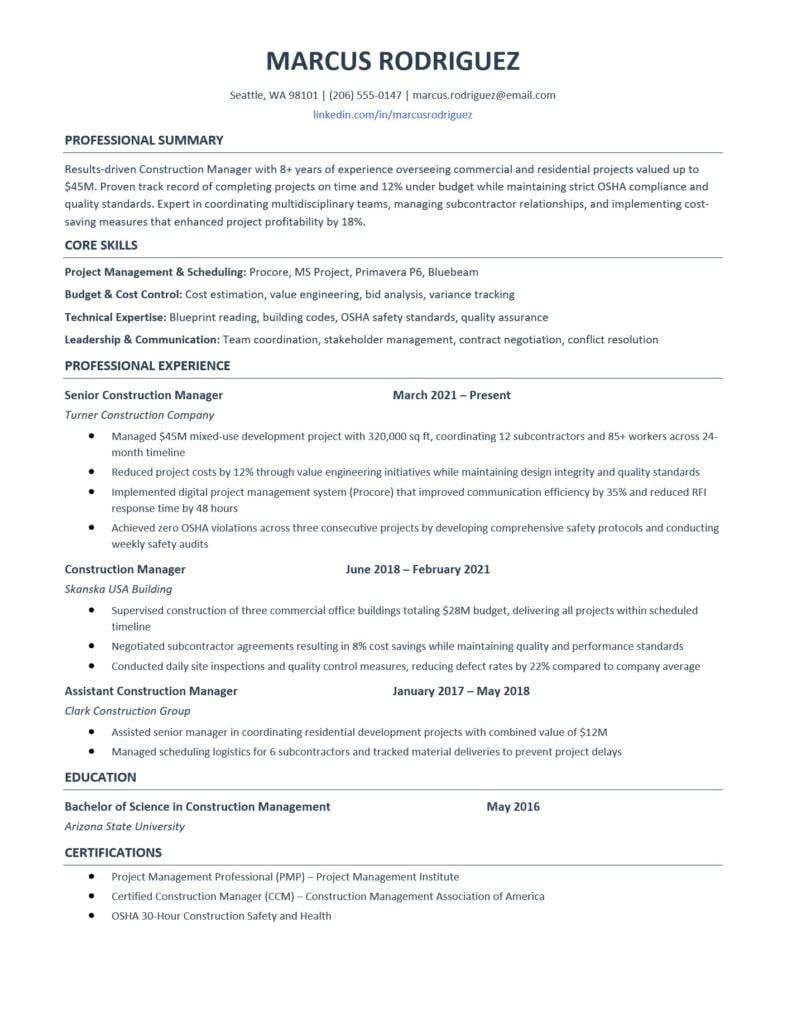
Here’s a professional construction manager resume template you can download and customize. This template is designed to be both visually appealing and ATS-friendly, with clean formatting that highlights your strengths.
Blank Customizable Template
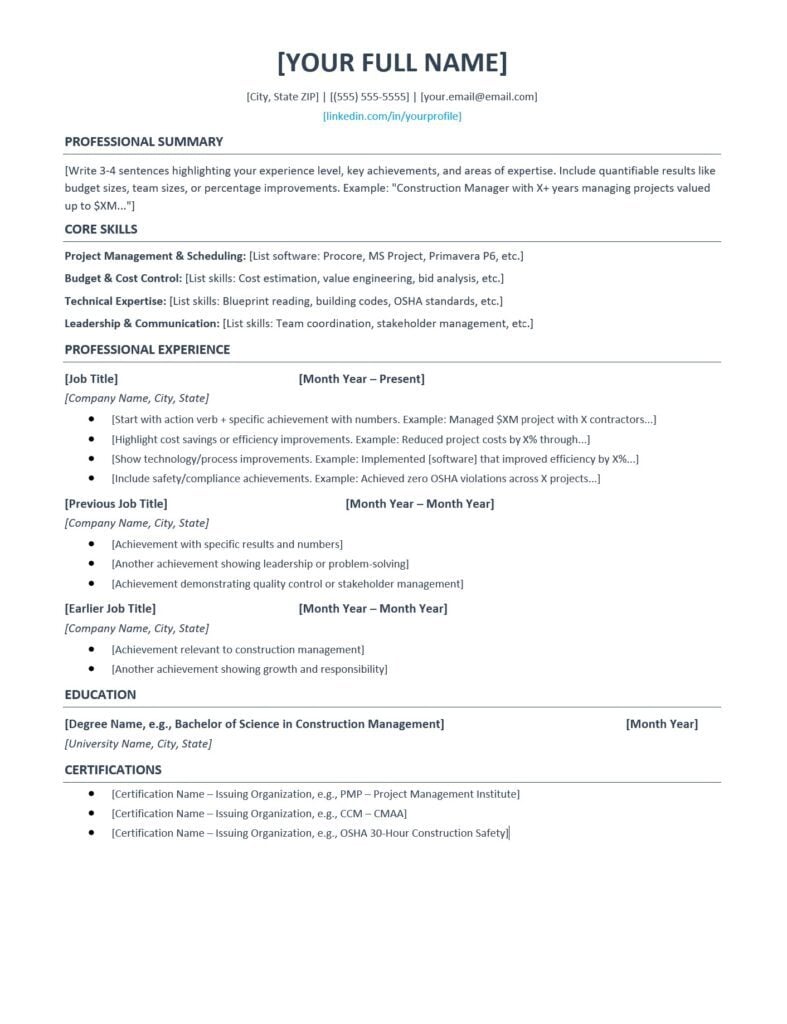
Download Your Free Template:
- Download DOCX Template (fully editable in Microsoft Word)
Interview Guys Tip: The DOCX template is fully editable, allowing you to adjust fonts, colors, and spacing to match your personal brand while maintaining professional formatting. Just replace the placeholder text with your own information.
Essential Resume Components for Construction Managers
Your construction manager resume needs six core sections, each serving a specific purpose in your marketing strategy.
The Professional Summary goes first, right below your contact information. This 3-4 sentence paragraph is your elevator pitch. It should mention your years of experience, the scale of projects you’ve managed (include dollar amounts), and your most impressive achievement. This section determines whether recruiters keep reading or move to the next candidate.
Core Skills comes next, organized into categories that match how hiring managers think about construction management competencies. Group your skills into Project Management & Scheduling, Budget & Cost Control, Technical Expertise, and Leadership & Communication. This organization helps both ATS systems and human readers quickly identify your qualifications.
Your Professional Experience section is where you prove everything you claimed in the summary. List your most recent position first, then work backwards. Each position should have 3-4 bullet points that start with strong action verbs and include specific, quantifiable results.
The Education section is straightforward but important. Most construction management positions require a bachelor’s degree in construction management, civil engineering, or a related field, according to the Bureau of Labor Statistics. List your degree, school name, and graduation date.
Certifications deserve their own section because credentials like PMP, CCM, and OSHA certifications significantly boost your credibility. List the certification name, issuing organization, and year obtained if relevant.
Some construction managers add a sixth section for Notable Projects if they’ve worked on high-profile builds, but only include this if your projects are genuinely impressive and you have room on one page.
Interview Guys Tip: Place your Core Skills section before Professional Experience. This strategic positioning ensures ATS systems and recruiters immediately see your technical qualifications, even if they don’t read your full work history.
How to Write Your Professional Summary
Your professional summary is the highest-value real estate on your resume. These 3-4 sentences need to compel hiring managers to keep reading instead of moving to the next candidate in their pile.
Start with your experience level and specialty. “Construction Manager with 8+ years of experience in commercial and residential development” immediately establishes your credibility. But don’t stop there.
Add the scale of projects you’ve managed. Including dollar amounts is critical because it contextualizes your experience. Managing a $2M residential renovation is very different from managing a $45M commercial development, and hiring managers need to know which category you fit into.
Include your most impressive, quantifiable achievement. “Reduced project costs by 12% while maintaining quality standards” or “Achieved zero OSHA violations across three consecutive projects” gives concrete proof of your capabilities. These specific results separate you from candidates who only list generic responsibilities.
End with your key areas of expertise. Mention 2-3 specializations like “Expert in coordinating multidisciplinary teams, managing subcontractor relationships, and implementing cost-saving measures.” This helps hiring managers quickly determine if your skills match their needs.
Keep the entire summary to 3-4 sentences maximum. Any longer and you risk losing the reader’s attention before they reach your achievements.
Structuring Your Core Skills Section
Your Core Skills section needs strategic organization to maximize impact. Don’t just dump a random list of skills. Group them into categories that demonstrate the full scope of your capabilities.
- Project Management & Scheduling is your first category. List specific software and methodologies: Procore, MS Project, Primavera P6, Bluebeam, and Gantt charts. These are the tools hiring managers search for because they indicate you can hit the ground running without extensive training.
- Budget & Cost Control comes next. Include cost estimation, value engineering, bid analysis, variance tracking, and procurement management. These skills directly impact a company’s bottom line, so highlighting them prominently is essential.
- Technical Expertise demonstrates your construction knowledge. Include blueprint reading, building codes, OSHA safety standards, quality assurance, RFI management, and permit coordination. This category proves you understand the technical side of construction management, not just the administrative aspects.
- Leadership & Communication rounds out your skills. List team coordination, stakeholder management, contract negotiation, conflict resolution, and client relations. These soft skills are just as important as technical abilities because construction managers spend significant time coordinating people, not just managing processes.
Format each category with the category name in bold followed by a colon, then list your specific skills on the same line. This compact format maximizes space while maintaining readability.
Interview Guys Tip: Match your skills to the job description keywords but only list skills you genuinely possess. During interviews, hiring managers will ask you to elaborate on specific tools or methodologies, so claiming expertise you don’t have will backfire quickly.
Writing Powerful Professional Experience Bullets
Your experience bullets make or break your resume. This is where you prove you can deliver results, not just show up and do tasks. Every bullet point should follow a specific formula: action verb + specific task + quantifiable result.
Start each bullet with a strong action verb. “Managed,” “Coordinated,” “Reduced,” “Implemented,” “Achieved,” and “Negotiated” are all more powerful than weak verbs like “Responsible for” or “Helped with.” The verb should convey authority and accomplishment.
Include specific numbers whenever possible. How large was the project budget? How many subcontractors did you coordinate? What percentage did you reduce costs? What was the square footage? Numbers provide context and credibility that generic descriptions can’t match.
Focus on achievements, not responsibilities. Instead of “Responsible for managing project schedules,” write “Implemented digital project management system (Procore) that improved communication efficiency by 35% and reduced RFI response time by 48 hours.” The second version shows initiative, technical savvy, and measurable impact.
For your most recent position, include 4-5 bullets. Earlier positions can have 2-3 bullets since recent experience carries more weight. If you’re looking to transition or advance, check out our guide on how to answer common construction manager interview questions to prepare for the conversations your strong resume will generate.
Connect your achievements to business outcomes. Reducing costs, improving efficiency, enhancing safety, and completing projects ahead of schedule all directly benefit employers. Make these connections explicit in your bullets.
ATS Optimization and Keywords
Over 98% of Fortune 500 companies use ATS to screen resumes, according to research from Jobscan. Your construction manager resume needs to pass these digital gatekeepers before human eyes ever see it.
ATS systems scan for specific keywords that match the job description. For construction managers, critical keywords include: project management, budget management, scheduling, OSHA compliance, building codes, subcontractor coordination, cost estimation, quality assurance, and value engineering.
Software names are especially important. If the job description mentions Procore, MS Project, or Primavera P6, your resume needs to include those exact terms, not generic phrases like “project management software.” ATS systems look for exact matches.
But keyword stuffing will backfire. Modern ATS systems flag resumes that unnaturally repeat keywords or include them in irrelevant contexts. The solution? Naturally incorporate keywords throughout your summary, skills section, and experience bullets in ways that authentically describe your background.
Use the exact job title from the posting somewhere in your resume, typically in your summary or as a section header. If they’re hiring a “Senior Construction Manager” and you list yourself as a “Construction Manager,” some ATS systems won’t recognize the match.
Save your resume as a .docx file unless the application specifically requests a PDF. Some older ATS systems struggle with PDF parsing, though most modern systems handle both formats. When in doubt, .docx is the safer choice.
Avoid tables, text boxes, headers, and footers. ATS systems often can’t parse text in these areas, meaning your carefully crafted content could be invisible to the screening software. Stick to a clean, single-column layout with standard section headings.
For more strategies on optimizing your resume format, see our article on best ATS-friendly resume formats for 2025.
Common Mistakes to Avoid
The biggest mistake construction managers make is listing job duties instead of achievements. “Managed construction projects” tells hiring managers nothing about your capabilities. “Managed $45M mixed-use development with 320,000 sq ft” immediately communicates the scale of responsibility you can handle.
Another frequent error is omitting safety compliance information. Construction managers are ultimately responsible for job site safety, and failing to mention your safety record or OSHA training suggests this isn’t a priority for you. Always include safety achievements and relevant certifications.
Many candidates undervalue their cost-saving achievements. If you negotiated better rates with subcontractors, implemented value engineering solutions, or brought projects in under budget, those accomplishments directly impact profitability. They deserve prominent placement in your experience bullets.
Avoid using identical descriptions for different positions. If you held similar roles at multiple companies, resist the temptation to copy and paste bullet points. Each position should highlight unique projects, different scales of responsibility, or new skills you developed. For guidance on tailoring your resume to different construction roles, see our guide on how to customize your resume for specific industries.
Don’t neglect your LinkedIn profile. 87% of recruiters use LinkedIn to evaluate candidates, according to Jobvite research. Your LinkedIn profile should reinforce the story your resume tells, using similar keywords and highlighting the same major projects.
Ignoring formatting consistency is another red flag. If you bold job titles, bold all job titles. If you use bullet points for one position, use them for all positions. Inconsistent formatting suggests carelessness, which is the last quality you want to communicate as someone responsible for coordinating complex construction projects.
Salary Expectations and Market Insights
Understanding current salary trends helps you negotiate effectively once your strong resume lands interviews. Construction managers earned a median annual salary of $106,980 in May 2024, according to Bureau of Labor Statistics data. However, actual compensation varies significantly based on factors you should understand.
Location dramatically impacts earnings. Construction managers in high-cost markets like New York, San Francisco, and Boston earn 30-40% more than the national median, while managers in smaller markets may earn slightly less. However, cost of living differences often balance these variations.
Industry sector also matters. Heavy and civil engineering construction managers earn median salaries around $110,940, while residential construction managers typically earn closer to $92,980. Commercial construction falls somewhere in between.
Experience and certifications significantly boost earning potential. Entry-level construction managers might start around $65,000-75,000, while experienced managers with certifications like PMP or CCM often earn $130,000-170,000 or more, especially when managing large-scale projects.
The job outlook is strong. Employment for construction managers is projected to grow 9% from 2024 to 2034, much faster than the average for all occupations, with approximately 46,800 openings projected annually. This growth is driven by ongoing infrastructure needs, commercial development, and retrofitting projects to meet current building codes and energy efficiency standards.
Frequently Asked Questions
How long should my construction manager resume be?
Keep your resume to one page if you have less than 10 years of experience. For senior construction managers with extensive project histories, two pages is acceptable but only if every line provides value. Hiring managers spend 6-7 seconds on initial resume screening, so conciseness matters more than comprehensiveness.
Should I include all my construction projects?
No. Focus on your most impressive, recent, and relevant projects. If you managed a $45M commercial development and several small residential projects, lead with the commercial project. Include projects that demonstrate the scale of responsibility relevant to the position you’re targeting.
What if I’m transitioning from another construction role to management?
Highlight any leadership experience, even informal. If you coordinated teams, managed schedules, or took initiative on process improvements, these experiences demonstrate management potential. Emphasize soft skills like communication, problem-solving, and stakeholder management. For more guidance, see our article on career transitions and transferable skills.
Do I need to include my high school diploma if I have a bachelor’s degree?
No. Once you have a college degree, omit high school information entirely. The education section should focus on your highest level of education and any relevant certifications or professional development.
How often should I update my resume?
Update your resume after completing major projects, earning certifications, or achieving significant results. Even if you’re not actively job searching, maintaining an updated resume ensures you’re ready when opportunities arise. Update at least annually to add new skills, adjust for industry trends, and refine your achievements.
Take the Next Step
You now have everything you need to create a construction manager resume that stands out. Download both templates (the completed example and the blank customizable version), review the strategies in this guide, and start crafting your own compelling resume.
Remember to quantify every achievement, incorporate industry-specific keywords naturally, and organize your sections strategically to pass both ATS screening and human review. Your resume is your first project presentation. Make it demonstrate the same attention to detail, strategic thinking, and results orientation you bring to construction sites.
Need more resume templates for different roles? Browse our complete free resume template library to find formats tailored to your career stage and industry.
For additional guidance on standing out in your job search, check out our articles on how to write compelling cover letters and essential interview preparation strategies to complete your application package.
Your next construction management role is waiting. Start building your standout resume today.
Before you send that resume: most Construction Manager resumes get filtered out by ATS before a human ever sees them. Upload yours and find out your score. It takes 60 seconds and it’s free.
Advice like this is the general version. Longbow scores your actual resume against the actual job you want and shows you what's missing, before the filters decide for you. Here's why we built it.

ABOUT THE INTERVIEW GUYS (JEFF GILLIS & MIKE SIMPSON)
Mike Simpson: Co-founder of The Interview Guys and Longbow. He has been the voice behind our interview advice since 2013 — his work has reached over 100 million job seekers around the world. The strategic mind behind Longbow, our new career platform.
Jeff Gillis: Co-founder of The Interview Guys and Longbow. He built the systems that put our work in front of those readers, and he leads the engineering on Longbow, the cutting edge career platform built for today’s job seeker.