
How to Tell If a Job Posting Is a Ghost Job (Before You Waste an Evening on It)

Here’s an evening that too many of you know by heart.
You find the posting. It’s almost suspiciously right for you: the title fits, the requirements read like your resume, even the location works. So you do it properly, the way we’ve always taught you to. You tailor the resume. You write a real cover letter. You research the company. Two hours, maybe three, and you hit submit feeling like this one is different.
Nothing. Not a rejection. Not an autoreply worth reading. Nothing, forever.
There’s a decent chance that job was never real. Not “they went with someone else” not-real. Never-going-to-hire-anyone not-real. It’s called a ghost job, and if you want the full investigation into who posts them and why, we already wrote it: our ghost jobs exposé names names. The short version is grim enough: hiring platform Greenhouse found that 18 to 22 percent of online job postings are ghosts, and in a LiveCareer survey, 93 percent of HR professionals admitted posting them at least occasionally.
This article is the practical companion to that one. Not who’s doing it or why, but the thing you actually need at 9 p.m. with a posting open in the next tab: how to check whether this specific job is real, in about five minutes, before you spend three hours on it.
The single strongest tell is one job boards work hard to hide
Almost every ghost-job red flag is a weak signal on its own. Vague descriptions? Some real jobs are written badly. No salary? Sadly normal in plenty of industries. Big company with layoff rumors? They might still be hiring for this exact team.
But there’s one signal that’s hard to fake and highly predictive: the posting’s true age and history.
A real job with real budget and a real hiring manager behind it usually fills, or at least progresses, within weeks. A posting that has been sitting open for two months, or that keeps expiring and reappearing like a horror movie villain, is telling you something no description can hide: whatever is happening behind that posting, it is not urgent hiring.
The problem is that job boards actively obscure this. When a posting expires and gets relisted, the clock resets. That “Posted 3 days ago” label might be the fourth lap for a posting that first appeared in March. The board has no incentive to tell you; postings are their inventory.
So the manual check below is mostly about reconstructing the posting’s real history from the outside. It takes about five minutes per job. It’s worth it every single time the job matters to you.
The five-minute ghost check, step by step
Step 1: Find the posting’s true age
Ignore the “posted X days ago” label; that’s the relisting clock, not the birthday. Instead, search the exact job title and company name in quotes on Google, then use the tools menu to filter results by date. If you find the same role being discussed, aggregated or listed months ago, you’ve found its real age. Aggregator sites often preserve the older copies that the original board has recycled.
While you’re there, notice whether you’re seeing the same job posted at multiple dates. That’s not a company with lots of openings. That’s one opening on its fourth lap.
Step 2: Check the company’s own careers page
Go to the company website and find the job there. This one check catches an entire category of ghost: postings that exist only on job boards, kept alive by agencies or aggregators long after the company stopped caring, or postings scraped and relisted by third parties fishing for resumes.
If the job isn’t on the company’s own site, treat it as unverified at best. If it is, check whether the details match; a title that exists on the board but has different requirements on the careers page is a recycled posting that nobody has updated.
Step 3: Look for a human attached to it
Real hiring has people attached. Search LinkedIn for recruiters at the company and see if anyone has mentioned the role, posted about hiring, or lists it in their activity. A named recruiter actively promoting a role in the last two weeks is one of the strongest positive signals there is. Total silence from every recruiter at a company that’s supposedly hiring for this role for two months is the opposite.
Step 4: Read the posting like a skeptic
Now, and only now, apply the classic red flags, because they mean more once you know the age:
- Vague, evergreen descriptions. “We’re always looking for talented engineers” is a pipeline ad, not a job.
- No salary anywhere, in a role and region where listing it is normal (or legally required).
- A wish list, not a role. When the requirements read like three jobs stapled together, nobody scoped the actual position.
- Boilerplate that doesn’t match the title. Signs the posting was cloned from another role and never really meant.
One of these alone proves little. Two or three of them on a posting that’s also 60 days old? You have your answer.
There’s a legal wrinkle that has quietly made this step more powerful. A growing list of states, including California, Colorado, New York and Washington, now require salary ranges on postings, and several of those laws cover any job that could be performed remotely from the state. Which means a “remote eligible” posting from a mid-size company with no range anywhere is no longer just annoying. It’s a posting that either ignores the law or was cloned and forgotten, and both readings point the same direction. The absence of legally required information has been upgraded from pet peeve to evidence.
Step 5: Check the outside chatter
Two minutes of searching “[company] hiring freeze” or “[company] layoffs” plus a skim of recent Glassdoor and Reddit threads catches the situations where the company itself is real, the recruiter is real, but the budget quietly died a month ago. Communities like GhostJobs.io exist precisely because job seekers got tired of doing this detective work alone; check whether the company already has a reputation.
Let’s run one, start to finish
Theory is nice. Here’s what the five minutes actually look like. The posting below is a composite of ones we see every single week; we’ve changed the details, but not the pattern.
The posting: Senior Marketing Manager at a mid-size SaaS company. Remote eligible. Posted on LinkedIn “5 days ago.” Solid description, decent brand, no salary listed. You’re excited. Before you open your resume, you open a new tab.
Step 1, true age. You search the exact title and company in quotes and filter results to the past six months. An aggregator site has the identical posting from eleven weeks ago. Another shows it with a “posted” date from six weeks ago. So the “5 days ago” label is the third lap at minimum. Real age: two to three months. Two minutes spent.
Step 2, careers page. The company’s own site lists nine open roles. This isn’t one of them. There’s a “Marketing Director” posting with overlapping bullet points, which suggests this LinkedIn listing is an orphaned draft of a role that got re-scoped. One minute.
Step 3, find a human. The company has two recruiters on LinkedIn. One hasn’t posted in four months. The other posted “excited to be hiring!” three weeks ago, about an engineering role. Nobody anywhere mentions marketing. One minute.
Step 4, skeptic’s read. No salary, on a remote-eligible posting from a company with employees in two transparency states. The requirements ask for demand gen, product marketing and brand, which is three different jobs. Thirty seconds, because by now you’re just confirming.
Step 5, chatter. A three-week-old Reddit thread from a claimed employee mentions a hiring slowdown “except backfills and engineering.” Thirty seconds.
Verdict: this posting is somewhere between an abandoned draft and a pipeline ad. It is not a job with a desk waiting. Five minutes, and you just kept your evening. If the company genuinely interests you, the right move costs another ten minutes, not three hours: connect with the recruiter who is actually active, mention your interest in marketing roles, and let the real opening find you when it exists.
That’s the whole skill. Now, some context that changes how often you’ll need it.
Your odds vary wildly by industry
Ghost rates are not evenly distributed, and knowing the odds for your field changes how much verification energy you should spend.
A 2025 analysis of Bureau of Labor Statistics JOLTS data published in the Columbia Law Review found the highest ghost rates in government roles, at roughly 60 percent, with education and health services around 50 percent and information and technology sectors around 48 percent. Separate research on LinkedIn specifically, covered in Forbes, estimated that more than a quarter of U.S. listings there show no signs of an intent to hire.
Those government and education numbers deserve a second look, because the mechanism is different. In the public sector, many postings are compliance theater: the law or the policy requires the job to be advertised publicly even when an internal candidate was chosen before the posting went up. The job is real. Your chance at it never was. Which leads to a useful rule: in government, education and healthcare, the referral and the internal contact aren’t just helpful, they’re most of the game. A cold application into a compliance posting isn’t a long shot; it’s a formality you’re performing for someone else’s paperwork.
In tech, the mechanism is more often pipeline building and growth signaling, which means those postings sometimes do convert to real hiring later. That’s the one silver lining of applying into a tech ghost: your resume can surface when the budget finally lands. Just don’t spend three hours on the version of you that enters that lottery.
So should you still apply?
Here’s where we’ll be more honest than most articles on this topic: an old posting is not automatically a dead posting. Some real roles genuinely take months to fill: niche skills, slow public-sector processes, hard locations. The point of the check isn’t to give you permission to skip every stale job. It’s to let you budget your energy like someone who knows the odds.
Our rule of thumb, and the one we built into our own software:
- Posted within the last week: treat it as live and move fast. Speed genuinely matters; early applicants get disproportionate attention.
- A few weeks old: normal. Apply properly.
- Past 45 days: temper expectations. Apply if it’s a genuinely strong fit, but cap the time you invest, and don’t let its silence tell you anything about your worth.
- Expired and reposted, especially more than once: this is the strongest negative signal on the board. If you apply at all, do it with a recycled resume and zero emotional deposit.
And if it’s your dream job and it’s stale? Apply anyway, but differently: skip the three-hour version, send the strong-but-efficient version, and spend the time you saved finding a human at the company to contact directly. A stale posting with a warm referral beats a fresh posting into the void.
The automatic version: how we check every job at Longbow
We got tired enough of ghost jobs that we built this entire workflow into Longbow, the career platform we make. It’s called Ghost Check, and it does automatically what the five steps above do manually.
Longbow fingerprints every posting it tracks, by company, title and location, and then watches what actually happens to it over time. When did it first appear? How long has it really been listed, regardless of what the board’s counter claims? Did it expire and quietly come back? Every job in Longbow then carries its verdict, with the receipts shown:
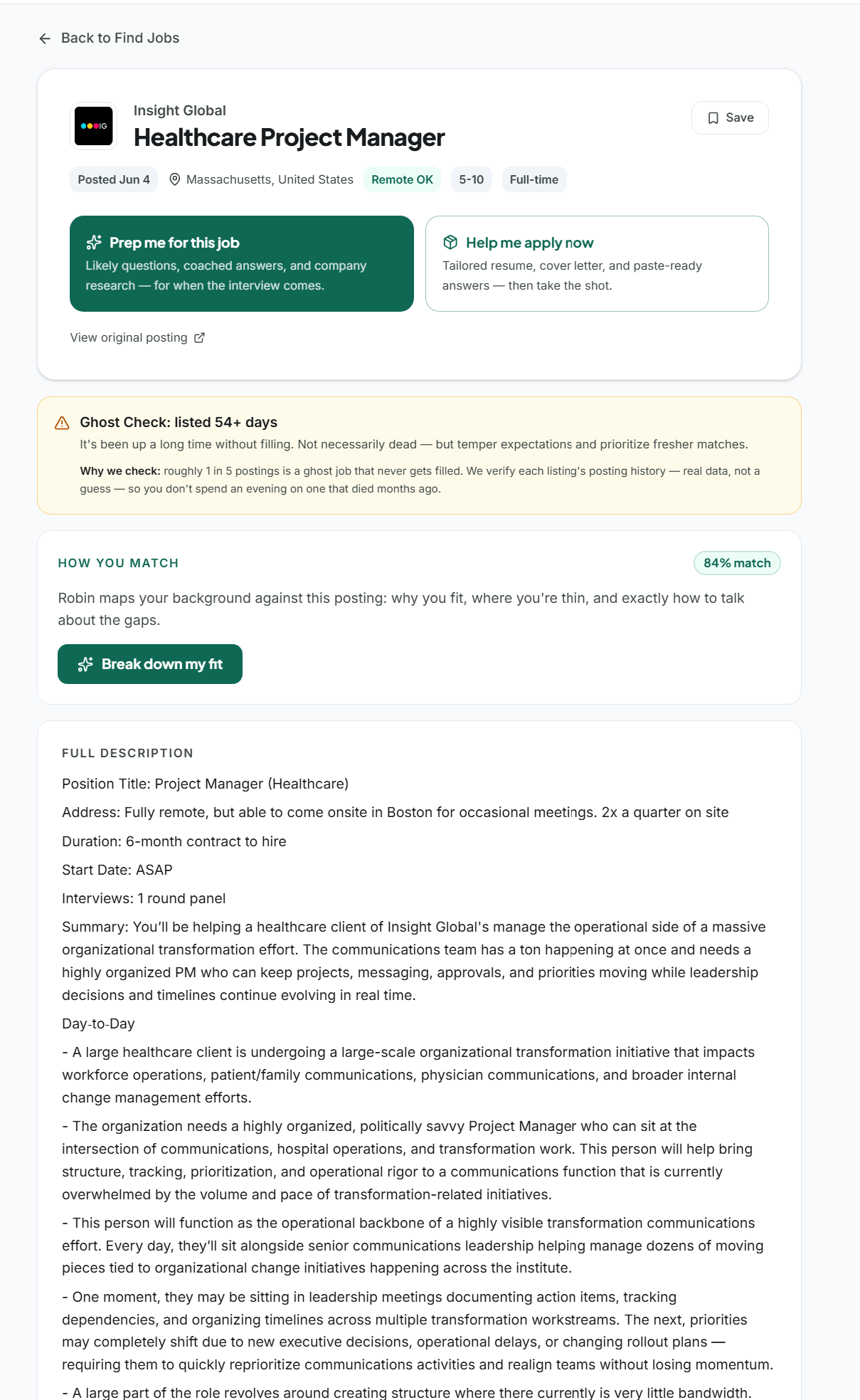
Notice what the warning actually says, because we wrote it carefully: “Not necessarily dead, but temper expectations and prioritize fresher matches.” That’s the honest version. A binary “GHOST / NOT GHOST” stamp would be easier to market and worse at being true. What you deserve is the posting’s real history and a sane recommendation, and that’s what we show: the true first-seen date, the real days listed, and whether it has the repost pattern.
A posting that expired and came back gets called a repost even if it looks fresh today, because a posting that keeps returning tells you more than its current age does. One sitting open past 45 days gets flagged stale. And a fresh one gets told to you too, because “move fast on this one” is just as valuable as “don’t waste your evening.”
The check runs on every job in Longbow’s feed and on any posting you paste in, free, no card required. If you’ve just spent this article thinking about one specific suspicious posting, paste it into Longbow and you’ll have your answer along with a full prep brief, in case it turns out to be real.
Questions we get about ghost jobs
Does applying to a ghost job hurt me?
Not in any way a future employer will see. There’s no record following you around. The real costs are the ones you already know: hours you didn’t spend on live postings, and the slow morale damage of silence you had no way to interpret. That second one is worth taking seriously; research on job seekers consistently ties ghosting to financial stress and burnout, and burnout makes people apply worse, which compounds. Protecting your energy is a legitimate strategic decision, not self-indulgence.
One honest nuance: applying to a pipeline-style ghost does put your resume in their system, and pipeline postings occasionally turn real when budget lands. So a quick application to a suspected ghost isn’t always wasted. A lovingly tailored three-hour application almost always is. Match the investment to the evidence.
Why would a company interview me for a job that doesn’t exist?
It happens, and it’s the cruelest version of this. The usual reasons: collecting market intelligence on salaries and available talent, benchmarking current employees against outside candidates, or compliance processes that require interviews even when the outcome is predetermined. The tells are the same ones postings give off: vague timelines, interviewers who can’t describe the team or the first project, and a process that keeps adding rounds without ever adding specifics. If you ask “what does success look like in the first ninety days” and nobody can answer, you’re allowed to quietly downgrade your hopes and keep applying elsewhere.
Are some job boards worse than others?
The structural answer matters more than any ranking: aggregators and boards make money from posting volume, not from your hire, and relisting resets the very age signal you just learned to check. Bigger boards also mean more third-party scrapes and recycled copies. That’s not a reason to abandon them; it’s a reason to treat every board’s “posted recently” label as marketing and verify age independently, which is exactly what Step 1 does.
Should I report a ghost posting?
If you’re in a jurisdiction that has started regulating posting honesty, reporting through official channels is a real option, and community databases like GhostJobs.io accept submissions everywhere. Do it if it feels worth your time. But hold onto the priority: your job is getting hired, not policing the boards. Flag it, close the tab, and put the evening into a posting that shows signs of life.
Can I check a specific posting right now?
Yes. The five manual steps above work with nothing but a browser. And if you’d rather have the history pulled for you, paste the posting into Longbow and Ghost Check will show you its real age and repost pattern, free, along with the full prep brief in case it’s alive.
The bigger picture
Ghost jobs are a trust problem, and they’re not one you caused. As we said in the full investigation, the silence you’re getting is very often about the posting, not about you. The best defense is exactly what you’ve just learned: check the history before you invest the evening, budget your energy by the evidence, and put your real hours into the jobs that show signs of life.
And if you’d like the checking done for you on every job you look at, that’s one of the reasons we built Longbow. Twelve years of watching readers get ghosted was enough.
Stop applying into the void. Start landing interviews.
Longbow finds the jobs worth your time (including 576 job boards most people never see), tailors your resume to each posting so it actually gets past the filter, and shows you where you stand before you hit apply. The tool we built to get you interviews — not more rejections.
Try Longbow free →Free to start · No credit card · Built by The Interview Guys
Find the right jobs.
Get more interviews.
This is the general advice. Longbow applies it to your actual search: real match scores, ghost-job checks, and prep for the jobs worth your time. Here's the full story.

ABOUT THE INTERVIEW GUYS (JEFF GILLIS & MIKE SIMPSON)
Mike Simpson: Co-founder of The Interview Guys and Longbow. He has been the voice behind our interview advice since 2013 — his work has reached over 100 million job seekers around the world. The strategic mind behind Longbow, our new career platform.
Jeff Gillis: Co-founder of The Interview Guys and Longbow. He built the systems that put our work in front of those readers, and he leads the engineering on Longbow, the cutting edge career platform built for today’s job seeker.