
The State of AI in Job Interviews 2026: The Year 96% of Hiring Pros Went All-In on AI

A candidate sits down for a remote interview, smiles into the webcam, and answers every question with eerie fluency. The recruiter on the other end is impressed, and suspicious. By the end of 2025, that suspicion had a name and a number: 81% of Big Tech interviewers said they believed candidates were cheating with AI during remote interviews. The interview, the oldest ritual in hiring, had quietly become a contest of who could out-AI whom.
Here is the number that captures the whole strange moment: 66% of U.S. adults say they would not apply for a job that uses AI in hiring, even as 96% of hiring professionals now use AI in their recruiting tasks. We say we hate it. We use it constantly. Both things are true at once.
This report maps how we got here, who is winning, and where it goes next, drawing on dozens of 2025 and 2026 studies covering employers, candidates, the technology market, and the regulators racing to catch up. The picture that emerges is not a clean story of progress or doom. It is an arms race, with real efficiency gains, real bias risks, and a trust gap nobody has figured out how to close.
☑️ Key Takeaways
- Adoption crossed the tipping point. AI use in HR doubled in a single year, from 26% to 43% of organizations, and 96% of hiring professionals now use AI in at least some recruiting task.
- Candidates brought their own AI. 74% of job seekers now use AI in their search, and 22% admit to using it live, in real time, during actual interviews.
- Fraud is outpacing detection. 62% of hiring managers say candidates now fake identities better than HR can catch them, yet only 31% of companies have deepfake-detection software deployed.
- It works, when humans stay in the loop. Pairing AI screening with human final interviews cuts time-to-hire by 40% and lifts first-year retention by 25%.
- Trust is the unsolved problem. 66% of Americans say they would not apply to an employer using AI in hiring, and only 26% trust AI to evaluate them fairly.
By the Numbers: The Year AI Took Over the Interview
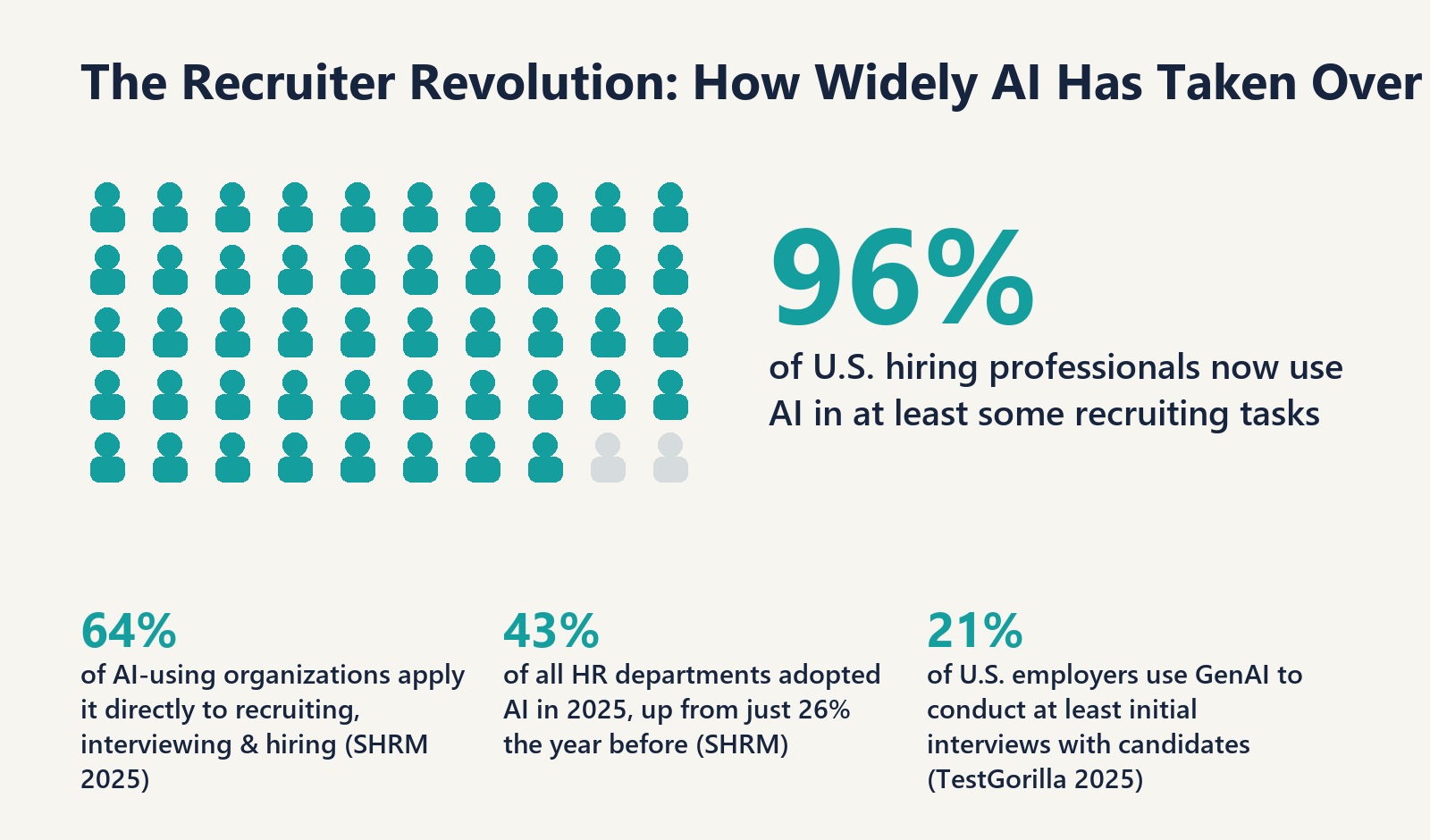
Here’s the number that should stop you cold. In a single year, AI adoption across HR functions doubled, jumping from 26% to 43% of all organizations, according to SHRM’s 2025 survey of more than 2,000 HR professionals.
That’s not a trend. That’s a phase change. Technologies don’t usually double their footprint in twelve months unless something fundamental has shifted underneath them.
And 43% might actually undersell it. When Resume Now surveyed more than 900 U.S. hiring professionals, 96% said they now use AI in at least some recruiting tasks like screening and resume analysis, per reporting in Time. Zoom out to the company level and roughly 87% of organizations are using AI somewhere in their recruitment process.
So why the gap between 43% and 96%? It comes down to what you’re measuring. The 43% counts formal, organization-wide adoption. The 96% counts the recruiter who quietly pastes a job description into ChatGPT or runs resumes through an AI filter. The grassroots use is everywhere, even where the org chart hasn’t caught up.
Once a company commits to AI in HR, hiring is where it lands first. Among organizations already using AI in any HR function, 64% apply it directly to recruiting, interviewing, and hiring. That makes sense when you think about it: hiring is high-volume, repetitive, and painfully slow, which is exactly the kind of work AI eats for breakfast.
But this wave didn’t start at the bottom. It started at the top. Large enterprises led the charge, with about 60% of big firms using AI in HR versus just 33 to 35% of small and midsize companies. The giants had the budgets, the applicant volume, and the engineering teams to deploy first.
What that means for you depends on where you’re applying. Send your resume to a Fortune 500 company and you should assume an algorithm reads it before a human ever does. Apply to a 40-person startup and you might still reach a real person on the first pass, though that window is closing fast.
The takeaway is simple and a little brutal. AI in hiring has crossed from experiment to standard operating procedure. If you’re still preparing for interviews like it’s 2019, you’re preparing for a process that no longer exists. For the wider picture, see our breakdown of the state of the hiring process.
- Adoption doubled in a year: AI use in HR jumped from 26% to 43% of organizations between 2024 and 2025 (SHRM 2025).
- Nearly universal at the practitioner level: 96% of U.S. hiring professionals report using AI in at least some recruiting tasks (Resume Now via Time).
- Hiring is the favorite use case: 64% of AI-using organizations apply it specifically to recruiting, interviewing, and hiring (SHRM 2025).
- The big players moved first: 60% of large firms use AI in HR versus 33 to 35% of small and midsize companies.
AI in hiring has crossed from experiment to standard operating procedure, and if you’re prepping like it’s 2019, you’re prepping for a process that no longer exists.
Your AI interview questions depend on your company and role:
Inside the Machine: Where AI Now Lives in the Funnel
AI isn’t one tool sitting at one stage. It’s a layer running underneath the entire hiring funnel, touching your application before you even hit submit and following you all the way to the interview.
It starts before you arrive. Roughly 66% of U.S. employers now use generative AI to write job descriptions, according to the TestGorilla State of Skills-Based Hiring 2025. The posting you read and the keywords you’re trying to match were very likely drafted by a machine in the first place.
Then it screens you. About 61% of employers use generative AI to screen resumes, and 52% use it to source candidates in the first place. That means the system can find you, rank you, and filter you out before a human spends a single second on your name.
Behind the scenes, AI is also clawing back the time recruiters hate losing. A staggering 35% of all recruiter time gets eaten by interview scheduling, so it’s no surprise that 41% of talent acquisition teams piloted AI scheduling tools in 2025, with another 23% rolling them out fully. The back-and-forth emails about your availability? Increasingly handled by a bot.
Here’s the shift that changes everything for you, though. Between 21 and 23% of U.S. organizations now use generative AI to conduct at least the initial interview, per TestGorilla and ResumeBuilder data. The AI interviewer is mainstream now, not some fringe experiment.
The scale is hard to overstate. Nearly 20 million assessments and video interviews were completed on HireVue’s platform in the first quarter of 2024 alone. That’s one vendor, in three months. Millions of candidates are already answering questions to a camera and an algorithm, often without realizing how much of the evaluation is automated.
Picture your next first-round interview. You log on, a chatbot or voice agent greets you, asks its questions, records your answers, and scores your responses against a rubric before any human reviews the transcript. No small talk, no read on the room, no human warmth to lean into. If that sounds unfamiliar, our guide on how AI chatbot screening interviews work walks through exactly what’s happening on the other end.
What this means in practice: you need to prepare for two audiences at once. You have to satisfy the algorithm with clear, keyword-aware, structured answers, and you have to stay human enough to win over the person who reviews the shortlist later. Learning to do both is the new core skill, and our walkthrough on mastering AI-powered job interviews is built for exactly this moment.
- Job descriptions are machine-written: 66% of U.S. employers use generative AI to draft them (TestGorilla 2025).
- Screening and sourcing are automated: 61% use AI to screen resumes and 52% to source candidates (TestGorilla 2025).
- Scheduling is being handed to bots: 35% of recruiter time goes to scheduling, and 41% of TA teams piloted AI scheduling in 2025.
- AI interviewers went mainstream: 21 to 23% of organizations now use AI to run at least the initial interview, with ~20 million assessments on HireVue in Q1 2024 alone.
Millions of candidates are already answering questions to a camera and an algorithm, often without realizing how much of the evaluation is automated.
The Other Side of the Table: Candidates Bring Their Own AI
If employers brought AI to the interview, job seekers showed up with their own. This isn’t a one-sided takeover. It’s an arms race, and both sides are armed.
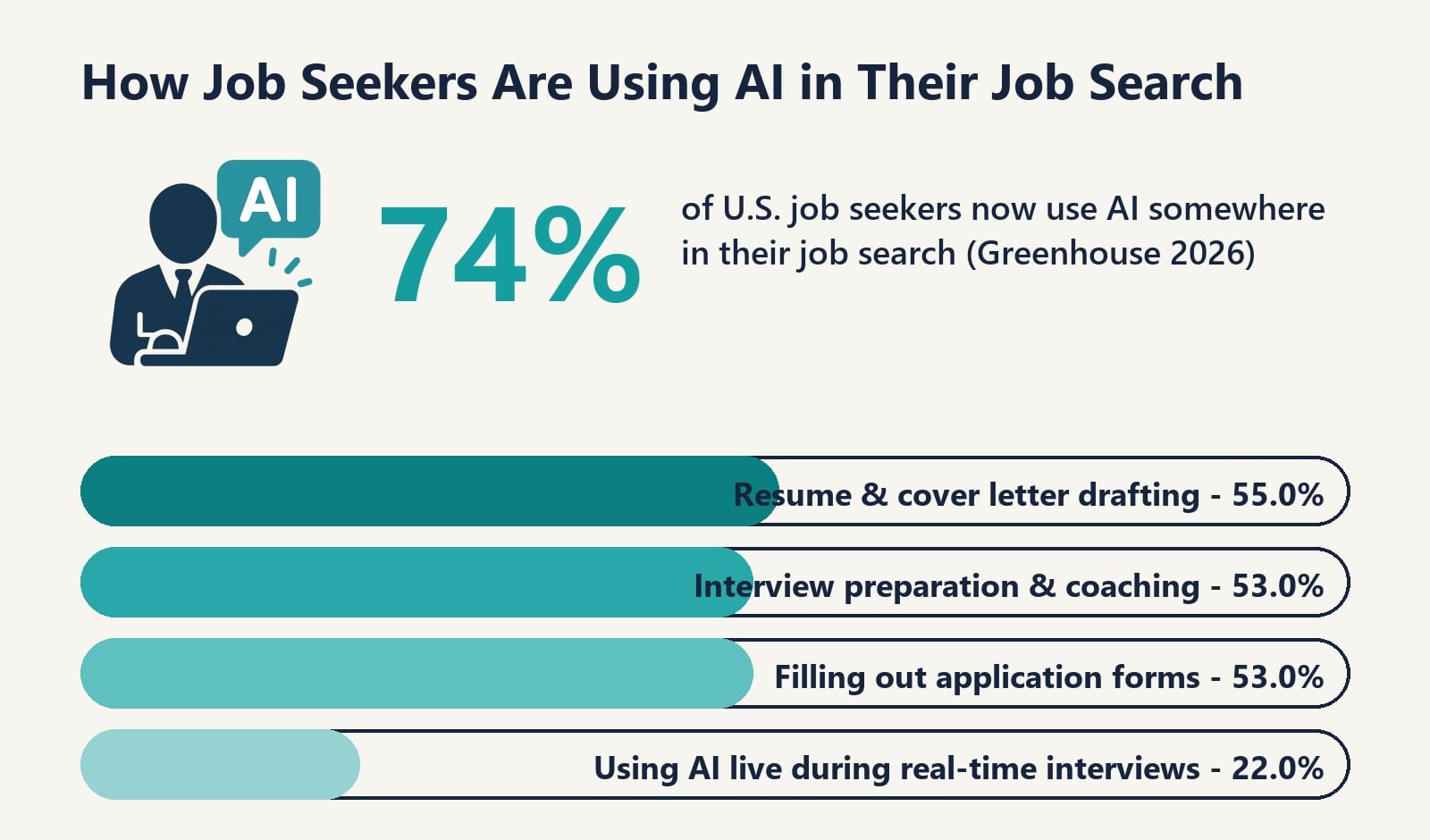
The headline number: 74% of U.S. job seekers now use AI somewhere in their job search, according to the Greenhouse 2026 AI Hiring Report. Three out of four. If you’re not using it, you’re competing against people who are.
Look at how they’re using it and the picture sharpens. The most common uses are drafting resumes and cover letters (55%), preparing for interviews (53%), and filling out application forms (53%). A separate Indeed study found 70% of job seekers use generative AI to research companies, draft materials, and prep their talking points.
Honestly, none of that is cheating. Using AI to research a company, rehearse your answers, or tighten a cover letter is just smart preparation, the modern version of practicing in the mirror. Our look at how Gen Z is using AI in interviews shows just how routine this has become.
If you want that prep handled for you, paste the job posting into our new app, Longbow, and it builds your interview prep for that exact role: the questions you’re likely to face, with coached answers to practice from.
But here’s where the line gets blurry. Around 22% of active U.S. job seekers admit to using AI assistance during live, real-time interviews, per the Resume Genius 2026 Job Seeker Insights Report covered by Newsweek. That’s not prep anymore. That’s feeding answers in real time while a recruiter believes they’re hearing the unfiltered you.
And the unsettling part is that the prep itself works. MIT Sloan Management Review found that candidates who used AI tools to prepare received higher overall interview performance ratings than unassisted peers. The tool that helps you genuinely also makes it harder for interviewers to trust what they’re measuring.
Think about what that does to the whole exercise. If two candidates give equally polished answers, but one knows the material cold and the other is reading off a second screen, the interview can no longer tell them apart. The signal recruiters have relied on for decades gets noisier by the month.
So where does that leave you? Use AI to prepare without apology. Research deeply, rehearse hard, sharpen your stories using the SOAR method (Situation, Obstacle, Action, Result) so your real experience lands clean. But know that the moment you start piping answers into a live interview, you’ve crossed from preparation into misrepresentation, and as the next section shows, employers are spending a fortune to catch exactly that.
- AI is now standard job-search gear: 74% of U.S. job seekers use it somewhere in their search (Greenhouse 2026).
- Prep leads the use cases: resume and cover letter drafting (55%), interview prep (53%), and form-filling (53%).
- The line gets crossed live: 22% of active job seekers admit using AI during real-time interviews (Resume Genius 2026 via Newsweek).
- And it measurably works: AI-prepped candidates scored higher overall interview ratings than unassisted peers (MIT Sloan 2025).
Use AI to prepare without apology, but the moment you pipe answers into a live interview, you’ve crossed from preparation into misrepresentation.
When the Candidate Isn’t Real
Now we reach the part that keeps hiring managers up at night. It’s not just candidates using AI to sound sharper. It’s candidates who aren’t who they claim to be, or who aren’t even real people at all.
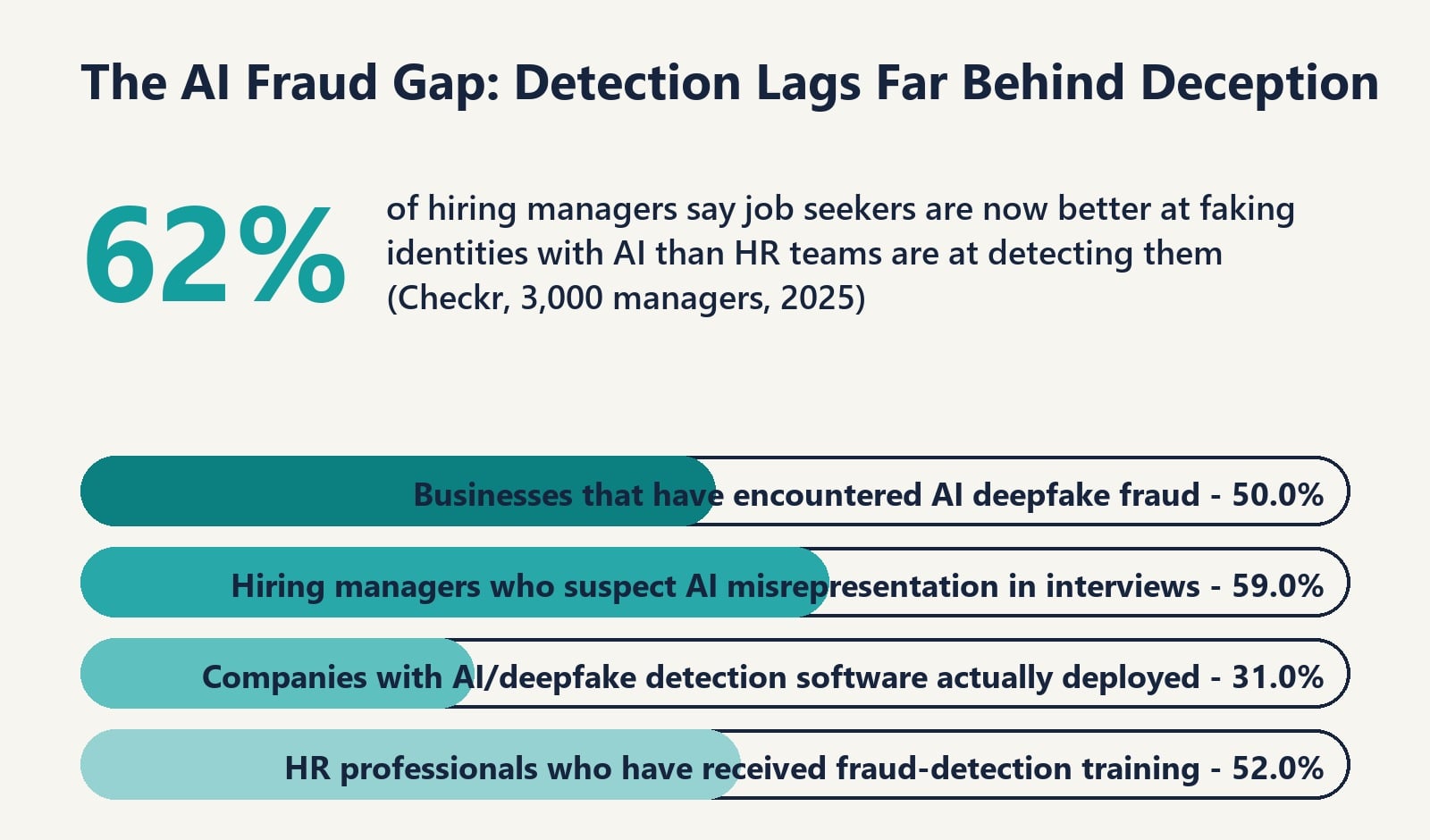
Half of all businesses have already run into it. A CBS News study cited in Sherlock.ai’s 2026 research found that 50% of businesses have encountered AI-driven deepfake fraud in some form. This is no longer a hypothetical from a cybersecurity conference. It’s showing up in real interview pipelines.
How bad is it about to get? Gartner surveyed 3,000 job seekers and found 6% admitted to interview fraud like impersonation or proxy interviews. Worse, Gartner projects that by 2028, one in four candidate profiles worldwide will be fake, according to reporting via CXOToday.
The deepfake threat is already inside the video call. By mid-2025, 17% of HR managers had directly encountered deepfake technology in a video interview. Tools like Cluely and Interview Coder, which overlay AI assistance invisibly during screen-shared interviews, have racked up more than a million combined users. The infrastructure for cheating at scale is built, cheap, and easy to find.
Now here’s the gap that turns a problem into a crisis. Detection isn’t keeping up. Nearly two-thirds of hiring professionals, 62%, believe job seekers are now better at faking identities with AI than HR teams are at catching them, per Checkr’s survey of 3,000 managers.
And most companies aren’t even trying yet. Only about 31% have implemented AI or deepfake detection software, and roughly 48% of HR professionals report receiving no training at all on AI hiring fraud. The threat is accelerating while the defense sits mostly unbuilt.
Picture the recruiter’s dilemma. They’re staring at a confident, articulate candidate on screen who answers every question perfectly. Is that a brilliant hire, an AI overlay feeding lines, or a hired stand-in entirely? Increasingly, the honest answer is that they can’t tell, and they know they can’t tell.
This is why the interview itself is changing in front of you. Companies are deploying detection software, redesigning their processes, and dragging finalists back into conference rooms for face-to-face conversations, a shift we cover in why in-person interviews are making a comeback. For honest candidates, the irony stings: a handful of fraudsters are making the process slower and more suspicious for everyone, and the deception data sits right alongside the older finding that 44% of job seekers admit to lying in interviews. The trust problem isn’t new. AI just gave it horsepower.
- Deepfake fraud is already widespread: 50% of businesses have encountered AI-driven deepfake fraud in some form (CBS News via Sherlock.ai 2026).
- Fake profiles are about to flood the pipeline: 6% of candidates admit interview fraud now, and Gartner projects 1 in 4 profiles will be fake by 2028.
- The cheating tools are mainstream: Cluely and Interview Coder have over a million combined users, and 17% of HR managers had hit a deepfake in a video interview by mid-2025.
- Defense is badly behind: 62% say candidates fake better than HR detects, only 31% have detection software, and 48% of HR got no fraud training.
A handful of fraudsters are making the process slower and more suspicious for everyone, and AI just gave the trust problem horsepower.
The Arms Race Nobody Wins
Here’s the strangest thing about hiring in 2026. Both sides of the table are armed with the same weapon, and both sides are pretending the other one is cheating.
Candidates use AI to draft applications, prep answers, and in some cases whisper to them live during the interview. Employers use AI to screen those applications, then deploy more AI to catch the candidates using AI. It’s a snake eating its own tail.
Look at the numbers and the escalation is obvious. 61% of companies now run software to detect AI use during interviews, according to the Greenhouse 2026 AI Hiring Report. Meanwhile 39% are conducting more interviews in person as a direct counter-measure, and Gartner research puts the share of recruiting leaders going in-person to fight fraud at 72%.
The in-person comeback is the loudest signal. In-person interview requests at major recruitment firms surged 500%, jumping from just 5% in 2024 to 30% in 2025. That’s not a tweak. That’s an industry slamming the rewind button on a decade of remote convenience.
And it’s not fringe players doing it. Google, McKinsey, and Deloitte’s UK graduate program all reintroduced mandatory in-person rounds by mid-2025, specifically to stop AI-assisted fraud. When the biggest, most digital-first firms on earth start flying candidates in to watch them think, you know remote trust has cracked. We broke this down further in our piece on why in-person interviews are making a comeback.
Now here’s the part that should make your blood boil a little. 54% of hiring managers say they would penalize a candidate for using AI on their application, while 96% of those same managers use AI in their own hiring tasks. Read that twice.
The Insight Global and Resume Now data lays the hypocrisy bare. The employer screens your resume with a bot, writes the job description with a bot, schedules your interview with a bot, then disqualifies you for using a bot to keep up. One set of rules for the gatekeeper, another for the person at the gate.
The deeper problem is that this arms race has no equilibrium. Every detection tool spawns a better evasion tool, and 62% of hiring professionals already admit job seekers are better at faking with AI than recruiters are at catching them (per Checkr’s survey of 3,000 managers). Detection is losing, so employers retreat to the analog world, which slows everything down for everyone. Nobody wins. You just get a more expensive, more paranoid, more exhausting process on both ends.
- Detection is now standard: 61% of companies use software to spot AI use during interviews (Greenhouse 2026).
- The analog retreat is real: in-person requests jumped from 5% to 30% in a single year, a 500% surge, with 72% of recruiting leaders citing fraud as the reason.
- The double standard is the story: 54% of managers would penalize AI-assisted applicants while 96% of them use AI to hire.
The employer screens you with a bot, then disqualifies you for using one. One set of rules for the gatekeeper, another for the person at the gate.
Does Any of This Actually Work?
Strip away the fraud panic and the hype for a second. Does AI in hiring actually deliver better hires, or is it just expensive theater? The honest answer is: it depends entirely on whether a human is still in the room.
When AI handles the grunt work and a person makes the final call, the results are genuinely strong. Companies that combine AI screening with human-led final interviews cut time-to-hire by 40% while improving first-year retention by 25%, according to SelectSoftwareReviews 2026. Faster and stickier at the same time is rare.
The people running these systems are sold. 98% of hiring managers already using AI say it improved their hiring process, and teams using AI save roughly 20% of their work week. That’s a full workday back every single week, mostly clawed out of scheduling, since 35% of recruiter time used to vanish into coordinating calendars.
There’s a quality argument too, not just a speed one. Structured, AI-enforced interviews carry a predictive validity of 0.42 versus 0.19 for unstructured interviews, per a Wiley meta-analysis. In plain terms, a structured process is nearly twice as good at predicting who’ll actually succeed in the job. The structure is what works, and AI is good at forcing structure.
So far this sounds like a clean win. Here’s the counterweight that the vendors won’t put on a slide.
Both average cost-per-hire and average time-to-hire have actually risen over the past three years, the exact same window that produced the biggest AI adoption surge in history (per SHRM analysis). If the tools worked uniformly, those lines should be falling. They’re going the wrong way.
That contradiction tells you everything. The gains are real but they’re not automatic. When AI is bolted on badly, layered onto a broken process, or trusted to make decisions it isn’t built for, it adds cost and friction instead of removing it. The 40% time-to-hire drop and the rising industry average can both be true because implementation quality varies wildly from company to company.
What it means for you is simple. The companies getting value treat AI as a co-pilot that clears the runway so humans can focus on judgment. The ones wasting money treat it as autopilot. If you want to understand the human side that still decides everything, our breakdown of the psychology of job interviews is a good place to start. AI works when it’s paired with people, not when it’s pointed at replacing them.
- The pairing pays off: AI screening plus human final interviews cuts time-to-hire 40% and lifts first-year retention 25%.
- Structure beats vibes: structured AI-enforced interviews hit 0.42 predictive validity versus 0.19 for unstructured, nearly double the accuracy.
- The reality check: cost-per-hire and time-to-hire both rose during the biggest adoption surge, proof that bad implementation can erase every gain.
AI works as a co-pilot that clears the runway for human judgment. It fails the moment a company treats it as autopilot.
The Bias Paradox: Same Tool, Opposite Outcomes
If you want a fight at a dinner party, ask whether AI makes hiring more fair or less. The honest answer is that it does both, sometimes with the same software, and the difference comes down to how it was built and pointed.
Start with the case for the defense, because it’s stronger than skeptics admit. Properly implemented blind AI screening has been shown to cut gender bias by 54% and improve underrepresented minority hiring by 35%, per InCruiter’s 2026 review of multiple studies.
The candidate experience data backs this up. In a controlled study of roughly 70,000 interviewees, people interviewed by an AI voice agent were about half as likely to report feeling discriminated against based on gender compared to those who faced a human, as NPR reported on the PSG study. A bot that doesn’t flinch at your accent or your name can feel like a relief.
Now the case for the prosecution, which is brutal. A 2024 University of Washington study found AI resume-screening models favored white-associated names in 85.1% of cases. For Black male candidates, the models were disadvantageous in up to 100% of comparisons. Not most. All.
It gets worse at the voice layer. Some speech-to-text systems used in AI interviews introduce accent-related error rates as high as 22% for certain groups. If the transcription mangles your words because of how you speak, the model scores garbage, and you lose a job you were qualified for without ever knowing why.
And the system itself admits to leaks. 19% of organizations concede their AI tools accidentally overlook qualified candidates, a persistent accuracy gap that’s easy to ignore when the rejected person never finds out they existed in the pipeline at all.
So how can one technology cut gender bias by half and reject Black men in nearly every test? Because AI doesn’t invent fairness or prejudice, it inherits whatever lives in its training data and its design. Blind screening that strips names and standardizes questions heals. A model trained on a biased history of who got hired hardens that history into code and runs it at scale.
Regulators have noticed the stakes. The EU AI Act now classifies hiring AI as high-risk, with full enforcement from August 2, 2026 and fines up to 15 million euros or 3% of global turnover, and you can read the framework straight from the European Commission. For you as a candidate, the lesson is that the technology is neutral and the implementation is everything. The same tool can be the fairest interviewer you’ll ever meet or a wall you can’t see.
- The healing side: blind AI screening cut gender bias 54% and improved minority hiring 35%; AI-interviewed candidates felt half as discriminated against.
- The hardening side: a UW study found AI favored white-associated names 85.1% of the time and disadvantaged Black men in up to 100% of cases.
- The hidden failure: accent-related transcription errors hit 22% and 19% of orgs admit their AI overlooks qualified people.
AI doesn’t invent fairness or prejudice. It inherits whatever lives in its training data, then runs it at scale.
The Trust Gap We Can’t Close
People say they hate AI in hiring. Then they pick it. That single contradiction is the most important thing to understand about candidate sentiment in 2026.
On paper, the resistance is overwhelming. 71% of Americans oppose AI making a final hiring decision, and 66% say they would not even apply to an employer that uses AI in hiring, according to Pew Research. That’s two-thirds of the talent pool threatening to walk.
The distrust runs deep. Only 26% of applicants trust AI to evaluate them fairly, and 79% want clear transparency about when AI is being used on them. If you read just those numbers, you’d predict a candidate revolt.
Then you watch what people actually do, and the story flips. When given a real choice between a human recruiter and an AI voice agent, 78% of candidates chose the AI. Women chose it at even higher rates than men.
And the comfort isn’t fringe. 64% of job seekers say they’re fine with AI conducting the initial screening interview. The resistance lives almost entirely at the final-decision stage, not the early stages where AI actually saves everyone time.
So what’s going on? It isn’t rejection, it’s ambivalence, the very human ability to distrust something in the abstract and still prefer it in the moment. An AI screener feels lower-stakes, less judgmental, and weirdly less scary than a human who might be having a bad day or quietly deciding you’re not a culture fit.
The recruiter side of the table has already made up its mind. HR professional confidence in AI systems climbed from 37% to 51% between 2021 and 2025, per HireVue’s survey of over 4,000 respondents, and 93% of recruiters plan to increase their AI usage in 2026. The trust gap isn’t closing because employers are sprinting in one direction while candidates stand still, suspicious but compliant.
Here’s what it means for you. The companies are not going to abandon AI to win your trust, so the leverage you have is knowing how these systems work and using transparency to your advantage. Learn how AI chatbot screening interviews actually function, and walk into the AI round prepared instead of resentful. The gap we can’t close isn’t going anywhere. The smart move is to stop protesting the screener and start beating it.
- The stated resistance: 71% oppose AI final decisions, 66% won’t apply to AI-using employers, only 26% trust it to judge them fairly, 79% demand transparency.
- The revealed preference: 78% chose an AI voice interviewer over a human, and 64% are comfortable with AI handling initial screening.
- The recruiter gap: HR confidence rose from 37% to 51% and 93% plan to use more AI in 2026, so employers aren’t slowing down for anyone.
People say they hate AI in hiring, then 78% pick it over a human. That isn’t rejection. It’s ambivalence.
The Money Behind the Machines
Want to know whether AI interviews are a fad or your new permanent reality? Follow the money. It tells you everything.
Start with the narrow slice: the dedicated AI recruiting software market sits at roughly $641 million in 2026, and Mordor Intelligence projects it climbing to $921 million by 2031 at a 7.52% annual clip. That’s the software built specifically to source, screen, and interview you.
Now zoom out to the broader picture. The full AI-in-HR market hit $8.16 billion in 2025 and is forecast to reach $15.24 billion by 2030, growing at a punishing 24.8% CAGR, according to Grand View Research data via Pin.com. When a market nearly doubles in five years, companies don’t unwind it. They build their whole hiring stack around it.
The geography matters too. North America already controls about 41% of the AI recruiting market, while Asia-Pacific is the fastest-growing region at a 7.01% CAGR, driven by aggressive adoption in India, China, and Japan. This isn’t one country’s experiment. It’s a global build-out happening on every continent at once.
And the venture capitalists smelled it early. Funding for AI recruitment technologies jumped 44% in the first half of 2024 alone. That capital doesn’t flow toward dying ideas. It chases infrastructure that investors expect to dominate for a decade.
Here’s the part that should make it real for you. In the first quarter of 2024, roughly 20 million assessments and video interviews ran through HireVue’s platform. That’s one vendor, one quarter, twenty million candidates facing a screen instead of a person.
The reason this keeps accelerating is brutally simple: it saves time and money. Teams using AI save about 20% of their work week, which is essentially one full workday handed back every week. Multiply that across a recruiting department and the math writes itself.
So when someone tells you AI interviews might blow over, look at the balance sheets. Billions are committed, growth rates are double digits, and the tooling already touches tens of millions of candidates a year. This is permanent infrastructure now, not a passing trend you can wait out. Your job is to learn the system, because the system isn’t going anywhere.
- Narrow market: dedicated AI recruiting software runs ~$641M in 2026, headed to $921M by 2031 (Mordor Intelligence).
- Broad market: AI in HR hit $8.16B in 2025 and is projected at $15.24B by 2030, a 24.8% CAGR (Grand View Research).
- Geography: North America holds ~41% share; Asia-Pacific grows fastest at 7.01% CAGR.
- Investor signal: VC funding for AI recruitment tech rose 44% in H1 2024.
When a market nearly doubles in five years, companies don’t unwind it. They build their whole hiring stack around it.
The Regulatory Reckoning Arrives
For a few years, AI hiring tools operated in a legal gray zone. Build it, ship it, point it at candidates, sort out the rules later. That window is closing fast.
The biggest hammer is the EU AI Act. It classifies hiring AI as high-risk, and full enforcement for those employment tools began on August 2, 2026, per the European Commission. Violations carry fines up to 15 million euros or 3% of global annual turnover, whichever stings more.
Read that number again. Three percent of global turnover is not a parking ticket. For a large multinational, that’s a board-level threat, which means compliance just became a C-suite problem instead of an HR footnote.
The Act also went after one of the creepiest features on the market. Emotion recognition in workplace hiring has been prohibited since February 2025, which puts any video platform selling facial micro-expression analysis squarely in legal jeopardy. If a vendor still pitches you on reading a candidate’s face, that’s now a liability, not a feature.
The pressure isn’t only European. New York City’s Local Law 144 requires annual bias audits and candidate notices before an employer deploys an automated employment decision tool. Colorado’s SB 24-205 took effect February 1, 2026, mandating bias audits for AI used in employment decisions across the state.
Why the sudden wall of rules? Because trust cratered while adoption soared. Only 26% of applicants trust AI to evaluate them fairly, and 79% of candidates say they want transparency about when AI is used. Regulators are simply codifying what people have been demanding all along.
And the compliance load is about to land on candidates too. Gartner predicts that by 2027, 75% of hiring processes will include certifications and tests for workplace AI proficiency. The same forces forcing employers to prove their tools are fair will soon ask you to prove you can actually work alongside AI.
Here’s what it all means. The lawless phase of AI hiring is ending, and the era of audits, notices, and hard penalties is beginning. If you’re an employer leaning on opaque tools, the grace period is over. If you’re a candidate, you finally have legal grounds to ask how you’re being evaluated, and increasingly, the right to a straight answer.
- EU AI Act: hiring AI is high-risk, full enforcement from August 2, 2026, fines up to 15M euros or 3% of global turnover.
- Emotion recognition banned: micro-expression analysis in workplace hiring prohibited since February 2025.
- U.S. patchwork: NYC Local Law 144 mandates bias audits and notices; Colorado SB 24-205 took effect February 1, 2026.
- Coming for candidates: Gartner predicts 75% of hiring processes will include AI-proficiency tests by 2027.
Three percent of global turnover is not a parking ticket. Compliance just became a C-suite problem instead of an HR footnote.
What This Means For You
Enough theory. Let’s get practical, because the rules of this game have changed for everyone in the room.
If you’re a candidate, the first rule is the most important: use AI to prepare, not to deceive. The research is encouraging here. Candidates who used AI tools to prep received higher overall interview performance ratings than unassisted peers, according to MIT Sloan Management Review. Prep is your edge. Cheating is your downfall.
Because the other side is watching. A majority of hiring managers say they would penalize you for AI-assisted applications, 61% of companies now run software to detect AI use during interviews, and 62% of pros admit candidates are getting better at faking than recruiters are at catching it. That arms race is not one you want to be caught inside. Learn to master AI-powered interviews the legitimate way instead.
Expect more rounds happening face to face. With 39% of companies conducting more in-person interviews and 72% of recruiting leaders doing it specifically to fight fraud, the live, structured conversation is roaring back. Brush up on your fundamentals, because in-person interviews are making a comeback and they reward genuine preparation.
You also have leverage you didn’t have before. With 79% of candidates wanting transparency and regulators now requiring it in many regions, you can ask how AI is being used in your evaluation. Asking isn’t rude anymore. It’s expected.
Now flip to the employer side, because the data is just as direct. Keep humans in the loop, full stop. Companies that combine AI screening with human-led final interviews cut time-to-hire by 40% while improving first-year retention by 25%. Those gains evaporate when you let the machine decide alone.
Audit for bias before a regulator forces you to. Properly implemented blind AI screening has cut gender bias by 54% and improved underrepresented minority hiring by 35%, but only when it’s built and checked correctly. The same tool that fixes bias can bake it in if nobody’s watching.
And train your people. Roughly 48% of HR professionals have received zero training on AI hiring fraud, which is a gaping hole when 50% of businesses have already hit deepfake fraud in some form. You can’t defend against a threat your team can’t recognize. If you’re rethinking your funnel, start with skills-based evaluation that tests what people can actually do.
- Candidates, prep don’t cheat: AI-prepped candidates score higher (MIT Sloan), but 54% of managers would penalize AI-assisted applications and 61% run detection.
- Candidates, expect live rounds: 39% of firms are doing more in-person interviews; 72% of leaders use them to combat fraud.
- Employers, keep humans in the loop: AI screening plus human final interviews cuts time-to-hire 40% and lifts first-year retention 25%.
- Employers, audit and train: blind screening can cut gender bias 54%, but 48% of HR staff have no fraud training at all.
Prep is your edge. Cheating is your downfall. The two have never been further apart.
The Interview, Rebuilt
So where does all of this land? Picture your next interview two years out, because it’s already taking shape in the data.
The people inside the system see the upheaval coming. A striking 88% of survey respondents predict AI hiring fraud will reshape the hiring process within the next five years. When the practitioners themselves expect a teardown, you should plan for one.
The first visible change is the return of the room. In-person interview requests surged 500% at major recruitment firms, jumping from 5% of interviews in 2024 to 30% in 2025, a direct countermeasure to AI-assisted fraud. The handshake came back not for nostalgia but for verification.
The second change is what those interviews actually test. Skills for the most AI-exposed jobs are now changing more than twice as fast as for the least-exposed roles, per the PwC 2026 Global AI Jobs Barometer. The questions you trained for last year may already be obsolete this year.
You can see it in what employers are hiring for. AI-native roles like AI Engineer and ML Engineer surged 240% in early 2025, and the expectation underneath that shift is telling. Interviews are pivoting away from knowledge recall and toward reasoning-with-AI, meaning they want to watch how you think alongside the tools, not whether you memorized a definition.
Tie it together with the AI-proficiency testing that’s coming, and the near-future interview gets clear. It’s more likely to be in person, more tightly structured, increasingly designed to measure how well you work with AI, and legally required to be transparent about its own use of it.
Don’t mistake the in-person revival for a retreat from automation, though. A full 62% of leaders say it’s extremely or very likely that AI will run their entire hiring process by the end of 2026. The machine handles the funnel; the human verifies the finalist. Both things are true at once.
That’s the paradox you’re walking into, and it’s worth understanding the psychology underneath it. AI screens you, schedules you, maybe even interviews you first, and then a person looks you in the eye to make sure you’re real and capable. The winners on both sides will be the ones who treat AI as a tool to sharpen judgment, never a substitute for it. The interview isn’t disappearing. It’s being rebuilt, and you’ve got a short window to learn the new blueprint.
- The room returns: in-person interview requests surged 500%, from 5% in 2024 to 30% in 2025, to combat AI fraud.
- The content shifts: skills for AI-exposed jobs change twice as fast (PwC), and AI-native roles surged 240% in early 2025.
- The mandate spreads: 62% of leaders say it’s very likely AI runs their entire hiring process by end of 2026.
The machine handles the funnel; the human verifies the finalist. The interview isn’t disappearing, it’s being rebuilt.
The honest takeaway from 2026 is that there is no going back to the pre-AI interview, and there is no clean version of the AI one either. Employers got faster and, when they kept humans in the loop, better. Candidates got sharper tools and, too often, a shortcut into dishonesty. The result is an arms race where detection chases deception, in-person rounds make a surprise comeback, and everyone uses the technology they claim to distrust.
If you’re job hunting, the move is simple: let AI sharpen your preparation, never your impersonation, and walk into rooms ready to prove you’re real. If you’re hiring, the data is just as clear: the wins go to teams that treat AI as a co-pilot under human judgment, audit it for the bias it can quietly amplify, and tell candidates the truth about how they’re being evaluated. The interview isn’t dying. It’s being rebuilt in real time, and the people who understand both sides of the table will be the ones who come out ahead.
Resources & References
- SHRM 2025-2026 AI in the Workplace Survey Reports
- Greenhouse 2026 AI Hiring Report, Candidate Deception & AI Job Search Behavior
- TestGorilla State of Skills-Based Hiring 2025, GenAI Interviewing Adoption
- Mordor Intelligence: AI Recruitment Market Size & Forecast 2026-2031
- Grand View Research / Pin.com: AI in HR Market $8.16B in 2025, 24.8% CAGR to 2030
- Pew Research Center: Public Attitudes Toward AI in Hiring Decisions
- HireVue 2025 Global Hiring Report, HR Professional Confidence in AI
- NPR: Recruiting Companies Are Starting to Hold Job Interviews Using AI (PSG/NBER Study)
- MIT Sloan Management Review: When Candidates Use Generative AI for the Interview
- Checkr: The Hiring Hoax, Survey of 3,000 Managers on AI Hiring Fraud (2025)
- Gartner: 1 in 4 Candidate Profiles Will Be Fake by 2028 (via CXOToday)
- Resume Genius 2026 Job Seeker Insights Report, Live AI Use During Interviews (via Newsweek)
- PwC 2026 Global AI Jobs Barometer, AI’s Impact on Skills, Wages & Hiring
- SelectSoftwareReviews: AI Recruiting Statistics, What the Data Says About Hiring in 2026
- European Commission: EU AI Act, High-Risk Classification for Employment AI (Full Enforcement August 2026)
- Insight Global: 2025 AI in Hiring Survey Report
- Fabric: State of AI Interview Cheating in 2026, Analysis of 19,368 Interviews
- SHRM: AI in the Workplace Survey 2025 (HR Adoption Benchmarks)
- SQ Magazine: AI Recruitment Statistics 2026, Hiring Trends & Data
- Pew Research Center: AI and Human Enhancement Survey (Public Attitudes on AI in Hiring)
- Market Research Future: AI Recruitment Market Size & Forecast to 2035
- HireTruffle: 100 AI Recruitment Statistics for 2026 (Comprehensive Data Roundup)
- Sherlock AI: Rise of AI Interview Fraud in 2026, Deepfakes, Proxy Hiring & Detection
- ClassAction.org: AI Job Screening & Interview Lawsuits, Bias and Privacy Concerns
- arXiv: Behind the Screens, Uncovering Bias in AI-Driven Video Interview Assessments Using Counterfactuals (2025)
- IntervueBox: How AI Video Interviews Reduce Bias in Hiring (Wiley IJSA Meta-Analysis)
- InCruiter: AI in Recruitment 2026, Trends, Stats & What’s Actually Working
- Federal Reserve Board: Monitoring AI Adoption in the U.S. Economy (April 2026)
- Azumo: 77 AI Recruitment Statistics for 2026, Data, Trends & Insights
- Technavio: AI in Recruitment Industry Market Analysis, Size & Forecast 2026-2030
- Demand Sage: AI Recruitment Statistics 2026, Global Data & Trends
Don’t go into your interview without knowing the AI Interview questions your specific company uses:
After twelve years of writing advice like this, we built the tool that does it with you. It's called Longbow, and here's the whole story.

ABOUT THE INTERVIEW GUYS (JEFF GILLIS & MIKE SIMPSON)
Mike Simpson: Co-founder of The Interview Guys and Longbow. He has been the voice behind our interview advice since 2013 — his work has reached over 100 million job seekers around the world. The strategic mind behind Longbow, our new career platform.
Jeff Gillis: Co-founder of The Interview Guys and Longbow. He built the systems that put our work in front of those readers, and he leads the engineering on Longbow, the cutting edge career platform built for today’s job seeker.