
The 2% Rule: Why 98% of 2026 Applications Fail (And 75% Never See Human Eyes)
If you feel like you’re shouting into a void every time you hit “submit” on a job application, the math says you’re absolutely right.
In 2026, the application-to-interview conversion rate has crashed to a historic low. For every 100 people who apply to a corporate role, only 2 to 3 actually get invited to interview. The remaining 97-98 candidates? They’re rejected before a human being even glances at their qualifications.
This is the new mathematical reality of job searching in an era where:
- Artificial intelligence screens faster than you can blink
- Automated systems process hundreds of applications per second
- AI resume screening has become the industry standard
Welcome to the 2% Rule, the single most important statistic that explains why your job search feels impossibly difficult right now.
☑️ Key Takeaways
- The brutal numbers are in: only 2-3% of applicants get interviews in 2026, meaning 97-98 out of every 100 applications vanish into the void
- Your odds improve dramatically by company size, with small businesses offering significantly better interview rates than Fortune 500 companies due to lower application volumes
- AI screening now rejects 75% of resumes in under 0.3 seconds, while referrals bypass the system with 8x higher hiring rates
- The solution isn’t applying to more jobs but applying smarter, focusing on the “SMB sweet spot” where lower competition dramatically improves your odds
The Numbers That Changed Everything
Back in 2016, the average applicant-to-interview rate sat at 15.25%. By 2023, that had plummeted to 8.4%.
Fast forward to 2026, and we’re looking at 2-3%. According to CareerPlug’s 2025 Recruiting Metrics Report, which analyzed over 10 million applications from 60,000+ businesses, the applicant-to-interview ratio in 2024 was just 3%. Recent data on how many applications it takes to get one interview confirms this downward trend has continued.
Interview Guys Take: If you’ve submitted 50 applications and received only 1-2 interviews, you’re not failing. You’re hitting the statistical average. The system is broken, not you.
The Perfect Storm: Three Forces Crushing Your Odds
Force #1: The AI Screening Surge
The biggest culprit is the rapid adoption of artificial intelligence in the initial screening process. According to Resume Builder’s survey of 948 business leaders, 83% of companies will use AI to screen resumes by the end of 2025, up from 48% currently.
This isn’t gradual change. This is a fundamental transformation in how companies approach hiring.
Here’s what makes AI screening so brutal: speed. These systems can reject a resume in just 0.3 seconds, faster than the blink of an eye. They process applications at a pace no human recruiter could match, scanning for:
- Keyword matches with the job description
- Required years of experience
- Specific technical skills or certifications
- Education requirements
- Employment gaps and formatting quirks
The numbers get worse. According to multiple industry reports, 75% of resumes are discarded without any human review due to AI-powered Applicant Tracking Systems. Even more concerning, 21% of companies now automatically reject candidates at all stages of the hiring process without human oversight.
Your carefully crafted resume, the one you spent hours perfecting? It gets 0.3 seconds of robot attention before disappearing forever.
Force #2: The Application Volume Tsunami
The second force crushing your odds is pure mathematics: too many applicants chasing too few interview slots.
The average job posting in 2026 attracts 180-250 applicants, according to CareerPlug’s data. In competitive markets like San Jose, California, that number jumps to 153.77 applicants per job ad in just one week, according to LinkedIn data.
Companies haven’t increased their interview capacity to match this flood. Most hiring managers still conduct 3-5 first-round interviews per open position. The math is brutal: 250 applicants competing for 5 interview slots equals a 2% conversion rate.
This volume explosion has multiple causes:
- Easy Apply features make submitting applications effortless
- Remote work opportunities mean you’re competing nationally, not locally
- AI-powered auto-apply tools let candidates submit hundreds of applications per week
- Economic uncertainty keeps more people actively job searching longer
Interview Guys Take: This is an arms race nobody wins. AI helps companies screen faster, which encourages candidates to use AI auto-apply tools, which forces companies to adopt even more aggressive screening. Job seekers are the collateral damage in a technological escalation that benefits no one.
Force #3: The Referral Bypass System
The third force making your odds worse: employee referrals are eating up interview slots before cold applicants even have a chance.
Here’s a statistic that will make your blood boil:
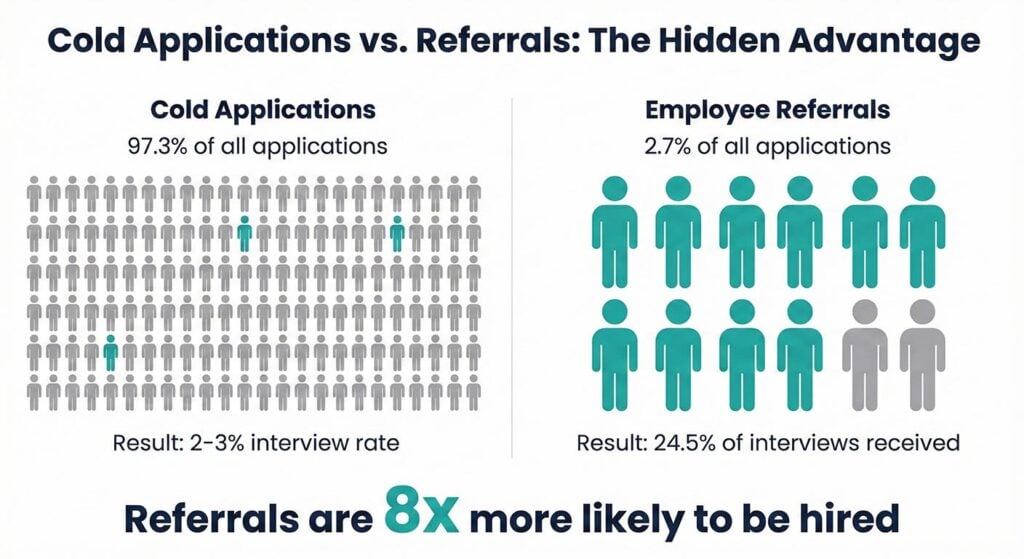
- Referrals make up only 2.7% of all applications
- Yet they account for 24.5% of interviews
- Referred candidates are 8x more likely to be hired than those who apply through LinkedIn
- They have a 40% higher chance of receiving an offer compared to other candidates
Many companies in 2026 have formal or informal “referral-first” policies. Some reserve the first 10-20 interview slots exclusively for employee referrals. Others don’t even post jobs publicly until checking their internal referral pipeline first.
This means that by the time your cold application hits their system, the best interview opportunities may already be spoken for. You’re not competing against 250 other applicants. You’re competing against 250 other applicants for the scraps left after preferred candidates have been accommodated.
The Company Size Paradox: Why Bigger Isn’t Better
The 2-3% rule isn’t universal. Your odds vary dramatically by company size.
Fortune 500 companies represent the worst odds in the job market. When a single Google or Amazon posting attracts 500-1,000+ applicants and they’re only interviewing 5-10 candidates, you’re looking at conversion rates well below the 3% average.
Interview Guys Take: Working at a Fortune 500 looks great on a resume, but getting hired at one is statistically harder than almost anywhere else. You’re fighting massive volume and ruthless AI screening for brand-name bragging rights.
Small and medium-sized businesses show dramatically better conversion rates. A 75-person company posting a role receives 30-80 applicants instead of 250+. With the same interview slots (5-7), your odds automatically improve. These companies also use less automated screening, with hiring managers often personally reviewing applications.
Why the massive difference?
Smaller companies receive fewer applications per posting. A job at a 75-person startup in Des Moines might attract 30-50 qualified applicants instead of 250. The screening process is often less automated and more personal. Small business owners and hiring managers frequently review applications themselves rather than relying entirely on AI systems. And these companies are often more willing to take chances on candidates who might not check every box but show potential.
The data is clear: if you want to improve your odds beyond the 2-3% average, you need to shift your focus from household-name corporations to growing small and medium-sized businesses.
Breaking Down Your 98% Rejection Rate
Let’s walk through exactly what happens to your application in the modern hiring process. Understanding the state of the hiring process in 2025 helps explain why so few make it through.
Stage 1: The AI Filter (0-5 Seconds) – 75% Eliminated
Your application hits the ATS. The AI scans for keyword matches, required experience, education requirements, employment gaps, and resume formatting. This eliminates 75% of applicants in under 5 seconds.
Many rejections aren’t about qualifications. They’re about formatting quirks, missing keywords, or algorithmic biases the company doesn’t even know exist.
Stage 2: The Hard-Gate Check (Day 1-2) – 15-20% Eliminated
If you survive AI screening, a recruiter verifies minimum requirements: degree, years of experience, work authorization, salary range, licenses. Employment gaps of 6+ months eliminate candidates in over 50% of companies.
Stage 3: The Human Glance (Day 2-7) – Final 2-3% Selected
You’re in the top 5-10% now. A human will spend 6-8 seconds on your resume, looking for quick-scan relevance, professional presentation, red flags, and standout achievements.
Another 2-3% make it through to receive interview invitations.
This is your 2%.
The Referral Advantage: Why Some Never Face These Odds
Employee referrals operate in a parallel universe with completely different mathematics. Referred candidates have a 40% conversion rate from applicant to new hire, compared to 2-3% for cold applicants.
Why such a massive difference?
Referrals often skip AI screening entirely. Many companies have a “referral review” queue that goes directly to human recruiters, bypassing the automated systems that eliminate 75% of cold applicants.
Referrals come with built-in credibility. When an employee stakes their reputation on a recommendation, hiring managers take notice.
Referrals address the hiring manager’s biggest fear: hiring someone who looks good on paper but doesn’t work out.
The numbers:
- Referrals make up only 2.7% of total applications
- They represent 24.5% of interviews
- In some companies, referrals account for 30-50% of all new employees
Interview Guys Take: Spending 100% of your job search on applications and 0% on relationship-building is playing a rigged game. Who you know isn’t everything, but it’s worth 8-20x more than cold applications.
What Smart Job Seekers Are Doing Differently
The job seekers landing interviews in 2026 aren’t applying to more jobs. They’re applying smarter.
Strategy #1: The SMB Pivot
Smart job seekers target small and medium-sized businesses instead of Fortune 500 companies.
- Fortune 500: 250-500+ applicants, heavy AI screening, 0-2 interviews from 50 applications
- SMBs: 30-80 applicants, personal review, 2-5 interviews from 20-30 applications
Strategic targeting beats spray-and-pray volume every time.
Strategy #2: The Referral Cultivation System
The most successful job seekers build relationships 3-6 months before they need them:
- Identify 10-15 target companies
- Find 2-3 current employees at each on LinkedIn
- Engage with their content for 2-3 months
- Reach out with genuine interest (not asking for jobs)
- Build authentic relationships before positions open
When a role opens, they’re known quantities with internal advocates. Their conversion rate isn’t 2%. It’s 40%+.
Strategy #3: Quality Over Quantity
Targeted, customized applications have 2.1x higher conversion rates than generic ones. Generic applications compete against thousands of other AI-generated submissions. Customized applications that demonstrate research and specific value stand out because they’re rare.
Strategy #4: The Multi-Channel Attack
The most sophisticated job seekers use multiple touchpoints:
- Apply through the company website
- Connect with the hiring manager on LinkedIn
- Comment on company content
- Reach out to employees for informational conversations
- Follow up after 5-7 days
This can boost conversion rates by 3-5x compared to single-channel strategies.
The Uncomfortable Truth About Volume vs. Precision
Every job search advice blog will tell you: apply to more jobs. It’s a numbers game. If 2% of applications lead to interviews, then applying to 100 jobs should yield 2 interviews, and applying to 500 should yield 10.
Except that’s not how it actually works.
Here’s what happens when you prioritize volume over everything else:
- Your applications become increasingly generic because you’re moving too fast to customize them
- Your conversion rate drops from 2% to 1% or lower
- You waste time applying to positions you’re not qualified for or don’t actually want
- You burn out from the emotional toll of constant rejection
- You miss the 5-10 truly good-fit opportunities that deserved your focused attention
The data backs this up. According to research on how many applications it takes to get hired in 2025, job seekers need 32-200+ applications to land an offer, with the wide range reflecting the enormous difference between strategic and spray-and-pray approaches.
The ones in the lower end of that range? They’re applying strategically to roles they’re genuinely qualified for, at companies where they have some advantage (referral, cultural fit, niche skill match).
The ones submitting 200+ applications? They’re playing the volume game and losing.
Interview Guys Take: Spending 15 minutes on 20 applications will always outperform spending 2 minutes on 150 applications. The job search isn’t a numbers game anymore. It’s a precision game.
Why the 2% Rule Matters More Than Your Resume Format
Having a perfect resume gets you from a 0% chance to a 2% chance. That’s not nothing, but it’s not the game-changer most people hope for. Understanding the ATS resume rejection myth helps clarify what actually matters.
What actually moves the needle?
- Applying where you’re not competing against 250 people (SMBs, niche positions)
- Having someone on the inside advocating for you (referrals)
- Demonstrating specific, relevant value (customization)
- Building relationships before jobs open (proactive networking)
These strategies don’t just improve your 2%. They fundamentally change which game you’re playing.
The Path Forward: Moving from Volume to Surgical Precision
Stop beating yourself up. If you’ve submitted 50 applications and received 1 interview, that’s exactly what the statistics predict. You’re not failing. You’re hitting the average.
Radically shift your strategy from volume to precision:
Week 1-2: Strategic Targeting
- Identify 15-20 small to mid-sized companies (under 500 employees)
- Research their recent growth and hiring needs
- Create a spreadsheet ranking them by fit
Week 3-4: Relationship Building
- Find 2-3 current employees at each target company on LinkedIn
- Engage with their content genuinely
- Send 5-10 personalized connection requests per week
Week 5-6: Application Optimization
- Apply to 5-7 positions per week at your target companies
- Spend 45-60 minutes customizing each application
- Reference specific company challenges
Week 7-8: Multi-Touch Follow-Up
- Reach out to hiring managers on LinkedIn after applying
- Request informational conversations
- Follow up after 5-7 days
This approach generates 30-40 applications over 8 weeks instead of 200+. But by targeting smaller companies with less competition, you’ll dramatically improve your odds. More importantly, the interviews you get will be for roles you actually want.
The Future Is Already Here: Adapting to the New Normal
The 2% rule isn’t temporary. It’s the new baseline reality.
This trend will continue because:
- AI screening tools are getting more sophisticated
- Companies are investing heavily in recruitment automation
- Auto-apply tools mean application volumes keep rising
- Remote work has eliminated geographic boundaries
The job seekers who thrive adapt their strategies:
- Accept that most applications will be rejected
- Focus on quality and strategic targeting over volume
- Build referral networks before you need them
- Prioritize SMBs over prestigious large corporations
- Use data to make strategic decisions
Interview Guys Take: Once you understand how the system works, you can game it legitimately. You’re not tricking anyone. You’re just focusing your efforts where you actually have a fighting chance.
The Bottom Line: Your Job Search Is a Math Problem
In 2026, the goal isn’t to apply to more jobs. The goal is to be the 1 in 50 who gets the interview.
That requires surgical precision: targeting SMBs with lower competition, building referral networks that bypass the 98% rejection funnel, and customizing applications that demonstrate specific value.
The 2% rule is brutal, but it’s just math. Once you understand the math, you can work it to your advantage.
Every successful job seeker in 2026 stopped fighting battles they couldn’t win. They stopped applying to 200 Fortune 500 positions and started building relationships at 20 carefully selected SMBs. They stopped submitting generic applications in 5 minutes and started crafting targeted value propositions in 45 minutes.
The data:
- Cold applications to large corporations: brutal competition, hundreds of applicants
- Referrals: 40% conversion rate
- Customized applications: 2.1x higher conversion rate
Your job search success comes down to choosing which numbers you want to play with. Choose wisely, because your time and energy aren’t infinite.
The question isn’t whether you’ll face the 2% rule. The question is whether you’ll adapt your strategy to beat it.
Additional Resources
For more insights into navigating the 2026 job market, check out:
- How Many Applications It Takes to Get Hired in 2025
- How Many Applications Does It Take to Get One Interview in 2025
- 83% of Companies Will Use AI Resume Screening by 2025
- State of the Hiring Process in 2025
- The ATS Resume Rejection Myth

BY THE INTERVIEW GUYS (JEFF GILLIS & MIKE SIMPSON)
Mike Simpson: The authoritative voice on job interviews and careers, providing practical advice to job seekers around the world for over 12 years.
Jeff Gillis: The technical expert behind The Interview Guys, developing innovative tools and conducting deep research on hiring trends and the job market as a whole.