
The 40% Impersonal Concern: Why 4 in 10 Recruiters Worry AI Is Making Hiring Too Robotic
When Efficiency Becomes Cold
The hiring revolution promised speed, accuracy, and fairness. Instead, it’s creating a growing divide between what recruiters want and what candidates will tolerate.
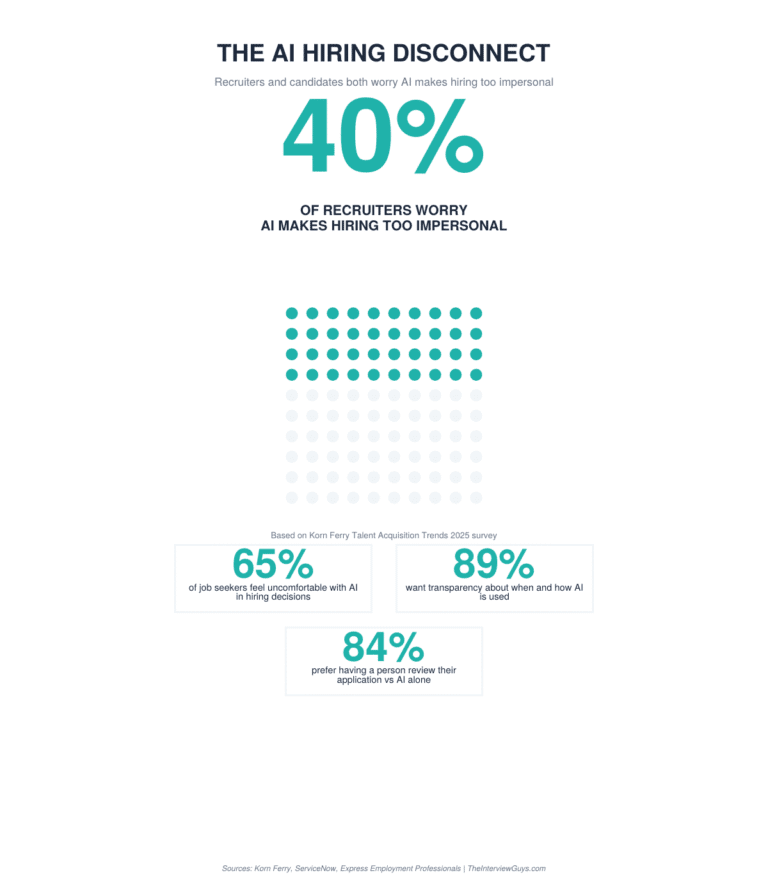
Here’s the uncomfortable reality: companies are doubling down on AI hiring tools despite knowing they’re alienating the very talent they’re trying to attract. According to Korn Ferry’s Talent Acquisition Trends 2025 report, 40% of talent specialists now worry that excessive AI in recruitment could make the process impersonal, causing them to miss out on top candidates.
This isn’t just recruiter anxiety. The data shows they’re right to be concerned.
A ServiceNow survey found that over 65% of job seekers feel uncomfortable with AI being used in hiring decisions. Nearly 90% want complete transparency about how and when companies apply AI. The message is clear: candidates aren’t rejecting technology itself. They’re rejecting the feeling of being processed rather than considered.
The stakes extend beyond candidate experience. When job seekers view a hiring process as overly impersonal, unpredictable, or opaque, they’re significantly less likely to accept an offer. They’re also more likely to form lasting negative opinions about the organization, damaging employer brand for years.
☑️ Key Takeaways
- 40% of talent specialists worry excessive AI in recruitment creates impersonal experiences that cause them to miss top candidates
- 65% of job seekers feel uncomfortable with AI making hiring decisions, with 89% demanding transparency about when and how AI is used
- 84% of candidates prefer human review over AI-only screening, revealing a massive gap between automation adoption and candidate comfort
- The path forward requires strategic AI implementation that enhances rather than replaces human judgment in the hiring process
The Paradox of Progress
Here’s where it gets interesting. The same companies acknowledging these concerns are simultaneously increasing AI investment.
67% of talent acquisition professionals see increased AI usage as a top recruitment trend for 2025. They’re not ignoring the problems. They’re making a calculated bet that efficiency gains outweigh relationship costs.
The numbers suggest why this gamble feels necessary. According to AI recruitment statistics, 67% of hiring decision-makers cite time savings as the primary benefit of AI. Companies report 30-50% faster time-to-hire when implementing AI screening tools.
But faster isn’t always better when it drives away the candidates you actually want.
Interview Guys Tip: The most successful companies aren’t choosing between AI and human connection. They’re using AI to handle administrative tasks while preserving human touchpoints at critical moments like initial outreach, interviews, and offers.
Tired of Sending Applications Into the Void?
Companies upgraded their screening. Shouldn’t you upgrade your strategy? The IG Network gives you the complete toolkit: The actual ATS parsing tech companies use, access to 70% of jobs never posted online, and AI interview coaching that actually works and a lot more…
What Candidates Are Actually Saying
The candidate perspective reveals why 40% of recruiters are right to worry.
According to Express Employment Professionals, 84% of job seekers prefer having a person review their application rather than AI alone. This isn’t a marginal preference. It’s an overwhelming majority demanding human judgment.
The concerns go deeper than simple discomfort. Candidates report feeling that AI interviews are “dehumanizing,” with one professional describing the experience as “talking to a wall.” Some candidates are taking extreme measures, abandoning applications entirely when they discover AI screening is involved.
Fortune reported that unemployed professionals are outright rejecting AI interviews, preferring to remain jobless rather than engage with systems they view as fundamentally impersonal. One candidate ended an AI interview in less than 10 minutes, stating: “I’m not going to sit here for 30 minutes and talk to a machine. I don’t want to work for a company if the HR person can’t even spend the time to talk to me.”
This isn’t isolated frustration. It reflects a broader pattern where candidates use hiring processes to evaluate company culture. When AI dominates early interactions, candidates reasonably conclude that automation will define their experience if hired.
Discover Your Top 8 Perfect Career Matches in 60 Seconds
Take our quick “Career Code” Assessment and get your top 8 career matches. We rank these based on your unique combination of strengths, energy patterns, and motivations
The Human Skills AI Can’t Evaluate
The impersonality concern isn’t just about feelings. It’s about hiring effectiveness.
89% of hiring managers agree that human input is essential for evaluating soft skills. AI excels at analyzing technical qualifications and work history. It struggles with personality, cultural alignment, and growth potential.
87% of job seekers believe meeting with a human during interviews is important because AI cannot effectively vet candidates for soft skills like cultural fit and attitude. These aren’t peripheral considerations. They’re often the factors that determine long-term success in roles.
Consider what gets lost in AI-only screening:
A candidate’s ability to think creatively under pressure. The genuine enthusiasm that signals cultural fit. The intangible quality that makes someone coachable and collaborative. The career trajectory that doesn’t fit neat patterns but shows real potential.
Interview Guys Tip: While AI can process applications at scale, human recruiters remain essential for spotting the candidates who don’t check every box but possess the qualities that drive team success. The best hiring strategies use AI to surface possibilities, not make final decisions.
When Automation Creates Barriers
The impersonality problem extends beyond individual interactions. It’s reshaping the entire candidate journey.
40% of job seekers report being ghosted after second or third-round interviews. Approximately 60% abandon job applications due to overly complex forms. These statistics reflect what happens when efficiency optimization removes human oversight.
Candidates describe modern hiring as “cold, impersonal, and disheartening.” The irony cuts deep: companies claim they want creative, empathetic, emotionally intelligent employees, yet they design hiring processes that systematically filter out precisely those traits.
Research shows that 47% of job seekers say AI chatbots make recruitment feel impersonal. When automated systems become the primary touchpoint, candidates rightfully question whether the company values human connection at all.
The data reveals another concerning pattern. Candidates who experience impersonal hiring processes are less likely to refer others, engage with the brand, or apply for future positions. This creates compounding costs that far exceed the administrative savings AI provides.
The Cost of Getting It Wrong
Companies implementing AI without strategic oversight face measurable consequences.
35% of recruiters worry that AI may exclude candidates with unique skills and experiences. This concern isn’t hypothetical. Studies show that 19% of organizations using AI admit their tools have accidentally ignored qualified candidates.
The impersonality problem becomes a diversity problem. When screening relies exclusively on algorithmic pattern matching, candidates with non-traditional backgrounds get systematically filtered out. The very efficiency that makes AI attractive creates homogeneous candidate pools.
68% of hiring managers believe the risks of AI outweigh the benefits if people are removed entirely from the process. This acknowledgment creates an obvious solution: don’t remove people entirely from the process.
Yet many organizations continue pursuing full automation, creating the exact problems their own data predicts.
Finding the Balance
The 40% of recruiters worried about impersonality aren’t calling for a return to paper resumes. They’re recognizing that sustainable hiring requires both technological efficiency and human judgment.
The most successful implementations follow a clear pattern: use AI for tasks that benefit from speed and consistency, preserve human interaction for moments that require empathy and nuance.
Effective AI integration looks like this:
AI handles resume parsing, keyword matching, and initial qualification screening. Humans conduct actual interviews, evaluate cultural fit, and make final hiring decisions. The system surfaces candidates humans might miss while maintaining personal connection throughout the process.
According to the GRID 2025 Talent Trends Report, 88% of candidates who experienced well-implemented AI interviews rated them equal to or better than traditional interviews. The difference wasn’t the technology. It was the implementation approach.
Interview Guys Tip: Companies that transparently communicate their AI use, explain how decisions are made, and ensure human touchpoints at key stages see dramatically better candidate experiences and acceptance rates.
What This Means for Job Seekers
Understanding that 4 in 10 recruiters worry about impersonality creates opportunity.
You’re not alone in finding AI screening frustrating. The people on the other side of these systems often share your concerns. This knowledge should inform your strategy.
When applying to companies using AI screening:
Make your application standout for both algorithms and humans. Include quantifiable achievements and industry-specific terminology naturally integrated throughout your experience. Remember that your resume needs to pass initial AI screening while compelling the human reviewers who see it after.
Research company hiring practices before investing significant time. Look for signs that organizations value human connection: personalized communication, human interviews early in the process, transparent information about how AI is used.
Prepare for hybrid processes where you’ll encounter both AI screening and human interaction. Optimize your materials for algorithmic parsing while maintaining the authentic voice that connects with people.
When you do reach human interviewers, recognize that they likely share your preference for personal connection. These conversations are your opportunity to demonstrate the qualities AI cannot evaluate.
The Path Forward
The tension between efficiency and empathy won’t resolve itself through technology alone.
Companies need to make deliberate choices about where AI adds value and where human judgment remains essential. The 40% of recruiters expressing concern about impersonality understand something crucial: hiring is fundamentally a human activity.
The most effective recruiting strategies in 2025 will:
Use AI to eliminate administrative burden and surface strong candidates faster. Maintain meaningful human interaction throughout the candidate journey. Provide transparency about how AI is used and when humans make decisions. Design processes that allow both efficiency and authentic connection.
Organizations that master this balance will gain significant advantages. They’ll process applications faster while providing better candidate experiences. They’ll make more informed hiring decisions while building stronger employer brands.
The choice isn’t between speed and humanity. It’s about combining technological capability with human insight to create hiring processes that actually work.
Bottom Line
40% of recruiters worry that AI is making hiring too impersonal because they see what’s happening on the ground. Candidates are frustrated, uncomfortable, and increasingly willing to walk away from opportunities that feel robotic.
This isn’t a problem technology alone can solve. It requires strategic implementation that preserves what matters most: the human connections that lead to successful long-term hires.
The companies that recognize this reality and act accordingly won’t just hire faster. They’ll hire better, build stronger teams, and create candidate experiences that turn applicants into advocates.
The question isn’t whether to use AI in hiring. It’s whether you’ll use it wisely.
Tired of Sending Applications Into the Void?
Companies upgraded their screening. Shouldn’t you upgrade your strategy? The IG Network gives you the complete toolkit: The actual ATS parsing tech companies use, access to 70% of jobs never posted online, and AI interview coaching that actually works and a lot more…
Learn more about navigating AI in your job search:
- 83% of Companies Will Use AI Resume Screening by 2025
- Mastering AI-Powered Job Interviews: The Complete 2025 Guide
- The State of AI in the Workplace in 2025

BY THE INTERVIEW GUYS (JEFF GILLIS & MIKE SIMPSON)
Mike Simpson: The authoritative voice on job interviews and careers, providing practical advice to job seekers around the world for over 12 years.
Jeff Gillis: The technical expert behind The Interview Guys, developing innovative tools and conducting deep research on hiring trends and the job market as a whole.